Saturday Cooking Part 1

Saturday a week ago, the one before Valentine’s Day, was a full day spent cooking.  There were two separate events, both of which will get their own blog entry.  The morning event was the soft opening of the Seagull Cooking Cafe, a cooking school that the makers of Thailand’s premier line of stainless steel cookware products have opened on Sukhumvit Soi 63.

P1090953

The menu was Linguine Carbonara, Chocolate Truffles, and a mocktail called the Cinderella.  One of Tawn’s cousins, Wan, is friends with the daughter of the family that owns the Seagull company.  In additional to inviting her two sisters, Wan also invited Tawn and me to participate.

Tawn comes from a big family – he is number 35 out of 38 grandchildren on his father’s side of the family.  Keeping track of all these cousins is a bit of a challenge, especially those cousins here in Bangkok.  While I’ve met several of Tawn’s Bangkok cousins once or twice before in passing and am connected with some of them on facebook, this was my first opportunity to spend any significant time with them.

This opportunity fit perfectly with my plan to build connections with the rest of the family, in anticipation of the day that Tawn’s father, who regards me with something akin to a “don’t ask, don’t tell” policy, either changes his mind or is no longer a factor – to put it delicately.

P1100004

The school is on the top floor of Seagull’s headquarters in a large and brightly lit space.  There are fifteen working stations, each with stainless steel tops (no surprise there!) and all the other equipment you would need.  Tawn and his cousins were at the front of the class.

P1090990

We started by making the chocolate truffles as these would need to be refrigerated.  Here, Tawn poses with Som and Wan as they squirt chocolate ganache from a pastry bag onto parchment paper.

P1090987

My partner for the cooking was Pueng.  Despite her good humor and many talents, her ganache came out looking like little chocolate poos.

P1090989

See?

P1090992

After refrigerating the chocolates for a bit, we were able to shape them by hand, ostensibly rolling them into balls.  In practice, this didn’t work out so well.

P1100012-1

The end result of our efforts?  Some damn ugly and unevenly-sized truffles.

P1100030

Som’s two-year old daughter, First, was there as well, spending most of her time playing with her father.  Tawn was playing with her but she seemed a little shy.

P1100053

While not officially involved in the project, Chef Ian Kittichai (who has several famous Thai restaurants in New York, Barcelona, and Mumbai) had chefs from his organization conducting the class.  Tawn has appeared on his local TV show before as a guest (just chat with the chef and help as he cooks) and also knows his wife through common friends.  Had a nice chat with him about the challenges of managing restaurants around the globe and he provided some assistance with our truffles.  All the ones that are actually round were rolled by him!

P1100060

Next up was the Linguine Carbonara, which actually was not a Carbonara sauce since it contained milk and cream.  Nonetheless, Pueng practiced her technique of putting the pasta into the boiling water, twisting a standing bunch of dry pasta so is splays out.

P1100082

Somehow, partners were swapped during the course of the cooking so Tawn ended up helping me finish the pasta.

P1100084

Looks quite pretty, doesn’t it?  I hadn’t cooked the bacon as crispy as I could have and didn’t salt the water sufficiently.  Nonetheless, it was tasty.

P1100090

Pueng, Tawn’s elder, feels compelled to help him eat his pasta.

P1100097

I poked my head into the adjacent kitchen to see the cleanup process.  This being their trial run, they had tons of staff on hand and still seemed a little overwhelmed.  I think they didn’t anticipate just how much counter space they will need to handle the cleanup from fifteen cooking stations.

It was a fun experience and I enjoyed the chance to spend more time with Tawn’s cousins.  It is fun watching them interact with each other and I look forward to the day when I can be a part of family events.


A Profusion of Malls along Sukhumvit Road

Is it perhaps some sort of sibling rivalry?  Listening to the leaders of Bangkok, one could be forgiven for thinking that they were feeling a little bit of envy of their better manicured regional sibling, Singapore.  Like listening to a youngster who both admires and despises his older brother, I chuckle each time an idea is mooted that seems to be chasing after Singapore: Let’s build a giant Ferris wheel by the Chao Phraya River!  Let’s relocate street vendors into clean, well lighted facilities!  Let’s build an endless chain of malls from Siam Square to Sukhumvit!

Not that there is anything wrong with these ideas – well, except the Ferris wheel – but it seems that our civic leaders should find the confidence to just say what we all know to be true: We’re not Singapore, we never will be, and that’s perfectly fine.  After all, if we were so much like Singapore, we would lose a large chunk of our tourists: the Singaporeans on holiday from their overly-staid city state.

Bangkok Mall Map

One area of the sibling rivalry in which we are making progress is the building of malls.  Singapore may well have its Orchard Road, but we have our (admittedly difficult for visitors to pronounce and often taken over by protesters) Ratchaprasong Shopping District, stretching roughly from MBK and Siam Square on the west to Central Childlom on the east. 

You could logically extend the shopping district along the same street (which confusingly changes names from Rama I to Phloenchit to Sukhumvit along the way), bypassing the rather frightening Nana district and ending up at Asoke and Phrom Phong, which are seeing the development of their own new malls.

Let’s take a look at some of that development.

Phloenchit Area

Phloenchit Area Map

In the Phloenchit area, which stretches from the Chitlom to Phloen Chit Skytrain stations, there are three new developments.  In addition to these new developments, the reconstruction of Central World Plaza, which suffered severe fire damage in the wake of protests that were broken up on May 19 of last year, looks to be proceeding on pace for reopening by year’s end.

The largest new project, long discussed but finally announced this week, is Central Embassy, built by Central Retail Corporation, owners of the Central World Plaza and Central Chidlom properties, among others.

Central Embassy

Built between Chidlom and Phloen Chit stations on nine rai (14,400 square meters) of land bought from the British Embassy, this 37-story multi-use development will contain 70,000 square meters of retail on eight floors along with a 222-room luxury Park Hyatt hotel.  Its design will feature a unique “twisting ribbon” that should add another landmark to the city’s skyline.

P1090925

A view of the Central Embassy project property looking west towards Central Chidlom (white tower on the right and the shorter brown and green building to its left).  Buildings on the British Embassy grounds are in the lower right of the picture.  The angle showed here is equivalent to looking at the model in the previous picture from the far right side of that picture.

When it is complete in late 2013, the Central Embassy project will have an integrated facade with Central Chidlom, including a bridge connecting the two.  Central Chidlom will reportedly be renovated so the two properties have a consistent look, giving Central Retail Corporation a second large mall (along with Central World Plaza) in less than a one-kilometer stretch of Phloenchit Road.

P1090927 Stitch

Also in this neighborhood, not 100 meters to the east, is a large stretch of empty land next to Phloen Chit station.  (Pardon the poor job stitching two photos together.)  This property has undergone fitful attempts at development over the years, with constructions workers coming in from time to time to clear the land of vegetation and put up construction fencing, only to do no further work. 

This week the process started again with the clearing of an old building at the front of the property which had served as the sales office for whatever project had initially been started before the Asian economic crisis more than a decade ago.  No signage has been posted yet indicating what the development will contain, but based on the neighborhood and size of the property, it seems likely that a mixed-use building with retail, office, and possibly condominiums or hotel rooms will be built.

  DSC_3259

Directly across the Skytrain tracks from this property is the Park Ventures Ecoplex, a combination office building and 33-story hotel that will be finished this year.  Once all these properties are complete, all the free land at the Ploenchit-Witthayu (Wireless Road) junction will be developed, baring the demolition of any older properties.

Sukhumvit Area

New Emporium Map

Follow Ploenchit Road east a few Skytrain stops and you get to the middle  of Sukhumvit Road, an area populated with expats and well-heeled Thais.  Since 1997, The Emporium, owned by the Mall Group (part-owners of Siam Paragon), has been the main shopping center for this area.  In fact, it was the first mall to have a direct connection to a Skytrain station, something that has helped it continue to be popular even in the wake of the explosion of malls around Siam and Ratchaprasong.

P1090917

The Emporium’s retail monopoly of the mid-Sukhumvit neighborhood is set to end this year as the new Terminal 21 project (previous entry about it) finishes construction at the junction of Sukhumvit and Asoke Roads.  Featuring a nine-story mall including a cinema and 40,000 square meters of retail space, the project will also have 145,000 square meters of office space and a 20-story serviced apartment.

P1090290

In the last few weeks, another challenger to Emporium (and the Ratchaprasong-centrism of Bangkok’s retail scene) has appeared.  Directly across the Skytrain tracks from Emporium, construction has started on an extremely large property.  No signage has been posted indicating what will be built there, but given the location it is hard to imagine that it won’t include a large amount of retail along with either a hotel or condo, or both.  (Edit: I just heard today from two reputable sources that this will officially by an expansion of Emporium’s footprint, colloquially called “Emporium 2”.)

There is also another large project two stations to the east at Ekkamai.  Edit: this will reportedly be an IT mall.

Rama IV / Sathorn

Lumpini Night Bazaar

The final development, retail-wise, is that the Lumpini Night Bazaar, a popular nighttime shopping area located across from Lumpini Park, has finally closed.  This property, owned by the Crown Property Bureau, is slated for a multi-use development by the Central Retail Corporation.  If you look on the first map in this entry, you will see that the Lumpini development is just down the street from the new Central Embassy project.

The closure and development of the Night Bazaar was tied up in legal action for the past two years, but after the calendar turned to 2011 its doors were finally shut and the bulldozers have moved in.  Look for another large mall project to appear along this stretch of Rama IV Road in the next two years or so.

Conclusions

What do all these developments mean?  It seems safe to say that the dominance of the Siam-Ratchaprasong area in the shopping scene will be challenged as development moves eastward on the Sukhumvit Skytrain line.  If anything, this should help ease congestion, both in terms of the number of people as well as the number of vehicles, that crowd that already crowded area. 

The real, and as yet unanswered, question is whether Bangkok needs so much retail space.  Tourism growth has slowed over the last few years thanks to political instability and other concerns.  It would seem that the local population’s buying power has limited ability to grow, too.  If that is the case, one can only imagine that we will be awash in a glut of malls and in that, we will be able to proudly hold our own against Singapore.


Sunset Over Wat Arun

P1090589

Last weekend, the younger sister of a friend I’ve known since pre-school was in town for a visit.  We spent a day and a half touring some sites and on Sunday evening had dinner at The Deck, which is conveniently located across from Wat Arun, the Temple of Dawn.  Since she had an early flight on Monday, we sat down for dinner a few minutes before the sun set and I was able to get this photo.  Gorgeous, isn’t it?

Beautiful Pedestrian Bridge Opens on Sathorn

Last June I wrote about the opening of Bangkok’s Bus Rapid Transit, or BRT, line.  This new bit of mass transit is basically a light rail line but without the infrastructure costs of adding rails.  In a bid to connect a growing corner of the city that has never had significant mass transit to the existing rail network, BRT extends from the Chong Nonsi Skytrain station to the south side of the city along Rama III Road.

Of course, for the system to effectively feed passengers onto the rail network, there had to be an easy connection, something that was missing at the half-way point of last year.  Pictures at the BRT stations promised, though, that a grand, shaded walkway would link the BRT’s terminus with the Skytrain station.

P1030512

I’m glad to report that just a couple of weeks ago, the arched section of the pedestrian bridge opened.  There is still some additional work being done including the addition of additional, newer stairs to connect to the bridge from surrounding street corners.  This work is proceeding rapidly, though, so I think in just a few short weeks we’ll have a finished product.  Nice to see some bit of urban infrastructure actually come to fruition.

P1090017

Looking from the BRT station side of the intersection north towards the Skytrain station.

P1090019

While some finishing touches are being placed on the bridge, it is open and being used.

P1090023

Lots of people were taking pictures of what is a dramatic addition to the skyline.


Great Eats in Bangkok Volume 1 – Guaytiaw

As Andy whirled into town for a three-day side trip from visiting his parents in Taipei, I had high hopes of producing this mega-video in which we would taste all the great things to eat in Bangkok.  Sure enough, during the course of two full days we ate a whole lot of things that would qualify for the “great eats” list.  But as I sat down to edit the video, I realized that I didn’t have enough footage to really address that many dishes.

Since I promised a video a few days ago, I’ve gone ahead and edited a first volume of what I expect will be at least a dozen (and probably more) videos that highlight various great eats in Bangkok.  Volume One focuses on guaytiaw – rice noodles – and particularly the pink-broth fish soup called yen ta fo.  It doesn’t provide as much depth on the various types of guaytiaw as I’d like, so I imagine a revisit of the subject will occur one of these days.

Before editing the next video, I’m going to shoot some more footage and do better advance planning so that I can make sure that future volumes provide you with the high level of quality that you deserve.  In the meantime, you can visit Andy’s blog to see some beautiful pictures of the other foods we ate and the places we went. 

Please share any feedback you have, let me know if there are any particular types of Thai food you would like me to address.

Thanks to Andy for taking the time and energy to visit.  We had lots of fun and look forward to seeing you again soon.

Land Use in Central Thailand

Why is traffic in Bangkok so bad?  This is a persistent question that has been at the back of my mind for the more than five years I’ve lived here.  As someone interested in urban design and land use, I always wonder: Is this traffic inevitable or could it have been avoided? 

P1090213
How does this…

While bicycling on the outskirts of the city last Sunday, I realized that part of the answer lies in looking at the historical land use patterns and how long, thin rice paddies that cut between canals have led to a network of roads that are insufficient to handle Bangkok’s more than six million residents.

P1090207
Turn into this…

While this realization is the result of consuming other people’s writing and observations and digesting them, it wasn’t until I was riding through an area that is actively undergoing the transformation from rice paddies to development that it became clear to me.

NG Bangkok Traffic
And, eventually, become this?

The result is this six-minute video project, which I hope you’ll find interesting.


Beautiful Sunset

This afternoon I had to go to a photo shoot.  I’ve been invited to publish some of my entries from this blog on another site, one that is Thailand-specific.  To keep a consistent look and feel, the editor asked me to stop by the office and have their photographer shoot a new head shot for my profile.  No worries – I’m not going anywhere, just broadening my audience.

P1090034

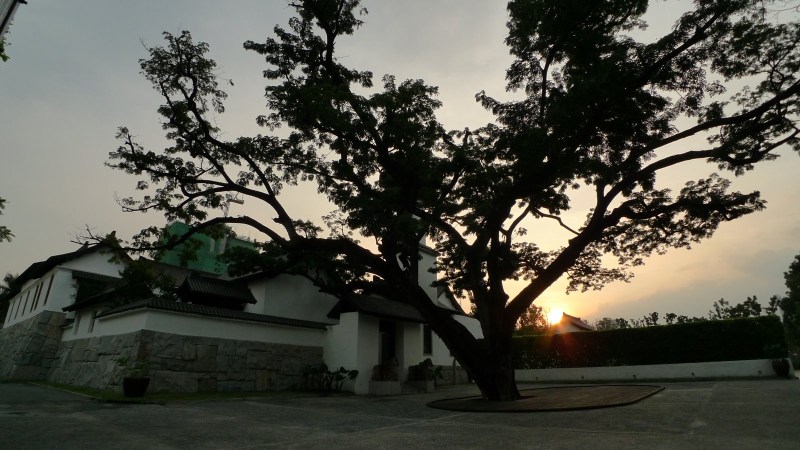
On the way home, I noticed that we were in for a gorgeous sunset.  The weather has been cool thanks to a system dropping in from China and the breeze, which had been strong the past few days, was very calm today leading to hazy but cloud-free skies.  I stopped by Benjakiti Park next to Queen Sirikit Convention Center and shot this picture.  It was a beautiful sunset.


Bicycle Riding in Phra Pradaeng

Since our guests are adventurous, outdoorsy sorts, I arranged for a half-day bicycle tour of the “Bangkok Jungle” through Spiceroads.  Located just across the river from the Khlong Toei district (which includes the part of Sukhumvit Road that I live in), this jungle is just that – an isolated and undeveloped section of the larger metropolitan area.  Joining us were a pair of expats, one American and the other British, who I know.

2010-11-30 01

The reason that Phra Pradaeng, the green patch nearly encircled by the Chao Phraya River, has avoided development is that it is actually part of Samut Prakan province instead of Bangkok.  Zoning laws were enacted to limit development in this section of the province.  The area is often referred to as the “lungs of Bangkok” and includes a large public park.

2010-11-30 02

Our starting point for the tour was a restaurant near the Thong Lo BTS Skytrain station.  We rode through a little bit of city traffic, although mostly on back sois (alleys), and then through the slum area of Khlong Toei down near the port.  Finally, we boarded a long-tail boat and left the city behind.

2010-11-30 03

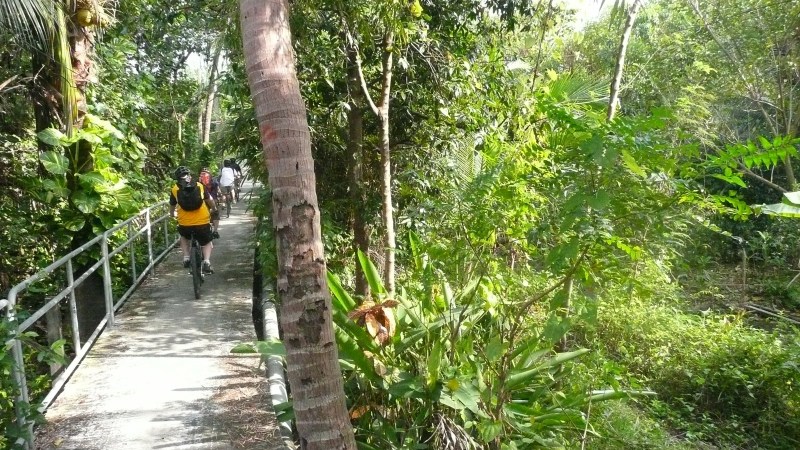
On the other side of the river, any sign of the hustle and bustle of the nation’s capital quickly melted away as we rode along small roads and elevated concrete paths through banana, coconut, and lychee plantations.  Except for the occasional view of a skyscraper peeking over the horizon, you could easily forget where you were.

2010-11-30 04

We had time for several breaks, seeing some of the local sites (which are limited), feeding the fish in the park, and trying a Thai snack of sticky rice and starchy bananas steamed in banana leaf.

2010-11-30 05

Back at the pier as we waited for our boat, some local children swam in the edge of the river, showing off for us by performing ever more daring stunts.  Here, a double flip into murky waters.

2010-11-30 06

Back near our starting point, I peeked in the front gate of a complex that is usually closed.  I don’t know what it is, but it looks almost like a shinto temple.  Very beautiful.

Wat Po After Hours

More than halfway through our seven different modes of transportation, Matt, Craig, and I ended up arriving at the Grand Palace just as it was closing, so instead we walked down the block to Wat Po, also known as the Temple of the Reclining Buddha.  This temple, which tourists usually see after sweltering in the hot sun over at the Grand Palace, rarely gets as thorough a viewing as it deserves.

P1070654

Predating the founding of Bangkok, the temple houses a 15 meter (46 foot) high, 46 meter (140 foot) long statue of the Buddha in a reclining pose, covered in gold plating with mother of pearl inlays on the soles of its feet.

P1070657

That the soles of the feet are so prominent seems appropriate, because Wat Po is also the home of traditional Thai medicine, a large portion of which is massage.  Thai massage uses a combination of stretching and deep tissue work and can be very therapeutic.  In fact, a well-regarded school is located on the temple grounds and my visitors stopped in for an hour-long foot massage.

P1070683-1

The temple is in the final stages of extensive renovations, and the entire place seems alive with color and light.  Here are a trio of chedis, which contain the remains of various members of the Chakri dynasty.  The current king is the ninth member of this dynasty.

P1070687

New roof tiles and paint seem to almost pulsate with color.

P1070694

And mirrored tiles catch the sun from every angle.

P1070669

While there, we came across a group of university students who are studying tourism.  They had to film themselves giving a speech (in both Thai and English – the Thai version is on the other side of the cue card) about the temple.  I watched for a few minutes and then asked some questions, thoroughly embarrassing the young ladies.

P1070730

The upside of my guests getting massages was that we were at the temple well after the time that tourists normally leave.  The temple’s website still lists the closing time as 5:00 pm but almost half a year ago they extended it to 9:00 pm every night.  The temple is beautifully illuminated as the sun goes down and is all the more enjoyable and inspiring when it is almost completely devoid of tourists.

P1070735

With the sun going down early now that we are heading into winter, the sky quickly went through various shades of blue to pink to purple, making for some amazing contrasts with the vivid hues of the chedis and temple buildings.

P1070737

There are many spotlights to bring out the details of the structures, including these decorations made from shards of broken Chinese pottery.  Almost looks like the decorations on a cake, doesn’t it?

P1070742

I’ve made up my mind that in the future, I am taking guests to Wat Po around sunset, a perfect time to see the real beauty of the temple without the crowds.  Plus, there is a really nice restaurant called The Deck that is just across the street along the banks of the Chao Praya River.  It is a nice place for an evening meal as another temple, Wat Arun (the Temple of Dawn), is right across the river and is also lit up at night making a pretty backdrop.  Ironically, it looks better at dusk than it does at dawn!  (Here’s a picture of Tawn and me dining there a few years back.)


Seven Modes of Transport Around Bangkok

Last week I took two of my visiting guests (the third is Thai and was visiting his family instead) around Bangkok to see the sights.  Instead of doing the usual things, we spent a good portion of the day exploring the city using different, and often less-touristy, modes of transportation. 

The idea occurred to me a few weeks ago.  One of the guests is an aviation enthusiast, so I extrapolated that he might also be interested in other forms of transportation.  When I’ve previously used other ways to get around the city, I find myself seeing Bangkok through an entirely different light.

The modes of transport used could be varied and there were at least three – bus, taxi, and motorcycle taxi – that we did not try.  In the future, I will have to refine this itinerary, but here are the notes from this time.

Seven Modes

Mode 1: MRT Subway from Sukhumvit Station to Hualamphong Station

Walking from their hotel to the nearby Asoke-Sukhumvit intersection, my guests and I descended into Bangkok’s five-year old subway for a ten-minute ride to the Hualamphong train station.  The subway is clean and modern and the insides of the trains as well as the platform areas are surprisingly free of advertising.  A short walk through an underground passage took us to the front entrance of the Hualamphong Railway Station.  Trip price, approximately 20 baht each.


P1070575

Mode 2: State Railways of Thailand from Hualamphong Station to Lat Krabang Station

Our timing was perfect as there was just enough time to buy our 8-baht tickets and get to the platform before the four-car diesel locomotive pulled out of this 1930’s-era station and began the thirty-minute ride to the eastern suburbs of the city.  We could have disembarked at an earlier station and shaved some time off our route, but these open-window, unairconditioned carriages (which are older than me) and their passengers provide interesting people watching.  My entry about the steam engines the State Railways pulls out for special occasions.


P1030423

Mode 3: Airport City Line from Lat Krabang Station to Makkasan Station

Also operated by the State Railways, this elevated electric train runs along the same right-of-way as the diesel train, so we retraced our steps.  The City Line and the Airport Express share the same track and we disembarked at the brand-new “in-city terminal” where one day passengers will be able to check in for flights, deposit their baggage, and take the 15-minute express train to Suvarnabhumi Airport.  15 baht each but will increase after January 1 to a distance-based pricing scheme.  Link to my review of the Airport Express.


P1070583
A dog taking a nap outside the Petchaburi MRT Station, near the Asoke Pier.

Mode 4: San Saeb Canal Boat from Asoke Pier to Golden Mount

A short walk from Makkasan Station is the San Saeb Canal, a major east-west aquatic artery in this “Venice of the East” and the only one that has regular boat service.  The water is murky and the boat engines are very loud, but it is an adventure and provides a view of yet another, much poorer, facet of life in the Big Mango.  The end of the line is at the foot of the Golden Mount, the only hill in the city.  11 baht each.

Some pictures from the canal boat:

P1070596
Craig and Matt and a few dozen other passengers enjoy their ride on the murky waters of the San Saeb Canal.

P1070601
The boats whiz under various bridges, some so low that the canopied top of the boat must be lowered.

P1070622
Which explains why the conductors/deck hands wear helmets and are very alert of their surroundings.

Tuk-Tuk
Not my guests.

Mode 5: Tuk-tuk from Golden Mount to Tammasat University

We negotiated with a tuk-tuk driver to take us to a riverside restaurant located just outside the gates of Tammasat University.  Tuk-tuks are three-wheeled auto-rickshaws that serve as transportation in many parts of town, so named because of the sound of their engines.  These are actually pretty dangerous and for the price you pay, a taxi offers greater comfort (air conditioning!) and safety (seatbelts!).  We could have taken the tuk-tuk all the way to the Grand Palace but I was hungry so lunch first.  60 baht total, so 20 baht each.


P1030754
Previous guests (not Craig and Matt) after disembarking from the Chao Phraya River Taxi.

Mode 6: Chao Praya River Taxi from Tha Tian Pier to Sathorn Pier

After lunch we were too late to see the Grand Palace (it closes at 3:30 – don’t believe anyone who tells you it is closed before that time) so we walked to Wat Po, the Temple of the Reclining Buddha.  I’ll write about that in another entry but once we were finished, a bit after rush hour, we caught a river taxi service from the Thai Tian Pier right near the temple back to Sathorn Pier underneath the Taksin Bridge.  Also 11 baht each.


Skytrain Departure

Mode 7: BTS Skytrain from Taksin Station to Asoke Station

We concluded our journey by walking to the nearby BTS Skytrain station.  The 10-year old BTS Skytrain is convenient and overcrowded.  Thankfully, new four-car trains are entering the system soon and additional cars have been ordered for the three-car trains.  From what I’ve read, BTS is also the hold-up in the efforts to create a common ticketing platform (a la Hong Kong’s Octopus card) between the three electric rail systems.  Nonetheless, for about 30 baht we made our way back to the Asoke-Sukhumvit junction.