Land Use in Central Thailand

Why is traffic in Bangkok so bad?  This is a persistent question that has been at the back of my mind for the more than five years I’ve lived here.  As someone interested in urban design and land use, I always wonder: Is this traffic inevitable or could it have been avoided? 

P1090213
How does this…

While bicycling on the outskirts of the city last Sunday, I realized that part of the answer lies in looking at the historical land use patterns and how long, thin rice paddies that cut between canals have led to a network of roads that are insufficient to handle Bangkok’s more than six million residents.

P1090207
Turn into this…

While this realization is the result of consuming other people’s writing and observations and digesting them, it wasn’t until I was riding through an area that is actively undergoing the transformation from rice paddies to development that it became clear to me.

NG Bangkok Traffic
And, eventually, become this?

The result is this six-minute video project, which I hope you’ll find interesting.


When I Am Through With the Hong Kong MTR

Before doing a final back-up of my November 2010 photos and videos and removing them from my laptop’s hard drive, I realized I had an unfinished project from my most recent trip to Hong Kong.  I was in the Tsim Sha Tsui MTR station on a Friday evening during rush hour and shot some video of the mass of humanity.

At the same time, I had just completed the third season of the Glenn Close TV show “Damages” and they have an interesting effect in the title sequence that I wanted to try to recreate: they show a crowded intersection in New York in fast-motion and then suddenly cut the clip to slow-motion.  (If you want to see the original, a link to it is here.  The shot I’m talking about lasts all of one second and takes place at about 0:08.)

As an homage to my inspiration, I “borrowed” the same title song, “When I Am Through With You” by The V.L.A.  It is an energetic, guitar-driven song which I crudely edited to just over one minute.  I hope you enjoy it.

I’ve been making an effort to post on a daily basis.  Right now I have a backlog of several entries and am trying to work through them.

Seven Modes of Transport Around Bangkok

Last week I took two of my visiting guests (the third is Thai and was visiting his family instead) around Bangkok to see the sights.  Instead of doing the usual things, we spent a good portion of the day exploring the city using different, and often less-touristy, modes of transportation. 

The idea occurred to me a few weeks ago.  One of the guests is an aviation enthusiast, so I extrapolated that he might also be interested in other forms of transportation.  When I’ve previously used other ways to get around the city, I find myself seeing Bangkok through an entirely different light.

The modes of transport used could be varied and there were at least three – bus, taxi, and motorcycle taxi – that we did not try.  In the future, I will have to refine this itinerary, but here are the notes from this time.

Seven Modes

Mode 1: MRT Subway from Sukhumvit Station to Hualamphong Station

Walking from their hotel to the nearby Asoke-Sukhumvit intersection, my guests and I descended into Bangkok’s five-year old subway for a ten-minute ride to the Hualamphong train station.  The subway is clean and modern and the insides of the trains as well as the platform areas are surprisingly free of advertising.  A short walk through an underground passage took us to the front entrance of the Hualamphong Railway Station.  Trip price, approximately 20 baht each.


P1070575

Mode 2: State Railways of Thailand from Hualamphong Station to Lat Krabang Station

Our timing was perfect as there was just enough time to buy our 8-baht tickets and get to the platform before the four-car diesel locomotive pulled out of this 1930’s-era station and began the thirty-minute ride to the eastern suburbs of the city.  We could have disembarked at an earlier station and shaved some time off our route, but these open-window, unairconditioned carriages (which are older than me) and their passengers provide interesting people watching.  My entry about the steam engines the State Railways pulls out for special occasions.


P1030423

Mode 3: Airport City Line from Lat Krabang Station to Makkasan Station

Also operated by the State Railways, this elevated electric train runs along the same right-of-way as the diesel train, so we retraced our steps.  The City Line and the Airport Express share the same track and we disembarked at the brand-new “in-city terminal” where one day passengers will be able to check in for flights, deposit their baggage, and take the 15-minute express train to Suvarnabhumi Airport.  15 baht each but will increase after January 1 to a distance-based pricing scheme.  Link to my review of the Airport Express.


P1070583
A dog taking a nap outside the Petchaburi MRT Station, near the Asoke Pier.

Mode 4: San Saeb Canal Boat from Asoke Pier to Golden Mount

A short walk from Makkasan Station is the San Saeb Canal, a major east-west aquatic artery in this “Venice of the East” and the only one that has regular boat service.  The water is murky and the boat engines are very loud, but it is an adventure and provides a view of yet another, much poorer, facet of life in the Big Mango.  The end of the line is at the foot of the Golden Mount, the only hill in the city.  11 baht each.

Some pictures from the canal boat:

P1070596
Craig and Matt and a few dozen other passengers enjoy their ride on the murky waters of the San Saeb Canal.

P1070601
The boats whiz under various bridges, some so low that the canopied top of the boat must be lowered.

P1070622
Which explains why the conductors/deck hands wear helmets and are very alert of their surroundings.

Tuk-Tuk
Not my guests.

Mode 5: Tuk-tuk from Golden Mount to Tammasat University

We negotiated with a tuk-tuk driver to take us to a riverside restaurant located just outside the gates of Tammasat University.  Tuk-tuks are three-wheeled auto-rickshaws that serve as transportation in many parts of town, so named because of the sound of their engines.  These are actually pretty dangerous and for the price you pay, a taxi offers greater comfort (air conditioning!) and safety (seatbelts!).  We could have taken the tuk-tuk all the way to the Grand Palace but I was hungry so lunch first.  60 baht total, so 20 baht each.


P1030754
Previous guests (not Craig and Matt) after disembarking from the Chao Phraya River Taxi.

Mode 6: Chao Praya River Taxi from Tha Tian Pier to Sathorn Pier

After lunch we were too late to see the Grand Palace (it closes at 3:30 – don’t believe anyone who tells you it is closed before that time) so we walked to Wat Po, the Temple of the Reclining Buddha.  I’ll write about that in another entry but once we were finished, a bit after rush hour, we caught a river taxi service from the Thai Tian Pier right near the temple back to Sathorn Pier underneath the Taksin Bridge.  Also 11 baht each.


Skytrain Departure

Mode 7: BTS Skytrain from Taksin Station to Asoke Station

We concluded our journey by walking to the nearby BTS Skytrain station.  The 10-year old BTS Skytrain is convenient and overcrowded.  Thankfully, new four-car trains are entering the system soon and additional cars have been ordered for the three-car trains.  From what I’ve read, BTS is also the hold-up in the efforts to create a common ticketing platform (a la Hong Kong’s Octopus card) between the three electric rail systems.  Nonetheless, for about 30 baht we made our way back to the Asoke-Sukhumvit junction.

Airport Link Now Fully Up and Running

In June I wrote about my first ride on the Bangkok Airport Rail Link (ARL), which spent the past few months running a limited test service.  The line has both a local and express service, the express promising to move you from the airport to the center of the city in fifteen minutes.  The trial run for the past few months, though, only featured the local service.  Two weeks ago the express portion was brought on line and the system was officially opened, so I went for another ride to check it out.

Now that all the stations were in operation, I decided to ride the express from the Makkasan terminal station (located near Asoke between Rama IX Expressway and Petchaburi Roads) nonstop to the airport, and then ride the local service back to Phaya Thai station, where the ARL connects with the BTS Skytrain.

P1030547

Back in June one problem I noticed was that the ARL station (on the right in the picture) didn’t physically connect with the BTS station (on the far left).  In fact, there was a gap of a good 5 meters, meaning that you had to walk down the stairs from one station, along the road, across the train tracks, and then ascend an escalator into the other station.  Not convenient at all – especially for someone with suitcases!

P1060240

I’m glad to report that on opening day, they had a connector bridge just barely finished (work was still underway but a narrow walkway was opened through it) that takes you from the paid area of the BTS station (in the background) to the public area of the ARL station (in the foreground).  The operator of the BTS has added fare gates and a ticket window so you can enter and exit the station conveniently, walking directly to the ARL station.

Amazing, but true – there was some amount of advance planning and coordination between the agencies!

P1060215

Unfortunately, I can’t say the same for the Makkasan Station, a beautiful, modern facility that is meant to offer the convenience of checking in for your flight at the station, checking your bags, and then being able to whisk off to the airport without the worry of lugging your suitcases with you.

P1060222

The station is set back some 200 meters (650 feet) from Asoke Road, a heavily congested north-south artery, and some 500 meters from the Petchaburi MRTA subway station exit.  Despite more than three years of construction, there is no direct pedestrian access between the MRTA and ARL and no vehicular ramps connecting the station to the southbound (inbound to the city) side of Asoke.

Illustration as to why this is a problem:

As I was walking from the subway station to the ARL station, a very pedestrian unfriendly route, I came across a family of travelers, pulling their suitcases from the ARL station.  I asked where they were heading, ready to give directions, and they were looking for a taxi.  Of course, the driveways weren’t open and no taxi queue was up and running, so they had to walk the 200 meters to the street and try to flag a taxi down.  To top it off, the taxi would be going the opposite direction from where they were headed.

P1060221
Open building but no taxis or any other traffic allowed up to the facility.

A week after the ARL opened, the State Railways of Thailand, which owns and operates the system, announced they would build an elevated pedestrian walkway to the subway station and would build ramps so cars could access the station from all directions.  Give them two years and then things might work better.

P1060220

The State Railways owns a huge tract of land around the Makkasan station, what used to be their main switch yards and maintenance facility.  Their grand vision is to eventually develop all of this – enough room for 20 or more skyscrapers – into a large mixed-use facility of offices, hotels, convention center, shopping, and maybe some residential.  At that point in time, it would be conveniently located.  Until then, it is not really near much of the city.

In fact, that is probably the reason they chose to make Makkasan station the in-city terminal.  They stand to make a lot of money (and maybe, for the first time in 50+ years, turn a profit?) from land development.  The obvious place for the in-city terminal would have been Phaya Thai station, adjacent to the BTS Skytrain.  Better synergy with the transit systems.

P1060224

The express train to the airport is quite nice.  The station is air conditioned and well signed, if lacking in taxis.  The trains run every fifteen minutes and the cars are comfortable with forward and rear facing seats, luggage racks, and overhead storage for small items.  The train is also very fast – top speeds supposedly of 150 kmh, but I think it is more like 120 most of the way.

P1060231

A view of the roads leading from the highway to the airport as we zoom past, arriving exactly fifteen minutes after leaving Makkasan.

My assessment: The system is a very welcome addition to the transit network here in Bangkok.  The local line, which connects from the airport directly to the Skytrain with six intermediate stops, is very useful and will probably do a lot of business, what with the rapidly-expanding suburbs to the east of the city.  The airport express itself isn’t useful as you pay more and wind up at a station that isn’t convenient to anything.  My advice – if you are arriving in the city and want to use the train, use the local line.  Or, if there are more than two of you, take a taxi.  In another two or three years, once the connections to the Makkasan station have been built and it is more convenient, I might revise my opinion.


Bicycle Taxi = BIXI

Urban planning, public transportation, and bicycling – three of my interests that are rolled into one in a Montreal-based bicycle sharing program called BIXI, short for BIcycle taXI.  BIXI was introduced in June 2009, quickly growing to 5,000 bicycles.  The one-millionth ride was taken in the first five months.  Perhaps this is a model that we will see gain traction in other cities?

Bixi_Rene-Levesque_Beaudry

Already, BIXI has expanded into Melbourne, Australia and Minneapolis, Minnesota – and London, England and Boston, Massachusetts are supposed to be online this summer.  A system in parts of Washington, DC is scheduled to be on the way, too.  Other cities around the world are installing similar systems.

There is a bicycle rental program here in Bangkok, but it is only in the touristy section of the old city, designed for sightseeing, not transportation.  I do ride my bicycle here, but since there are few places to park, I ride it mostly for exercise and not errands.

Bicycling is an ideal way to get around for many of the errands we run or even for some of the distances we commute.  Much of the year, the weather is fine, and bicycling is faster than walking.  But one of the biggest obstacles is that we don’t want to lug our bicycle all over the place, especially if we need to travel by bus, train, or car for portions of the journey.

Bicycle sharing programs eliminate the hassle.  By providing a bicycle when and where you need it, you can easily integrate a bicycle into your overall transportation options.  The system allows you to take a bicycle from wherever you are and leave it wherever you are going, without having to worry about bringing it back to your point of origin.  A subscription program lets you rent a bike on the fly, free for the first thirty minutes, or you can pay as you go.

Bicycle 3

The bicycles are durable and designed to keep you from getting messy – chain guards and fenders keep the oil and puddles off you.  A handy basket lets you carry your belongings with you and even pick up a bag of groceries or other small items.

Bicycle 2

Best of all, in my opinion, is their convenience.  This map of most of Montreal shows how densely located the BIXI bike stations are.  They are everywhere – usually within a block of where you are!  Especially when tied into transit systems like bus and train lines and large car parks, the bike sharing system makes it easy to switch to a secondary mode of travel, one that is better for you and for our environment.

If you would like more information about BIXI, you can click here.  For more information about bicycle sharing systems in general, here is the Wikipedia article.  Sorry if this sounds like a marketing brochure – I just think BIXI sounds like a cool idea that should be the standard rather than the exception in more cities.


New Pedestrian Bridges at Asoke and Thong Lo

For a city of about 8 million people with generally poor mass transit systems, Krungthep (Bangkok) can sometimes surprise you with the usefulness of some of its infrastructure development.  A good example of this are the pedestrian bridges built to connect some of the BTS Skytrain (elevated rail) stations to surrounding buildings.  In a city with lots of traffic congestion, poor air quality, and even poorer footpath quality, an elevated way to get from the station to the buildings is a big incentive to get out of the car and into the mass transit.

Asoke Road

The junction of Asoke and Sukhumvit roads is an example of this bridge building trend.  One of the busiest intersections in the city, crossing at street level has long been a hazardous activity for pedestrians.  Located at the intersection of the MRTA subway and the BTS Skytrain, this junction houses three high-rise offices each with a few floors of retail, two large hotels, and a nine-story mall that is under construction.

P1050837
The pedestrian bridge built under the Skytrain viaduct, heading east from the Asoke station.

In the past two years, pedestrian bridges were built to the west of the BTS Skytrain station, connecting the two hotels and one of the three office buildings.  Then a large bridge was built to the east under the Skytrain tracks on Sukhumvit, crossing Asoke in a single cantilevered structure.  On the east side of the junction the pedestrian bridge connected to the building in the southeast corner, but not to the newer building on the northeast corner.

P1050725
The northeast corner of the Asoke-Sukhumvit junction. 

Before the pedestrian  bridge opened across Asoke, you had to descend from the Skytrain station to the subway station, cross under Asoke road in the subway station, and then reemerge at the base of this building.  The subway entrance is in the lower left of the photo, near the large umbrellas.  The new pedestrian bridge is on the right that connects directly to the building is on the right.  What follows are some pictures of the connection under construction over the past two months:

P1030669

Taken about six weeks ago, you can see in this picture how the new extension of the bridge will connect from the existing pedestrian bridge (shown in the very first picture in this entry) to the third floor of the building.  At this point, just a part of the metal framework has been put into place.

P1040367

A few days later, crossbeams have been added and some of the concrete flooring is in place.  You can also see how a stairwell to the street level – a requirement for all the bridges that connect to buildings to allow after-hours access to the pedestrian bridge – fits into the design.

P1040665

A few days after that, the columns for the roof structure are mostly in place.  The following week, the roof itself has been added and most of the side panels are installed.

P1050726

Finally, about two weeks ago the bridge is finished and is nearly open.  Lighting is working, as you can see.  This will be much more convenient to access the building and its businesses.  Certainly much easier than having to pass through the subway station to get there!  Plus, you can now descend to the street and access businesses along this side of the street more easily.

Thong Lo

A second example of new pedestrian bridges is going up on the west side of the Thong Lo Skytrain station.  This is my neighborhood station and it lies just to the east of the junction of Thong Lo and Sukhumvit Roads, two stops to the east of the Asoke station.

P1210498
Looking west from the foot of the Thong Lo Station

The main driver behind this bridge is the Noble Remix condo (the purple building) which will have two floors of retail below about 35 stories of residences.  While the retail floors will get traffic from the residents, there’s no hope of anyone else traipsing over there unless it is convenient, and that means a pedestrian bridge. 

P1210501
Looking west from the station’s westbound platform.

Looking from the station platform to the west, you can see the condo on the left and the entrance to my alley on the right, just under the tracks before the first column.  The rationale for needing a pedestrian bridge is that someone walking along the sidewalk has to go along the petrol station and then cross a small but busy alley between the petrol station and the condo.  By building the bridge, it is safer and more convenient for pedestrians. 

At the same time, some stairs will be built on the north (righthand) side of the road in front of the international school – the building that is wrapped in blue construction tarp.  This should be safer for students and their parents to access the Skytrain station.

P1040406

Looking back from in front of the international school towards the BTS Skytrain station, you can see the condo to the right and the first columns of the pedestrian bridge.  This is about two months ago.

P1040692

As of four weeks ago, box frames were built around the train viaduct’s columns.

P1050579

A few weeks later, the bridgework was added to connect each of the support columns.  For the past two weeks, no further work has been done including the connection to the station itself.  I’m curious to see how quickly they will finish this project.  It seems like it should not be difficult but each step has moved quite slowly.  In the end, it won’t benefit me very much but it is another sign of progress in making the Skytrain more accessible to the area surrounding the station and and more user-friendly to potential passengers.


First Ride on the Bangkok Airport Link

Three years late, the rail line to the Bangkok Suvarnabhumi International Airport has finally started running, although on a limited, trial basis.  Last week I headed out for a look at this latest addition to Krungthep’s transit infrastructure.

The new airport, Suvarnabhumi, opened more than three years ago about 30 km east of the heart of the city.  The planned rail service, the so called “pink line,” suffered through interminable delays caused for any number of reasons, not the least of which might have to do with the State Railways of Thailand’s notorious inefficiency.  The SRT, which owns the right-of-way, built, and will eventually operate the pink line, has never turned a profit in its more than half-century of operations.

Nonetheless, I’m excited that another piece in the transit puzzle is nearly put into place as the line started limited trial service almost two weeks ago.

Airport Link Map

The pink line is actually two lines: the darker line is the city line, which will make multiple stops between the airport and Phaya Thai, which is currently the westernmost station.  As you can see in the above map, there were several planned but unbuilt stations, shown with station names in outlined font.  The second, light pink line is the airport link, which will run nonstop between the airport and the Makkasan station (at Asoke and Petchaburi Roads), where the in-city terminal will be located.

If all goes according to plan, passengers will be able to check in for their flights at Makkasan station, receive boarding passes and drop off their bags, then ride on the train to the airport.  Their bags will be carried in a secure storage area and, already ticketed, will go from the train directly into the airport’s baggage system.  It sounds like there will be some delay before that part is operational.

Additionally, the plan is that passengers on the pink line will be able to connect with the BTS Skytrain at Phaya Thai and with the MRT subway at Makkasan-Petchaburi.  Sadly, it appears that neither connection is currently built.

P1030547

I met up with Bill and Ken, two friends with an interest in things both transit and aviation related, at the Phaya Thai BTS station to give the pink line a try.  During this trial run, only the two end stations – Phaya Thai and Airport – are operational on the pink line.  The train service is running weekdays from 7-10 am and 4-10 pm nonstop between these stations, although some intermediate stops will be introduced next week.  This trial run is free and will last until August, when the full system is supposed to be in service.

Above, you can see the Phaya Thai station of the pink line, the big concrete behemoth on the right, and a ramp that is supposed to connect to the Phaya Thai BTS station on the left.  You’ll notice, though, that the ramp stops about 5 meters short of the BTS station.  I’m curious about this because passengers will have to walk down to the street level, along 100-200 meters of broken, dirty sidewalk, cross an active railway line, and then ascend into the second station, regardless of which way they are connecting.

P1030550

Above: Flagman at the active railroad tracks that passengers connecting between the pink line and BTS have to cross, directs cars off the track as a train approaches.

My theory for this is that the two systems didn’t communicate very well, even though the BTS has been running for more than ten years so certainly wasn’t an unknown entity.  The ramp would connect a paid area in the BTS station with a public area in the pink line station.  So someone is going to have to pay to build and maintain turnstiles and a BTS ticket booth somewhere at the connection point.  This is insane because the three rail systems in town are supposed to be moving to a common ticket platform – one ticket, all systems – so the ramp should lead from the paid area to another paid area, not pass through a public area of the pink line station.

Anyhow, we walked across the railroad tracks with no problems and took the elevators up several levels in the new pink line station, being directed by friendly guards the whole way.

P1030558

The trains (these are the city line trains being used for the test run, not the airport link trains) are from Siemens and they look nice enough.  The stations along the line are not very impressive, a collage of grey concrete and grey metal.  Only the Makkasan and Airport stations are air conditioned.

P1030423

The line was pretty well used when I took it about 4pm.  By the time the train left, the seats were full with many of the passengers looking like airport employees or people who live out in the eastern suburbs.  There were also many local tourists traveling just to see the new train and, surprisingly, a few people actually using the train to get to the airport with their bags. 

Once the line is fully operational, the city line will charge between about 10-40 baht (up to US$1.25) and the airport link will charge 150 baht (US$4.75).  I would assume that the seating arrangement on the airport link train will feature pairs of seats facing forwards and backwards along with storage space for carry-on baggage.

P1030427

Notice the wide gap between the train and the platform.  It looks like there is a ledge under the door that can be extended, but they were not doing that.

P1030421

The monitors in the station show a video of the route, alternating between Thai and English.  There is also a countdown clock until the next departure – shown in seconds!  I’ve never seen a train station that shows countdown time in seconds.  And, believe me, SRT isn’t the sort of prompt organization that runs things to the second.

P1030422

Looking east from Phaya Thai station towards the Ratchaprarop station, the two closest stations on the line.

P1030570

The ride itself was very smooth, with the exception of one station midway through the line where there is a passing lane.  We had to slow down significantly to change tracks, breaking our otherwise good speed of approximately 120 kmh or 75 mph.  We were going faster than all but the fastest taxis on the expressway that parallels the tracks most of the way to the airport.

Along the way, there was a nice view of the many new housing development springing up near the airport and the new stations on the pink line.  This line will probably become very useful, less for airport passengers and employees, but more for locals who live to the east of the city and need a fast way to commute into town to their offices.

P1030586

It took just about 20 minutes to go from Phaya Thai station to the airport.  I understand that the airport link service from Makkasan to the airport will be about 16.  The train pulls into the sub-basement of the car park structure, connecting directly into the terminal building.  A quick ride up the elevator or moving sidewalks and you are at the arrivals and departures levels.  Very convenient on this end of the line.  In the future, you will be able to walk through this station to the airport hotel, which you currently have to take a shuttle van to.  The station will also have various retail shops, although those are all located on the hotel side of the station, which doesn’t make much sense.

There are some potential cons to the system right now and I’ll have to wait and see how it works once the whole system is up and running, then I’ll talk more about the cons if they haven’t been addressed.  For the moment, I’ll simply say that I’m glad additional transit options are opening and I hope that we’ll see several more in the next few years.

P1030413

Speaking of which, one has to wonder where the pink line, which ends just to the west of the Phaya Thai station, will go in the future.  The master plan shows this line continuing, turning north and heading towards the old Don Meuang airport (and beyond) and also turning south and heading to the current Hualamphong train station and then underground, across the river, and southwest to Samut Sakhon province.  Ambitious!
Bangkok Bus Rapid Transit

Months after I thought the project was fatally stalled, Bangkok’s new Bus Rapid Transit scheme started running this past week.  Finally, the City of Angels is making some more progress away from private automobiles and towards public transit.

The concept of Bus Rapid Transit, or BRT, is somewhat akin to having a light rail system but substituting busses for the rail cars.  This way, you don’t have the significant infrastructure investment while still enjoying many of the benefits of light rail transit.  Cities as varied as Jakarta, São Paulo, Bogotá, Seattle, and Brisbane use various BRT systems to good effect.

P1030475

This first route (four more are planned in the years to come) is shown in green at the bottom of the map.  It begins near the Chong Nonsi BTS Skytrain station on Narathiwat Road between Silom and Sathorn Roads, running southeast along Narathiwat Road and then turning onto Rama III Road and heading west along the south side of the city, terminating on the Thonburi side of the river near the future Ratchadapisek BTS station on the western extension of the Silom Skytrain line.  Prolific blogger Richard Barrow has created a Google map showing the whole thing in detail. 

Based on questions I’ve asked, the new Ratchadapisek BTS station should be within easy connecting distance of the BRT terminus, but looking around once we reached the terminus, I could see the Skytrain tracks but no indication of construction of the new station.  Articles I’ve read in the newspaper say that BTS plans to have this extension opened by the end of 2012.  We’ll see…

P1030513

The first map left out one important part of the larger transit scheme here in Bangkok – the Airport Express.  The Airport Express (the dotted red line labeled “Airport Link” in the map above) just began trial runs for the public this week and I’ll take a ride next week and report on it, too. 

As you can see, we are starting to get a more comprehensive transit network in place.  If you are really curious, a reader of 2Bangkok.com created a very nice map that shows what our rail transit network would look like if every single proposed line and extension were built.  You can find that map here.

So let’s get on with a review of the BRT itself.  My friend Ken and I, after completing an errand at the US embassy, took the bus down to the Sathorn/Narathiwat intersection.  Last October I wrote an entry about the intersection and I’ve pulled some “before” pictures from that entry to contrast with current pictures.

P1030512

This is an artist’s rendering of what the intersection will look like (facing northwest looking up Narathiwat Road towards Sathorn) once the construction is complete.  The BRT station is at the bottom and the Chong Nonsi BTS station is at the top.  The area with the yellow arch is part of the pedestrian bridge that is being constructed over Sathorn Road, replacing two smaller pedestrian bridges that currently exist at the corners of the intersection.  A green-roofed walkway connects from the Chong Nonsi BTS station to the pedestrian bridge.  That walkway is pictured below, with the Chong Nonsi station in the distance.

P1030516

Current view of the walkway, above, and the way it looked in October 2009, below.

P1030516


P1030519

A view from the Skytrain looking southeast towards the BRT station.  You can see the significant steel works that will form the pedestrian bridge crossing Sathorn Road.  This is the area where the yellow arches appear in the artist’s rendering a few pictures above. 

P1190739.JPG

A closer view of the walkway leading from the Sathorn intersection to the BRT station under construction in October 2009.

P1030465

And that same completed walkway now.  In the walkway, you pass through a ticketing area (which, I understand, will eventually use the same stored-value fare cards that the Skytrain, subway, and Airport Express will use) and descend escalators to an enclosed waiting room.

P1030480

The waiting room at the Sathorn station has glazed glass and air conditioners, making your wait for the bus more comfortable.  Interestingly, the rest of the stations along the line do not have air conditioning, only the two terminal stations.  But the other stations are in the middle of the road and, presumably, catch a decent breeze. 

P1030492

Busses, which look like Heimlich, the German caterpillar in the animated Pixar film A Bug’s Life,  run every ten minutes.  The operator’s compartment is separated from the passenger compartment, rather like on a train. 

P1030484

The layout of the floor includes bench seating in the front and lots of standing room.  Capacity is around 50 passengers.  An LCD monitor at the front shows a map of where the bus is on the route, updating in real time, kind of like the “air show” maps on airplanes.  Information on the monitor alternates between English and Thai.

P1030485

The back half of the bus has single seats, which seem to be a waste of the raised floor space.  They should change these to be benches as well, which would make better use of the space.  The two men in blue shirts and ties were from the BTS Skytrain organization, apparently conducting some corporate espionage.  Competition between transit systems must be fierce!  Ha ha…

P1030507

Near the end of the route, the bus crosses the Chao Phraya River on the Rama III Bridge.  Above is a view looking northwards towards the heart of the city.  You can see that many condos (and a few hotels) have sprung up along the river.  Supposedly, there has been a moratorium on further riverside development higher than eight stories, but I don’t know if that is actually true.  Off in the distance you can barely make out the gold-domed State Tower, which appears in the pictures from our stay last weekend at the Peninsula Hotel.

P1030502

Above is the view from the same bridge looking roughly southwards as the Chao Phraya River prepares to make a large turn to the east.  In April 2006, Tawn and I stopped by the temple you see on the right of the picture during Songkhran.  There was something like a summer school for young boys, all of whom had their heads shaved and had donned the saffron robes of novice monks.

DSCF7363

They were playing around – kung fu fighting, it looked like – on the roof of the temple in the heat of the early afternoon.  Not very monastic behavior, but it made for a good picture.  The rest of the story of that trip to Thonburi is here.

P1030510

Stations along the way are in the median of the road, requiring a climb up stairs or escalators and then across the road on a pedestrian bridge.  About 70% of the BRT’s route has a dedicated lane for the bus, set off from the rest of the traffic by green and white striped concrete barriers. 

The remaining 30% is on a section of road with only two lanes, one of which has been painted and signed as being only for BRT busses and vehicles with three or more occupants.  Needless to say, traffic on the remaining lane has become even more congested on that section of road, leading to a lot of complaints by car drivers that the BRT is worsening traffic, not improving it.  Hopefully, the policemen will actually enforce the law and keep drivers out of the BRT lanes.

P1030496

An interesting feature of the BRT system is that there are additional concrete curbs installed on both sides of the lane at the station.  The driver wants to get as close to the platform as possible to make boarding smooth and safe.  There are two small wheels sticking out from under the bus, parallel to the ground.  These sense the curb and alert the driver so he can properly position himself.  All boarding is through the single door in the center of the bus, which is at the same level as the platform.  There is one emergency exit (see the red handle?) at the back of the bus.

The trip took about thirty minutes one way and provided an interesting look at some corners of the city I don’t see very often.  The ride is smooth and comfortable, the stations seem well-located, and the directions and announcements were easy to understand.  All in all, I have to give a solid B+ to the Bangkok BRT system.  If they would bring the same sort of rationalization to the rest of the dozens of bus routes that ply this city, they wouldn’t need to build any more rail. 

Next week… the Airport Express is finally running.  Stay tuned.


Skytrain Sukhumvit Extension – Update

Being a transit/infrastructure/civil engineering buff as well as a long suffering resident of this traffic clogged metropolis, I’m always curious as to the status of different mass transit projects.  One of the two that I’m eagerly anticipating is the extension of the Sukhumvit Line of the BTS Skytrain.

Sukhumvit is the main east-west running road in Krungthep.  It changes names along the way, but it pretty much runs from the heart of the old city, through the Siam Square area, past the Asoke, Thong Lor and Ekkamai neighborhoods, before turning to the southeast and eventually – a few hours later – ending up in Pattaya.

Even with the existing Skytrain line running to On Nut, traffic on Sukhumvit remains very heavy.  Currently, an extension is underway that will take the line all the way to Bang Na on the border of Bangkok and Samut Prakhan provinces.  There is an additional extension planned that will take the line well into Samut Prakhan and would help many commuters to reach the city.

Earlier this week I was dropping our car off at the Nissan dealership at Sukhumvit 101 and I decided to snap some pictures of the current progress.  It took me a while to find the previous pictures I had posted from the same spot.

Before and After – Taken from a pedestrian bridge just south of the future Punnawithi Station (at approximately Sukhumvit Soi 101), I was able to look north (back towards On Nut, Thong Lo, Asoke, and Siam) along Sukhumvit Road.  The top picture was taken in December 2007.  The bottom picture (taken just about 30 feet to the left of where I was standing for the top picture) was taken this week:

December
February

Of course the big question is, when is it going to open?  It seems that the infrastructure is largely complete.  According to reports, the delay in opening was caused by someone at city hall who didn’t process the paperwork to order track switching equipment.  Pardon me while I roll my eyes.

P1220467

Meanwhile, after dropping my car off at the dealer, I decided to catch one of the dozens of bus lines running along Sukhumvit to connect back to the On Nut Skytrain station, which is the current end of the line.  These busses do not have air conditioning, have wooden floorboards, and don’t quite come to a stop when picking up or dropping off passengers.  At 7 baht (about US$0.21) they are a bargain, though.  Thankfully, it was mid-day and there were few passengers.  I was able to snag a seat beneath one of the oscillating fans.


Narita

I told you we were done with Tokyo and, yet, we’re not.  After checking in at the airport, Tawn and I took the train back one stop to the town of Narita.  Longer-term readers may recall that we did this during an 8-hour layover in Tokyo in March 2007.  For those of you who haven’t been reading that long, here’s a brief account:

Narita is the town where Tokyo’s main international airport is located.  It is an hour by train northeast of the city, has a very old and beautiful temple, and is known for its unagi – grilled eel.

P1160231

Taking the local train from the airport back to Narita, I remembered to take a picture of the daily news headlines posted in the train car.  You don’t need to be able to read Japanese to tell that sex sells!

P1160215-1

Narita isn’t a very large town, maybe 100,000 people, and its agricultural roots are still visible, although much of the town now supports the nearby airport industries, including the many hotels where overseas aircrew spend their one- or two-night layovers.

The walk from either of the train stations to the temple is only about ten minutes, following a cute street lined with little shops selling all sorts of trinkets and souvenirs.  Just in the last two years, we’ve noticed a lot of change on this street, though, with several older buildings and mom-and-pop shops demolished in favor of newer, more generic stores, restaurants and bars.

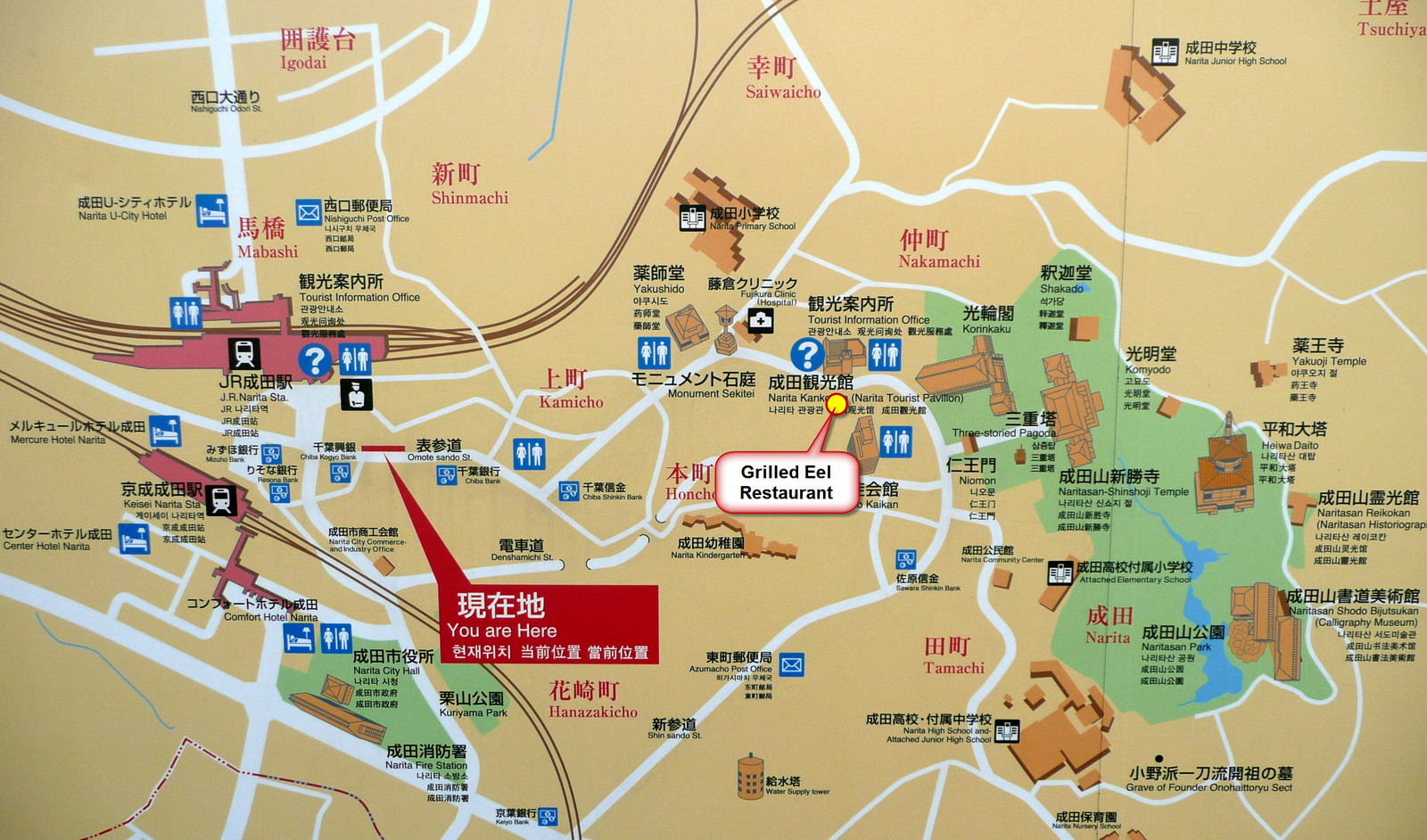
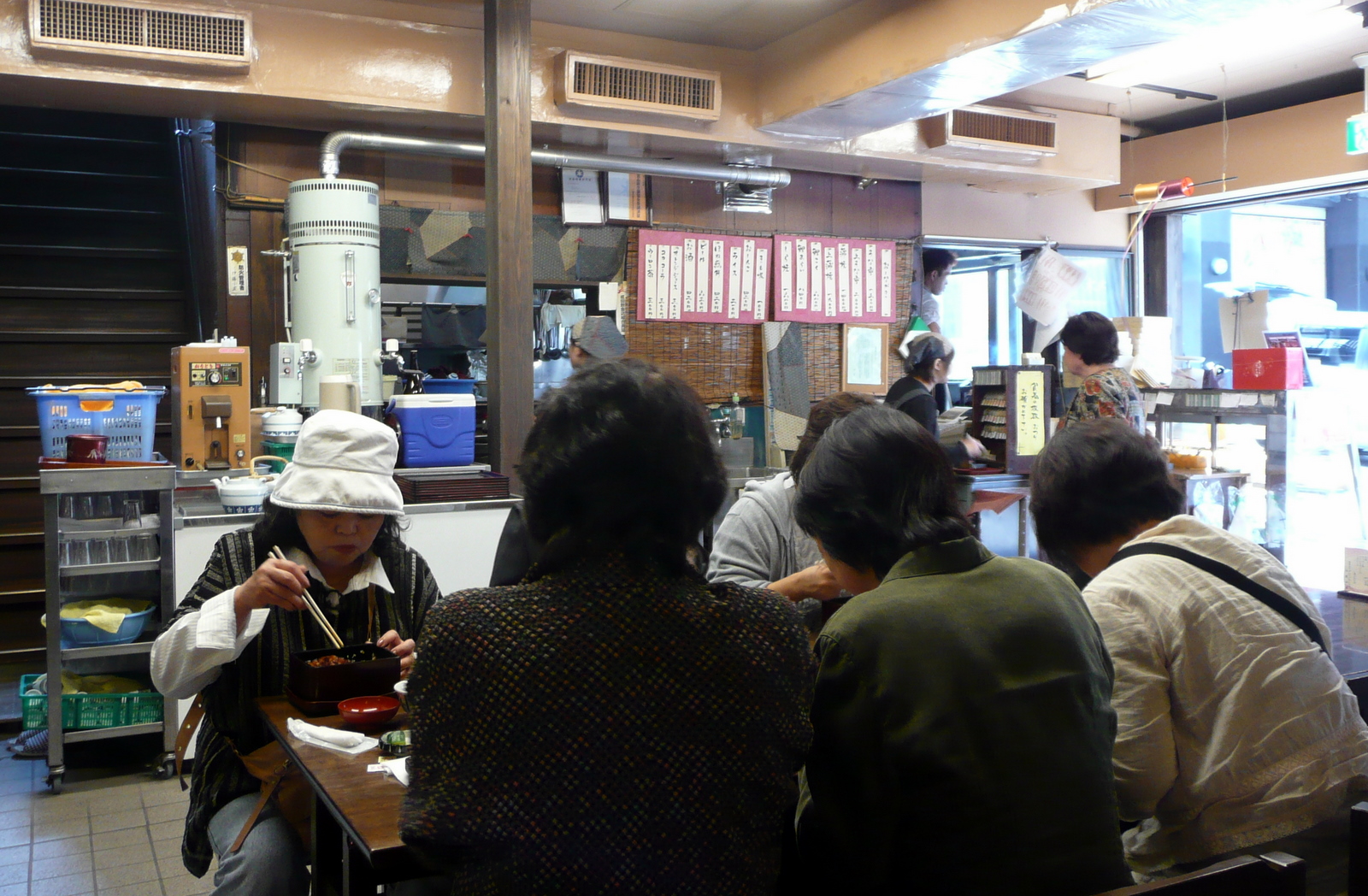
Right across from the tourist information office is a small grilled eel restaurant.  The kitchen faces the street and you can look in and watch the chefs grill the skewers of fresh eel.

P1160216

You order and pay at the front counter, receiving little paper tickets.  Then take a seat at a table (or in the traditional seating area on tatami mats, at the back of the restaurant).  A few minutes later, tender, sweet and crispy unagi comes your way!

P1160224

I’ve said it before and will say it again: if you have about six hours between flights at Tokyo Narita Airport, it is worth your effort to go through immigration and take the train into Narita Town.

After our return to the airport, Tawn did a little browsing in the shops and I went up to the observation deck.  Japanese airports still have observation decks that are open to the public, which I think is a great thing.  (Being an aviation enthusiast and all…)

P1160246

A Japan Airlines 747 touches down on the main runway, the same one that the FedEx MD-11 crashed on a few weeks ago.  I wasn’t able to spot any signs of that accident.  In the foreground is a Korean Airlines 777.

P1160255

With Delta Airlines’ recent acquisition of Northwest Airlines, they have been quick to repaint the Northwest fleet, at least the planes flying internationally.  Now you are able to see something that didn’t exist just a few months ago: a Delta 747 and A330.

P1160264

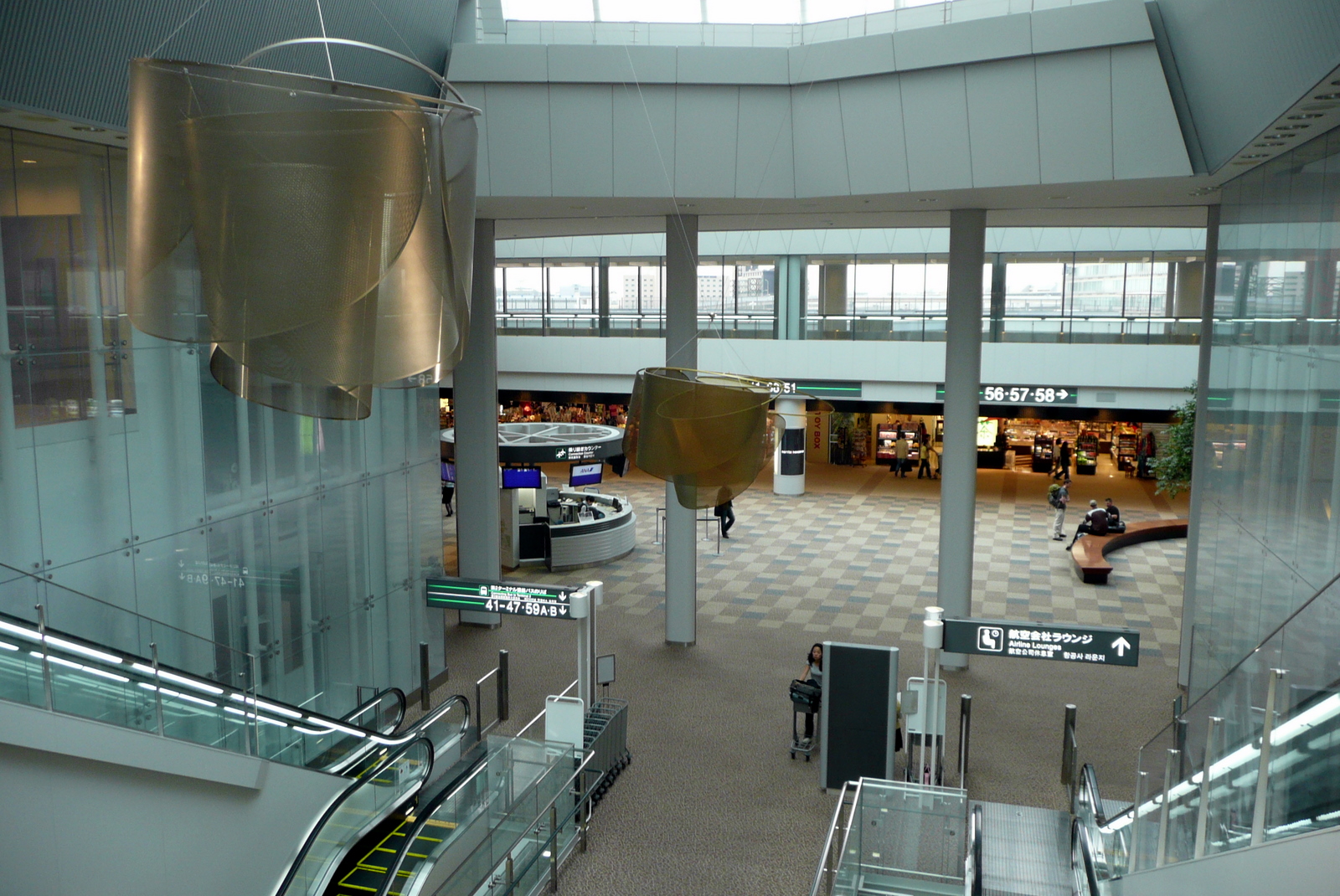
Beautiful new area in Terminal 1.  While Narita doesn’t have all the amenities of Singapore Changi Airport, it is a more beautiful airport.

P1160269

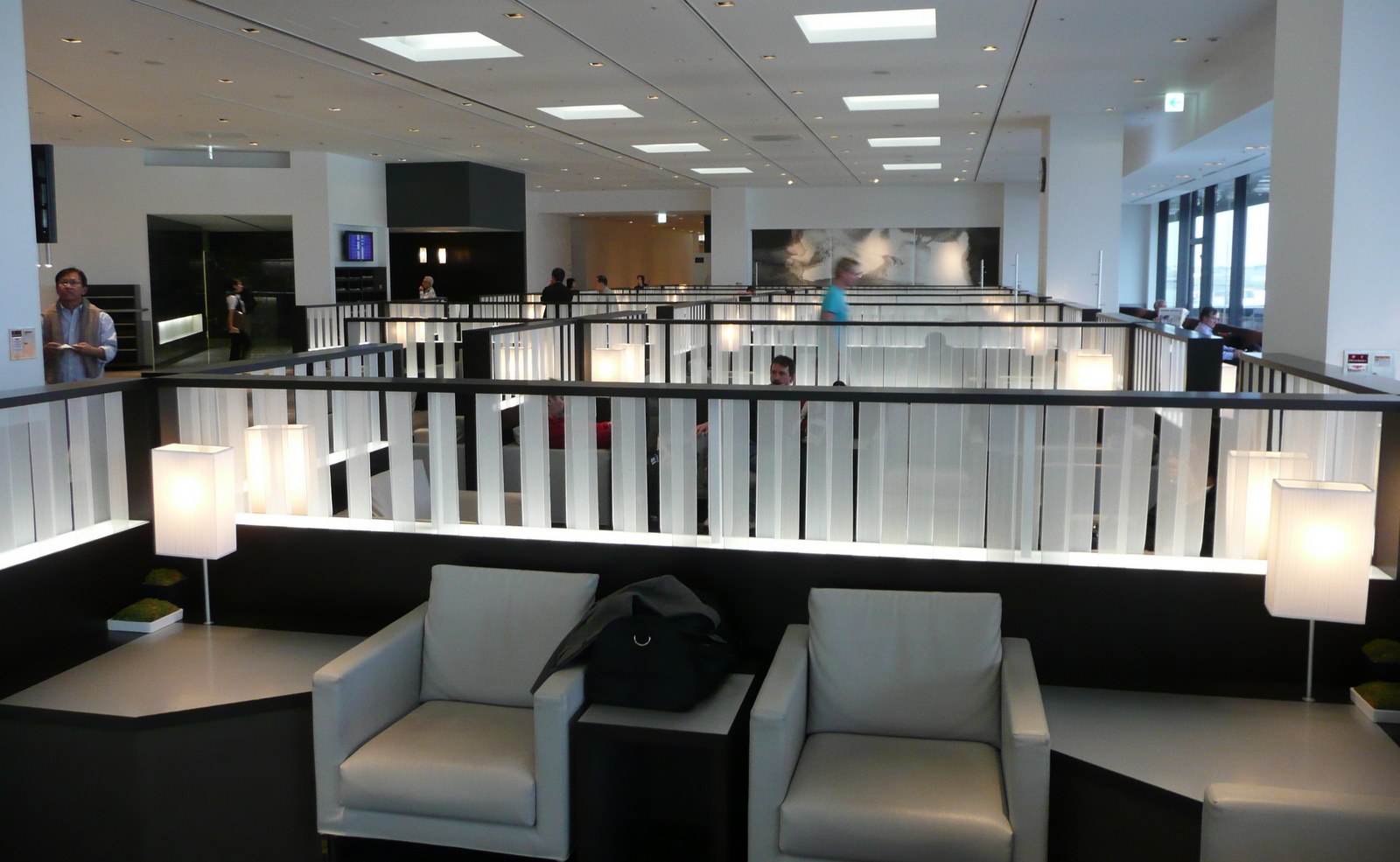
Since we had cashed in a few remaining miles to fly business class, we stopped by the All Nippon Airways lounge.  If you are flying Star Alliance through Tokyo, don’t bother with the United Airlines lounge – go straight to ANA’s as it is much nicer.

With shower facilities and a good selection of food and beverage – not to mention an excellent view of the airfield – the ANA lounge was a nice place to relax before boarding the flight home.

Our friend Masakazu, whom we had joined for shabu-shabu and sukiyaki a few nights earlier, had emailed several of his friends who were working the flight back to Bangkok.  The upside of this was that we received very friendly and attentive service on the way back home, including a complimentary bottle of wine to slip into our bag just before arrival!