Should Your Kids Be Free Range?

It is interesting when something you encounter in the news dovetails nicely with a thought you’ve already been thinking.  Such was the case yesterday when I heard an interview on NPR with Lenore Skenazy, who wrote an interesting article called “The Myth of Online Predators“.  Here’s an excerpt:

Is letting your kids go online the same as dropping them off at the Vince Lombardi Rest Stop in fishnet stockings at 3 a.m.?

A lot of parents think it is. Or maybe worse. My husband and I took our time letting our oldest boy, who is 13, start his social networking, though that was because we were worried it was like dropping him off at the Vince Lombardi Rest Stop to do his homework—we figured it would never get done. But the towering fear that the second a kid goes online he or she becomes cyberjailbait turns out to be way off base. According to new research, the danger online is teeny-tiny unless your kids are running into chat rooms, typing, “Anyone here like ‘em young?” and posting photos of themselves licking lollipops. Naked.

Free Range Kids Recently, the lengthening days have got me thinking a lot about my childhood and how my childhood seems very different than those of children today.  I used to play outdoors all the time.  I remember riding my bicycle up, down and around the block.  My first elementary school was three blocks from home and I was walking there on my own in first grade.  In third grade I transferred to a school six or seven blocks away and was walking there on my own, too, and allowed to ride my bike within maybe a mile radius of home.

I remember my parents telling me about potential predators and what to do and what not to do.  But they never sheltered me, kept me locked up inside, or refused to let me leave their sight.  The result?  It may be hard to scientifically prove, but I can trace my self-confidence, creativity, curiosity, independence and adventurous spirit to that shove out the screen door, that admonition to turn off the TV and go play outside.

“But things are different today,” you might say.  “Crime is so much worse than thirty years ago.”

Statistically, though, that isn’t true, especially with crime against children.  For more detail see this article in the Journal of Social Issues, but here are some interesting facts.  Note that the statistics are current through 2006, when the article was published.  More recent statistics confirm the trend.

  • From 1990 to 2006, substantiated cases of child sexual abuse went down 53%.
  • Physical abuse substantiations declined 48% between 1992 and 2006.
  • From 1993 to 2005, sexual assaults on teenagers decreased by 52%. The subgroup of assaults by known persons decreased even more dramatically

Across the board, crime in the US is at the lowest level it has been since 1970.  Source

All this gets to Skenazy’s larger point, which is that it is crazy to limit our lives – or our kids’ lives – based on fear of a wildly remote danger.  It seems to be part of a growing culture of fear, something that isn’t a very beneficial development for the United States.

Somehow, a whole lot of parents are just convinced that nothing outside the home is safe. At the same time, they’re also convinced that their children are helpless to fend for themselves. While most of these parents walked to school as kids, or hiked the woods — or even took public transportation — they can’t imagine their own offspring doing the same thing.

They have lost confidence in everything: Their neighborhood. Their kids. And their own ability to teach their children how to get by in the world. As a result, they batten down the hatches.  Source

The reading is interesting and thought-provoking.  Skenazy has a blog and has just released a book titled “Free Range Kids: Giving Our Kids the Freedom We Had without Going Nuts with Worry“, so there is plenty of reading to do.

What were your experiences growing up?  How are you treating your children and why?  If you don’t have children, how are your nieces/nephews/friends’ children being treated?  Smothered by overprotection or allowed to run amok with no supervision?


Upscale Issan

Kum Poon Friday evening I tagged along with Tawn as he met some of his university classmates for dinner.  This group all studied abroad and are very “worldly” in terms of being willing to try new things and broaden their tastes in music, food, art, and the like.

That said, we returned to our Thai roots for dinner, choosing a restaurant at Central World Plaza called Kum Poon, which features upscale Issan cuisine.

Issan is the northeastern region of Thailand, adjacent to Laos and Cambodia.  Poorer than the rest of the country, Issan is viewed by other Thais much in the same way that the southern United States is viewed by other Americans. 

While people from Issan are sometimes stereotyped as being lazy or backwards, the truth is that many aspects of Thai culture, including food and music, trace their roots to this region.  Not all, of course, but many.

P1160329  
The restaurant is very pleasant with subdued lighting, two large artificial trees, and bamboo poles lining the walls.  The effect of the spot lights filtering through the leaves is one of eating outdoors in the moonlight.  Service is reasonably attentive and very friendly.

Issan cooking is often classified into a few main categories:

The first category has two types of salad, tam and yumTam means “to pound” and the salad is made by putting the ingredients in a large mortar and pounding them with a wooden pestle.  Most common is the som tam, a salad of shredded green papaya that is pounded with other ingredients  Yum means “to mix”, so the ingredients are just mixed in a large bowl.  Certain seasonings regularly appear in these salads: lime juice, fish sauce, tiny dried shrimps, palm sugar, chilies, and sometimes tamarind paste.

The second category is laab (sometimes written “larb”), a dish made of cooked ground meat (often pork) that has shallots, ground toasted rice, lime juice and fish sauce.

The third category is yang – grilled meats.  These are often served with sticky rice, khao nieaw, a highly glutinous form of rice that can seem a little undercooked to someone who has never tried it before.

Okay, now that you’ve had your introduction to Issan food, let’s take a look at the many dishes we enjoyed.  My new “gorilla” tripod came in handy.

P1160310
For starters, Issan food comes with plenty of fresh greens as condiments.  You eat these both for the textural contrast with the dishes, as well as for the cooling aspect against the sometimes fierce chilies.  Cabbage, green beans and basil are standards along with some other greens you may not have ever tried.

P1160313
Laab Gai Yang – Mixed two categories of Issan cuisine, this laab dish is made with gai yang – grilled chicken – resulting in two great tastes in a single dish.  Notice the little specs: this is the ground, toasted rice.  Adding a nutty flavor and a little crunch, uncooked rice is toasted in a pan and then ground before being added to the dish.

P1160315
Gai Yang Khao Nieaw Tod – Grilled chicken served with deep-fried sticky rice balls.  I’m not certain that deep-fried sticky rice is traditional or not – I think it may be a bit of an improvisation on the chef’s part – but these are so tasty.  The chicken is moist and smoky.

P1160316
Som Tam Kai Kem – A typical tam (pounded salad) made with shredded green papaya (tastes tart like a Granny Smith apple but not so sweet), tomatoes, and salty boiled eggs.  The eggs are interesting because they are soaked in a brine for about a month before being boiled.  Some dried shrimp are added for texture.

P1160317
Laab Plaa Duke – This laab style dish, usually made with ground pork, is instead made from grilled, shredded catfish.  It has lots of shallots and mint in it and, as you can see from the chilies, has a bit of heat, too.

P1160318
Laab Hed – For you almost vegetarians, this laab is made with a variety of mushroom types and lots of shallots.  The only thing keeping it from being vegetarian is the fish sauce, which adds the saltiness to almost every dish.

P1160319 
Tam Mamuang – Instead of being made with green papaya, this version of tam is made with green mango, which has a slightly more astringent flavor and a crisper crunch.  Fresh shrimp are added along with the dried shrimp for more of a “sea” flavor.

P1160320
Yum Woon Sen with Sai Grawk IssanYum style salad with cellophane noodles, mushrooms and sai grawk issan – Issan style pork sausage.

P1160321
Kor Moo Yang – Grilled pork neck, thinly sliced and served with a spicy dipping sauce.  This can be a tough cut but when cooked properly, the connective tissue melts away, making the meat even more flavorful.

P1160322 
Tam Sua – This tam is mixed with a type of mildly fermented rice noodles called kanom jiin.  When eaten cold by themselves, you can taste a slight tanginess to the noodles.

As you can see, we ate quite a bit of food for just five of us.  Even at a “upscale” restaurant like this one, the prices were still very reasonable.  We walked out having only spent about US$10 per person.

P1160334  
Left to right: Ko, Fluck, Pat and Tawn in front of the restaurant.

For dessert, we stopped by iBerry for some ice cream and brownies.  Hardly authentically Thai but tasty nonetheless!

P1160338

Have I whetted your appetite yet?

Socially Just Advertising

Here is an advertisement from Banco Provincia in Argentina that features a prejudiced old man and a transgendered woman.  The bank’s tag line: “Your life changes when there is a bank disposed to change.”  Initially, I was doubtful, but concluded that there may not even be an ounce of cynical manipulation.  Watch the ad and see what you think.

One interesting note: the man uses the female formal form addressing her.

Riding Around

Most Sunday mornings I go out for a ride.  There are exceptions – especially during rainy season – but I really enjoy the opportunity to explore other areas of the city and, when possible, leave the concrete jungle altogether in search of the real one.

Sometimes I’m joined by someone else.  Markus and I used to ride regularly.  Then his travel schedule for work got busy.  Then he and Tam packed up and moved to Germany.  Since then, Stuart and I have ridden several times.  Sadly he and Piyawat are packing up for Phuket.  My biking partners keep leaving!  Maybe I’m pushing them too hard?

In any case, one thing that strikes me when I get outside the main part of the city is how much wildlife there is.  Not just the mangy soi dogs that nip at my heels (I’m thinking I should buy some pepper spray) and not just the cows, water buffalo, horses and pigs I see in some of the small family farms.  I’m talking real wildlife, especially birds.  This could be an Audobon Member’s paradise.

P1160295

Above, some males have a little squabble.

P1160374

It is pretty difficult, even with a 10x optical zoom, to get very close.  The birds notice when I stop at the road sdie and shyly move away.

As I think I’ve mentioned before, there is a 4-km stretch of road out near the airport that is popular with cyclists.  It was built as part of a very ambitious plan to connect the eastern suburbs with the city.  It is three lanes in each direction with wide shoulders.  The problem is, it just peters out and never actually goes anywhere.

So the road is closed to all except local traffic and since it is an agricultural area still, there isn’t much of that.  This makes it the perfect place to ride.

Well, last Sunday I did some exploring to the north and west of the road, riding through some neighborhoods, running into several dead ends, until I managed to come across another section of the road that I didn’t know existed.

P1160302

In the distance, this stretch of the road connects to a frontage road along the Outer Ring Expressway.  The cars you see are doing driver training, using the closed road to practice driving.

The funny thing about this stretch is, unlike the stretch to the east that successfully bridges two khlongs (canals), we can see where the funds ran out on this one:

P1160301

The road rises up an embankment and then stops short, with not much in the way of barriers!  If you continued directly ahead about 1 km, you would connect with the stretch of road that I regularly ride.

Here’s a map showing the two segments.  It was taken before construction on the westernmost segment was complete.  Oops – I guess it still isn’t complete, huh?

New Road

On the way back today, I explored a new route and discovered that Thanon On Nut (On Nut Road), which connects to Sukhumvit at the end of the Skytrain line, actually goes all the way out to the new airport.  Some 16 kms!

Riding back along this road, I spotted another bird:


P1160382-1

What an interesting contrast of modernity and tradition, huh?


Tsukiji Fish Market

After a full week in Tokyo, we work up at 3:00 am Thursday to check one last thing off our list: a visit to the Tsukiji Market, also known as the Tokyo Central Wholesale Market.  Pronounced “tskii-jii”, this is the largest fish market in the world, doing some US$28 million of business each day.

The guidebooks all say that that the Tokyo Metropolitan Government has placed restrictions on what tourists can access at the market, after crowds caused concerns about sanitation and got in the way of the market workers.  That, combined with my perception that a wholesale fish market isn’t a place I want to be wandering around on my own, aimlessly, prompted me to search out guided tour options.

P1150967

Several reviews on the web sang the praises of Naoto Nakamura, a former market middleman who now gives tours three mornings a week.  While pricey at 7500 yen per person (about US$75), he limits his groups to no more than six and adjusts his tours each time based on the conditions of each day.

This, I was certain, would be a good way to learn about the market from someone with first-hand experience.

P1160032

My certainty was well-founded as the tour turned out to be every bit as insightful and informative as I could have hoped for.  Nakamura-san’s English was excellent and his sense of humor very dry.  We met our other two tour members, a pair of women (one who was half-Thai) visiting from the US.

The underlying subtext for the morning was a cat-and-mouse game.  Outsiders (non-employees) are not allowed in many areas of the market, especially on the auction floors around the seafood.  White-booted Tokyo Municipal Government inspectors were about and the captain of the market, Nakamura-san’s nemesis, kept appearing around corners and down hallways, so we would climb stairs, duck out side doors and do everything we could to avoid a confrontation.

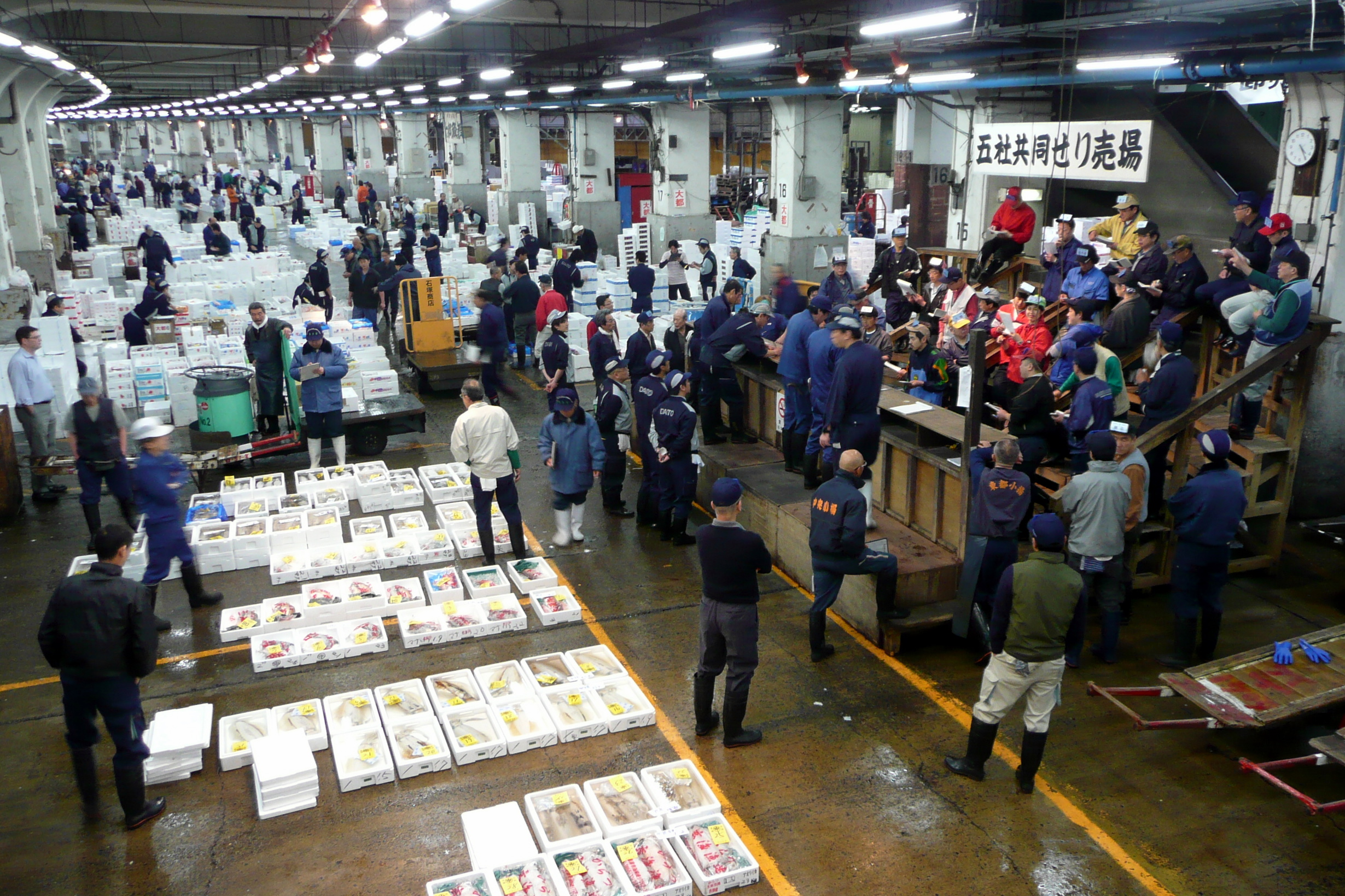
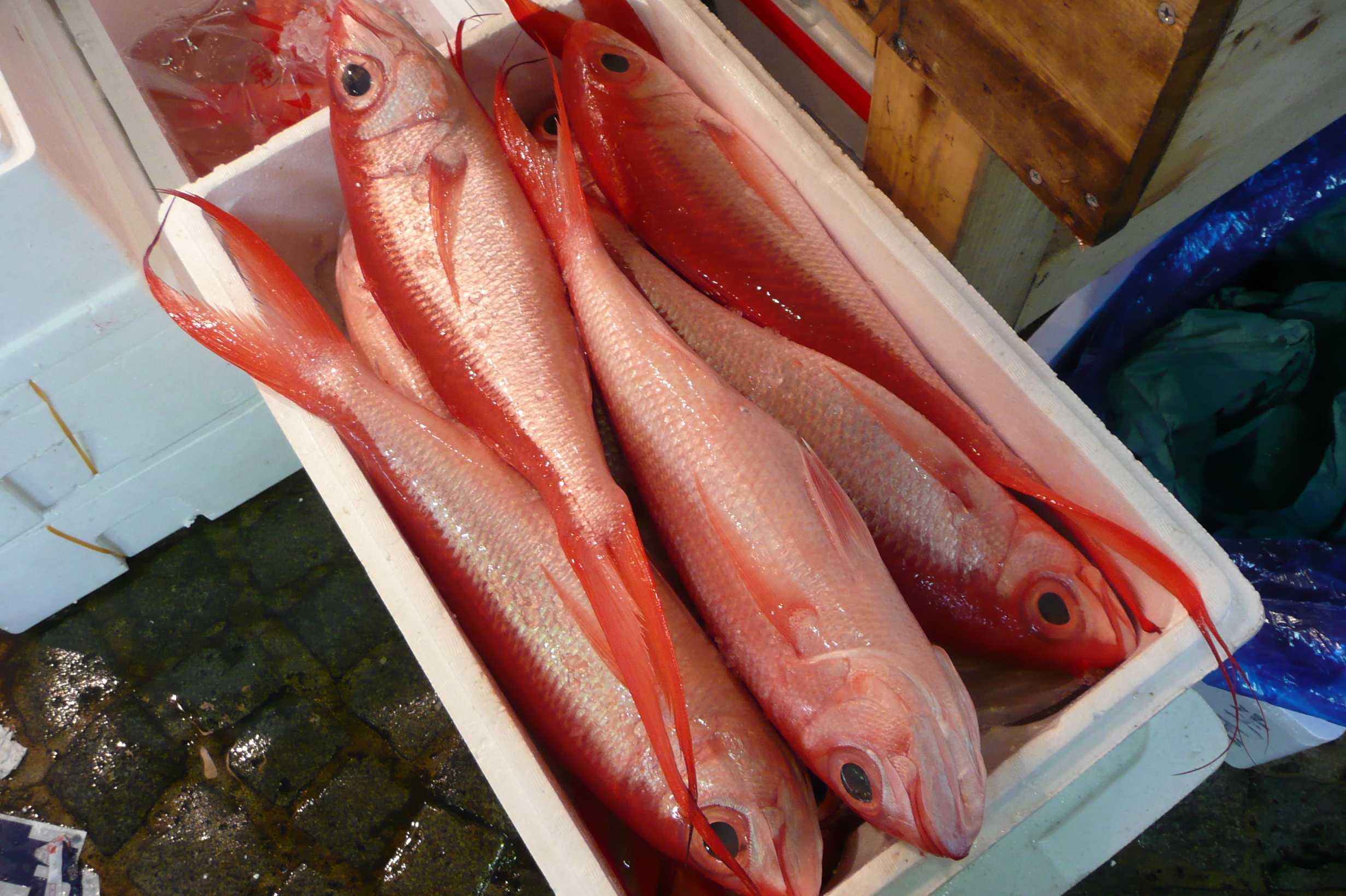
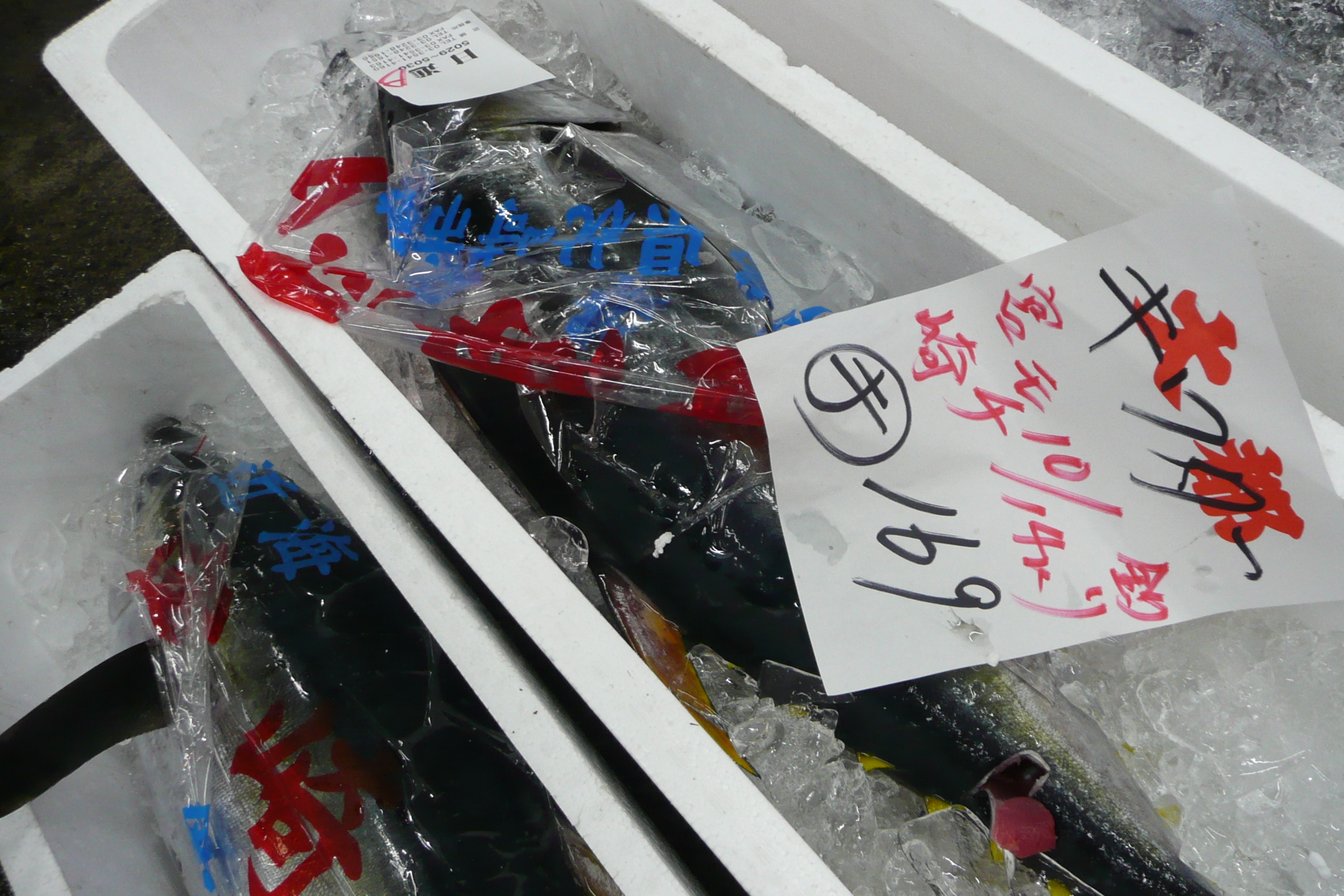
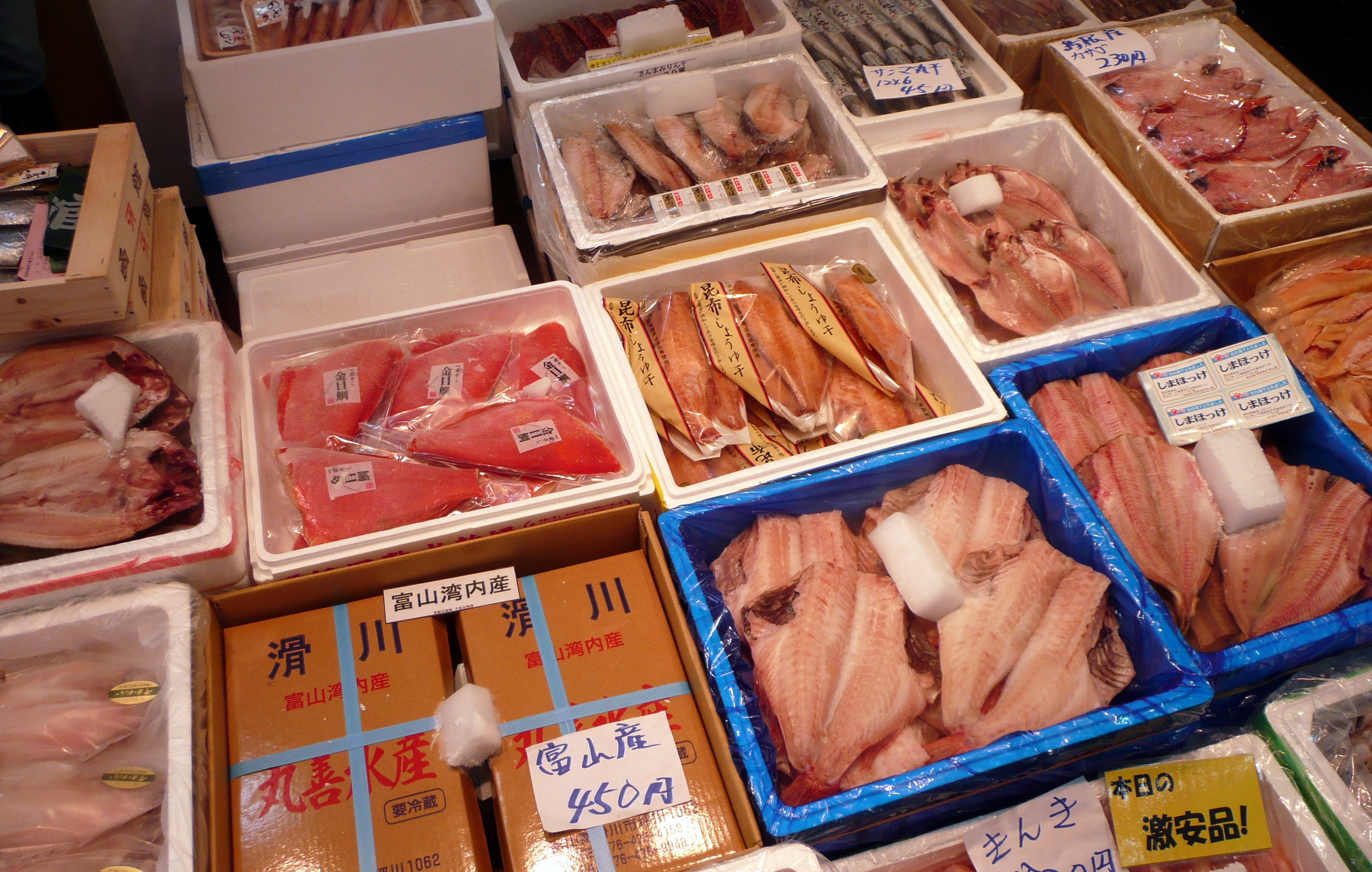
We started our tour in the fresh fish area, observing an auction and taking a look at the huge variety (more than 400 types!) of seafood for sale at Tsukiji.  The fish arrives between about 6pm and midnight and is arranged by the vendors for inspection.  By 3 am the middlemen start poking around, looking at the seafood and evaluating it.  These days a lot of the sales are pre-negotiated, so auctions play a smaller role.

P1150993

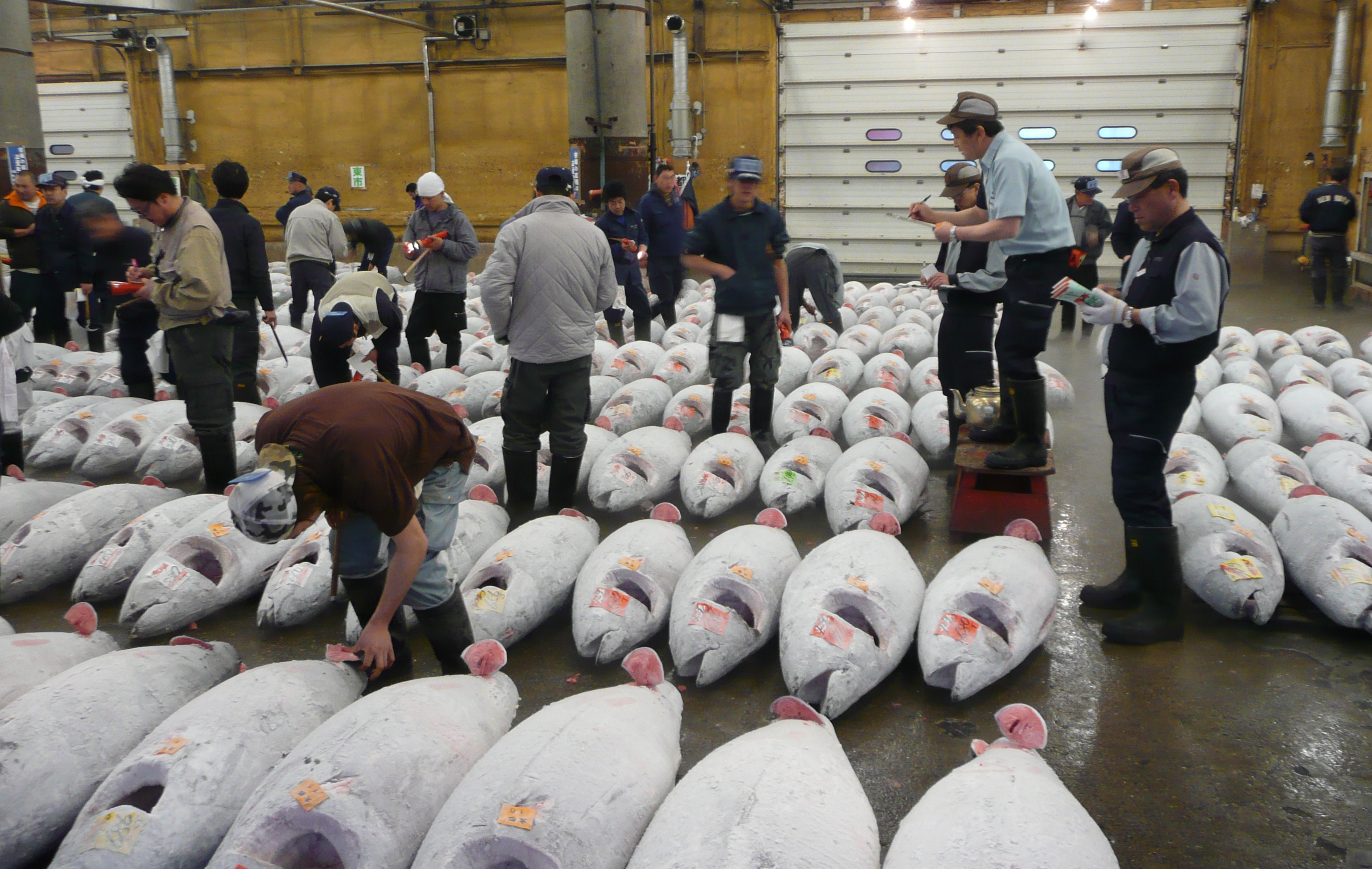
We then went to the fresh tuna warehouse, where these 70 kg (150 lbs) fish lay in neat rows, being inspected by middlemen, notches in the side allowing a clear view of the quality – and fattiness – of their flesh.

P1160017

This is the key area that visitors are no longer allowed.  So this picture was actually taken crouching down looking under a rolling door that was open about two feet high.  The things I’ll do to get my shot.

We attended the auctions for fresh fish, live fish and sea urchins, marching away through the busy market, dodging electric carts that would silently creep up on you.

It was obvious that the market workers don’t really enjoy having tourists in their way, so it took a lot of concentration to keep out of trouble.  I was amazed when, later in the morning, I saw tourists on their own, dragging children as young as about five around.  Dangerous and inconsiderate of the people working here.

P1160145

The frozen tuna auction is by far the most interesting, at least visually.  These frosted fish look surreal, lined up with frozen mist rising around them like smoke.  We had just a few minutes at the rolling door before it was closed on us, so we headed to the live fish auction.

P1160087

Nakamura-san was able to get us up close for the live fish auction, above.  This moves very fast as there are two auctions going on at the same time.  Nearby, we saw workers pulling live fish from tanks based on the auction results, bashing them on the head with a knife, slitting their tail so the blood would drain out, then ramming a steel rod through their mouth and down their spinal nerve, killing them.  Not quite so gruesome as it sounds, but definitely gives you an appreciation for the food you eat.

At the live tuna auction, the market’s captain caught up with us and gave Nakamura-san a lecture.  Afterwards, he said, “At least he’s calling me ‘Nakamura-san’ now instead of the nasty names he used to use.”

P1160195

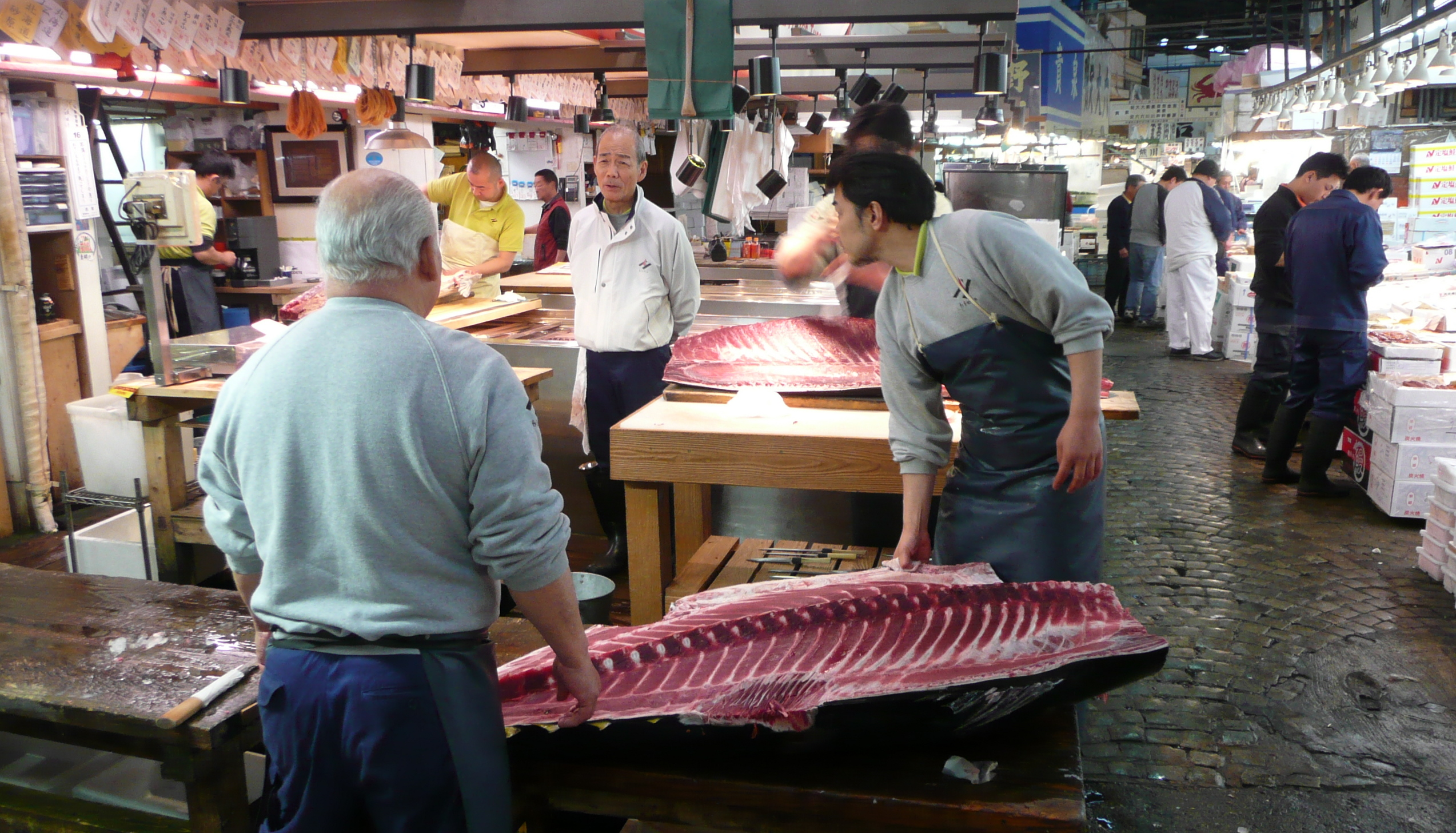
The auctions run from about 4:30-5:30, one after another.  Even before the last fish is sold, middlemen start carrying their purchases off to their stalls, where they prepare the fish for sale.  This is the last step in the transformation from whole fish to retail-ready cuts.

P1160045

Recognize this fish? It is whale meat.  The two rows on the right are from smaller whales but the back row is from whatever large-size whales Greenpeace tries to intervene in the hunt of.

Nakamura-san provided some perspective on why the Japanese are resistant to international pressure to end whaling.  After World War II, the whaling industry we re-established in Japan to help with severe food shortages.  For many baby boomers, whale meat was one of their main sources of protein during their childhood years.  To this day, it has strong resonance with the population even if its consumption has sharply declined.

According to statistics, almost 50% of the total animal protein consumption in 1947 in Japan was whale meat.  (Source: http://luna.pos.to/whale/jwa_trad.html)

P1160168

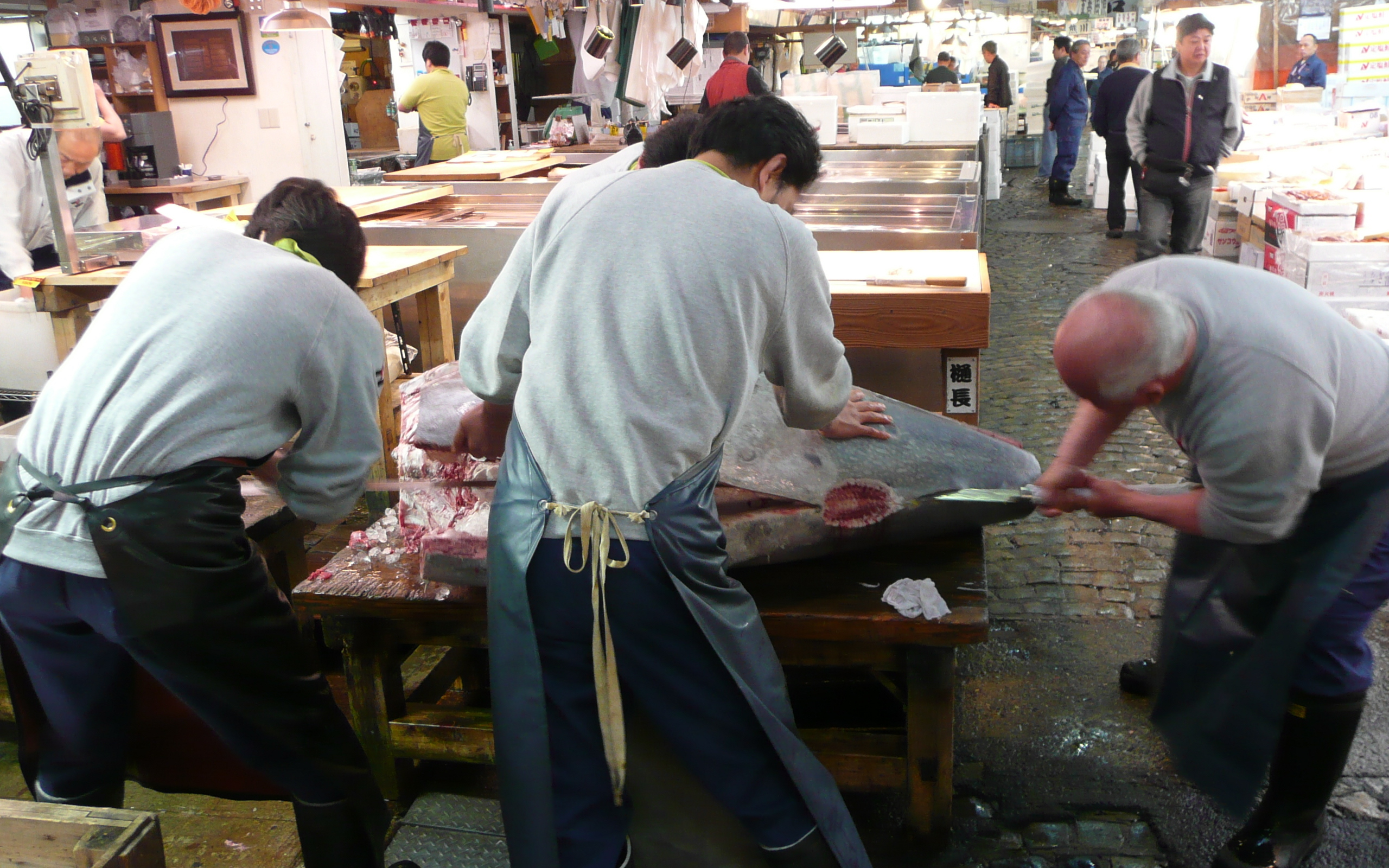
Watching the middlemen do their work was fascinating.  Knife skills are a beautiful art and this balding man in the picture below really was an artist.  Using a knife longer than a samurai’s sword, it took four men to carefully quarter a large fresh tuna.

The middlemen who bought frozen tuna had an easier time of it, using band saws to cut through the flesh.

P1160184

By 5:45 or so, many tourists had shown up, most guiding themselves and trying to edge in on our tour for free.  While they did get a peek at the tuna auction, I can’t imagine that they walked away with much of an understanding of the whole market.  For that reason, I’m glad we did the tour.

By shortly after 6:00, Nakamura-san had shown us all we needed to see.  He pointed out a few good sushi restaurants, took our money and thanked us.  Since we were already there and we knew the sushi would be fresh, Tawn and I queued up to eat the best sushi we’ve ever had.

P1160197

There are two restaurants in alley 6 of the “auxiliary market” (where the vendors that serve the needs of the market workers are located), both of which get quite a queue out their front doors.  These are are the two most highly recommended sushi bars.

Here’s what we ate.  Sorry that I can’t identify what everything was.

P1160199

Something very fatty (toro?) and squid

P1160202

Ebi (Shrimp) and Maguro (Blue Fin tuna)

P1160207

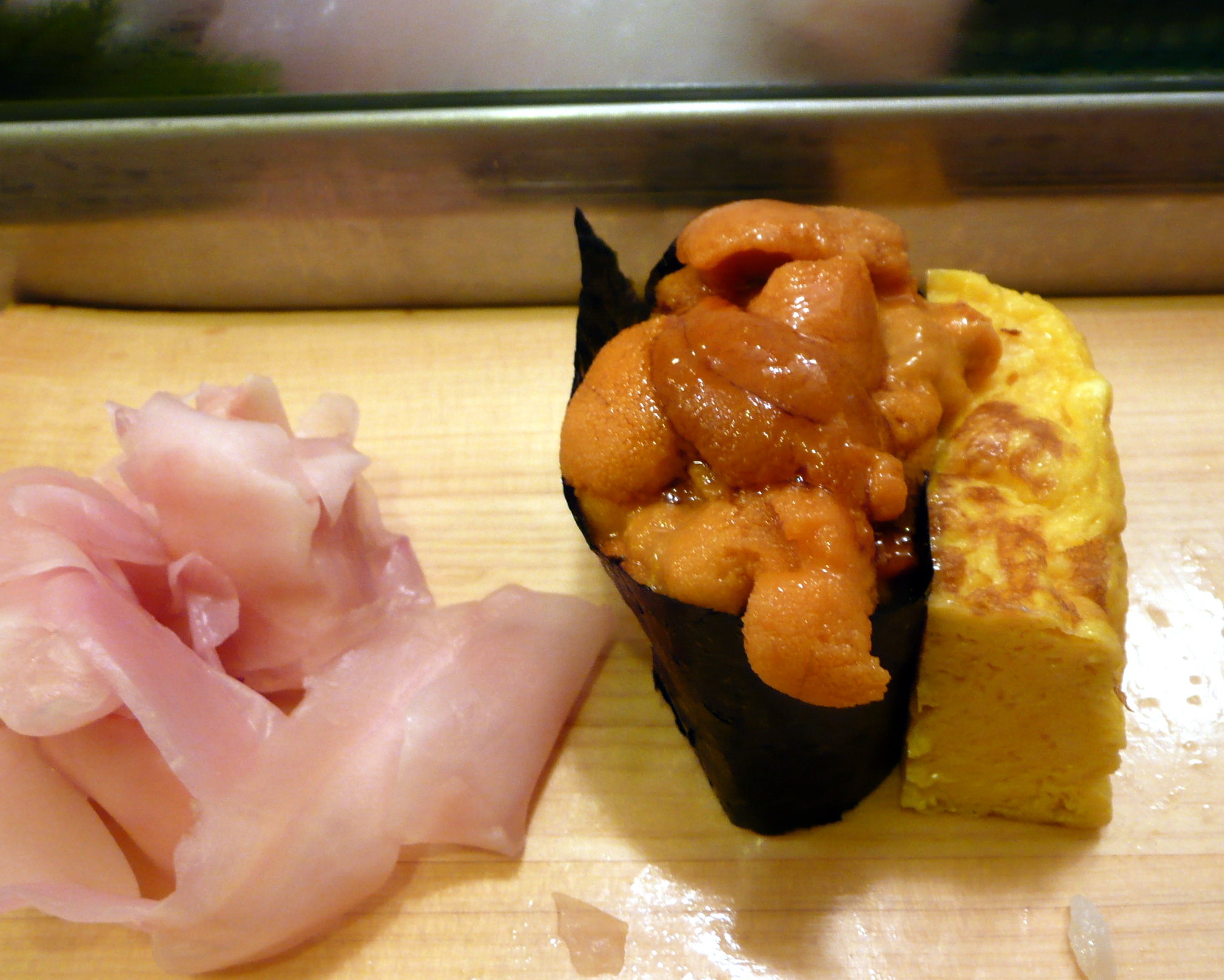
Uni – sea urchin with scrambled egg

P1160209

Tuna and Ikura (Salmon Roe) Nigiri (seaweed-wrapped sushi); and I think Grilled Saba (Mackerel) and Hamachi (Yellow Tail tuna).  But I’m not certain.

Total cost for the set including rice, soup and tea: 3500 yen, about US$35.  Pricey, but really good.  This is one of the few times I was willing to really splurge.

Again, I can’t say enough good things about the tour.  If you’re going to Tokyo and are interested in the tour of the market, you can find Nakamura-san’s website here.

Here’s a video of our trip to the market:

After “breakfast” we returned to the hotel for a few more hours of sleep, then packed our bags and headed to Narita Airport for the flight home.  And with that, eight days in Japan came to an end.

Shiodome and Naka-Meguro

After a night in Hakone Yumoto we headed back to Tokyo on a misty and overcast Tuesday morning for two final days in Japan.  Switching hotels from our comfy little place in Ueno, we went upper end and stayed at the swanky Park Hotel in Shiodome. 

This hotel, which I initially confused with the Park Hyatt Hotel of “Lost in Translation” fame, is still very nice and a very good value.  Located on the 25th-33rd floors of the Shiodome Media Tower (with the lobby on the 25th floor!) this new hotel is centrally located to four subway/rail lines.  Rooms are modern and well-equipped and the staff is exceptionally attentive.

Best of all, the view from the room (the same one as from the reception counter in the lobby), is stunning:

P1150921

The upside/downside of this hotel’s location is that Shiodome is kind of like Century City in Los Angeles: largely a complex of business towers, a glass and steel wasteland that is deserted at night.  It is at once well connected to the city and cut off from it. 

An example of the stunning modern architecture across from our hotel, along with the kitschy faux tori gate set up in front of it:

P1150801

Not far from this concrete netherland we did find signs of nature: the landscaped grounds of what is considered one of the world’s finest daily newspapers, the Asahi Shimbun.

P1150808

Along our way we found more of the ubiquitous vending machines.  Water, water all around and not a drop to drink… if you don’t have a 100-yen coin.

P1150806

One of our stops was the Tokyo Metropolitan Government complex in Shinjuku West.  The pair of buildings at the center of the complex house two free observation decks: one of each tower’s 45th floor.  The view is wonderful and Tokyo stretches as far as the eye can see.  They say that on exceptionally clear days, you can see Mt. Fuji.  Today, though, all we could see is this funny egg-shaped building.

P1150826

It took me a while to find out what building this is, but the internet is a wonderful tool.  Thanks to Emporis.com, an international commercial real estate database that is accessible to the public, I located the so-called “Mode Gakuen Cocoon Tower”.  This 50-story educational building houses three different vocational schools and was selected by Emporis as the 2008 Skyscraper of the Year.  More info here.

On the ground floor of the Tokyo Metropolitan Government towers is an excellent tourism office that provides all sorts of useful, free information about greater Tokyo.  One thing they offer (for which you are well-advised to sign up for in advance) is free tours in English.  Something I will do differently on my next trip to Tokyo: stop here on day one.

There is also an office providing information about the other prefectures of Japan.  Although much of the information is in Japanese, some English language materials are available.  There are some fantastic three-dimensional wall displays showing the highlights of various regions.  They looked like the hats from Beach Blanket Babylon.

P1150832 P1150833
P1150834 P1150835

For lunch, we tracked down Funabashiya, a famous tempura restaurant in East Shinjuku recommended by a friend, Masakazu.  Dinners run around $50 here but like most restaurants in Tokyo, lunch is a much better deal.

P1150848 
P1150842 P1150838

This restaurant is about only one thing, tempura, and they do it incredibly well.  They’ve been around for years and their lunch special – about $10 – was a set of two batches of tempura with rice, soup and pickles.  The second batch of tempura was a surprise.  After receiving a generous serving of light, crispy vegetables and shrimp fresh from the wok, we were already satisfied.  Then the waitress returned a few minutes later with a second serving!

P1150846

It is hard to describe how perfectly cooked this tempura was.  Very light batter and not a bit of grease.  There were three types of sea salt to sprinkle on the tempura, including a red salt with lots of minerals and a pepper-salt mixture.

After lunch we did a little more shopping in Shinjuku, including a stop at Tokyu Hands, an eight-story crafts/hardware/home improvement/DIY store in which you can definitely find at least one thing you never knew you needed.

On the way back to the rail station we passed something surprising: a large Krispy Kreme donuts outlet.  Fellow Xangan Tony took a picture of this on a recent trip to Tokyo but I was surprised to see it in person, and even more surprised by the number of people queued outside at 3:30 in the afternoon!

P1150855

Nearing rush hour, we hopped on a train, connected at Shibuya and traveled two stops further to a hidden gem that isn’t on the tourist guidebooks’ radar screen, yet: Naka-Meguro.

P1150859

Everyone wants to find that little hidden corner of a city, one they enjoy because it is hip and cool but not yet discovered.  Of course, by the time you find out about it, the secret is already out and Naka-Meguro is no exception.  Recently dubbed “the coolest corner of Tokyo” and profiled in the NY Times travel section, Naka-Meguro is a collection of cafes, boutiques and bookstores that runs along an idyllic, tree-lined river.

P1150869

Sure, gentrification is quickly happening and this area, which has never been inexpensive, is getting pricier by the week.  But it is still a cool and relatively quiet area and, given that it is just two stops from Shibuya – home of the intersection that sees two million people a day pass through it – it is amazing that it exists at all.  I’d definitely recommend you spend a few hours in the afternoon here, spilling into dinnertime if at all possible.

P1150873 P1150898 P1150907

Left to right: clothing and other fun items recalling Blackploitation and the 70s; Tawn in front of something a hair hipper than a Goodwill Store; a uber-modern Japanese sweets shop.

P1150878 P1150886

Left: Another clothing store with a vaguely “rust belt” look; a stock pot cools on the windowsill of a restaurant specializing in squid.

P1150892

Sadly, evening was falling fast, Tawn was feeling a bit exhausted from all our running around, and we had a 3:45 am appointment the next day, so we excused ourselves from Taro, Mark and HP’s company and headed back to Shiodome, stopping at a tiny hole-in-the-wall tonkatsu place at the JR Shimbashi station and unwittingly finding the best tonkatsu we had in Tokyo!

P1150917

This tiny place was full of salarymen – the typical Japanese office workers – and there was nothing in English except for the Asahi beer bottle label.  We pointed to one thing on the menu (after all, everything there was a form of tonkatsu so how wrong could we get?) and ordered two plates of it.

P1150914

What arrived was beautiful in its simplicity.  The chef cooked and drained cutlets of pork loin, each with a small strip of fat along one side and served with shredded cabbage, rice, pickled daikon radish, and miso soup with baby clams.  The setting was pretty plain and the plating was that of a blue plate special, but the tonkatsu was divine: moist and flavorful interior with a crisp, dry exterior.  Perfection.

We were in bed by 10:00, trying to catch a few winks before a very early morning on our final day in Tokyo.

Shibuya and Surroundings

In the interest of not falling too far behind in my posting, I’ll get pictures up with some comments and then can go back to fill in stories and details later.  Saturday we headed to Shibuya, the center of Tokyo youth fashion.  The main intersection at Shibuya – (the one that when you’re in Times Square in New York makes you think, this looks like the “Shibuya of the US!”) is the one featured in Sophia Copola’s “Lost in Translation”.  Some two million people a day pass through this intersection.

P1150333

We started our day with a quick bite at one of the commuter restaurants near the Ueno train station, a simple meal of katsudon (fried breaded pork cutlet topped with scrambled egg and served over rice) and soba (buckwheat noodles).

P1150338

As we waited for the train, Tawn took care to observe the various signs warning as to correct behavior on the trains.

P1150351

We arrived in Shibuya and spent a few minutes just taking in the sheer number of people.  Unlike Manhattan’s Times Square, which stretches over several blocks, Shibuya’s crowds converge at one single intersection.

P1150354

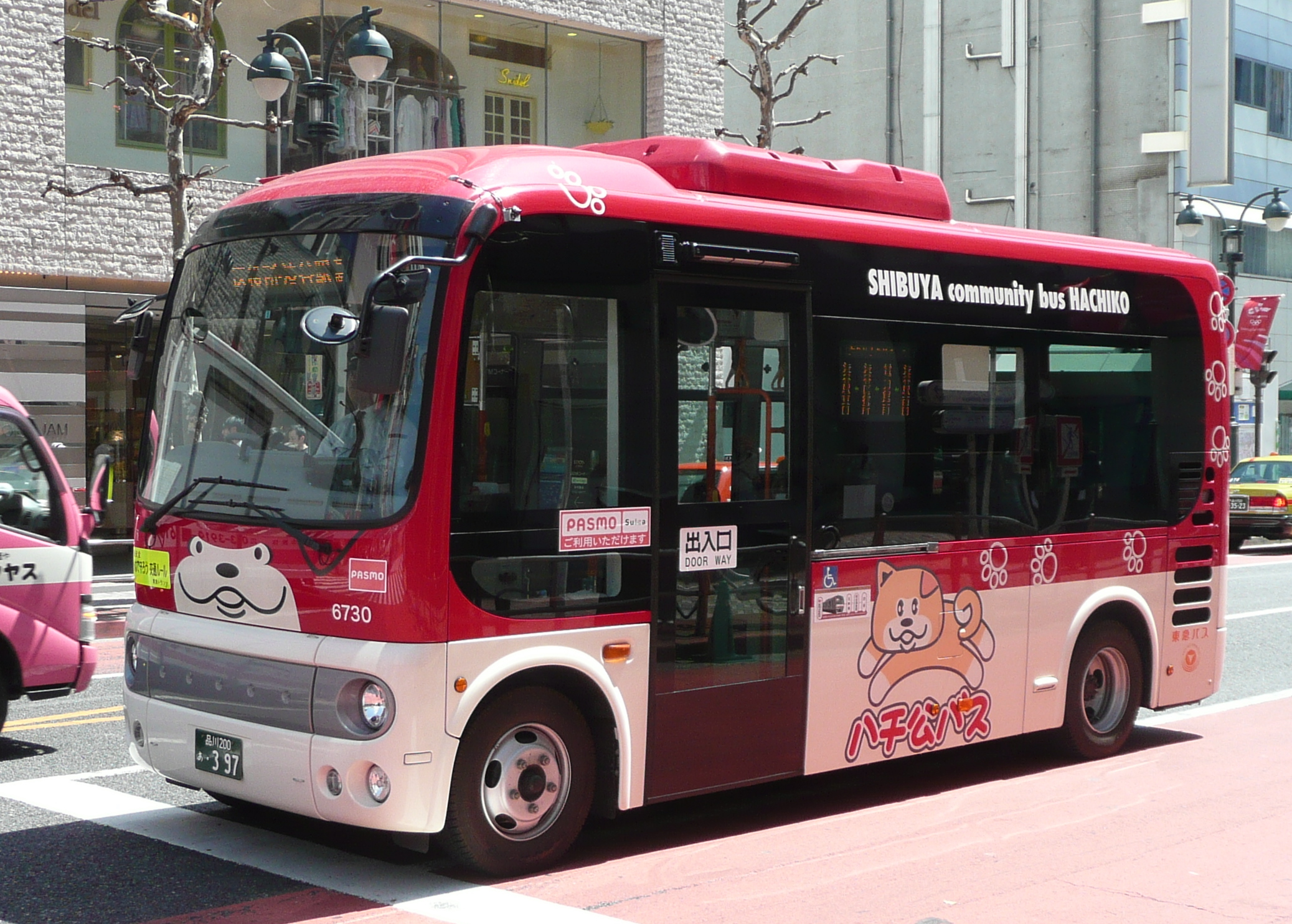
There is a free shuttle bus for the area.  But what really struck me about this bus was an observation that Tawn made: here in Japan there are cartoon characters used all over the place: signs, advertisement, logos, announcements… anything and everything can have a cartoon character and still be taken seriously.

P1150360

We met Taro and his friend Kathy near the station and then went to Taro’s favorite ramen restaurant.  This one specializes in noodles that are slightly thicker than the average.

P1150362

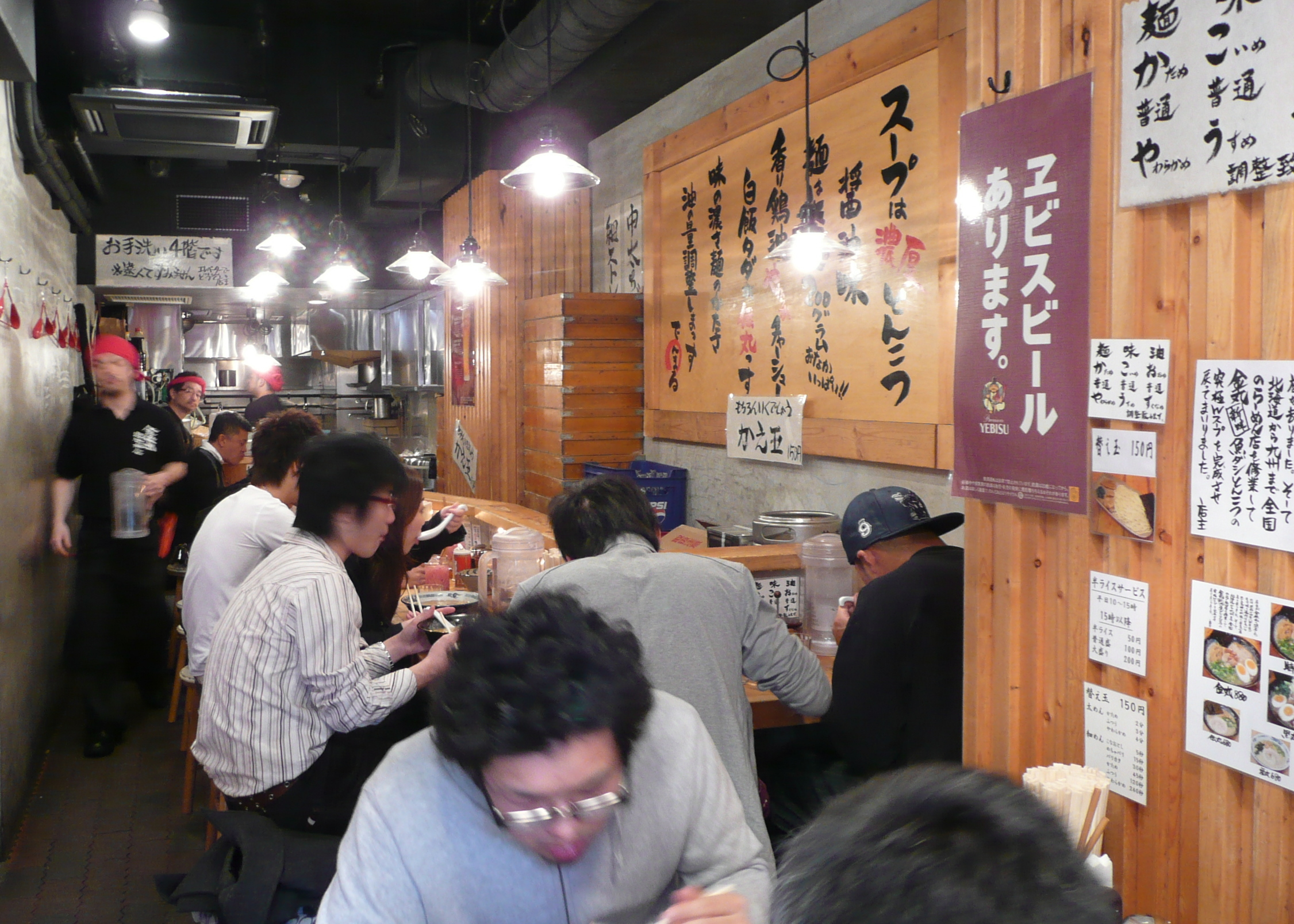
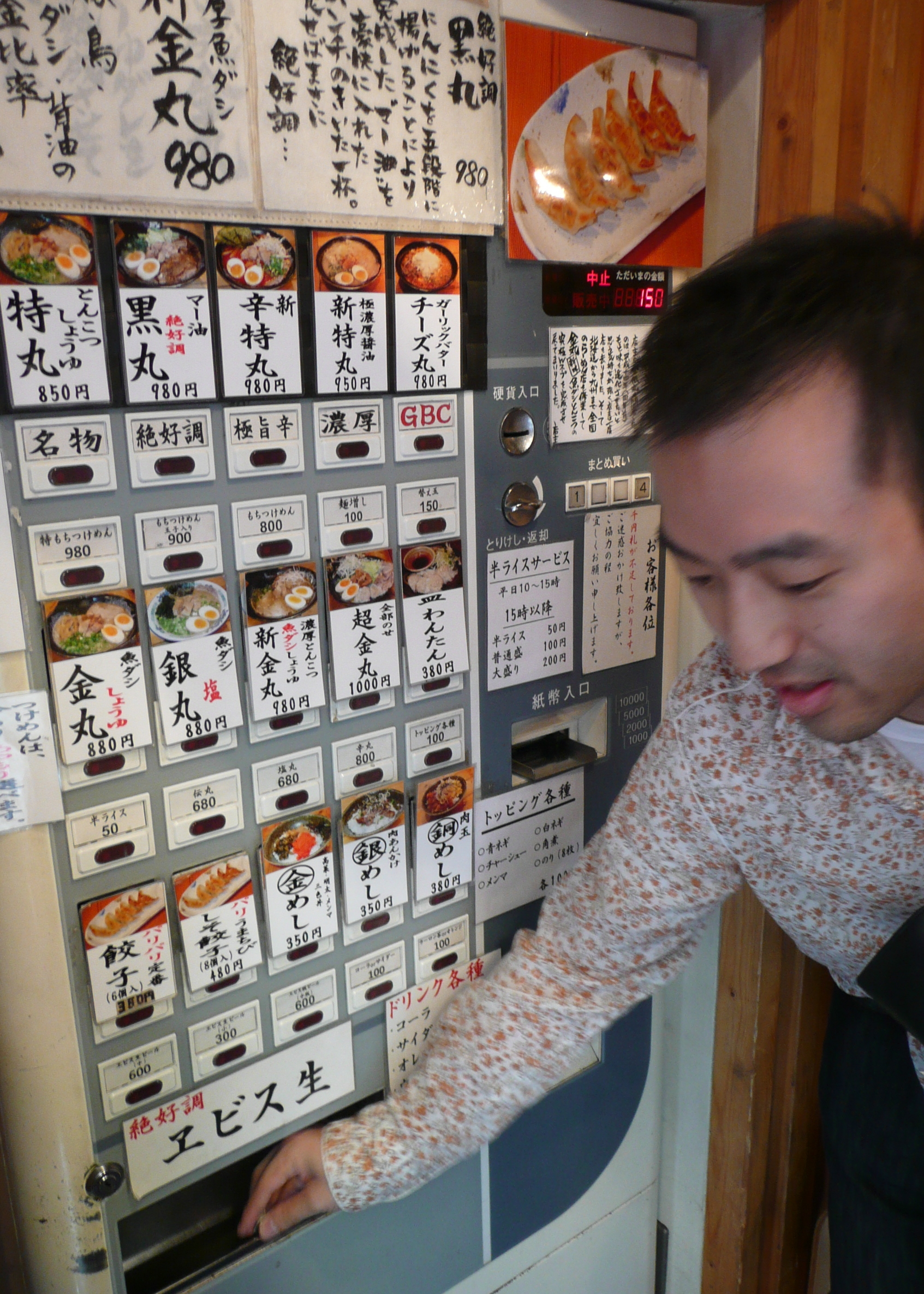
The restaurant only seats about twenty people, mostly along a counter.  Before you enter, you select what you want on a vending machine near the front door and pay there.  Your order is transmitted to the kitchen and you receive a small ticket in exchange.  Don’t read Japanese?  No problem – order by picture.

P1150364

Our table came with a wide range of condiments: Pickled ginger (pink), toasted sesame seed grinder, black pepper (in the can), toasted garlic, and fresh garlic.

P1150365

P1150366

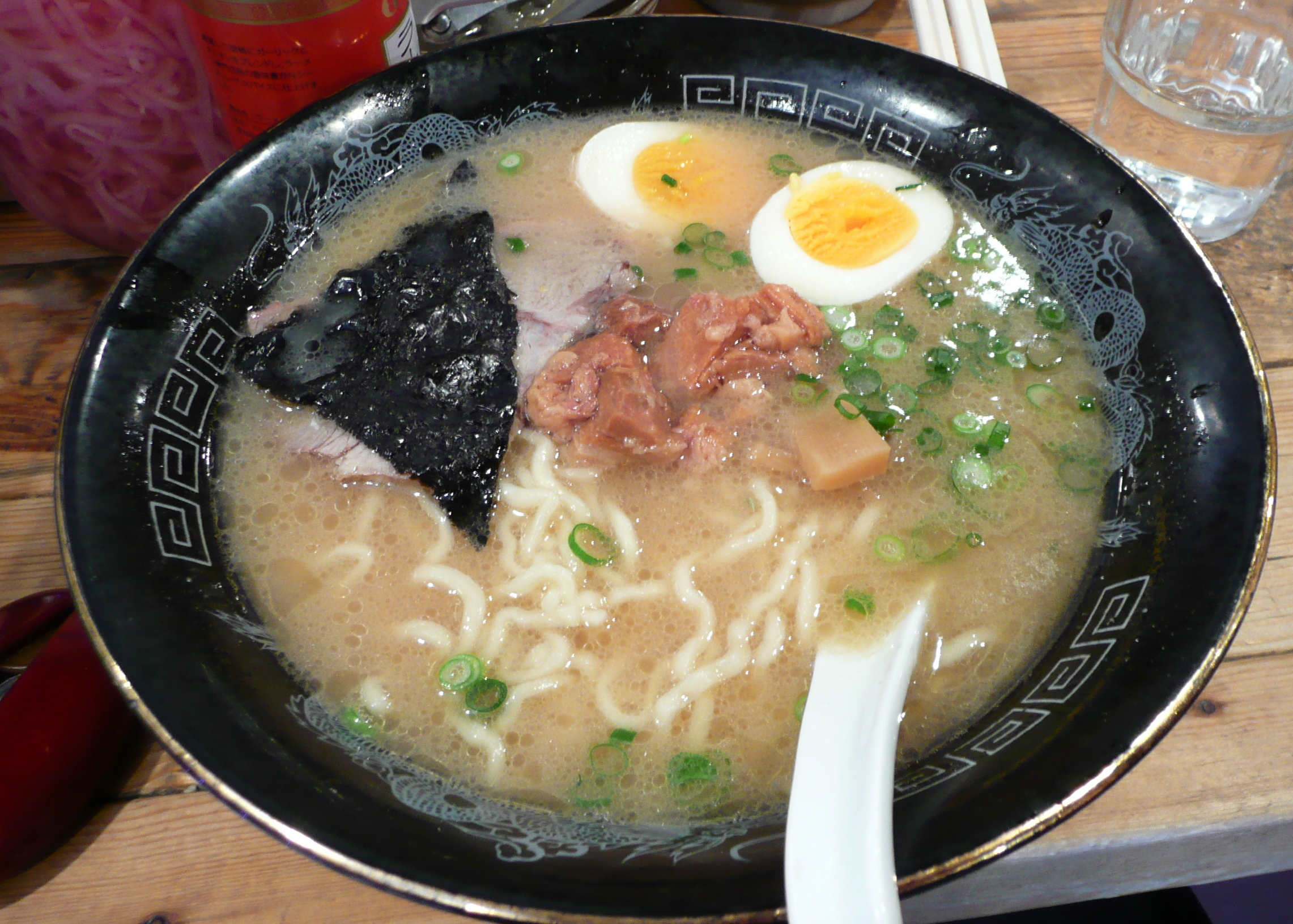
Our soups arrived – a traditional one for me and a spicy version for Tawn.  The difference that makes this ramen so good, Taro says, is the soup.  Instead of being just one or the other, the soup is a mixture of pork and fish broths.  Sure enough, it was the best ramen I’ve ever had.

P1150368

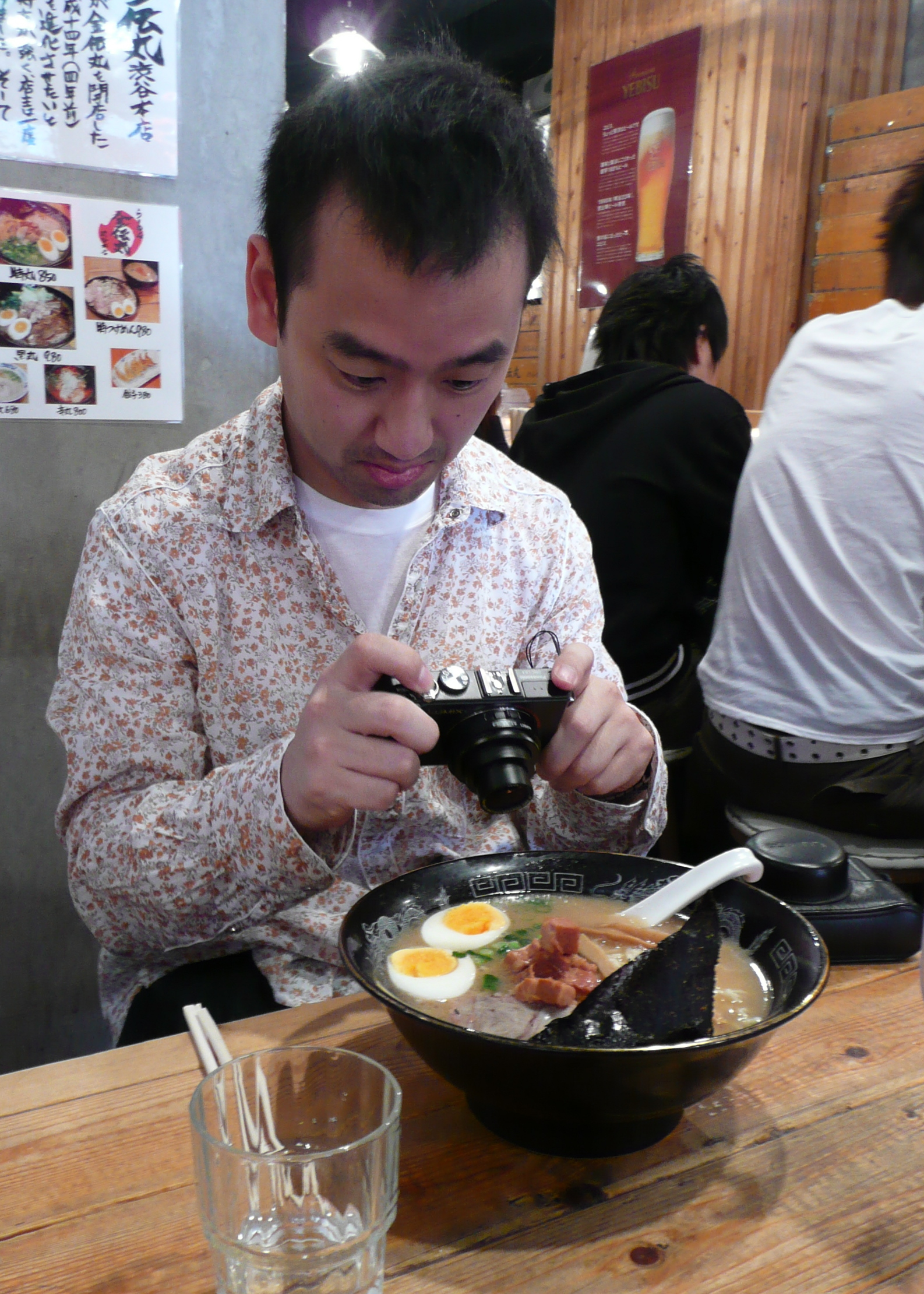
You’ll be glad to know I wasn’t the only one taking pictures.  Taro had a new Panasonic Lumix camera that had superb low-light performance and macro function.

P1150370

After lunch we did some sight-seeing / window-shopping in Shibuya.  There were these funny little fake cacti plants done up to look like desserts.

P1150454

We went to the park that runs along the northwest side of the Imperial Palace’s moat.  With two windy days since our arrival the cherry blossoms were largely descimated.  But to give you an idea of what it would have looked like, see this picture below.  You can still see the cherry blossoms – now imagine them with about 20 times as many blossoms, hanging down the bank towards the water.  That was what it was like a week earlier.

P1150415

This is one of the most popular paths both for cherry blossom viewing and general strolling.  There were plenty of young lovers enjoying the breezy spring weather.

P1150423

Where there are people there are invariably ice cream vendors.  Some locals were posing for my camera.

P1150426

Tawn tried the seasonal specialty: sakura flavor.  Notice the color-coordinated shirt!

P1150463

In addition to ice cream vendors, since the weather was a bit chillier today than the day before, there was a roasted sweet potato vendor, using a wood-fired oven in the back of a truck.  Very creative arrangement.  At 300 yen ($3) per potato, these sweet and hot morsels were perfect for warming us back up after the ice cream.

We walked from the moat towards the Yasukuni Shrine.  This beautiful shrine is the official home of State Shintoism.  It is also the shrine regularly in the news when a Japanese prime minister goes to pay his respects to the war dead, outraging residents of nations such as Korea and China that see this as Japan’s continued unwillingness to acknowledge and come to terms with the attrocities it committed during World War II.

The extensive museum there definitely tells the history of the so-called “Greater East Asian War” from the Japanese perspective.  It is useful to understand how they see things but also easy to see why neighbors who suffered at Japan’s hands take such offense.  I could go into a lot more detail here but won’t do so right now…

P1150449

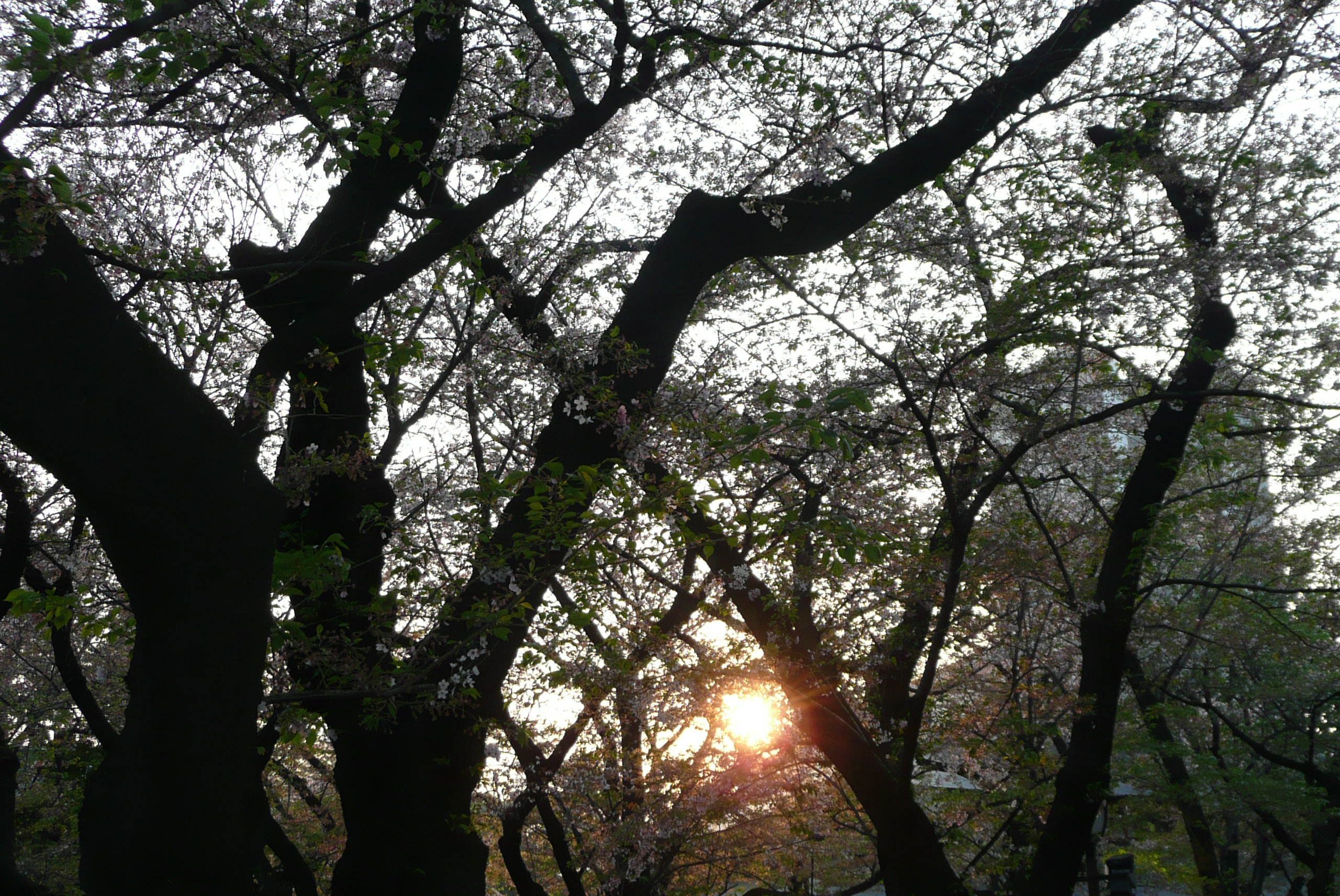
Above, the sun setting through the fading cherry blossoms at Yasukuni Shrine.

P1150428

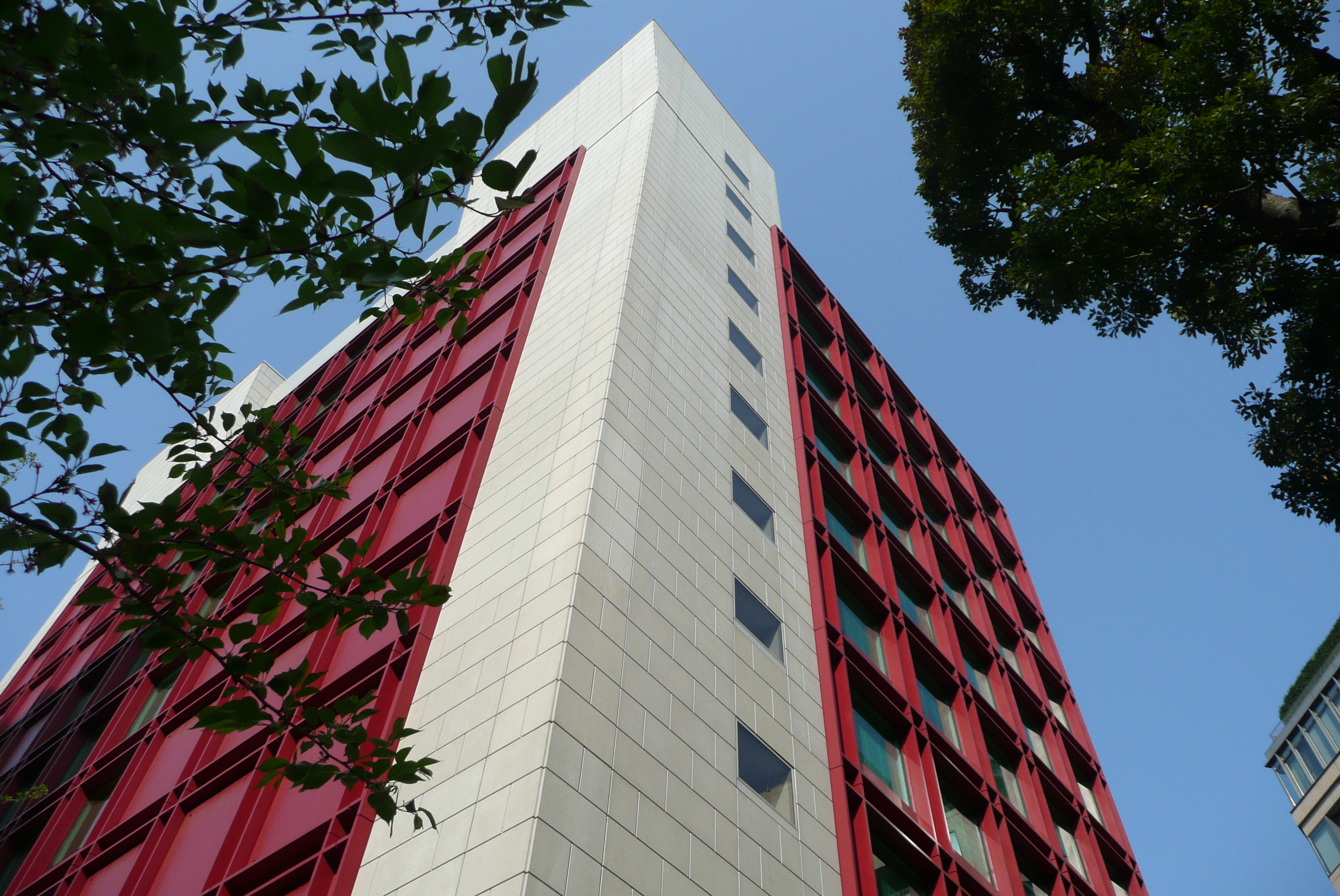
There was some fascinating architecture in this part of town, including the striking Italian Cultural Institute building.  This neighborhood (surrounding the shrine) reminded me a lot of downtown Seattle, actually.

That evening, we met up with HP and Mark (from San Francisco) and another couple with whom they were traveling.  Taro took us to an amazing (and amazingly hard-to-find) Okinawan style restaurant.  His camera’s low-light capabilities were put to good use and once I get all the pictures from him, I’ll do an entry just on that meal.

P1150472

Meantime, in the same neighborhood as the restaurant we came across a vending machine corner that had just about everything in a vending machine you could want: drinks, cigarettes, underwear, socks…

P1150477

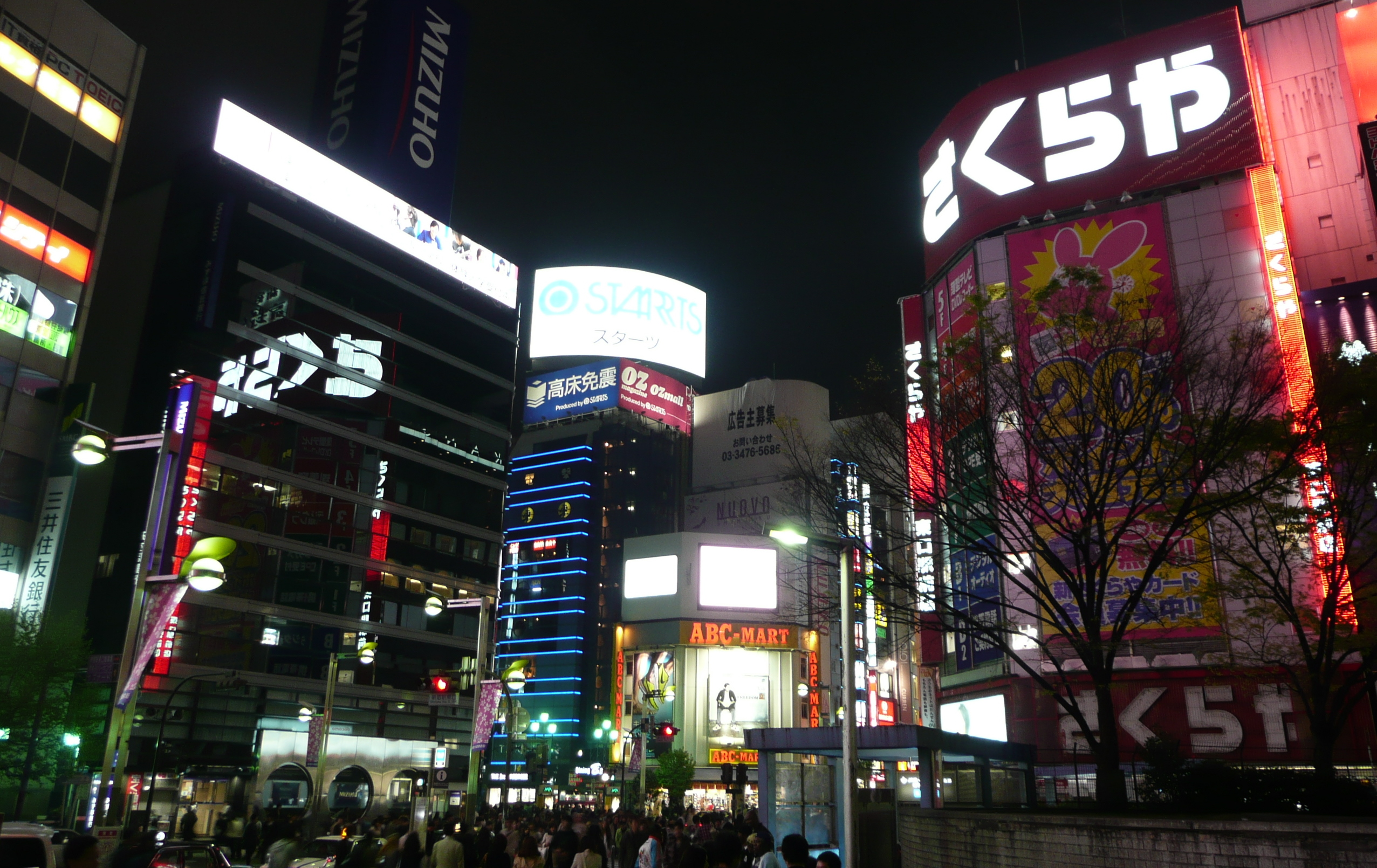
Finally, we headed to Shinjuku, Tokyo’s nightlife district, for some drinks.  This was just one corner of the city that looks like something out of Blade Runner.

Up next… Hakone.

Op-Ed Feature from The Nation: Without Equality, Tolerance is Just A Myth

Since you may not have a chance to read it yourself, I’m sharing an op-ed piece byPaisarn Likhitpreechakul written for The Nation, one of Thailand’s two English language daily newspapers.


CNX Gay Pride 2 Without equality, tolerance for gays is just a myth

By PAISARN LIKHITPREECHAKUL

SPECIAL TO THE NATION

Published on April 3, 2009


Thee’s a myth, especially among foreigners, that Thailand is “tolerant” towards gays and transgenders. After all, hardly a day goes by without one seeing ladyboys or katoeys (male-to-female transgenders). Most Thais also like to believe in such a feel-good story, as well as spin it to foreigners. To say anything to the contrary will cause a loss of face. However, that kind of simplistic rationale based on visibility is akin to reasoning that Thai women must have equal rights to men because every other Thai appears to be female. 


Even long-term foreign residents aren’t likely to have heard about, for example, a bisexual woman who was burned alive in 2006, and the rape, murder and burning of a lesbian last year. Both cases were reported only in the Thai dailies. Continue reading

Me and the Thai Bureaucrats

In the past two days I’ve spent about eight hours engaging the Thai Ministry of Labour and other bureaucrats in order to learn how to get a 90-day extension to my work permit. Previously, I’ve just gone to a law firm and paid them about 2000 baht (US$58) to do this work for me. Over time, I wondered whether I could learn to do the renewal myself and save money. After the past two days, I’m not sure the “savings” are worth it.

Some background first:

In order to live and work in Thailand, you need both a non-resident visa as well as a work permit. The visa is issued overseas from a Thai embassy or consulate and is good for one year. However, you are required to physically leave the country every 90 days. Ostensibly this is so Immigration can run a criminal check on you when you come back in, to make sure your record is clean. In reality, there’s no reason you need to leave the country to do this. It is just a ploy to inject more money into the tourism and travel sectors.

On top of the visa, you have to get a work permit. It is also applied for at the Ministry of Labour once a year but it can only be valid for as long as your visa is valid. Since I can only get a 90-day entry with my visa, my work permit is only valid for 90 days at a time. So after returning from a “visa run” I have to get my work permit extended to match my new 90-day stamp in my passport.

Confused yet?

My friend Stuart is in a similar situation as me and he’s been going to the Ministry of Labour and extending his work permit himself for some time. He agreed to go with me and walk me through the steps, so we set off yesterday afternoon. The MOL’s website doesn’t contain a list of requirements but a little searching online gave me a simple list: copies of my company’s articles of incorporation, copies of my passport and all the pages in my work permit book, and the completed application form.

We arrived at the MOL, picked up the application form, which is in Thai and English, and I filled it out. Some parts are confusing (in both languages). For example, I am asked to fill out the name and address of my employer on one line, then am asked to fill out the company name and address two lines below that. These would be the same information in most cases. Additionally, there was a second form that Stuart hadn’t seen before.

Arriving at the counter, the lady went through the paperwork, discarded a third of the sheets in the articles of incorporation (“no need”), then pointed to the form which Stuart had never seen. “This has to be in Thai.” Even though the instructions are in both Thai and English and there’s no indication of what language was required. This new form requested some financial data from my company, which I didn’t have memorized.

I returned home from the MOL and spent the evening reviewing the forms with Tawn, making sure they were both completed correctly in Thai.

This morning I switched partners and brought Kobfa along, figuring that a native Thai might be helpful. When I went up to the counter at the MOL (different lady this time), she asked whether I wanted a one-year or 90-day work permit extension. After reviewing the work permit book she determined that I was only eligible for the 90-day as it had to match my current visa expiration date. For a 90-day extension that extra application form with which Stuart was unfamiliar, wasn’t necessary. Would have been nice to know yesterday…

She then looked through the articles of incorporation and discarded several more sheets. “Not necessary, not necessary…” Then she came to two documents in the articles of incorporation. “Wait a minute,” she said, “these documents from the Department of Business Development were prepared 16 months ago. You can’t use documents that are more than six months old.” She explained we had to go to the DBD and get new copies.

Leaving the MOL, I decided we had best go to the law firm I used in the past and seek some clarification: they have been renewing my work permit every 90 days for the past 16 months, since I started my company. It that’s the case, then these 16-month old documents had been more than 6 months old for the last 10 months! How were they getting the work permit renewed? Or were they getting updated documents and not giving them to me afterwards?

The law firm was surprisingly helpful, considering that I wanted information that would enable me not to use their services in the future. The young man who is the work permit contact explained what the DBD was and gave us a number for them. He didn’t, however, really answer my questions about how they had managed to get me a work permit in the past.

Kobfa and I headed to the DBD, which thankfully had an office not too far away. This was something I would never have been able to navigate on my own and I’m in debt for his help. Everything was in Thai only. While I read and write Thai, government language is not my strength. The process for getting updated copies of the documents was surprisingly easy, though, complicated only by the fact that we arrived at 11:50 and the office closes for lunch at 12:00.

After retrieving the completed documents at the DBD after lunch we took a taxi back to the MOL. The lady with whom we had dealt in the morning asked if we had all the other documents we had given her (and she had taken) that morning. No, we replied, she still had them. She pointed to a row of baskets in the working area behind her, each basket given a different date of the month, and indicated that we should go back there and retrieve them. We were both a little confused: we were supposed to go back into the clerks’ working area and rummage through a bunch of applications? Yep. So I sorted through a stack of work permit extension applications (and personal data) until I found mine.

After another thirty minutes of bureaucratic back and forth – go to this window, no not complete yet, take it to that window, go to the cashier then come back, etc. – we finally walked out with my 90-day work permit extension. Which means that sometime in the next 90 days I’ll have to do this all again, except for the trip to the DBD, which shouldn’t need to be done until the end of September.

Whew! And who said living in paradise was easy?

The Sound of Music in a Very “The King and I” Sort of Way

Less than an hour after returning home from the 90+ km bike ride on Sunday, I had to turn around and head out with Tawn for an evening social event.  One of Tawn’s childhood friends is the director of Satit Bilingual School of Rangsit University, located north of the old Don Meaung Airport in Pathumthani Province.

As part of the school’s emphasis on an international, Thai-English education, this is the second year they’ve mounted a production of an English language musical.  This production, into which a great effort was put, was of “The Sound of Music”.  Running multiple days and featuring the university’s orchestra and a cast of primary and secondary school students, this special event was attended by Her Royal Highness Princess Soamsavoli Kitiyakara, the former wife of His Royal Highness the Crown Prince and mother of the first grandchild of Their Majesties the Kign and Queen.

First we stopped to pick up another of Tawn’s childhood friends, Mon, who looked stunning in her outfit. 

We got a little lost in finding the school but had left home plenty early, so arrived with an hour to spare before curtain.  There were police everywhere – I’d imagine 200 or more officers are used whenever a member of the Royal Family goes to some event – but fortunately as friends of the school’s director, the guard pointed us to what he called the “IP” parking.  I guess we didn’t make “Very” status, only “Important” status!

Pim and her daughter Tara greeted us.  Tara had a special responsibility along with another young girl: to give a present to the Princess.  Kind of like the role of a flower girl in a wedding, she was all dressed up (as a princess, no less!) and when the time came to curtsey then walk up to the Princess, Tara and her friend needed a lot of guidance from one of the Naval Protocol Officers.

There was a large reception in the administration building.  We were upstairs in a secondary reception area – the IP area, I guess.  Notice the red carpet in the picture below.  This was set up for the Princess and students were sitting the full length of it, neatly dressed, awaiting her arrival.

We entered the auditorium about twenty minutes before show time.  Oddly, the chairs were set some distance back from the stage and orchestra.  You’ll notice the raised platform and special chair set up for the Princess.  We’ve been many arts events where a member of the Royal Family has attended and I always think they must get a bit lonely because even if they attend with friends or family members, the highest ranking person is always set on a pedestal, away from all the other seats.

The show itself was interesting: they removed almost all of the dialogue between the musical numbers, so the entire show was done in less than ninety minutes, compared to the usual three hours.  If you weren’t familiar with the story, though, you could easily have become lost.  Who is this person delivering mail?  Why is Maria going back to the abbey?  Who is the Baronness?

How was the singing?  Well, Maria and Captain Von Trapp were not the strongest singers.  Some problems with the microphones and amplification made the situation even worse, rendering their high notes nearly inaudible.  The girl who played Liesl, though, had a lovely voice and her duet with the boy playing Rolf (“Sixteen Going on Seventeen”) was one of the high points of the show.

The biggest thing that tickled me was the accents.  I know, I shouldn’t laugh at this, but it was so cute as many of the students are Thai and some of them speak English with a strong Thai accent.  Especially the boy playing Captain Von Trapp.  When he spoke, I couldn’t help but think of Yul Brenner saying “etcetera, etcetera, etcetera” in The King and I.  Awful thing to say, huh?

After the show we stood as Her Royal Highness departed to the playing of her own anthem, and then took some more pictures before heading home.  Needless to say, I slept very well Sunday night after a bike ride, a drive all the way to Rangsit, and then an exciting musical performance.