Shopping for Coffee on Ratanakosin Island

After the last entry about the shooting in Cole Camp, I’ve been surprised by the number of people who were directed to my blog from a variety of sources including the Sedalia (Missouri) Democrat’s website, a local newspaper.  Along the way, I’ve received messages from several people who lived in and around the town and who knew (to one degree or another) the victims.  Many thanks to all who have visited and those who have left words of support.

Part of me feels like writing another entry, particularly one just about everyday life, is a bit trivial.  But life does go on and it is for the living, so I’ll pull another entry together and, with it, try to celebrate and honor the memories of all victims of violence.

Last weekend Tawn and I headed down to the “old city” – defined as Ratanakosin Island, the heart of the original city of Krungthep – to search out some coffee. 

Last October while we had a guest in town, I had about two hours to kill while the guest was conducting an audio walking tour of the old city.  Taking a break in a small family-run coffee shop called Mari Green Coffee, I got into a conversation with the proprietor and discovered someone who takes his coffee even more seriously than I do.

He chooses only Arabica beans grown in northern Thailand and is very picky, explaining to me in detail about the noticeable difference and quality and taste from one mountain ridge to the next.  He then roasts these beans himself in small batches about once a week.  Needless to say, the coffee there was great.

Months later, having finished up a supply of beans from the US – previously I was buying these wonderful fair trade organic beans from a co-op based in Chiapas, Mexico, organized and sold by Cafe Mam – I decided on a return visit to Mari Green Coffee and support the local coffee industry.  Plus, I’m starting to realize that I need to be more selective when deciding what to bring back from the US.  Five pounds of coffee takes up a lot of space in the suitcase.

For fun, we invited our friend Bob along, since he was also in the market for some more coffee beans.  Ironically, I didn’t get a single shot of the coffee shop itself.  Will have to do that next time.  While we were waiting for the owner to prepare the coffee order, we enjoyed some banh xiao – Vietnamese rice crepes – and explored the surrounding area.

P1170245

The coffee shop is a few doors down from an old fashioned ice factory, where they take big blocks of ice, chip them, then deliver them around the city.  Tawn was a little chilly standing by the delivery truck.

P1170239

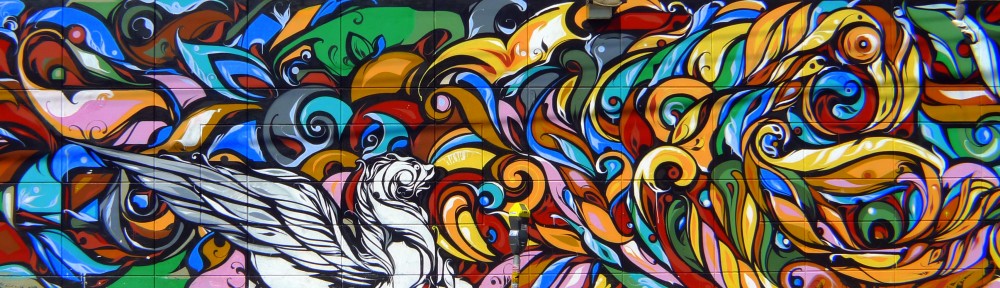
A block over we found an intense bit of graffiti, something we don’t see a lot of here in Krungthep and never so elaborate.

P1170238

Down the street across from the Tiger Temple was a tea shop (Mari Green Coffee’s competitor, I guess!) that had a huge white rabbit outside.  Tawn was born in the year of the rabbit, so a picture was inevitable.

We picked up our coffee, thanked the proprietor, and headed on with our day followed by the heady aroma of dark-roasted coffee beans.

My, How The Neighborhood Changes

Browsing the posts on 2bangkok.com, there was an interesting collection of old photos of Krungthep, many taken by servicemen who were hear during the Vietnam War era, as well as those taken by others.

248303899666f22a1bc8b  

One photo that caught my attention was this one, dated 1957.  It is taken at the intersection of Rama I and Phaya Thai Roads, looking east.  (Google Map here)  There used to be a traffic circle – gone now – and the green area on the left is where the Siam Discovery, Sian Center and Siam Paragon malls are. 

Between the time of this picture and today, the land that was Siam Paragon was home to the beautiful old Siam Intercontinental Hotel.  This landmark, with lush tropical gardens and a unique roof line, opened in 1968 and then was torn down in 2002 to make was for Siam Paragon.

After seeing this photo, I decided to go seek out the same vantage point and see how fifty years have changed the landscape.

P1170148

Now you see the Skytrain track, an elevated pedestrian walkway and, upper left, the office building that is part of the Siam Discovery complex.  MBK mall is off to the right of the picture.

Would be interesting to see more “now and then” photos.

While walking from BTS National Stadium Skytrain station to this photo site, I watched a pick-up football game (Thai pronunciaton: foot-BON) played on a concrete pitch.  Thought the colors were interesting.

P1170147

The Thais love their footbon!


Raising the Wall

At the mouth of our soi, right next to the Thong Lo BTS Skytrain station, is a nice large property.  This area of town is “old money” and decades ago was considered to be out in the countryside.  Many of the larger properties here started out as weekend homes for well-to-do families in business and politics, whose homes in the heart of the city could feel suffocating once they had enough money to buy a weekend home.

Over time the city grew and this area became indistinguishable from the rest of the urban sprawl.  Khlongs (canals) were filled in and paved, rows of trees were felled to widen the streets, and decades later an elevated train put the “countryside” just ten minutes from the heart of the city.

Yet some of these large estates still exist, large gardens and mature trees hiding them from the march of progress that knocks at their walls.  And, so, the answer is to raise the walls.  At least this was the case last week for the large property next to the Skytrain station.

P1170048-1

Walls that used to be about six feet tall, topped with another two feet of iron work, have been increased to ten feet of concrete block.  During the day and early evening, some vendors park their carts along this wall, selling coffee, food, vegetables and, in the evening, magazines and books.

P1170051
Above, looking over the wall, there is a large pond and several trees.  The house is set back about 150 feet / 45 meters.

Of course, I don’t mind that they want to increase the wall.  It is a busy street and their privacy is their right.  Hopefully, though, they will do something nice to finish it, so it doesn’t end up looking like a miniature Berlin Wall.

Sometimes in these tropical environments, it becomes hard to tell where man-made ends and nature begins.  While sitting in traffic one afternoon on Sukhumvit Soi 31, I noticed this interesting wall.

P1160933  

More precisely, this interesting wall-utility pole-tree combination.  Why don’t they just cut down the tree, you ask?  My first guess would be that the tree is holding the rest of it up.  But for a better guess, a good clue would be the faded ribbons and jasmine garlands on the tree. 

Thais have a healthy dose of animism running in their hearts and they generally believe that all natural things have spirits in them, particularly the land and trees.  Old trees like this often survive for a long time and have offerings at their trunks precisely because the locals believe that the spirits of the developed lands are now living in the tree.

That would be an interesting strategy for western environmentalists to employ!


Little Hanoi Bangkok

For a few years, there was a vegetarian restaurant on Sukhumvit Soi 20 called Tamarind Cafe.  It was owned by French-born Sylvie Bruzeau and Taiwanese-born Luka Wong, two women who met in Japan and decided to open a restaurant.  Tamarind Cafe was a chic little place with a small gallery on the second floor.  It had a wide variety of vegetarian food, done in a variety of culinary styles.

Little Hanoi Sadly, the lease on the space ran out and the owners did not renew.  However, they opened several ancillary food places at some department store food halls, including a Vietnamese place called Little Hanoi, located on the fifth floor of the Emporium shopping center.

Vietnamese food is one of my favorites, so when I discovered that Bruzeau and Wong had opened Little Hanoi, Tawn and I made it a point to visit.

The restaurant is small, as you can see.  And it wasn’t nearly as busy as the picture from their website shows!  Sadly, the Emporium remodeled their food court, leaving several of the businesses in sort of a blind spot at the back of the floor.  Not good for foot traffic, I’m afraid.

P1160906

We began with a vegetarian variation on what is traditionally beef skewers wrapped in betel leaves.  Instead of beef, Beuzeau, who is the chef, creates a mixture of herbs and potatoes.  It was tasty, although a little under-seasoned.  Gorgeous presentation.

P1160912

While Bruzeau emphasizes vegetarian options, there are plenty of meat items on the menu.  We enjoyed this spring rolls with shrimp, which were very fresh and plump.  Lots of beautiful herbs accompanied the meal.

P1160916

For a main course, we were feeling like fish, so we ordered this white fish, fried with spices and greens.  This was served with a plate of banh trang, the rice paper crepes used to wrap spring rolls, and rice noodles.  We wrapped our own little dumplings with a little fish, some greens, noodles and fresh herbs.  The fish was tasty, although the portion (which was meant for two people) seemed a little small for the price. 

For dessert, we tried their beignets, little puffs of dough friend up donut-style.  These were light and not at all oily, but they had the faint aftertaste of fish, making me think that the oil in the deep-fryer was perhaps a bit old.

P1160929

A return visit a few days later for lunch and I tried their pho, the hearty beef noodle soup, and a vegetarian banh mi, the French roll sandwich.  The soup was excellent, very flavorful, but something that I could probably find for half the price at the small shop run by the Vietnamese lady near Thong Lor Soi 12.  The banh mi was inventive, with roasted pumpkin.  The menu announced that it also had cheese, and I was expecting a nice goat cheese or something.  Instead it was a single slice of oily cheddar.  In addition to a slathering of much too much aioli, there was plenty of cilantro and carrots.

All in all, Little Hanoi gets high marks for creativity and beautiful presentation.  The food was good but not great, kind of b-grade food from the standpoint that it makes a good effort but just falls a bit short of excellence.  For the money, there is better value elsewhere, but if I’m in the mall and going to eat at a sit-down place as opposed to the inexpensive food court, Little Hanoi is still a decent option.


Three Dots

One of the blog rings I subscribe to is “I Bring My Camera Everywhere” – and I really do, because life in the Big Mango seems to afford so many picture-perfect opportunities.  Here are a few of the recent examples.

A reader once criticized me of trying to impose my Western standards on Thai culture, when I expressed amazement that a worker who was using a backhoe to tear up a street curb, let his toddler child play on the adjacent sidewalk with no apparent concern to the child’s welfare – especially his hearing!

Along the same subject line, I was bemused to watch a painter touch up the corner of a building adjacent to Thong Lor BTS Skytrain station, standing on a folder chair that was perched precariously on a  scaffolding, atop a concrete overhang above the sidewalk.

P1160832  

There just seems to be safer ways to get to that “hard-to-reach” corner that needs a dollop of pain.

. . .

Thais have a wonderful sense of humor and are surprisingly tolerant of “adult entertainment” venues, despite an otherwise conservative Buddhist moral code.  I was tickled when I was stuck in traffic a recent rainy morning and looked across the street to see this “massage” parlor – pictures of the massage providers displayed in the glass case outside the front door.

P1160838

The name of the venue?  If you transliterate it, it would be spelled “p-i-m-p”.  Any questions about the type of adult entertainment you might be able to find there?

. . .

They say the world economy is going to hell in a handbasket and Thailand’s along with it.  The words is that Starbucks has had to close hundreds of locations across the globe due to declining demand for premium coffee beverages.

I’m happy to report that after lunch on a recent afternoon, the Starbucks in the lobby of All Seasons’ Place on Witthayu Road was jam-packed.

P1160496

It was one of the busiest Starbucks I’ve seen in a long while and while there were several farang, you’ll be glad to hear that the majority of customers were Thai, who are quickly chasing after the Americans’ girth.

. . .

Speaking of Starbucks, Tawn and I stopped for a coffee at the Ploenchit Center location after lunch the other day.  He ordered a drip coffee and the manager insisted that he try one of their new blends.  So she brewed a fresh pot and gave him a sample in this cute little cup.

P1160829

You all know that Tawn just loves cute little things like this.  (It is a surprise we didn’t return from Japan with more cute little things in our bags!)  I’m just amazed that he didn’t put up a fight when the Starbucks manager took the cup back from him.

Happy middle of the week!


Wan Visakha Bucha

Last Friday was Visakha Bucha day in Thailand and many other parts of the Buddhist world*.  This is the holiest day in Buddhism, commemorating the day when Gautama Buddha was born, attained enlightenment, and passed away.  On this day, believers gather at temples to worship and recall the wisdom, purity and compassion of the Buddha.

In Thailand, Visakha Bucha observance began during the Sukhothai period (around 700 years ago), because of the close religious relations between Thailand and Sri Lanka. Sri Lankan monks came to propagate Buddhism in Thailand and were highly respected.  Thai monks also went to study in Sri Lanka.  It’s believed that those monks introduced this ceremony to Thailand around that time

P1160631

While many people arrive at the temple early in the day to make merit by feeding the monks, many more go in the evening to participate in a ceremony known in Thai as wian tian.  (wian = circle, tian = candle)

The core of this ceremony involves a procession three times around the bot, or main sanctuary, of the temple.  Depending upon the temple, sometimes you will proceed around a Buddha image or a chedi (a stupa containing relics) instead.  Regardless, believers carry the traditional offerings: a candle, three sticks of incense, and a lotus blossom. 

The candle represents enlightenment, with knowledge being the source of light in a dark world.  The three incense sticks represent the Buddha, the Dhama (his teachings) and the Sangha (the monks).  As for the lotus, the roots of a lotus are in the mud, the stem grows up through the water, and the flower lies above the water, basking in the sunlight.  It is a common symbol in Buddhism because its pattern of growth reflects the progress of the soul from muddy materialism through the waters of experience to the sunlight of enlightenment.

P1160667  

On this day, and especially during this procession around the bot, believers are encouraged to meditate, reflecting on the teachings of the Buddha and how they can better follow the Five Precepts:

  1. To refrain from taking life (non-violence towards sentient beings)
  2. To refrain from taking that which is not given (not committing theft)
  3. To refrain from sensual (including sexual) misconduct
  4. To refrain from lying (speaking truth always)
  5. To refrain from intoxicants which lead to loss of mindfulness (specifically, drugs and alcohol)

We went to Wat Phra Ram IX (King Rama IX Temple), a more modern temple founded by the current King of Thailand.  This beautiful temple follows traditional design but features a resplendent all-white exterior, stark compared to the elaborate decorations more common in Thai Buddhist temples.

There were several thousand people present including about two hundred monks and novices.  While some people were already making their procession around the bot, most were listening to the abbot’s sermon, a lighthearted parable about the importance of remaining true to Buddhist teachings even in the midst of contemporary life.

P1160678-1

After the sermon was over, the monks led the crowd on the procession, a nearly endless stream of believers, some chanting, some walking silently, some chatting pleasantly amongst each other as Thais enjoy doing even at religious events.

I shot some footage after we had made our rounds and have compiled it here for your enjoyment:

Observing various religious ceremonies is interesting because there are some aspects that are very universal (or, at least, common across many faiths and traditions) while other aspects are very characteristic of local culture.  I’m not a religious scholar so I won’t expound on those observations.  Suffice it to say that it was a beautiful ceremony to participate in.  

*because of calendar differences, some countries observe Visakha Bucha on different days, but most of the time it falls in April or May.


Bangkok … Bananas!

Many cities in Asia try to trumpet their lively arts scene, positioning themselves as cities of culture on the pages of tour guidebooks and travel magazines.  The Big Mango is no exception.  Last week the Ministry of Culture launched the first “Bangkok … Bananas!!” contemporary arts festival.

P1160551
Above, a crowd gathers to watch a stage performance while a sculpture titled “Alien” watches them.

It was a combination of everything from live performance to sculpture installations to cinema screenings.  Interestingly, it was geared heavily towards Thais – i.e. no Thai subtitles on films or at live events. 

It is great that Thais are getting more exposure to their own contemporary arts scene, something that is sorely lacking here.  But I think that, given the drop off of tourists (arrivals down some 30% year-over-year) caused by both the global economy and the ongoing political unrest here, Bangkok … Bananas!! is the type of event that could draw tourists.  The only thing is, you have to tell them about it and you have to make sure it is accessible.

P1160552
Nearly a full moon over Siam Paragon mall, site of many of the Bangkok … Bananas!! events.

In true Bangkok fashion, the setting for most of these art events was the shopping district – where Rama I and Ratchaprasong roads meet.  In fact, most of the staged events took place in the two public plazas located between three of the largest malls: Siam Discovery, Siam Center and Siam Paragon.

P1160571

The best event, in my opinion, was the series of nightly film screenings.  These were done outdoors with a screen set up between two malls.  This is reminiscent of the history of Thai motion picture exhibition, which used to be done from the back of a truck that would travel from town to town, setting up the screen and showing the movies, the sound coming from a speaker on the top of the truck.

In fact, there was a restored movie truck, repainted with the name and claims of an old pharmaceutical company, as these were the usual sponsors of these village screenings.  Harking back to the old days, they had a classic Thai silent film one night, with veteran voiceover actors providing the dialogue live from a table at the rear of the plaza.

All of this was great fun, but largely unintelligble to me.  All the more sad because several of the films they showed were true classics of Thai cinema, films that are rarely seen and are not available on DVD. 

P1160572

Of special interest to me were the projectors.  My first job was in a cinema and I spent 13 years working for the AMC Theatres chain.  So I was thrilled to see two classic 35mm projectors and watch the projectionists do changeovers at the end of the reels.


The Hottest Day is Doused

The Thai Meteorological Department announced that Monday April 27th would be the hottest day of the year, as it was the apex of the sun’s seasonal arc across Thailand.  As we inched towards that day the weather became hotter and hotter, leaving few doubts that their prediction would hold true.

But then in the midst of the high temperatures a few days before, the forecast began to crack: a high pressure system was descending from China and instead of the hottest day, the 27th would instead be a preview of the coming rainy season, which the department announced would officially begin May 15th.

P1160440

Sure enough, by lunchtime Monday the thunder and lightning was upon us and rain fell for nearly two hours in a steady downpour.  By the time I tried to return home I found our soi flooded.  This often happens when it rains as the city lies low and its water system struggles to handle a deluge, but it usually clears out quickly.

The water reached levels I have not seen in our two years here on the soi.  I couldn’t find a motorbike that would attempt to traverse the waters so I walked home, eventually up to my shins on the flooded sidewalks.

Here’s a video compilation of the storm set to a wonderful song, “Come In Out of the Rain” performed by Chicago jazz vocalist Audrey Morris.


Upscale Issan

Kum Poon Friday evening I tagged along with Tawn as he met some of his university classmates for dinner.  This group all studied abroad and are very “worldly” in terms of being willing to try new things and broaden their tastes in music, food, art, and the like.

That said, we returned to our Thai roots for dinner, choosing a restaurant at Central World Plaza called Kum Poon, which features upscale Issan cuisine.

Issan is the northeastern region of Thailand, adjacent to Laos and Cambodia.  Poorer than the rest of the country, Issan is viewed by other Thais much in the same way that the southern United States is viewed by other Americans. 

While people from Issan are sometimes stereotyped as being lazy or backwards, the truth is that many aspects of Thai culture, including food and music, trace their roots to this region.  Not all, of course, but many.

P1160329  
The restaurant is very pleasant with subdued lighting, two large artificial trees, and bamboo poles lining the walls.  The effect of the spot lights filtering through the leaves is one of eating outdoors in the moonlight.  Service is reasonably attentive and very friendly.

Issan cooking is often classified into a few main categories:

The first category has two types of salad, tam and yumTam means “to pound” and the salad is made by putting the ingredients in a large mortar and pounding them with a wooden pestle.  Most common is the som tam, a salad of shredded green papaya that is pounded with other ingredients  Yum means “to mix”, so the ingredients are just mixed in a large bowl.  Certain seasonings regularly appear in these salads: lime juice, fish sauce, tiny dried shrimps, palm sugar, chilies, and sometimes tamarind paste.

The second category is laab (sometimes written “larb”), a dish made of cooked ground meat (often pork) that has shallots, ground toasted rice, lime juice and fish sauce.

The third category is yang – grilled meats.  These are often served with sticky rice, khao nieaw, a highly glutinous form of rice that can seem a little undercooked to someone who has never tried it before.

Okay, now that you’ve had your introduction to Issan food, let’s take a look at the many dishes we enjoyed.  My new “gorilla” tripod came in handy.

P1160310
For starters, Issan food comes with plenty of fresh greens as condiments.  You eat these both for the textural contrast with the dishes, as well as for the cooling aspect against the sometimes fierce chilies.  Cabbage, green beans and basil are standards along with some other greens you may not have ever tried.

P1160313
Laab Gai Yang – Mixed two categories of Issan cuisine, this laab dish is made with gai yang – grilled chicken – resulting in two great tastes in a single dish.  Notice the little specs: this is the ground, toasted rice.  Adding a nutty flavor and a little crunch, uncooked rice is toasted in a pan and then ground before being added to the dish.

P1160315
Gai Yang Khao Nieaw Tod – Grilled chicken served with deep-fried sticky rice balls.  I’m not certain that deep-fried sticky rice is traditional or not – I think it may be a bit of an improvisation on the chef’s part – but these are so tasty.  The chicken is moist and smoky.

P1160316
Som Tam Kai Kem – A typical tam (pounded salad) made with shredded green papaya (tastes tart like a Granny Smith apple but not so sweet), tomatoes, and salty boiled eggs.  The eggs are interesting because they are soaked in a brine for about a month before being boiled.  Some dried shrimp are added for texture.

P1160317
Laab Plaa Duke – This laab style dish, usually made with ground pork, is instead made from grilled, shredded catfish.  It has lots of shallots and mint in it and, as you can see from the chilies, has a bit of heat, too.

P1160318
Laab Hed – For you almost vegetarians, this laab is made with a variety of mushroom types and lots of shallots.  The only thing keeping it from being vegetarian is the fish sauce, which adds the saltiness to almost every dish.

P1160319 
Tam Mamuang – Instead of being made with green papaya, this version of tam is made with green mango, which has a slightly more astringent flavor and a crisper crunch.  Fresh shrimp are added along with the dried shrimp for more of a “sea” flavor.

P1160320
Yum Woon Sen with Sai Grawk IssanYum style salad with cellophane noodles, mushrooms and sai grawk issan – Issan style pork sausage.

P1160321
Kor Moo Yang – Grilled pork neck, thinly sliced and served with a spicy dipping sauce.  This can be a tough cut but when cooked properly, the connective tissue melts away, making the meat even more flavorful.

P1160322 
Tam Sua – This tam is mixed with a type of mildly fermented rice noodles called kanom jiin.  When eaten cold by themselves, you can taste a slight tanginess to the noodles.

As you can see, we ate quite a bit of food for just five of us.  Even at a “upscale” restaurant like this one, the prices were still very reasonable.  We walked out having only spent about US$10 per person.

P1160334  
Left to right: Ko, Fluck, Pat and Tawn in front of the restaurant.

For dessert, we stopped by iBerry for some ice cream and brownies.  Hardly authentically Thai but tasty nonetheless!

P1160338

Have I whetted your appetite yet?

Riding Around

Most Sunday mornings I go out for a ride.  There are exceptions – especially during rainy season – but I really enjoy the opportunity to explore other areas of the city and, when possible, leave the concrete jungle altogether in search of the real one.

Sometimes I’m joined by someone else.  Markus and I used to ride regularly.  Then his travel schedule for work got busy.  Then he and Tam packed up and moved to Germany.  Since then, Stuart and I have ridden several times.  Sadly he and Piyawat are packing up for Phuket.  My biking partners keep leaving!  Maybe I’m pushing them too hard?

In any case, one thing that strikes me when I get outside the main part of the city is how much wildlife there is.  Not just the mangy soi dogs that nip at my heels (I’m thinking I should buy some pepper spray) and not just the cows, water buffalo, horses and pigs I see in some of the small family farms.  I’m talking real wildlife, especially birds.  This could be an Audobon Member’s paradise.

P1160295

Above, some males have a little squabble.

P1160374

It is pretty difficult, even with a 10x optical zoom, to get very close.  The birds notice when I stop at the road sdie and shyly move away.

As I think I’ve mentioned before, there is a 4-km stretch of road out near the airport that is popular with cyclists.  It was built as part of a very ambitious plan to connect the eastern suburbs with the city.  It is three lanes in each direction with wide shoulders.  The problem is, it just peters out and never actually goes anywhere.

So the road is closed to all except local traffic and since it is an agricultural area still, there isn’t much of that.  This makes it the perfect place to ride.

Well, last Sunday I did some exploring to the north and west of the road, riding through some neighborhoods, running into several dead ends, until I managed to come across another section of the road that I didn’t know existed.

P1160302

In the distance, this stretch of the road connects to a frontage road along the Outer Ring Expressway.  The cars you see are doing driver training, using the closed road to practice driving.

The funny thing about this stretch is, unlike the stretch to the east that successfully bridges two khlongs (canals), we can see where the funds ran out on this one:

P1160301

The road rises up an embankment and then stops short, with not much in the way of barriers!  If you continued directly ahead about 1 km, you would connect with the stretch of road that I regularly ride.

Here’s a map showing the two segments.  It was taken before construction on the westernmost segment was complete.  Oops – I guess it still isn’t complete, huh?

New Road

On the way back today, I explored a new route and discovered that Thanon On Nut (On Nut Road), which connects to Sukhumvit at the end of the Skytrain line, actually goes all the way out to the new airport.  Some 16 kms!

Riding back along this road, I spotted another bird:


P1160382-1

What an interesting contrast of modernity and tradition, huh?