Changing Landscape

This morning I went for a bicycle ride, enjoying the breezy weather and using the opportunity to see what’s changing in Wattana, the larger district in which Tawn and I live.  This area, with its large expat and middle-class Thai population, is forever changing.  In what used to be the outskirts of town forty years ago, well-off Thai families built their weekend homes here along the canals and fruit orchards.

The canals and orchards have long since passed with condos, restaurants and spas taking the place of the 1960s style modern Thai family homes.  One of these homes, located in the property to the north of our condo, has just been torn down.  The condo’s management has checked with the district office to see what is planned for the property but no plans have been submitted yet.

Interestingly, most of the demolition was done by a team of a half-dozen laborers.  It was only shortly after the point shown above that a machine was brought in to tear down the final walls.  The result, weeks and weeks the sound of breaking glass, cracking concrete and tearing wood.  Made it a bit hard to record audio for some training programs I was working on.

Something I noticed from our side of the property was that a poster of His Majesty the King, something that pretty much all Thais put on a wall in their house or place of business, was still attached to the wall even as demolition commenced.  Is that kosher to do?

At the end of our soi (the small alleys that branch off the main roads) another large property has been cleared and construction fencing erected.  According to the sign posted on the front of it, a seven-floor condo is being built there.  More neighbors.

Riding through the Wattana neighborhood, I spotted several interesting things.  On Sukhumvit Soi 33, which is in an entertainment area geared largely for the Japanese community, I noticed this massage parlor.  Based on the various massage services offered (“Lady of the Night Massage”?) I would assume that it isn’t the most legitimate place to find practitioners of traditional therapeutic Thai massage.

My riding took me up along the train tracks that run parallel to Petchaburi Road.  For four years now the Airport Express (“red line”) elevated rail line has been under construction.  Bear in mind that the airport itself opened three years ago.  Word is that it will be running either in April or August of next year.  As most of the physical construction is complete, the frontage roads that parallel the tracks of the traditional railroad (the red line being built above the right-of-way for the regular train) has been rebuilt after having been shut down during construction.

There is a lot of housing built adjacent to the train tracks.  I’m sorry for the people who live there; I’m sure the noise of construction was terrible and the noise of the trains not much better.

I was able to follow the train tracks about 8 kms to the east of my house to the Hua Mark station (just shy of halfway to the airport) before the paved road runs out.  I then turned around and pedaled back, overshooting my house and going to the main in-city Makkasan station, located at Asoke Road.

This is the Ramhamhaeng station located at Sukhumvit Soi 71.  Oddly, there are a dozen parking spaces under the station, wholly inadequate for any actual parking needs.  Also interesting: at all of the stations there are escalators that will run only in the up direction.  The tracks are four to five stories above ground but passengers will have to descend manually.

When I made it to the main Makkasan station, I pedaled into the construction gate and asked the guard if I could ride around.  Not surprisingly, he didn’t think that would be a good idea despite the fact that the roads are all paved and perfectly safe to ride on.

Some other sights: the Terminal 21 building, about which I wrote a few weeks ago, is making quick progress now that all the foundation and underground work is done.  I’ve started shooting weekly pictures of the progress so that in the end I have a record of this building, which is rising at the corner of Sukhumvit and Asoke Roads.  Anyone need another nine-story mall, cinema, office building and service apartment?  Good, you’ll be glad to know a new one is being built for you.

Passing another construction project on Ekkamai Road, I was tickled that the contractor made an effort to put the sign in English.  Normally I have to practice reading Thai but this one was very clear.  The project is to “make new restaurant.”  Now, we’re not going to tell you what restaurant it is.  That’s a secret.

Under Steam Power

Going back in time to Saturday morning, before I came down with this lung infection:

Three times a year the State Railways of Thailand pulls out a pair of their old steam engines, fires them up and operates a round-trip from Hua Lamphong Station in Krungthep to the former capital of ancient Siam, Ayutthaya.  The three dates are the birthday of His Majesty the King (December 5), the anniversary of the opening of the first railroad service in Thailand (March 26) and the anniversary of the death of King Rama V (Chulalongkorn Day, October 23), under whose guidance this first railroad service was introduced. 

Setting out about 7:15 on a cool Saturday morning, I made Hua Lamphong Station my bike ride destination.  I arrived there twenty minutes later and, it being a holiday, found the station pretty busy with people traveling to and from the provinces.  Rail travel is heavily subsidized (State Railways has never turned a profit) and so the masses travel its more than 4,300 kilometers of tracks to get to and from their homes in the provinces to their work in Krungthep.

P1210304.JPG

The station itself has a graceful, European style and the exterior is done in Thai Art Deco.  While railway operations in Thailand started in 1897, this new station didn’t open until 1916. 

P1210273.JPG

There were lots of excited passengers waiting for the ride, taking pictures and looking on with fascination.  Families were climbing onto the front of the engine to pose as people took their pictures.  The railway officials seemed largely unconcerned with the people on the tracks.  The train on the right in this picture actually arrived and departed while I was standing there and it just moved very slowly and honked its horn a few times.  Nobody was injured.

P1210276.JPG

Shooting a black steam locomotive is tough.  Trying to set exposures is challenging.  I also noticed afterwards that the pictures almost uniformly look better in black and white than in color.  There’s so much texture.

P1210284.JPG

At eight a.m. the national anthem played as everyone stood at attention.  Then, a moment later, the signal man blew a whistle, waved his green flag, and the train slowly pulled out of the station.  Had I not been on bicycle, I would have ridden it to one of the stations at the north end of town which connects with the subway.  That would have given me twenty minutes or so of a ride without committing to an entire day out of town.

P1210246.JPG

P1210189.JPG

Maybe in March I can coordinate better and take the ride.


Biking in Prachinburi

Right before heading to Japan, Stuart and I completed a biking adventure up to Prachinburi province, northwest of Krungthep (Bangkok).  We had talked about doing a combined train-bike day trip just for the experience, so with the clock ticking before his move to Phuket, we decided we had better get this trip done.

(It is worth noting that this entry is actually a month old but I didn’t get a chance to edit the video until this past weekend.)

P1140864
A view of the station from a bridge heading into the old city.

We started early on Sunday April 5th, leaving the Thong Lor area about 6:30 am for the 10-km ride to Hualamphong Station, the main rail station in the city.  Stuart has ridden the Thai rails before but this was a first for me.

P1140867
The lovely Italian Neo-Renaissance exterior of this station.

Hualamphong is a big station and was teeming with travelers even at this early hour on a Sunday.  While Stuart watched the bikes I went to buy tickets and inquire about what to do with our bikes.  Even with both of us speaking a fair amount of Thai, this process wasn’t very clear.

P1140870  
Interior of the station waiting area – crowded even on a Sunday morning.

The ticket agent directed us to somewhere near track two for our bicycles.  Once we entered the track area it wasn’t clear where we were going so we stopped at an information kiosk.  The agent there vaguely waved towards the far end of the station.  Eventually, walking way down the tracks, we found the cargo area.

There, they checked out tickets and then explained that our particular train wouldn’t have a cargo car on it, so we were going to have to carry out bikes into the passenger car.  They then pointed to the other end of the tracks, indicating that we needed to go pay some surcharge to do that.

We walked back up the track and eventually fond another kiosk where we paid for “excess baggage”.  For our 122 km journey the fare was a whopping 26 baht per person, each way.  That’s right, less than one US dollar.  The baggage fee for the bicycles was something like 80 baht per person.

P1140873
Stuart and his bike share space with another passenger.  These two benches are meant to seat four people.

We eventually got everything straightened out and got on our train moments before it was supposed to depart.  Had we known how crowded the train would be, we would have boarded earlier.  As it was, we had to remove the front wheels from our bikes in order to make them fit.  Fellow passengers, who were mightily inconvenienced by our bikes, were very gracious about it.  Next time, we need to make sure there is a cargo car on our train.

P1140890   
A young boy enjoys the view from the window seat.

The train tracks snake through the heart of Krungthep, affording a front-row view of the belly of the Big Mango.  Needless to say, it isn’t the prettiest of views.

P1140892
One of the smaller stops within Krungthep complete with banana trees.

There are vast areas of low-income housing and many markets which are built right up to the edge of the tracks.  What is amazing is how vibrant life in this communities is: there is an entire world going on right next to the train tracks, paying no attention to the iron intruders that cut through their towns.

P1140902

The entire train was third-class seating, unassigned and un-air conditioned.   With the breeze and fans, the trip was fairly pleasant.  Vendors walked up and down the aisles with snacks and beverages, so it wasn’t much worse than a flight on one of these low cost airlines.

P1140907
Eventually, we found ourselves outside the city, spilling into the rice paddies that are a familiar sight in the central region of Thailand.

P1140917
One has to wonder at the lack of safety gear.  There was nothing to prevent people from falling between the engine and the train or out of any of the doors, all of which were open to the passing landscape.

At each stop we picked up more passengers until the train was near capacity.  Most everyone stayed on for the first two hours until we hit Chachoengsao Junction, where the northeastern and easter lines split.  At this station about two-thirds of the passengers disembarked, after which we had enough room to spread out and not worry about people getting greasy as they walked past our bikes.

P1140914

Our stop, Prachinburi Province, was an additional hour past Chachoengsao.  By this point it was nearing 11:30.  We offloaded our bicycles and watched as the train pulled away.  Checking our time, we had five hours before the return train arrived, and about 80 km planned on this hot day.

After a light meal in a small restaurant across the parking lot from the station we set out.  Frankly, there wasn’t a lot of memorable sights.  An “ancient city” was hard to find, or at least what we did find wasn’t very exciting.  It ended up being an ancient water storage pond with carvings of elephants along the side.

P1140931

It was cool in a sort of, “oh, that’s interesting” way.  But not in a “wow!” sort of way.

One stop that ended up being fun was the largest and oldest Bodhi tree in the kingdom: Ton Pho Si Maha Pho.  It is located across from a temple way out in the outskirts of the province.

P1140937

It is actually a beautiful tree and of course is well-venerated.  They say that some 2000 years ago, Phrachao Thawanampayadit, the ruler of Mueang Si Mahosot during the Khmer empire, sent his representatives to India to bring back a branch from the bodhi tree in Buddhgaya, India, under which Buddha attained enlightenment.  This is ostensibly the tree grown from that branch. 

Across the street in a temple, we encountered a group of novice monks.  During the summer months when school is out of session, parents will send their sons to the temples.  This time spent in the monastery is meant to gain merit for the parents’ future life, but sometimes I think it is more a form of summer school, just to keep the sons out of trouble.

P1140939

The young monks enjoyed the distraction of two bicycling farang and had many questions for us.  One was particularly fascinated with Stuart’s iPhone.  We visited for about fifteen minutes, drank some water that they offered, and then continued.

Along the ride, I was making great efforts to stay hydrated.  I had my 2-liter Camelback water pack with me.  But what I forgot was that staying hydrated is only half the battle.  After a while the water was warm and my body temperature was climbing.

After some 60 km, as we were working our way back around the loop to the provincial capital, I had to stop several times to cool down, buying ice-cold water at some stores and not just drinking it but holding the bottles to my neck to bring my temperature down.  Truly, by the end of about 80 km, I was frighteningly close to heat exhaustion.

P1140942

We made it back to the station about fifteen minutes before the return train, thoroughly wiped out from the ride.  The trip back was spent mostly staring, zombie-like, out the windows.  The good news was that this return train had a cargo car so we didn’t have to manage our bicycles during the ride.

P1140945

Along the way, we had fun with some “hanging out the door” shots.

P1140953

We also saw some exciting sights like large bonfires next to the track.  I guess burning is the most effective trash disposal option out here in the middle of nowhere. 

P1140958

By the time I returned home some 14 hours after leaving, my legs were red.  Not with sunburn, mind you: I had been very liberal in my reapplication of sunblock.  The red was from the dust of the volcanic soil in the northeast region.  Riding the road had left me covered with it from head to ankle!

All in all, it was a fun trip.  Exhausting, yes, but sometimes it is pushing yourself to the limit that helps you know what you really are capable of.  Here’s a video of the trip, mostly focusing on the train portion of it.

Airport Express to Open August 12

You can take this with a grain of salt, but the local papers are reporting that the Airport Express rail line – which will link downtown Bangkok with the new (well, three years ago) Suvarnabhumi Airport – is scheduled to open on the Queen’s birthday, August 12.

There may be some truth to this as a test run was completed from the Makkasan station (main in-town terminal) and the airport, conducted at normal speed.  The test was successful and the train made it the length of the route in just fifteen minutes, as planned.

Curious, I headed over to the Phayathai Skytrain station, which is where the Red Line, as the airport line is known, will connect with the Skytrain.  That section of the track was not tested last week, but it does look like a lot of progress is being made, below.

P1130904

The real question, of course, is why the project is so delayed in the first place.  After all, the plans for the airport were on the shelf for decades, the actual construction took over five years, so it wasn’t as if the airport suddenly opened up and surprised everybody.  Oh, look!  An airport!  We weren’t expecting that.

While at the Phayathai Station, I spotted what I think may be the root cause of the delay, below.

P1130895

Yes, the construction workers look a little pampered, in my opinion.  Three people catering to their every need, a comfy recliner to sit in.  Just how much construction actually gets done each day?

In all seriousness, though, if this line is anything like has been promised – the ability to check in for your flight (and to check your bags, too) at the in-city terminal – then we’ll have a major advance for our visitors as well as traveling locals.


Crossing Asoke

The airport link rail line, which will connect Suvarnabhumi International Airport (which opened almost exactly two years ago) to the center of the city, is taking shape.  Even though it still has at least another year to go – probably more like two – it is exciting to see some progress being made.

After my return from the United States, I noticed that the construction of the tracks crossing Asoke Road was finally taking place.  The viaducts on either side were completed first and finally the construction workers inched forward to build this connecting span.

Last week I stopped by the intersection early on a wet morning to take a look.

P1090934

The first thing I saw was this monk, waiting halfway across the street, standing on the State Railway of Thailand tracks, for a break in the oncoming traffic.  A minute later, there was a break and he continued across the street.
P1090914  

Above: This is the bridge itself or, more accurately, the three bridges.  The new in-city airport terminal (where you can check in for your flights before taking the train to the airport) is just out of the frame to the left of the picture.  We are looking here from the southeast corner of the intersection of Asoke and the frontage road that runs along the railway track, towards the northwest.
P1090947  

Above: The bridges are very high and I was amazed to see this worker standing there without any safety harness.

I walked a little further up Asoke to peer over the construction site fence and see how the terminal itself is progressing, below.

P1090943  

It looks like the terminal walls have been completed, but the structure over the tracks is still being done.  Also, ramps and much of the other infrastructure remains to be done.  My understanding is the large lot around the building will be developed with car parks underneath and office, retail and other commercial space nearby. 

In the distance you can see Baiyoke II Tower, the tallest building in Thailand and the tallest structure between Hong Kong and Kuala Lumpur.


Dining in Bangkok: Tonkatsu Raku Tei

Tonkatsu 1 Last weekend Tawn and I took a little time to get out of the house, run some errands, and see some friends.  This, despite the heavy load of work.

BK Magazine, a free English-language newspaper, published a list of what they consider to be the best five or six tonkatsu restaurants in town.  Japanese make up the largest expatriate population in Thailand and we live in the heart of the Japanese section of town.

Not too surprisingly, there is some really good and affordable Japanese food to be had.  In fact, every time I head back to the US, one of the things I specifically don’t want to eat (besides Thai food, natch) is Japanese food.

We decided to try one of the recommended restaurants: Tonkatsu Raku Tei, located in the basement level at the Citi Resort service apartments on Sukhumvit Soi 39.

When you walk in, it becomes very clear that Tonkatsu Raku Tei (Hey! They have the same initials as former Prime Minister Thaksin’s political party… conspiracy?) is the real deal because all the other diners are Japanese.  That’s a good sign, right?

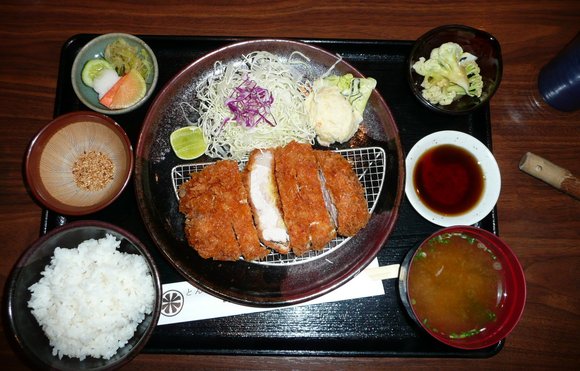
What I really wanted to try was the tried and true standard of all tonkatsu: rosukatsu, made from fillet of pork loin, with a thin layer of fat along the side, breaded in panko breadcrumbs, and lightly fried.

P1090794

Served with two homemade tonkatsu sauces, an original flavor and a really good spicy one that tastes a bit like barbecue sauce but without the tomato, the tonkatsu was tender and not too oily.  The pork itself was a bit bland, although moist, and served as a neutral carrier for the sauces’ flavors.

One lesson we learned – sadly, after the fact – was that the sesame seeds in the bowl on the left and meant to be ground up, using the wooden pestle on the far right of the picture that we mistook as a chopstick rest.  Oh, silly us!


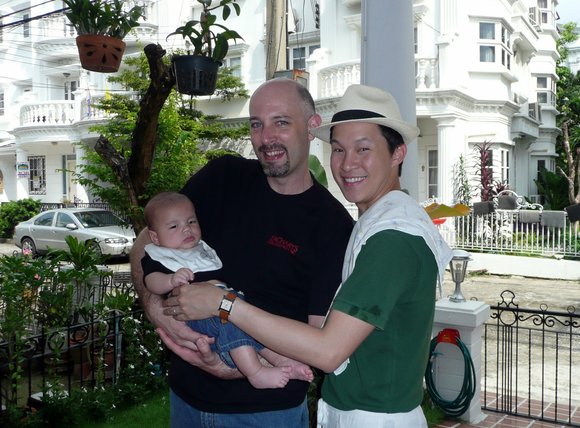
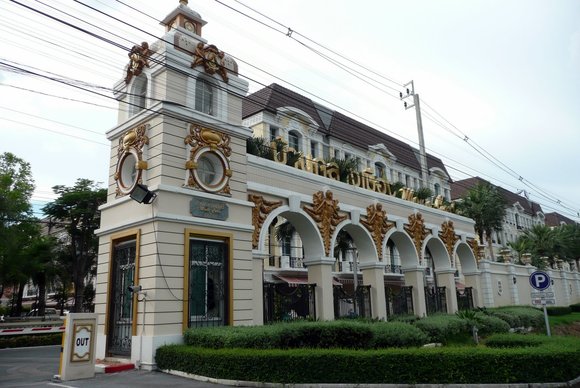
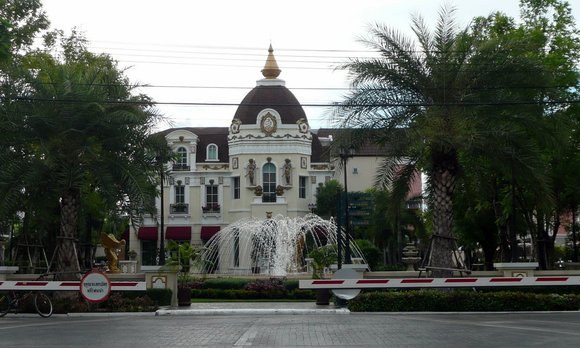
After lunch, we stopped by Scott and Jum’s house to see their new baby.  They live in an interesting townhome development that is very Grecco-Roman in its design.   Too bad I didn’t get a wider picture so you could fully appreciate the number of columns that adorned each building.

P1090802

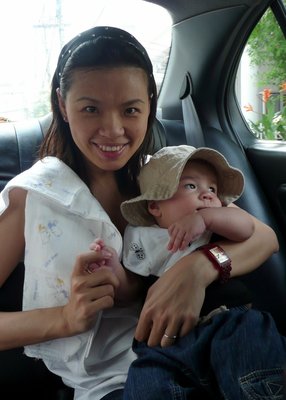
P1090805 The baby, whose name I’m not sure how to spell correctly so I won’t try here, is very cute.  He’s a mixture of Thai and American heritage so has blended features.

He’s so low-key.  He didn’t really mind who was holding him, but apparently really hates being cooped up indoors and his fussing quiets when he is brought outside.

We drove Jum and baby over to a gathering of former United Airlines colleagues.  Tawn flew with UA for a few years around the turn of the century.  (That sounds old, doesn’t it?)  Sadly, we just received news that as part of their further cutbacks, United will be closing their Bangkok flight attendant base for the second time since the 2001 attacks.

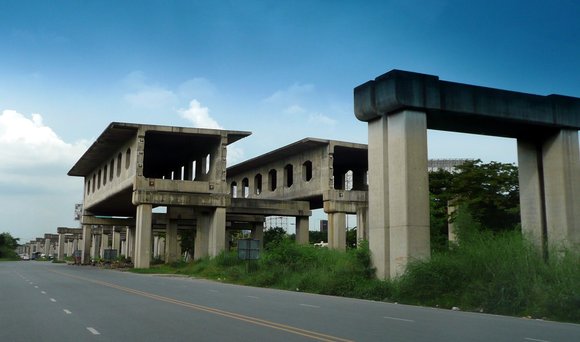
The colleague’s house at which the gathering was held is up near the old airport.  It took a bit of driving to get to and we were confused and overshot it by a few kilometers.  Along the way, we passed the remnants of the elevated rail line that was originally going to run from the center of the city up to the old airport and then on out to the Rangsit area.

The project, which was operated by a Hong Kong-based conglomerate called Hopewell Holdings, ran into problems in the late 90s and the contract was canceled by the Thai government.  Due to the inability of the project to ever really gain traction, it became largely derided as the Hopeless Project.  All that remains of the project are a significant number of columns running along the Don Meuang Tollway.

P1090809

P1090816

A sign of optimism, there were several housing estates built along the Hopewell right of way (which has a still-operating train line underneath it), including this slightly over-the-top property called Monte Carlo:

P1090812

P1090811

So the trip to see Tawn’s colleagues was a good use of time if for no other reason than it allowed me to get an up-close look at the Stonehenge of Thailand.  Every so often, there is talk of reviving the project or using the surviving infrastructure to build the extension of the airport link (which is still another year or more away from opening) to connect both the old and new airport.

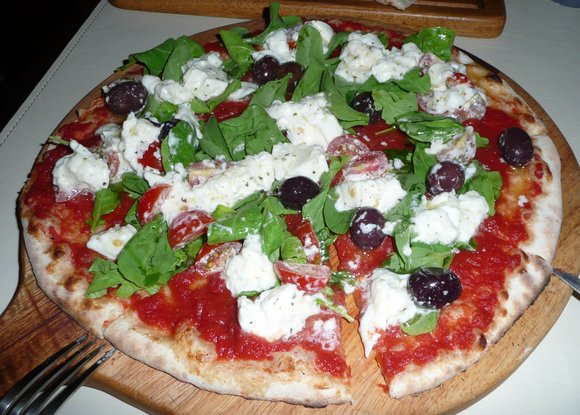
One final thing to leave you with, a very nice pizza I ate at Bacco restaurant, just at the other end of the soi from us.

P1090777

I think the restaurant makes its own ricotta cheese.  It was so good!