Lunch at Quince Bangkok

Recently, I stopped by Quince restaurant in Bangkok for a weekday lunch, a long-overdue chance to revisit a restaurant that features thoughtful food in a pleasant space. Tucked behind a furniture shop on Sukhumvit Road, Quince has gone through at least two chefs in about eighteen months. Originally helmed by Jess Barnes, now at the excellent Opposite Mess Hall, the menu at Quince continues to impress.

P1280676

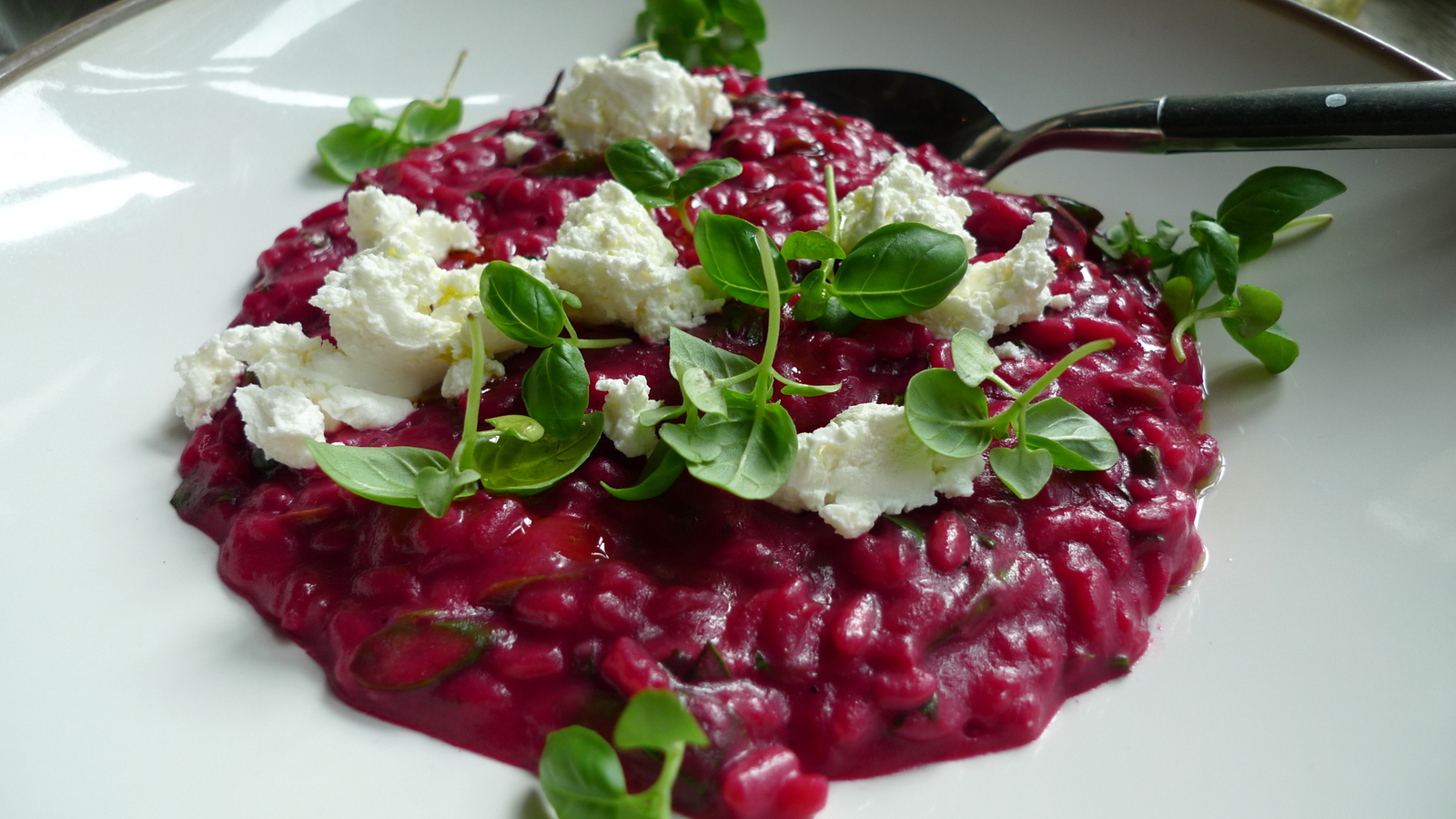
This being lunch and dining with only one other person, I didn’t get a chance to try a broad selection. This special, a beetroot risotto with asparagus, parsley, and feta, was nicely composed and properly cooked. I would have preferred the beetroot to have been diced and folded in at the last moment instead of being pureed into the dish, but you have to admit that the scarlet color is striking.

P1280677From the regular menu, the ricotta gnocchi with zucchini, green pea, lemon, mint, and chili was nicely executed, bright flavors with good attention to the vegetables not being overcooked.

The interior of the restaurant continues to be one of my favorite in Bangkok – lots of light without being overly bright, different rooms have different types of energy. It is an especially good place for lunch or brunch, simply because it isn’t as crowded. I look forward to another return visit soon.

Christmas in Mae Sot

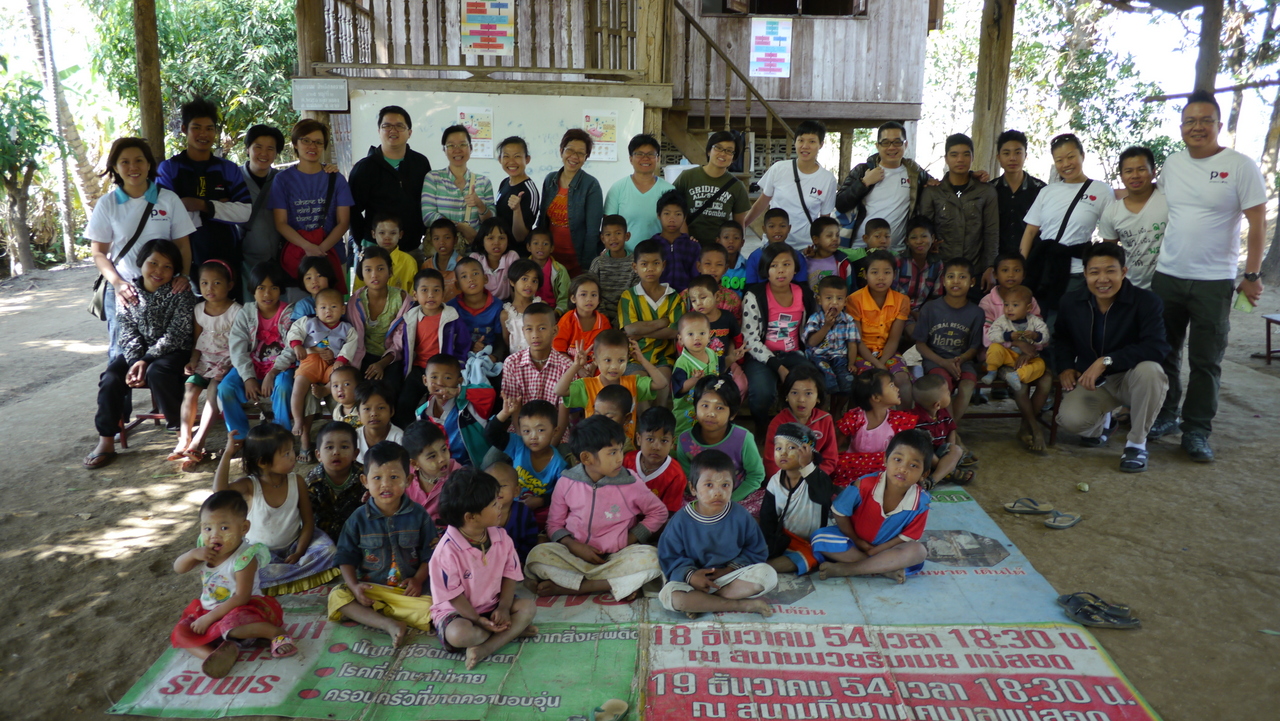
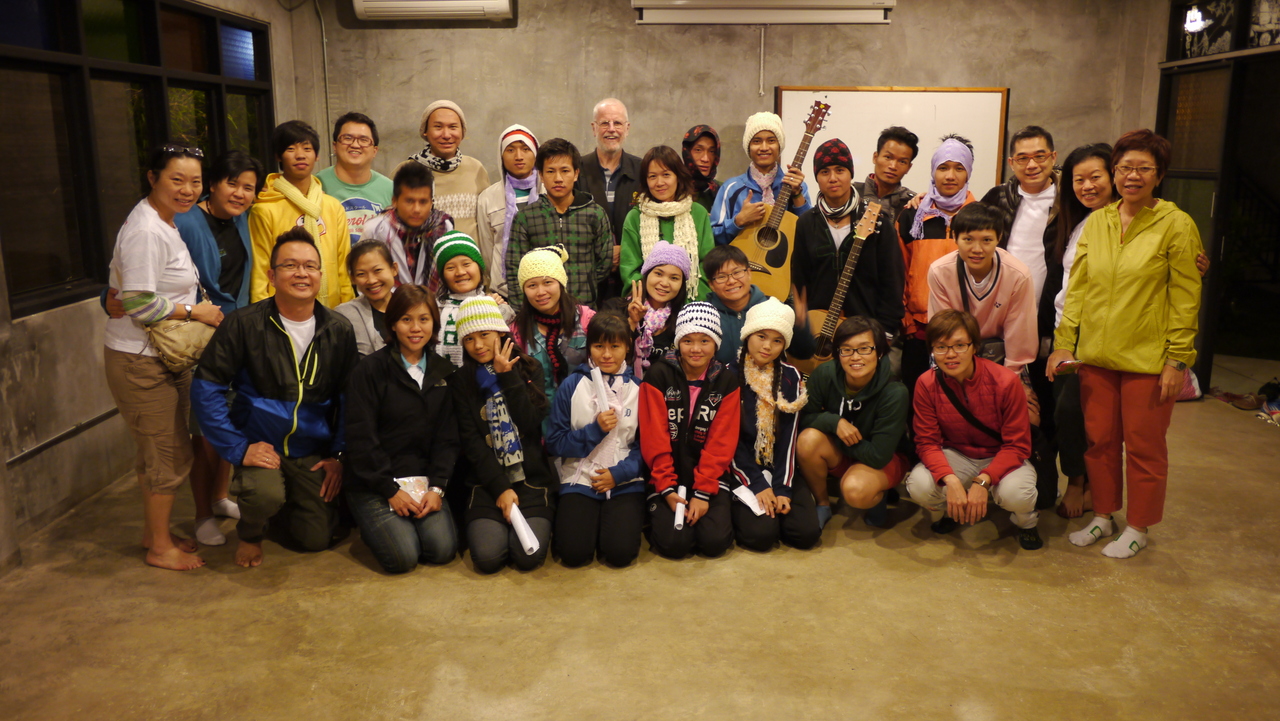
With just a few days left before I begin my new job, I took the opportunity to join a group of friends from Project LOVE Asia for four nights of volunteering in Mae Sot, a town along the Thai-Myanmar border. Our job was to help bring Christmas to the children at the Heavenly Home orphanage and the young adults at the Love & Care learning center.

Let me share some pictures and some brief notes about the experience.

Day 1

P1040677

The first day, we went to a “day care” that is run by the orphanage. Located a few miles away in the midst of rice paddies, the structure is just a shack and a broad roof over a packed-dirt floor. Volunteers provide free lunch and basic education for the children of itinerant farmers and laborers four days a week.

P1040611

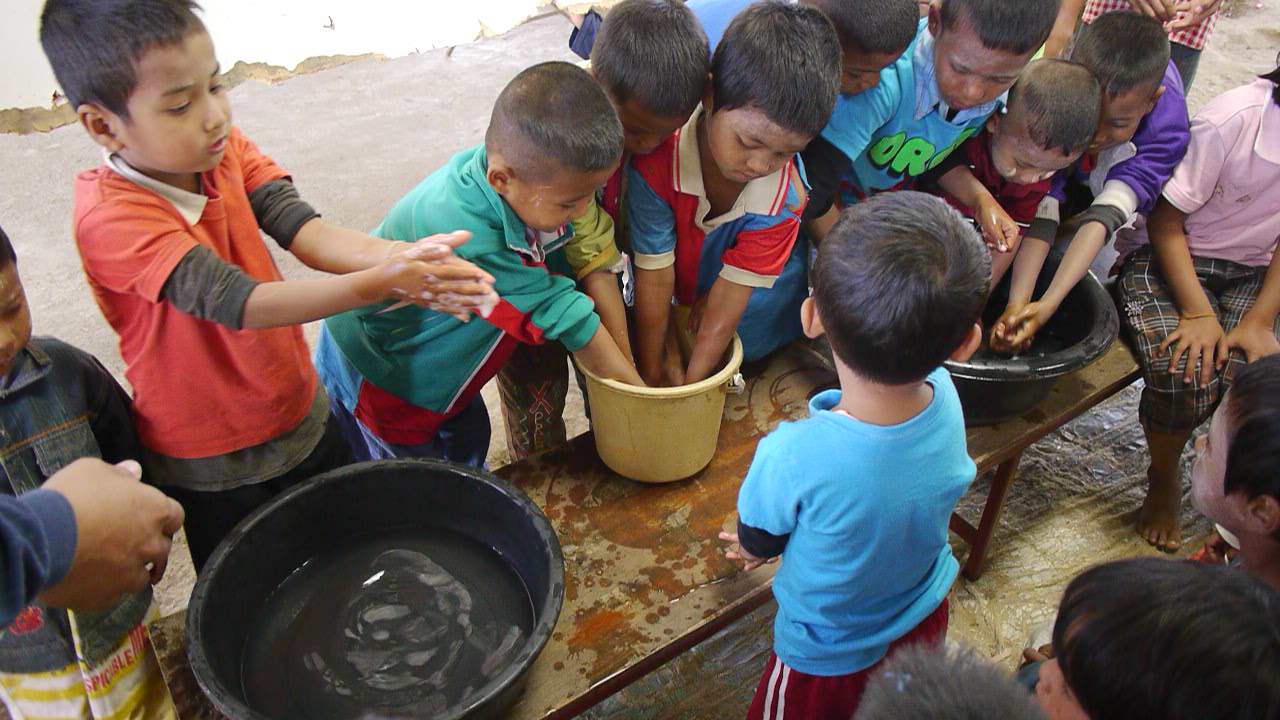
Our group of volunteers (who are not the normal day-to-day volunteers at the day care) played games with the children and then before lunch, gave them a lesson in proper hand-washing technique including teaching them the “hand washing song”.

P1040620

Given that these children mostly speak Burmese or a local dialect based on their ethnic group (mostly Shan or Karen), I’m not sure they learned the song. But hopefully the basic lesson of the importance of good hand-washing was learned.

P1040639

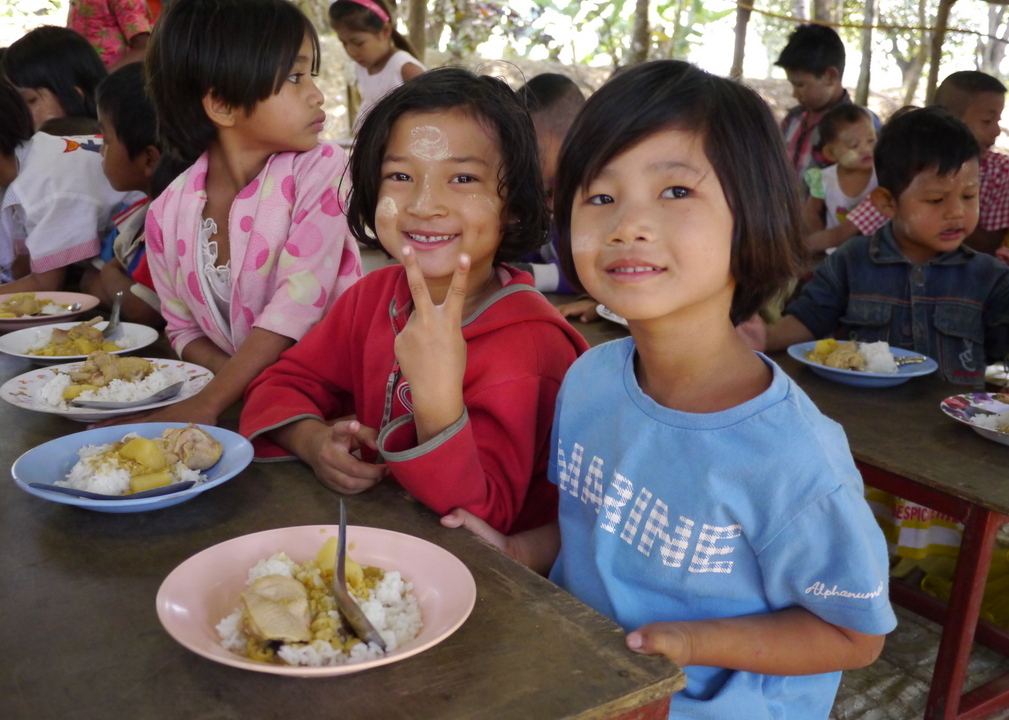
This day for lunch, the children had rice with chicken and curry. Most of the time, the orphanage cannot afford to feed them meat so today’s lunch was a special treat. The children’s parents, who are dirt-poor, do not have to pay for this day care. It is provided by donations to the orphanage.

P1280197

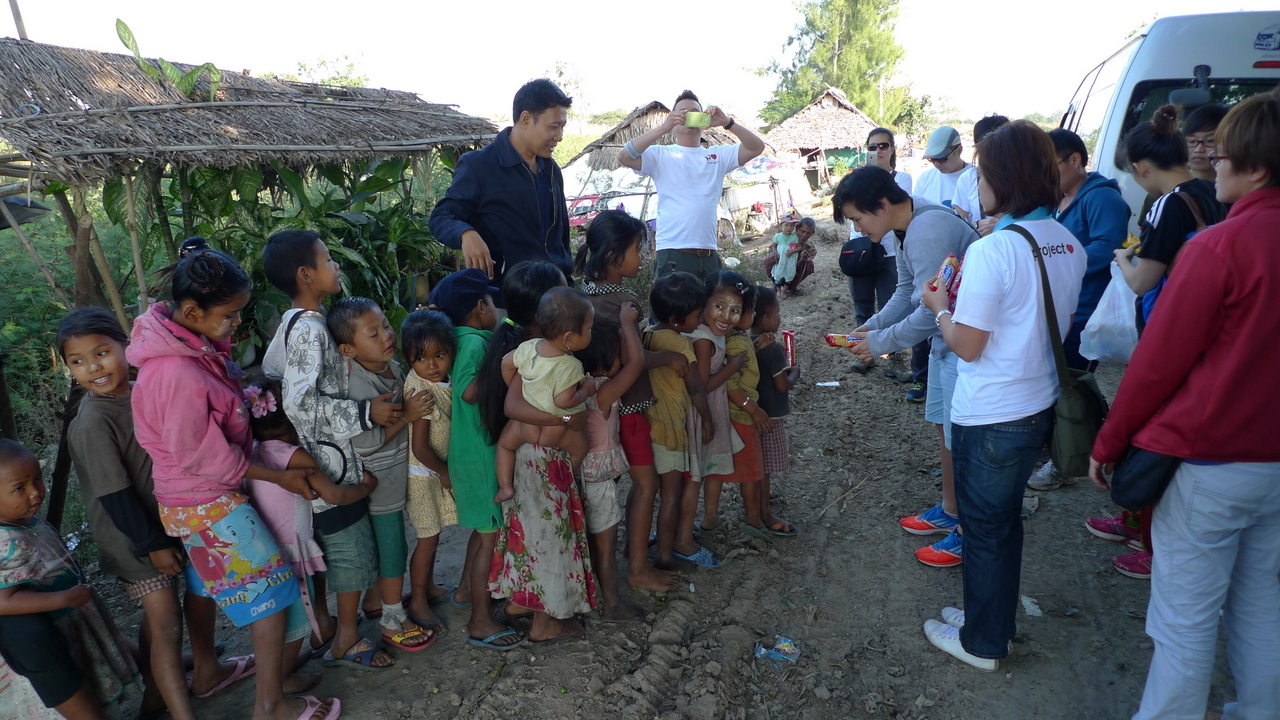
In the afternoon, after finishing at the day care, our vans drove for nearly an hour over bumpy roads until we arrived at the middle of the provincial dump. There, we met families of illegal immigrants who earn a living sorting through the refuse and selling materials for recycling.

2013-12-22 01

Their rickety shacks line the roads and their children, who are now able to receive some education thanks to a nearby school recently built by an NGO, were happy to see us and receive some Christmas treats.

P1040735

That evening in the guest house while we were debriefing the day, the sound of Christmas carolers filled the air. A group of students from the Love & Care secondary school (which we would visit on Day 3) had come to sing us songs. I felt so bad for them as they had piled in the back of a pickup truck and driven 20 minutes in the chilly weather. It was a lovely surprise, though, and quite festive.

Day 2

P1040745

The next day we spent at the Heavenly Home orphanage, playing with the children, organizing games, bathing and feeding them, and singing songs.

P1040843

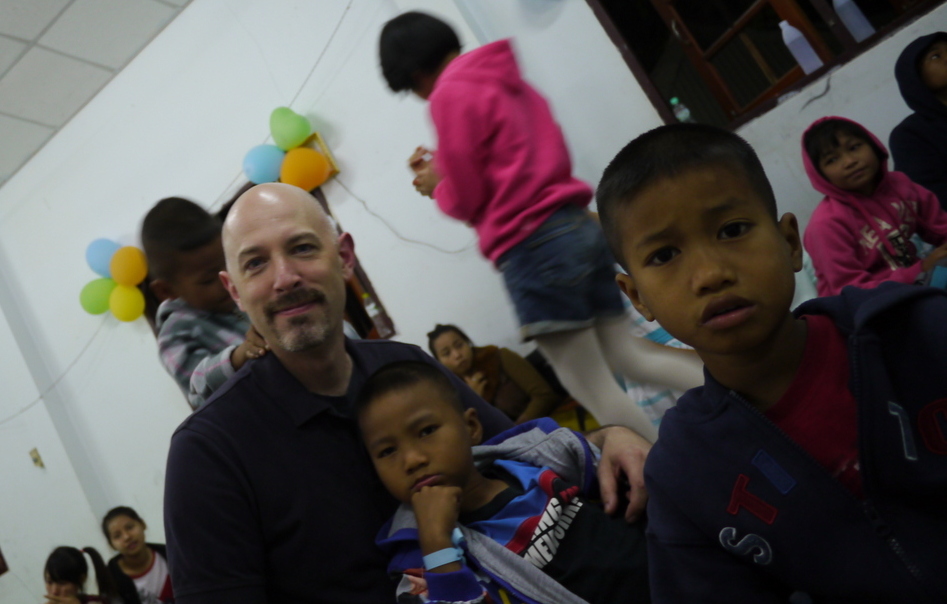
This was a particularly rewarding experience because the children are used to visitors and are very eager to play with them. It wasn’t unusual to have four youngsters balanced on my knees with another two or three trying to climb up.

P1040805The founders of the orphanage, Thantzin and his wife Lily, are a Burmese couple who lived many years in Singapore. Unable to have their own children, they felt called by their faith to help the children of Burmese refugees and migrants in Thailand.

P1040920

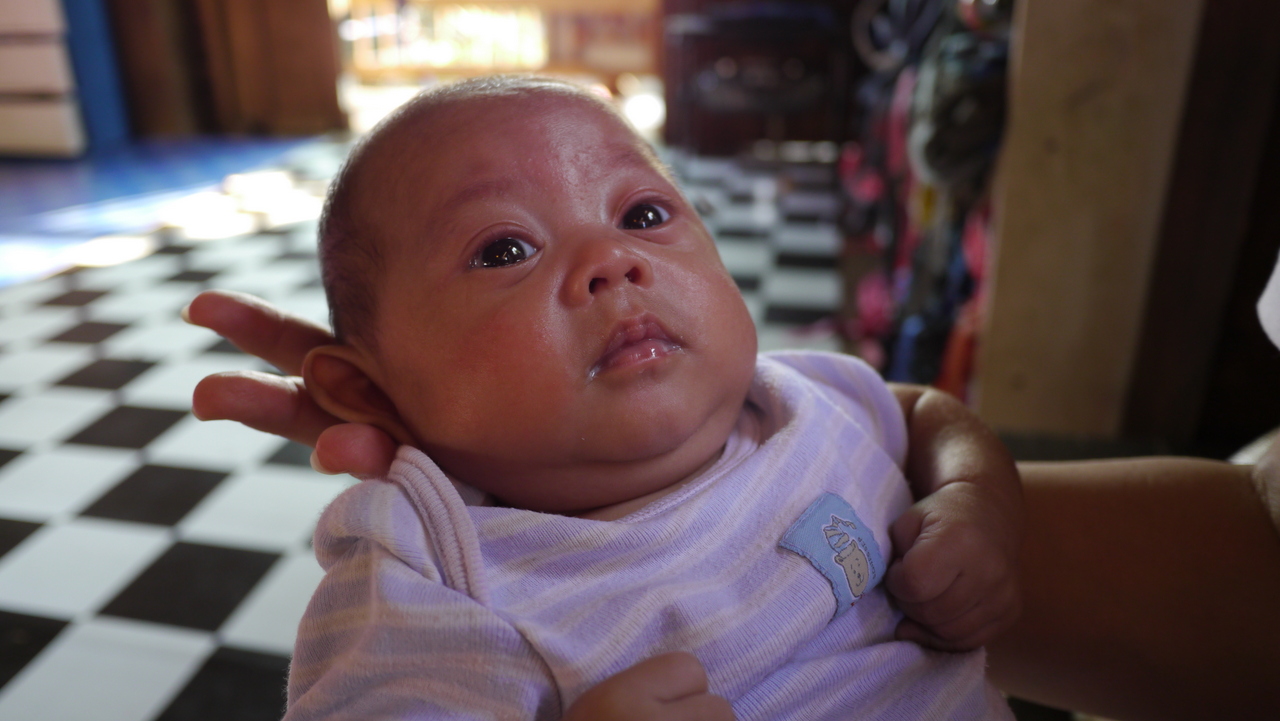
What started initially as a day care has expanded and they now care for more than 50 children whose parents have given them up as well as another dozen whose parents pick them up each evening.

P1040900

While children can stay up to the age of 18, right now they only have children from the age of 3 months up to about 12 years old.

P1040863

Our primary mission was to spread the spirit of Christmas so early on the evening of the 23rd, after the children had eaten their dinner and been bathed, dried, and dressed, they lined up for cake. We then went upstairs to sing songs and give gifts.

P1040999

The happy family of Heavenly Home orphanage, crowded into the upstairs living area, which is also the girls’ bedroom. It was a chilly evening so everyone was bundled tight, happy at having such a fun evening.

Day 3

Our final full day was spent at Love & Care, a secondary learning center about 15 minutes outside of Mae Sot. Burmese migrants and refugees face a challenge: undocumented in Thailand, they cannot attend local public schools, but they education they may have received in Myanmar isn’t sufficient for meaningful work in Thailand. Love & Care is one of many learning centers (not “schools” as they don’t follow the curriculum of the Thai Ministry of Education) serving this group.

P1050038

About 70 students live at the school, which boards all its students. They range in age from about 16-21 and many have already matriculated from secondary school in Myanmar. Love & Care offers grades 10-12 taught in Burmese, English, and Thai.

P1050021

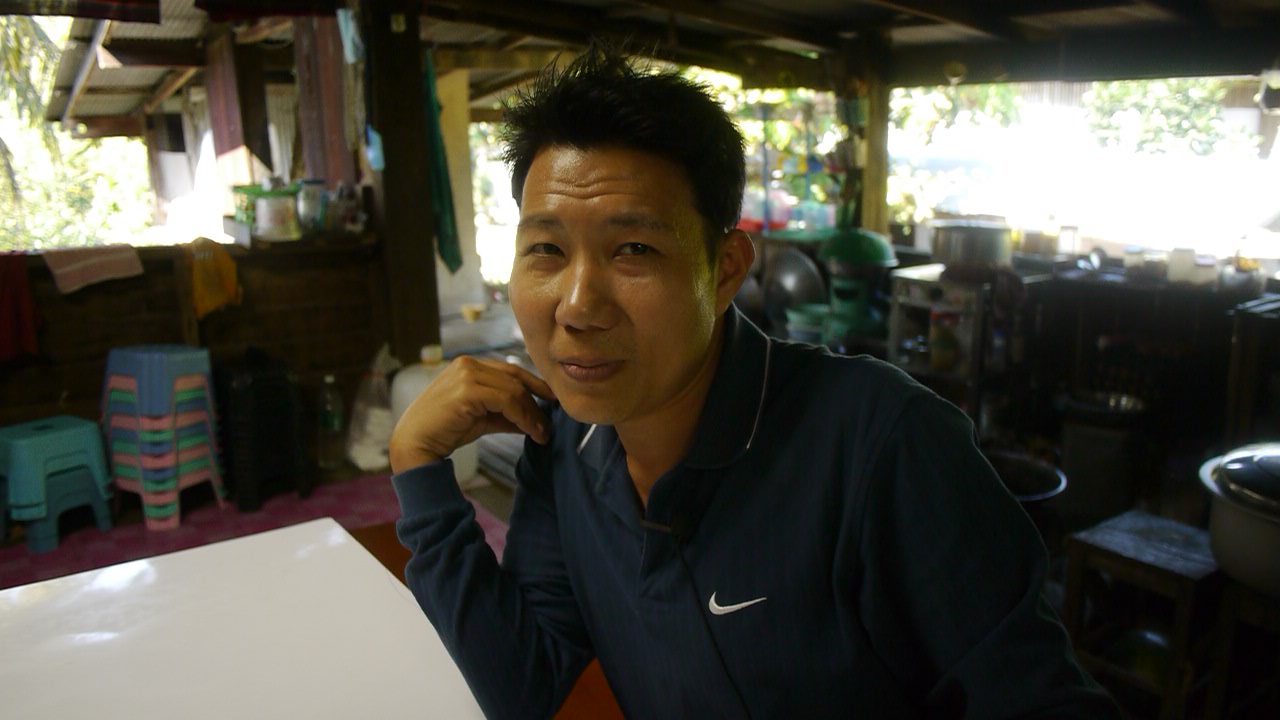
While there, I did interviews of several of the students and faculty. Their parents are almost uniformly farmers or laborers and one common thread is that none of them seem to be the oldest child. While I didn’t clarify why this is, I would guess that the oldest child is needed to help on the farm and it is only once you have several children that you can consider sending them for education.

P1050067

We played many games with the students, mostly focused on team-building and other types of skills. After the games, we talked a bit about the lessons learned. A common theme among these students is that they came from different tribes – Karen, Shan, etc. – and it was at Love & Care that they first met people different from themselves and learned that people are all basically the same. Perhaps the most important lesson they have learned, considering they come from a place where deep-seeded animosity exists between different ethnic groups.

P1050138

In the afternoon, we did an exercise where each student created a dream board, using paper, pens, old magazines, etc. The objective was to illustrate the dream they hold for their future. They then took turns sharing their dreams with each other. Most wanted to be doctors, nurses, teachers, or other professions that would enable them to return to their communities and help others. It is easy to imagine what a powerful impact these young people will have on the future of Myanmar.

P1050192

In the evening, about half the children from Heavenly Home joined us and we had a large Christmas show. Different groups of students and children performed, gifts were given, and songs were sung. By the end of the day, many of the students had asked to connect with me on Facebook and I left with many new friends.

P1050157

In the days after this trip, I’ve had several people say nice things about how generous I am, how nice it is that I did this trip, etc. In truth, it is the children and students who have been so generous and I have to admit that I’ve taken a great deal from the experience.

Each visit to Mae Sot serves as a reminder that it takes precious little to be happy in life, and that so many people barely have that. Our common humanity binds us and there is great power in showing compassion and sharing love.

Painting Smiling Faces

Catching up on the events of the past month or two, in late October I attended an annual Halloween party at the Mercy Center in the Bangkok neighborhood Khlong Toei. Mercy Center, founded by a Catholic priest who has been a longtime fixture in the surrounding slums, provides extracurricular activities and ongoing education for local children. The Halloween party is pulled together by several business owners associated with the American Chamber of Commerce.

20131026_132007-001 photo 1-001

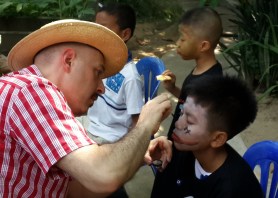
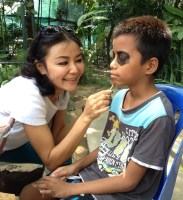
This was the second time I volunteered and this year I scored the assignment of working the face-painting table. While we had lots of face paint, our tools were limited and the children had high expectations: Zombie! Dracula! Ghost!

As you can imagine, over time the ghosts started to look more like vampires and the zombies started to look more like children with green faces. I was thrown for a loop when one girl asked to be a butterfly. It wasn’t until I looked at one of the face painting kits that I realized that there was a picture of a girl with a very elaborate butterfly on her.

photo 2-001 photo 3-001 photo 4-001 photo 5-001

Regretfully, I hadn’t the tools to make her as beautiful a butterfly as on the package, but she seemed pleased with the results. I tried my best and next year will be sure to bring some proper makeup sponges (instead of just using the random foam sponges we had access to) and brushes.

Still, it was a fun time and the 300 or so children seemed to really enjoy themselves. It is neat that there are so many people who come together to create these sort of opportunities for children.


Afternoon Tea at Four Seasons Chiang Mai

While in Chiang Mai a few weeks ago with visiting guests, I made a stop at the Four Seasons resort for afternoon tea. The resort is located about a thirty-minute drive north of town, which only enhances its feeling of being in the middle of nowhere. The resort is gorgeous and the afternoon tea is a worthwhile splurge for an hour or two of pampering yourself.

P1270774

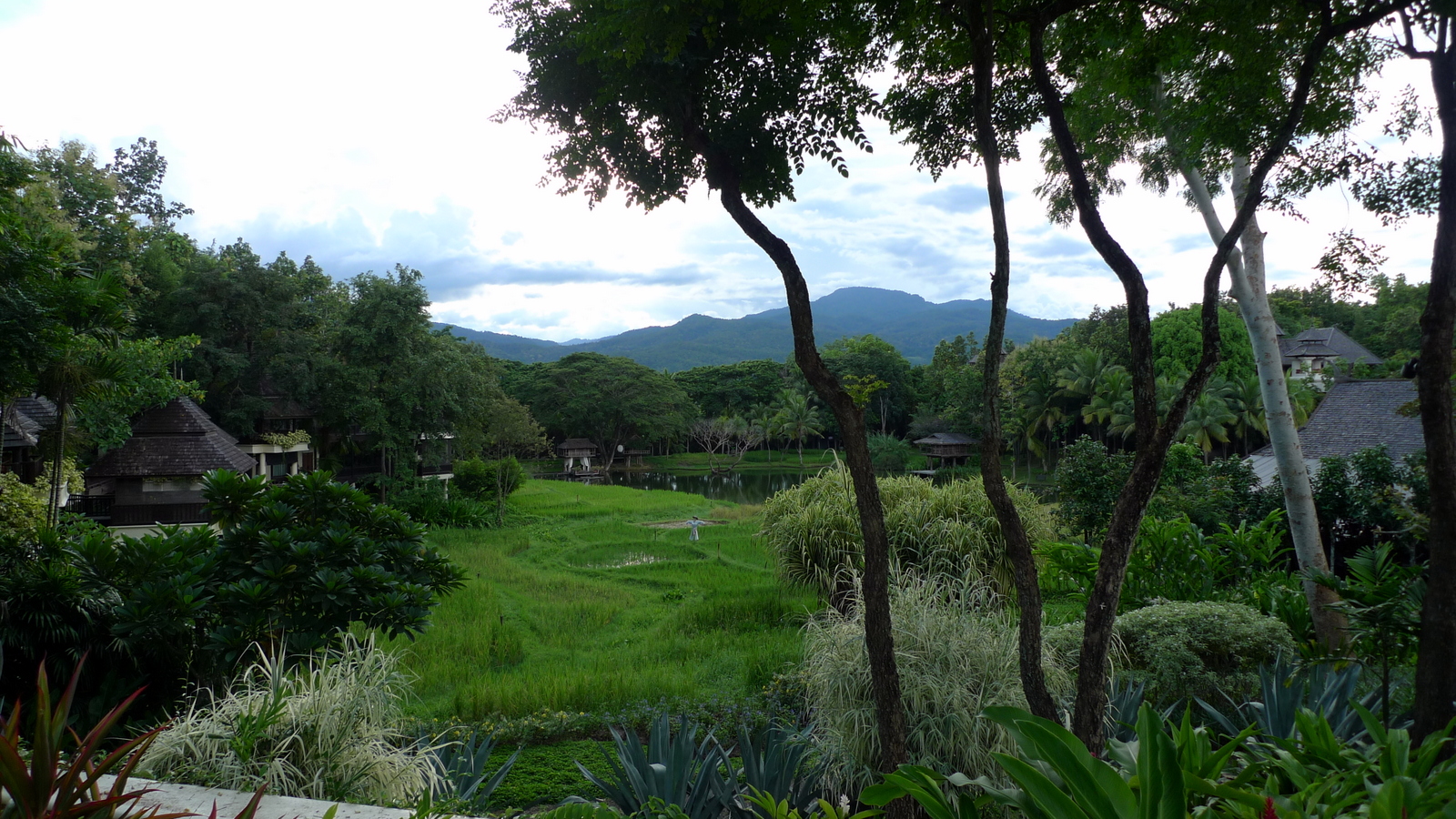
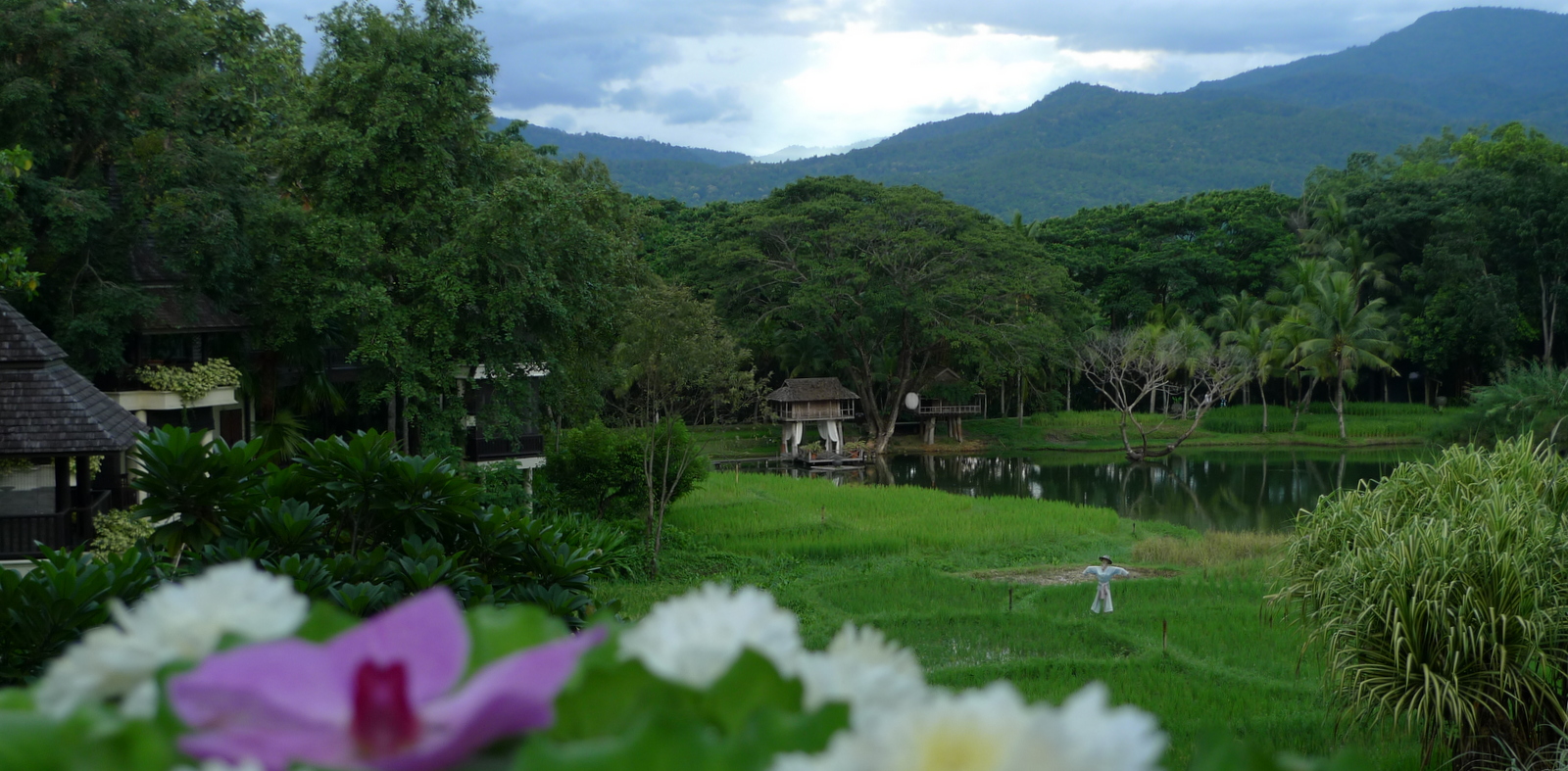
The resort is arranged around a pond designed to look like a Northern Thai village complete with rice paddies. The only buildings you see are those belonging to the resort and with the mountains in the distance, you could easily be forgiven for thinking you had been transported to some magical Thai Brigadoon. At 5:00, the “farmers” (resort employees dressed in traditional Northern Thai farmer’s clothes) paraded across the paddies to the rhythm of a gong, “returning” to the village, a touch that was a bit kitschy but also fun.

P1270768

Trish, Allen, and I pose for a picture at the Sala Mae Rim restaurant. We didn’t make reservations but fortunately were able to get a prime table, perhaps because it was the midst of rainy season and the slowest time for tourists. We ordered one tea set (designed for two) plus an extra pot of tea, which was more than enough food for the three of us. The total price was approximately US$50, more than I would usually spend but certainly a worthwhile treat while on holiday.

P1270772

The top plate in the tea set featured mango sticky rice with a palm sugar floss; crisp water chestnuts in sweet coconut milk; Parisian macaroons, and chocolate truffle cake.

P1270770

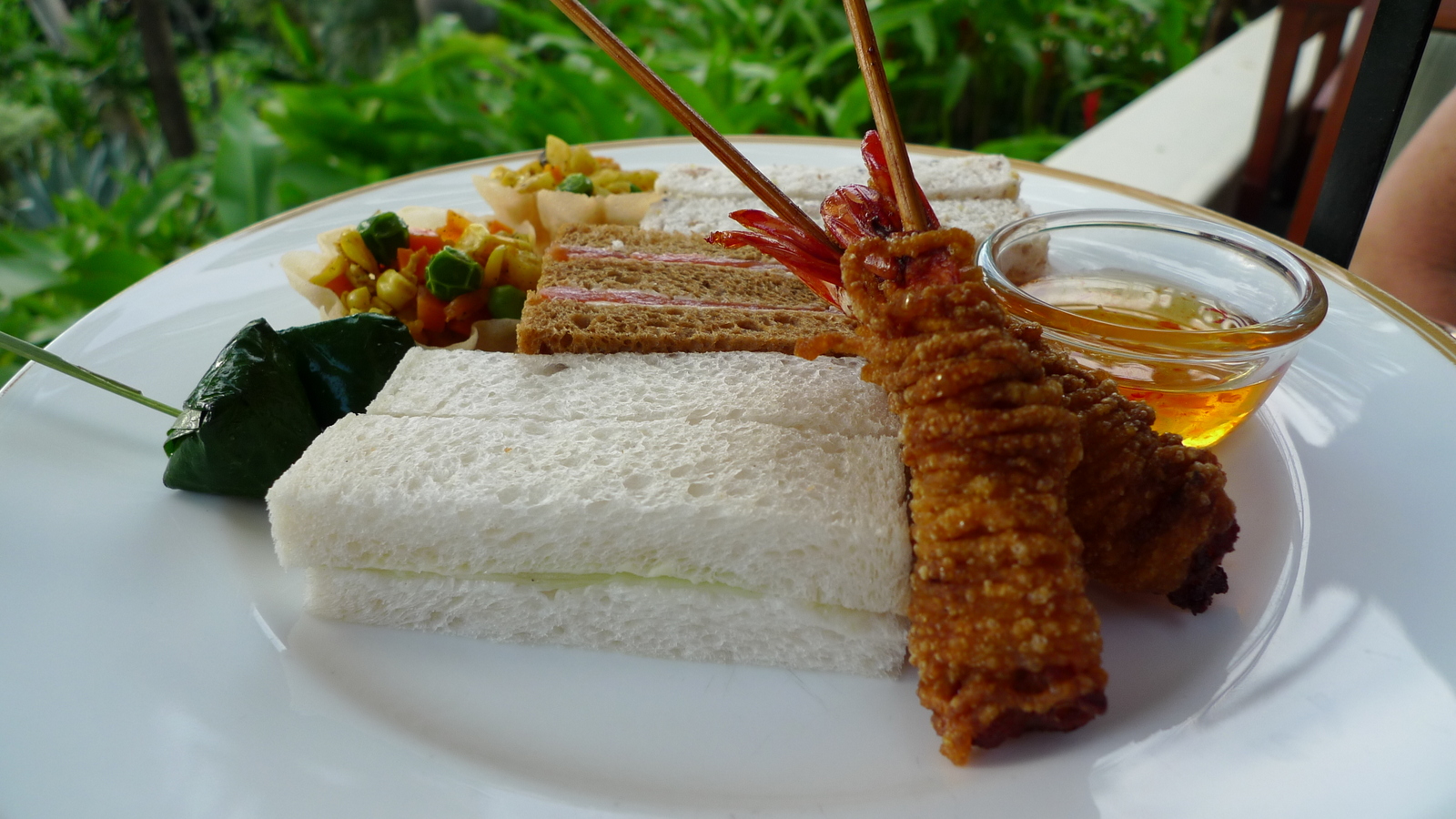
The middle plate in the set featured finger sandwiches (ham and cheese, cucumber, and smoked salmon); fried shrimps wrapped in egg noodles, miang kham (a Thai snack of betel leaves wrapped around savory fillings); and krathong tong (literally “golden baskets” – crispy shells filled with minced chicken and shrimp).

P1270773

The final plate in the set featured kaffir-lime and raisin scones, served with clotted cream and strawberry jam. All the food was fantastic and the portions were more than adequate for the three of us.

P1270784

After almost two hours of indulgence, we finally left paradise to return to the city. Without a doubt, the Four Seasons is on my list for future visits. While it may be too far away from the city to actually stay at (unless you specifically want to escape from the world), it is worth a visit for tea.


Views Around Chiang Mai

While up in Chiang Mai with visitors last week, I took several pictures that I want to share. It is the height of rainy season and the surrounding countryside was particularly verdant.

P1270721

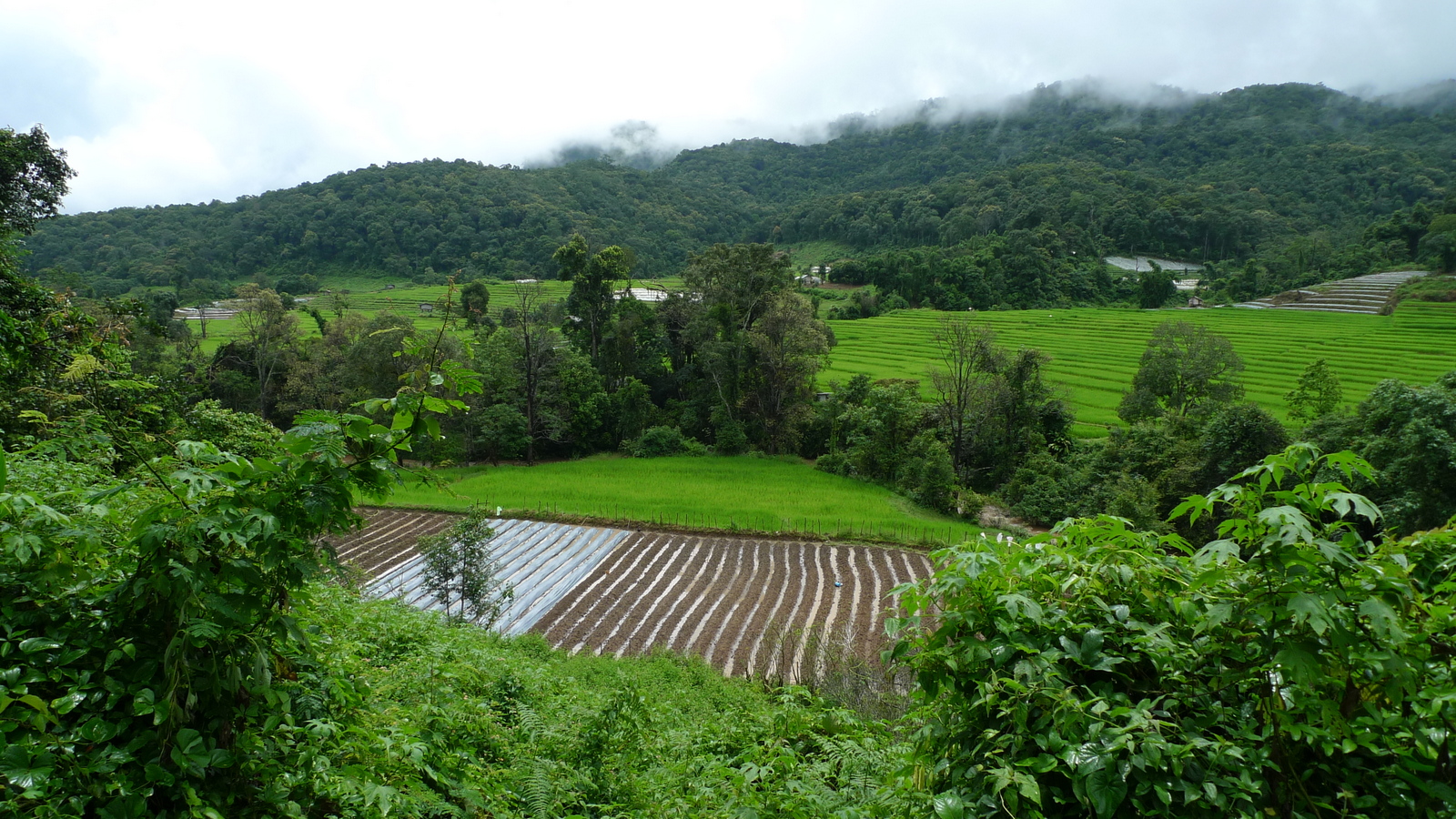
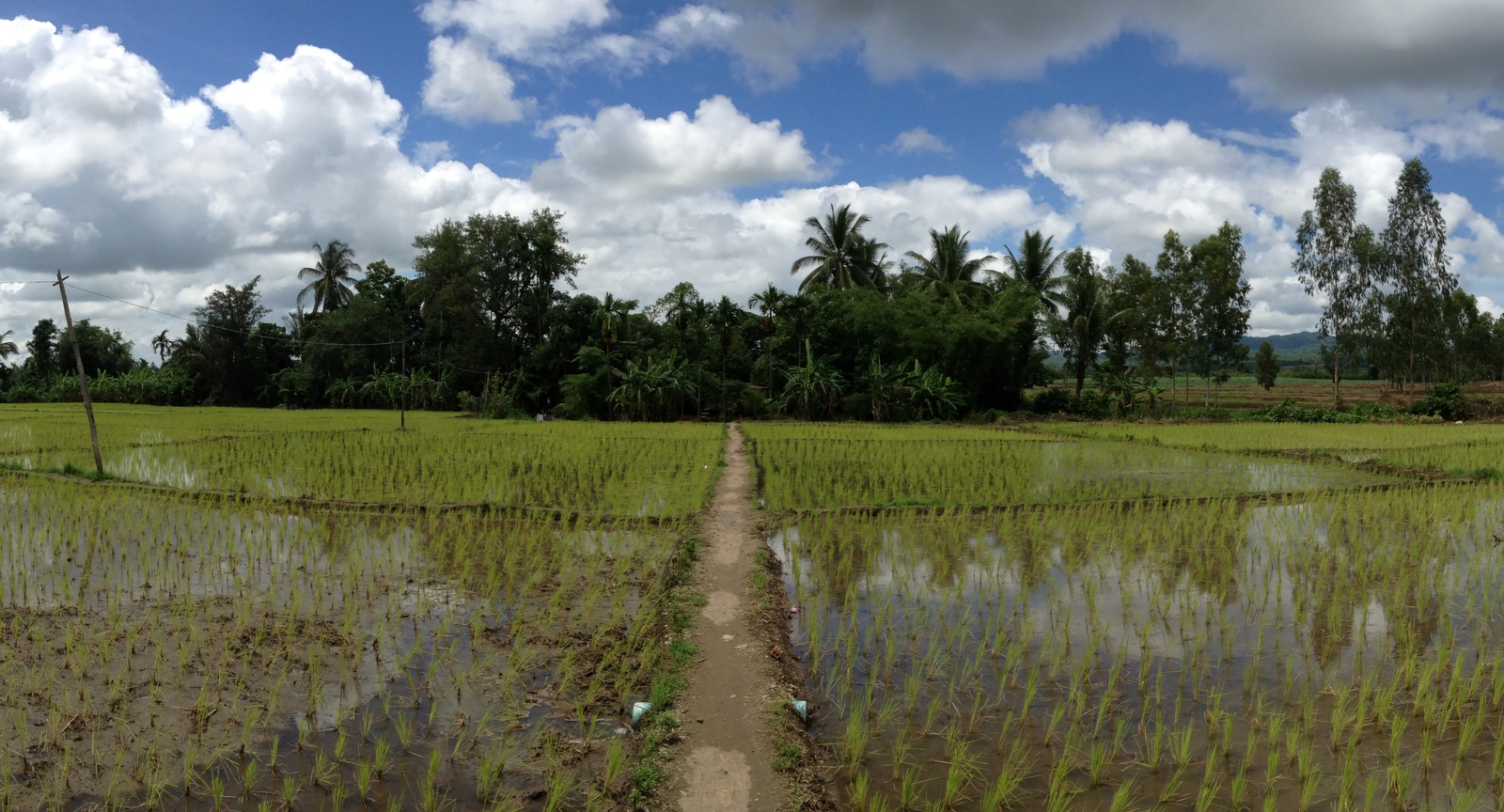
On the way up Doi Inthanon, Thailand’s highest mountain, we pulled over to snap this picture of rice paddies terraced in a small valley.

P1270733

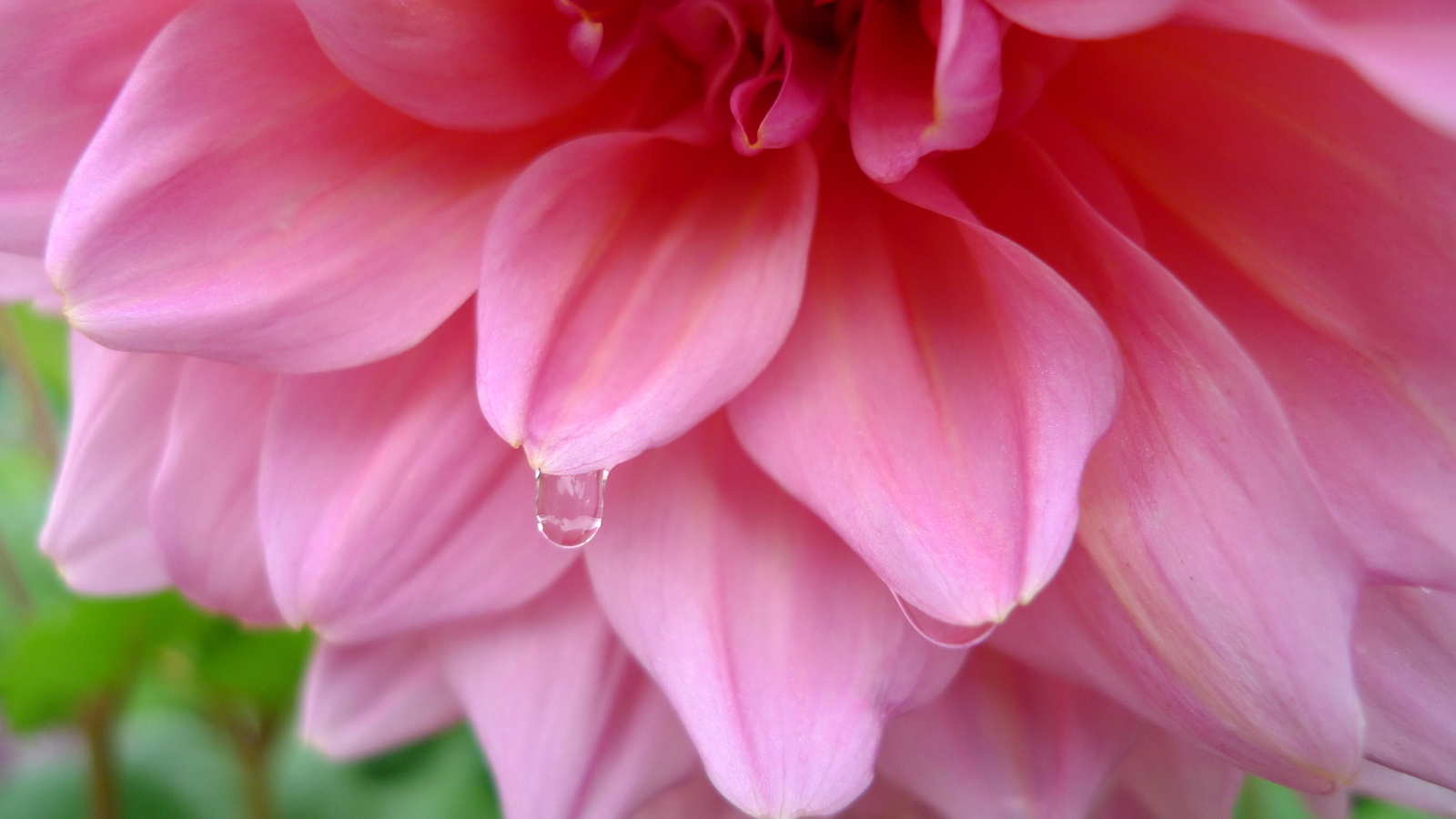
Further up the mountain, we visited the Royal Agricultural Project, which over the last few decades has helped local hill tribes transition from growing poppies (which were used to make heroin) to growing a wide variety of fruits, vegetables, and flowers. The higher elevation provides a climate suitable for select vegetables that could otherwise not be grown in Thailand. The pictures of flowers below are from the display gardens at the project.

P1270738-001

P1270754

P1270743

P1270749

By visiting during the weekdays of the rainiest month of the year, we enjoyed not only the beautiful flora but also the smallest crowds of tourists I have ever seen. In fact, “crowds” is not the correct term. “Handfuls” would be more apt.

P1270711

We also visited Doi Suthep, the mountain immediately to the west of Chiang Mai, which houses a spectacular temple with a golden chedi, or stuppa. This is the second time I’ve visited the temple on an overcast and damp day. The effect is interesting because the gilding is not as bright as on a sunny day, but it contrasts beautifully with the grey skies. In the above picture, I focused on a row of bells the line the temple buildings. Bells are purchased with donations and the donors can write wishes or prayers on the metal leaf hanging from the clapper.

P1270778

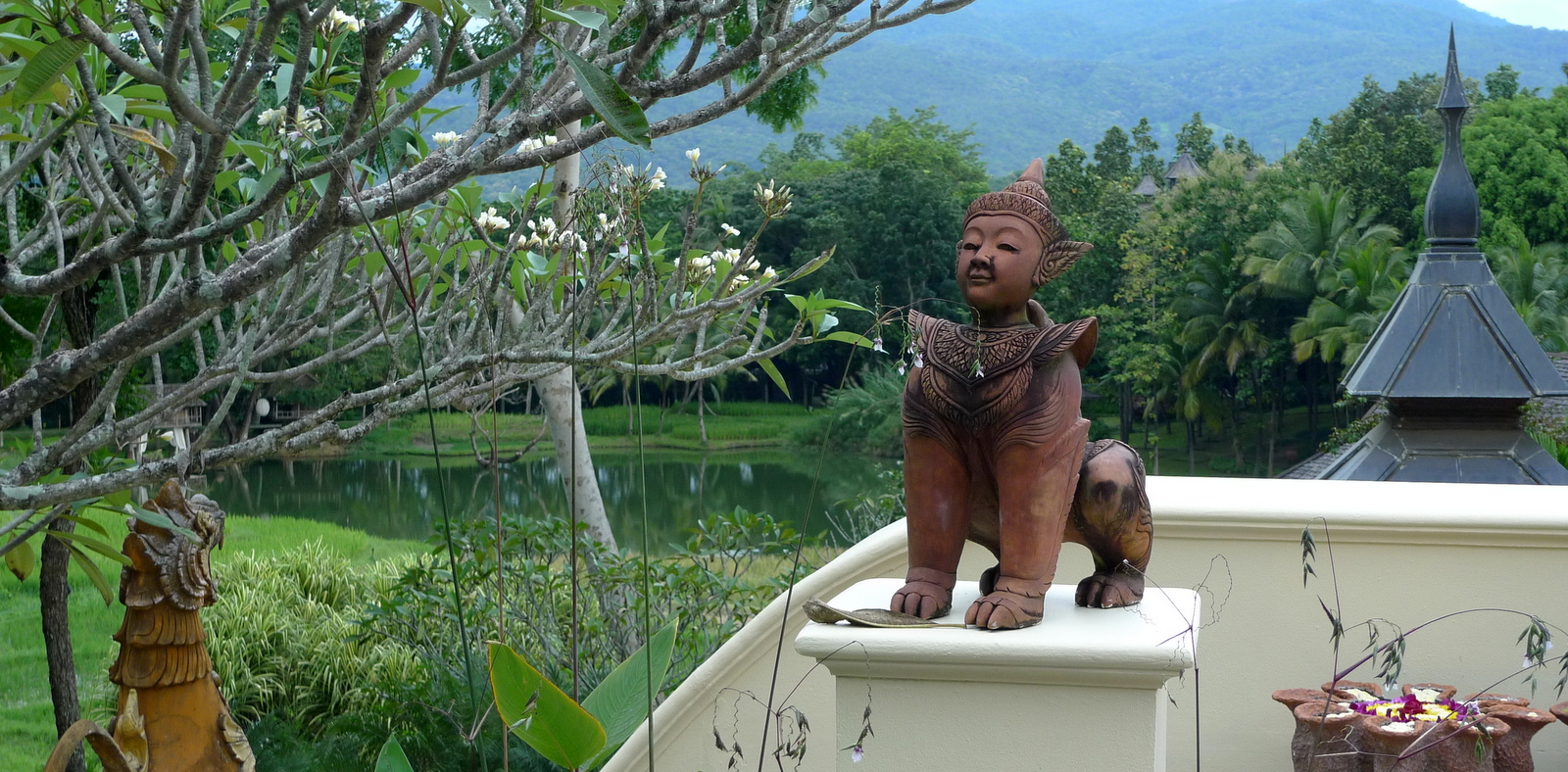
On our final afternoon, we drove  north of Chiang Mai to the Four Seasons Resort to enjoy afternoon tea overlooking their property, which is designed to look like a rice farming village. I’ll share the pictures of the gorgeous tea service in another post but wanted to share this view of their pretty property.


Food in Chiang Mai: Burmese Restaurant

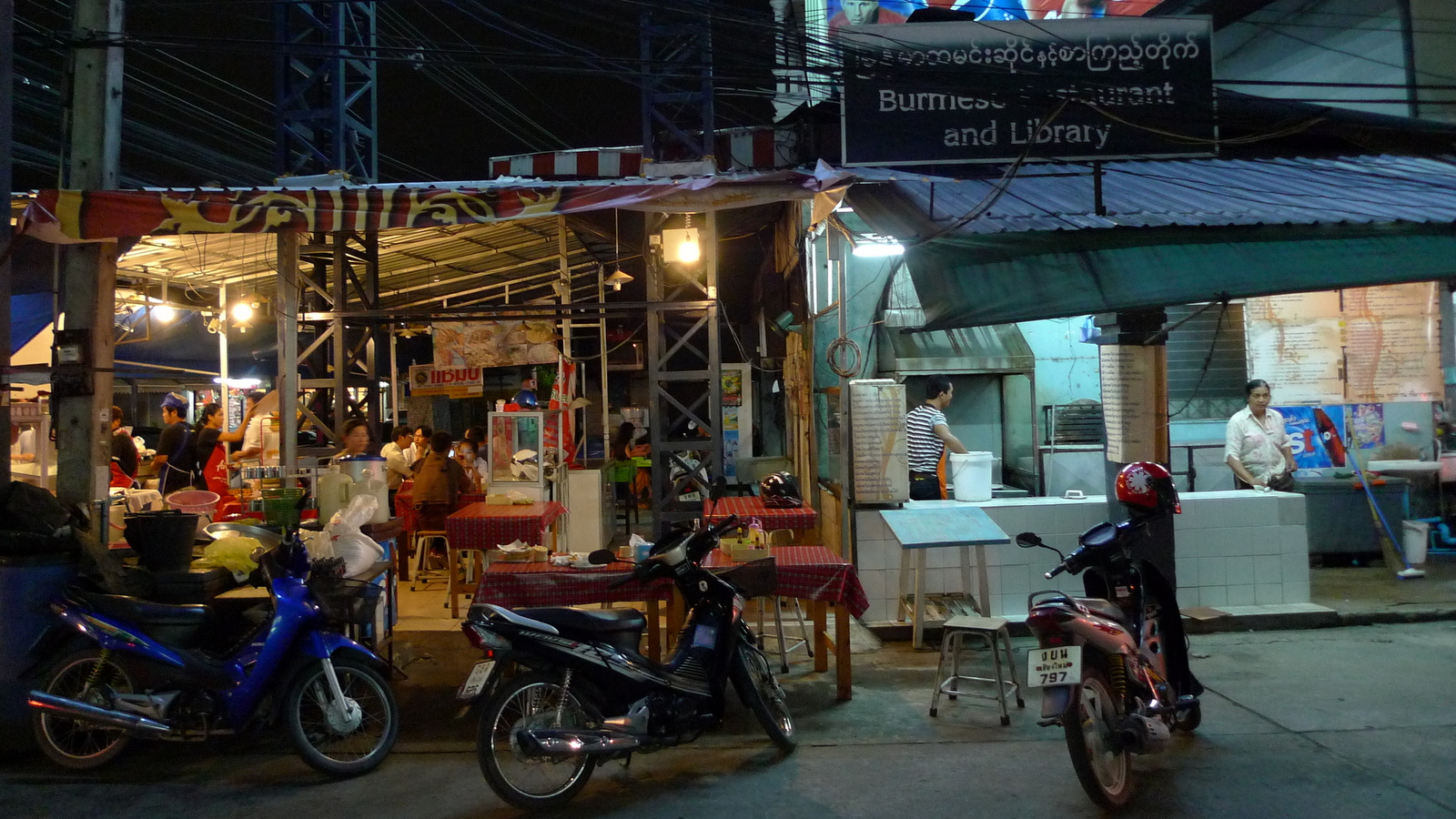
Along Niemenhamen Road, the artsy district of Chiang Mai located near Chiang Mai University, sits a nondescript restaurant with a utilitarian name: Burmese Restaurant. Recommended by a friend who moved to Chiang Mai recently, a recommendation confirmed by several Burmese staff members of the hotel at which we stayed, I went for dinner.

P1270794

The restaurant sits directly on the street at the corner of Soi 8, the cooking area and one dining area located outdoors, another dining area indoors. The crowd of diners was very light this Friday evening, maybe due to the impending rain. The friendly staff welcomed us and offered us a table indoors, turning on fans to ensure our comfort.

There are two menus, each a single page with about thirty items. One menu features Burmese dishes. The other menu features Thai/Chinese style dishes. We ordered from the Burmese menu with the exception of one vegetable dish. Unfortunately, several items we ordered were not available either because they were out already or the dish is not offered every day.

Here is a look at the dishes we ate – all of which were tasty. The entire bill for five diners was less than US$20. Needless to say, I’ll be back next time I am in Chiang Mai.

P1270792

We had ordered a curried fish soup that is the national dish of Burma. Sadly, it was not on the menu so we instead ordered this bean soup, which was tasty although not very distinctive.

P1270791

The goat curry, which our local friend enthused about, was also not available that day so we chose the chicken and potato curry instead. While it may not look particularly attractive, especially because of the oil slick on top, the curry was very flavorful and we ordered a second serving.

P1270785

The stand-out dish was this tamarind leaf salad, one of several salads on the menu made with what I would consider “unusual” ingredients. This salad was refreshing and it is difficult to describe the flavor of the leaves. The flavor is entirely pleasant and entirely unlike the taste of the tamarind fruit. One blogger described it as “eating al dente ferns”, which is about right. The salad is sweet and sour and salty with chopped peanuts and tomatoes.

P1270786

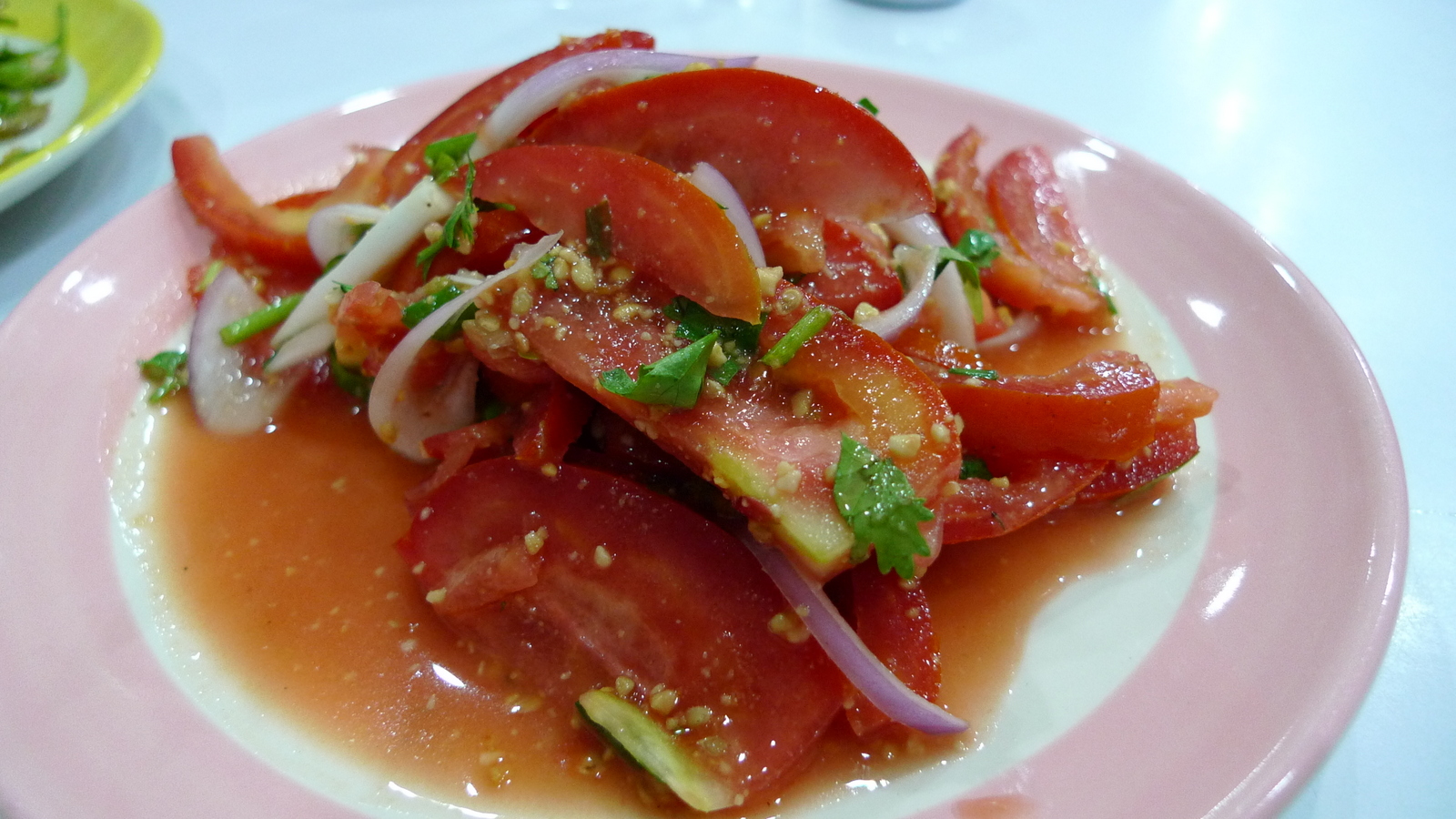
We also ordered a tomato salad, which was a pleasant surprise. With the exception of cherry tomatoes, which are generally very red and sweet, tomatoes in Thailand are usually pale pink and crunchy. These were anything but, and with onions and cilantro, they made for a refreshing dish.

P1270787

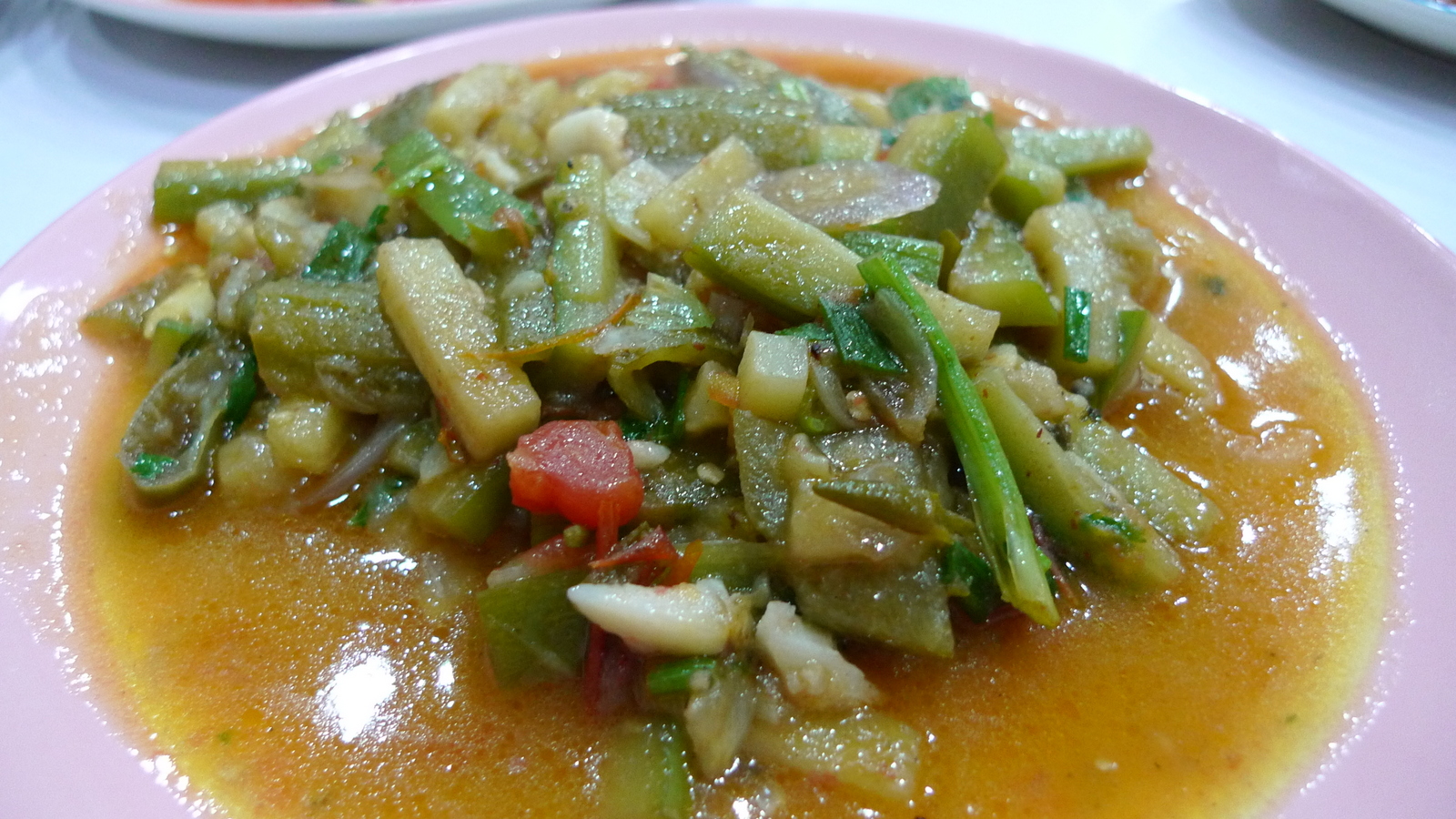
The menu contained many items translated into English as “curries” that are different from what you might expect, especially if you consider a curry as something with coconut milk in it. Instead, these curries feature a variety of spices but lighter sauces. The above picture is of an eggplant curry dish that was very nice.

P1270788

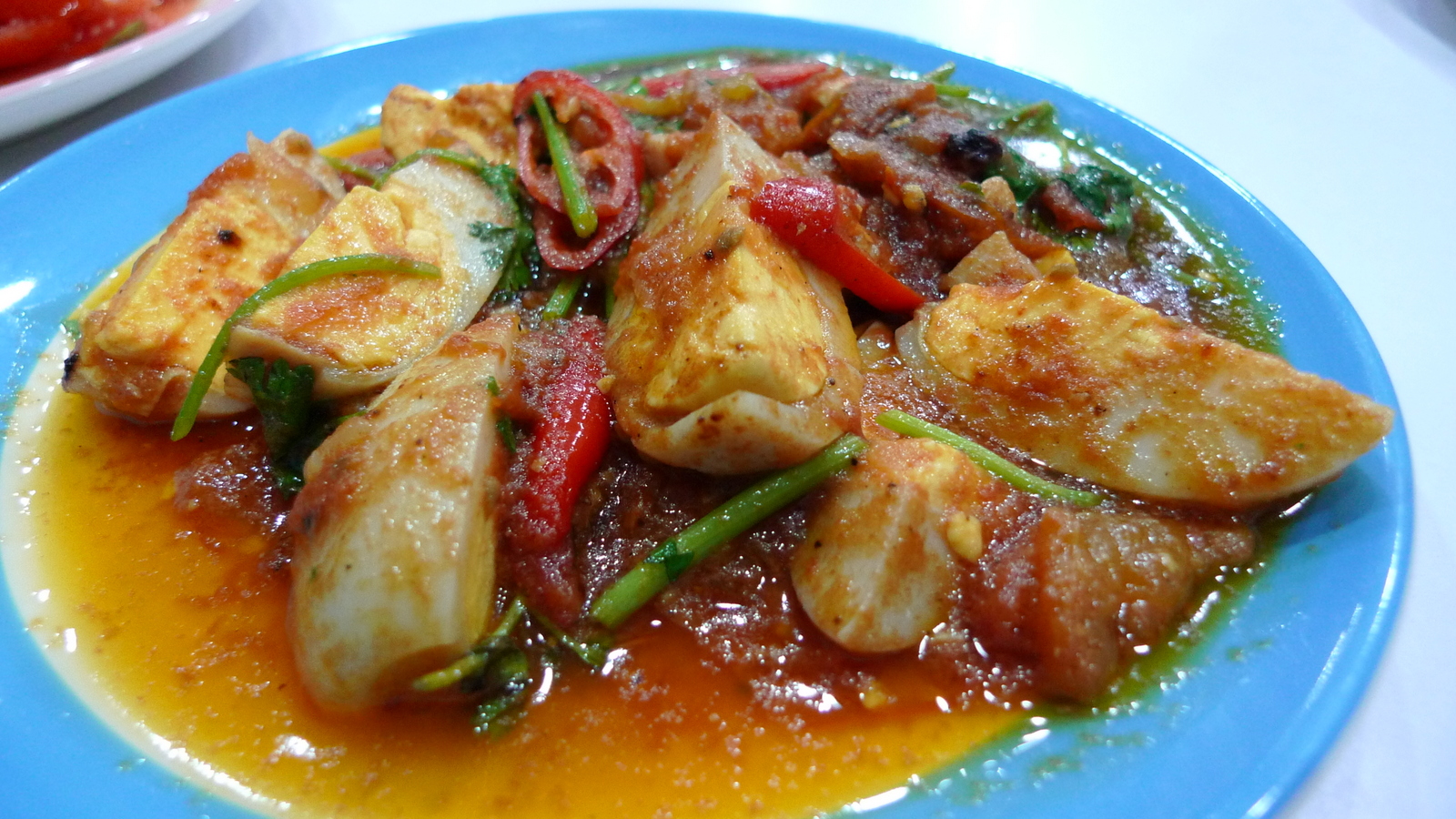
There was also a boiled duck egg curry dish that was tasty. While you see a lot of chilies in this (and other) dishes, they were not particularly spicy at least by the standards of Thai cuisine. As one Burmese friend described it, the food is more similar to Northern Thai cuisine than the super-spicy Northeastern or Southern Thai cuisines.

P1270789

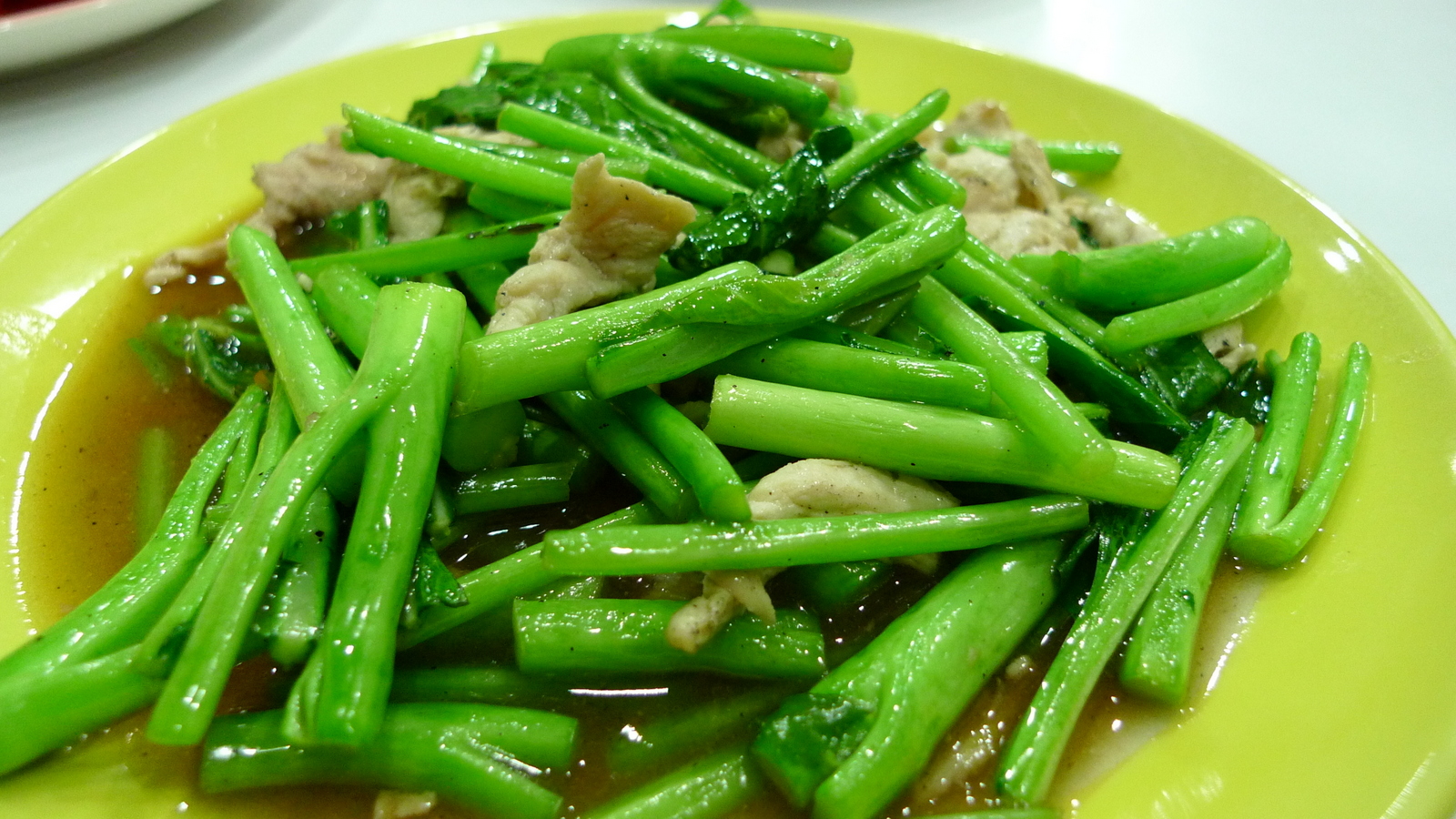
The only item we ordered off the secondary menu was this simple stir-fry of greens and pork. While the salads we ordered had lots of greens, it felt like another dish of vegetables would help balance things out.

This is probably only the third or fourth time I have eaten Burmese food, and the first time in more than a dozen years. Without a doubt, I need to seek it out more often!


Cooking Khao Soi with Chow

One of my favorite Thai dishes is khao soi, the curried noodles that hail from Northern Thailand. With a variety of textures and loads of rich broth, it makes a satisfying meal. Recently, my Bangkok Glutton friend Chow arranged for her aunt to share their family’s recipe for khao soi with us.

We returned to Chow’s kitchen to try our hand at recreating the recipe. While the results were good, it is safe to say that we are going to need a lot more practice before Chow’s aunt has anything to fear from our competition!

P1270118

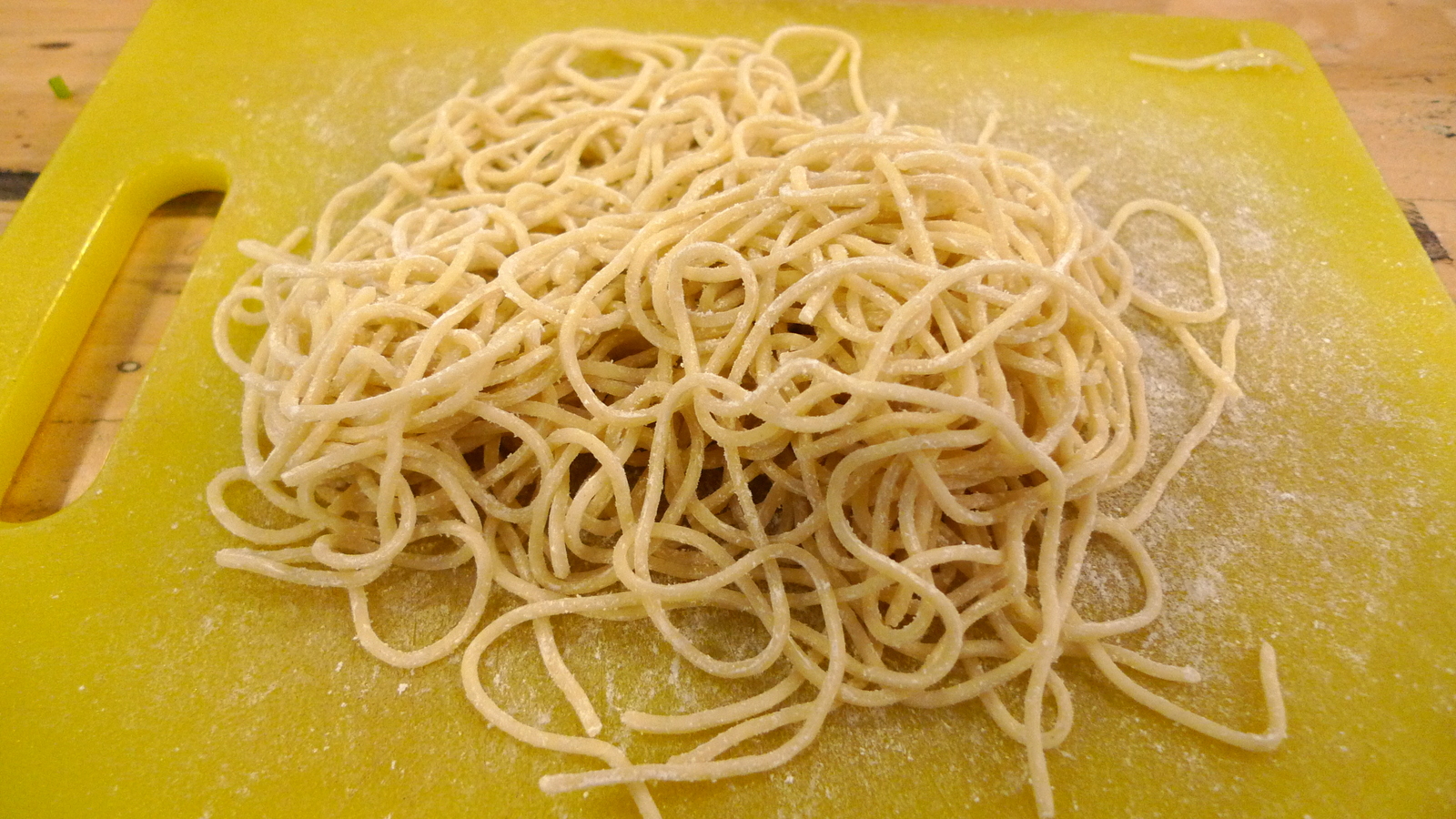
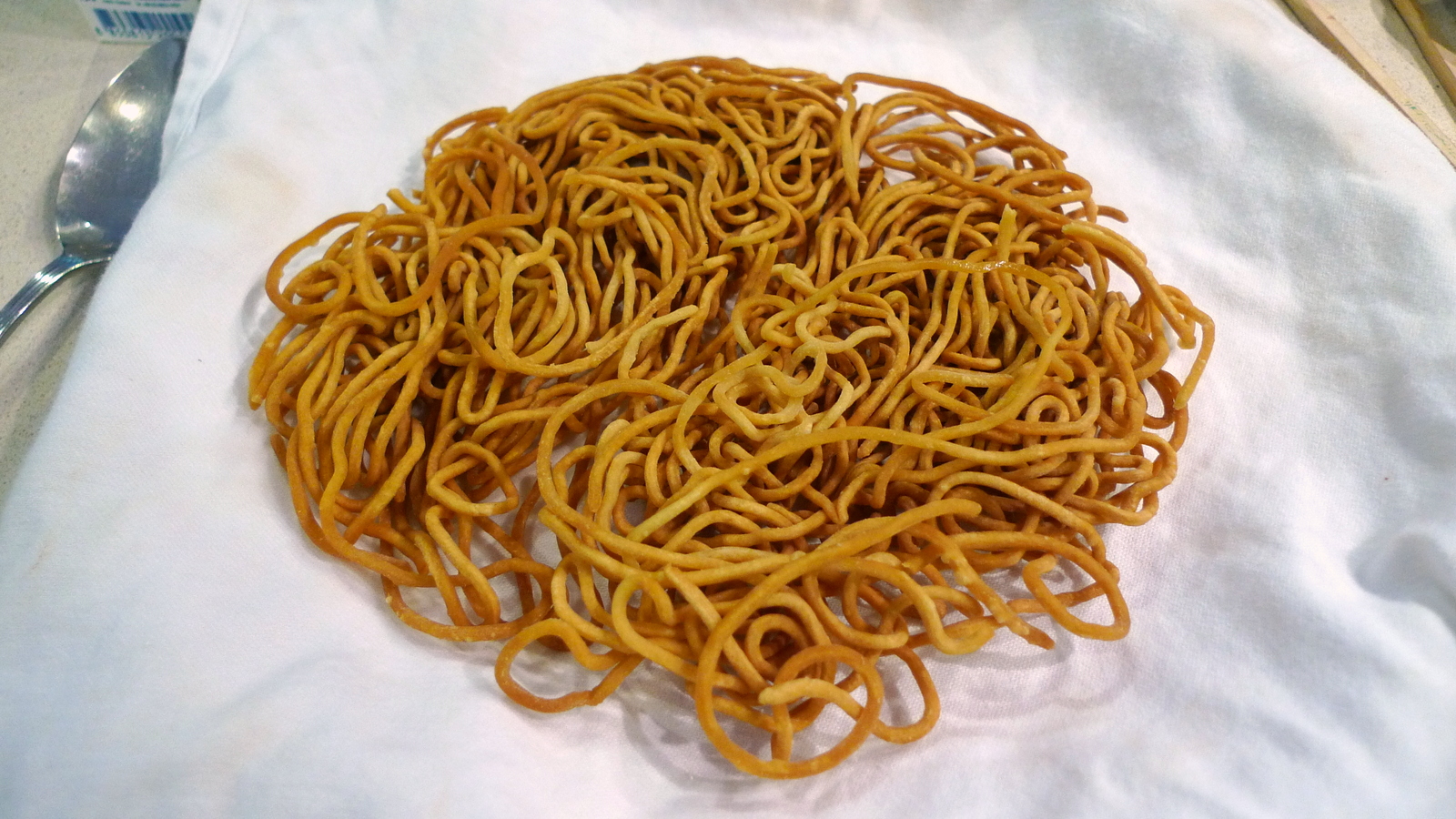
Khao soi is made with egg noodles. There are a variety of types, but if you have an Asian market in your city, any fresh egg noodles will do. The noodles are split into two batches: one that is blanched in boiling water and the other that is fried to make a crunchy garnish.

P1270115

The fried noodles are easier to make than I expected, not requiring much oil at all. The resulting crispy noodles are addictive. Hard to not eat them before finishing the rest of the cooking!

P1270112

The base of the khao soi is a yellow curry combined with a fried mixture of ginger and shallots. You can use any yellow curry paste available at your local Asian market. The better the quality paste, the better the flavor, of course.

Like many curries, coconut milk is added to create richness. You can use a “lite” coconut milk or add some broth to thin it out. For the meat, you can use any type of meat you like. Beef and chicken are more traditional but pork or firm tofu would be fine. The flavor of the curry might overwhelm shellfish, though.

P1270121

Like all noodle dishes in Thailand, proper khao soi is served with a variety of condiments. Here, you have dried chili flakes, chopped green onions and coriander, fresh shallots, chili oil, minced pickled cabbage (rinse off some sauerkraut as an easy substitute), and fresh lime.

P1270128

The end result looked fantastic and tasted good. Getting the proper balance of flavors – fish sauce and sugar need to be added to taste – is where the secret of a true khao soi master lies. Again, Chow’s aunt has nothing to worry about!

Visiting an Orphanage in Mae Sot

Last weekend, I traveled to Mae Sot, the largest town in Tak Province, Thailand. Situated on the border with Myanmar, Mae Sot is home to an estimated 100,000 Burmese refugees and immigrants – a number equal to the official local population. The purpose of the trip was to visit an orphanage and secondary school supported by some of my Singaporean friends.
20130714-2


The trip had a powerful impact on me and in the week since, I have spent a lot of time pondering how I can best contribute to improve the lives of these children. Perhaps the best way to share this experience with you is to post some pictures and write some explanatory thoughts.

20130714-14

Mae Sot is not a particularly large town. Nestled next to the border, it is common to see Burmese script on many signs and plenty of people are dressed in traditional Burmese outfits. The mountains of Myanmar are on the horizon and the gathering storm clouds seem to speak to the challenges that people on that side of the border face.

20130714-11


The orphanage is located in a residential neighborhood on one side of town. It is a typical Thai-style wooden house, built on stilts and with open windows for lots of ventilation. It cannot be much larger than 100 square meters (about 1000 square feet). The upstairs includes the kitchen, a small dining area, and two large rooms that are used as a multipurpose area and the girls’ dormitory. Downstairs, part of the area below the house has been bricked in and serves as the boys’ dormitory.

20130714-13

Approximately 60 children live in the orphanage, ranging from just under one year old to about thirteen. Technically, children could stay until age eighteen but they currently have no children that old. The orphanage is run in a very organized manner. Here, the children neatly line up their flip-flops on the concrete pad at the base of the stairs. As with all houses in Thailand, you do not enter with your shoes on.

P1270072

The orphanage is run by a Chinese-Burmese couple who spent many years living in Singapore, which is the connection with my Singaporean friends. Perhaps their sense of organization comes from having lived in Singapore! With no children of their own, the couple and four hired helpers take care of the orphans. While there are chores to be done, there is also time for fun. “Papa” plays the guitar and leads the children in songs and dancing.

IMG_7834

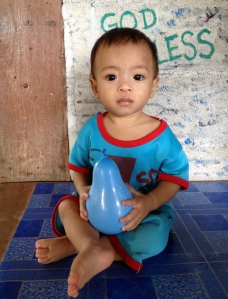
Extra effort is required for some of the children including the four youngest (all at just around one year old), two children who have polio, and a few children who have some developmental disabilities. While the amount of work may seem daunting, the systems in place allow the orphanage to operate efficiently and all of the children seem satisfied, cared for, and know they are loved.
20130714-17

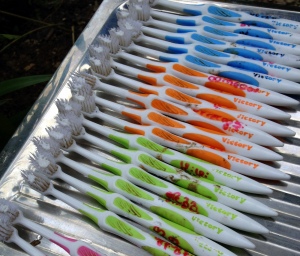
The details of the systems and processes intrigued me. Here, a row of toothbrushes are laid out in preparation for the after-lunch tooth brushing. While they are a bit worn out, each child has his or her own brush (names are written on them) and good hygiene is stressed.

20130714-15

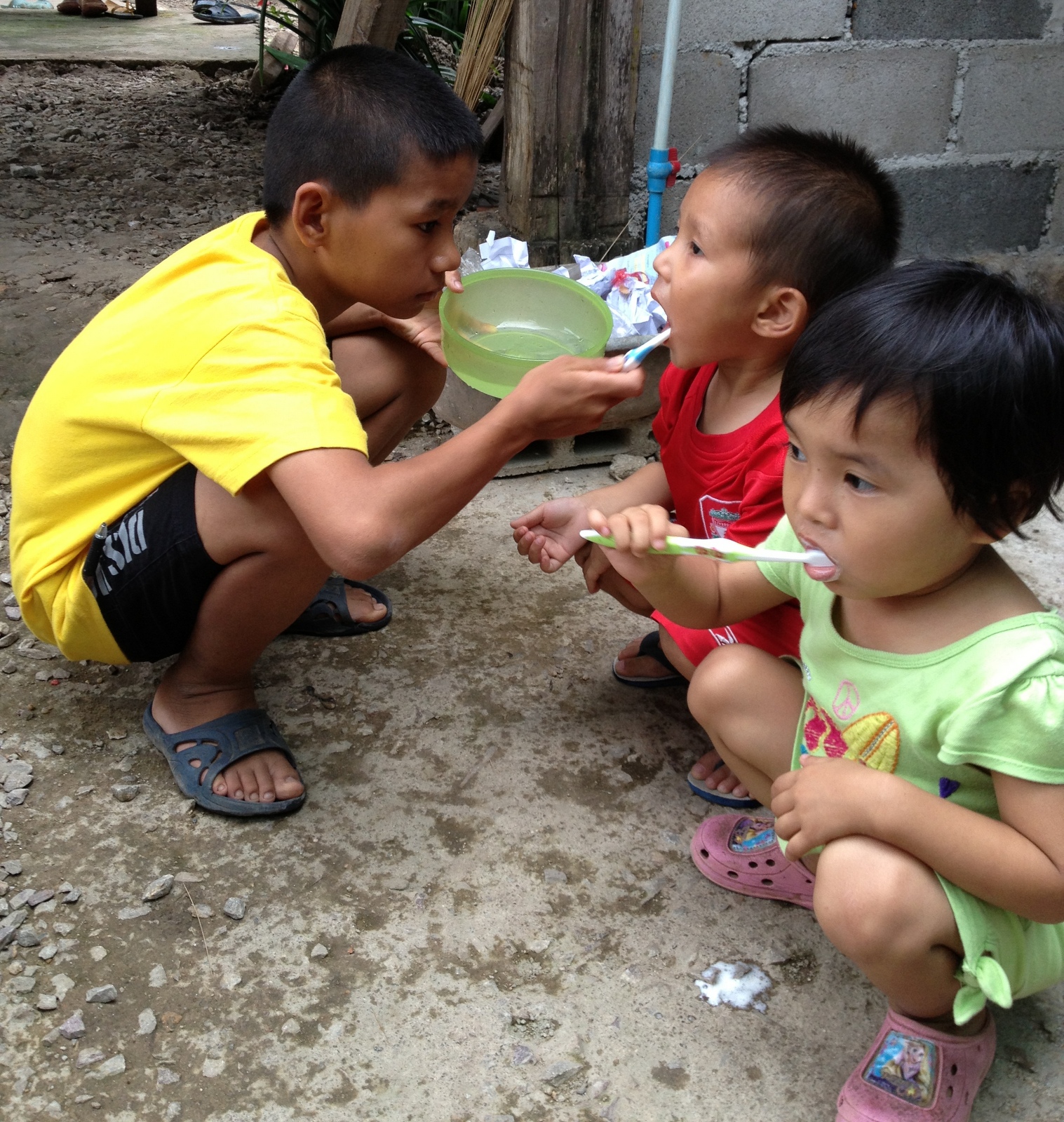
An important part of the process is that the older children help with chores and take care of the younger children. Two of the boys – brothers who are nine and ten years old – are responsible for ensuring that each child brushes his or her teeth and they help the younger children who have not yet learned how to brush. Time and time again, I saw children who were only six or seven stepping up to care for a crying younger child without anyone having to ask them. It made me realize that children in higher socio-economic situations are generally spoiled and not asked to contribute very much to the family in comparison.
20130714-10

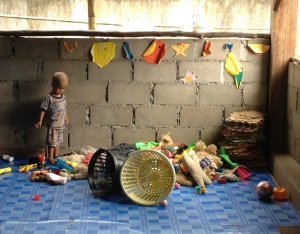
The children do have a play area, protected from the sun and with a good breeze. Many toys have been donated so there are plenty to choose from. Interestingly, I did not see many arguments or disagreements about toys. The children seemed to share pretty well.

20130714-16

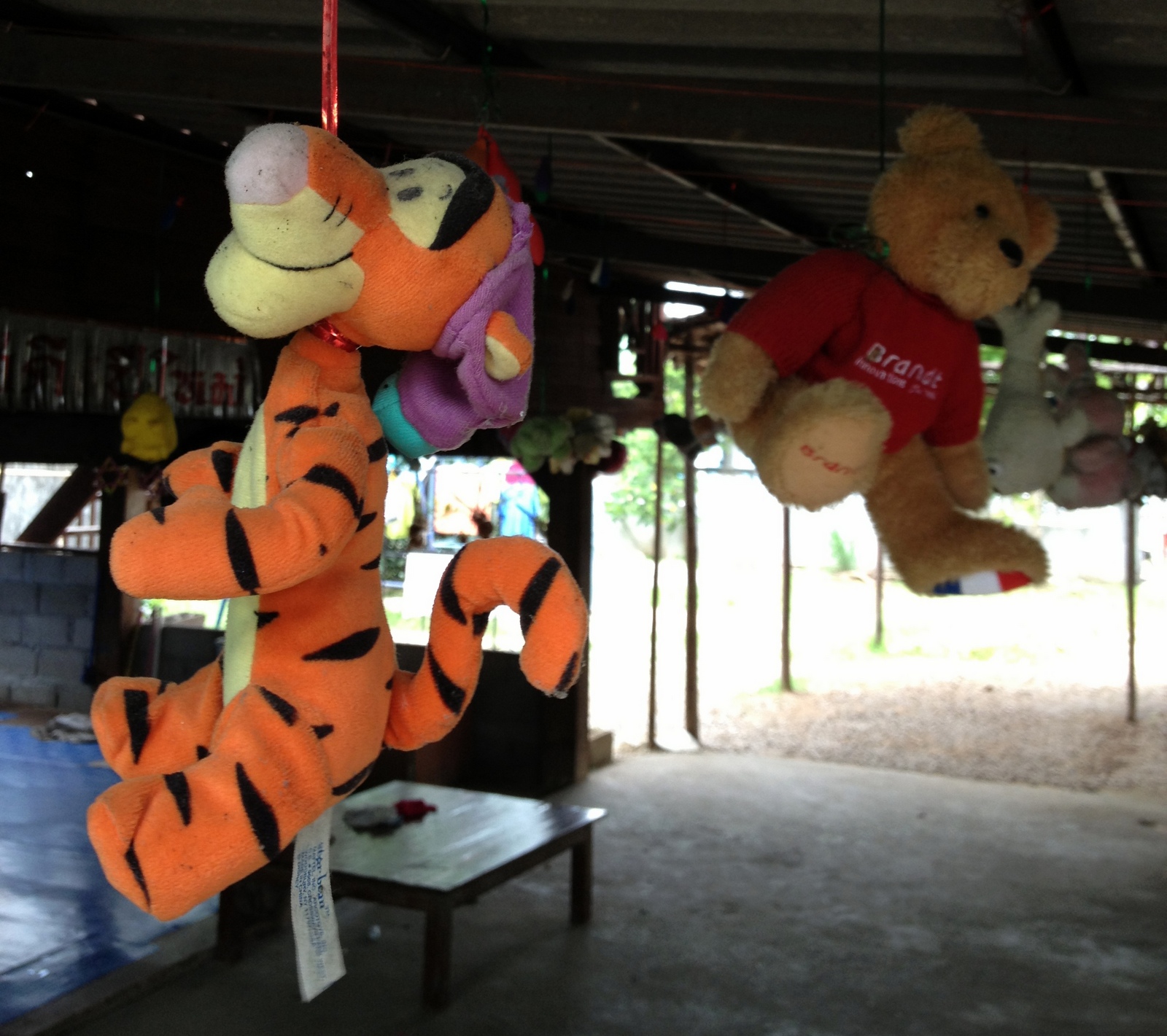
One macabre sight was the rows of stuffed animals hanging from the ceiling, like the victims of political violence by the Cartoon Network. The couple explained that while there are more stuffed animals than there are children, the stuffed animals resulted in possessiveness with children fighting over them. Instead, they are now suspended from the ceiling so everyone can see and enjoy them but nobody can claim them as their own.

20130714-7

While the older children (starting around age five) attend the local Thai public school, the younger children remain home all day. After their afternoon nap, they received a snack of crisps. They were generally quiet and reserved without the loud volume you might expect from a group of toddlers.
IMG_6612

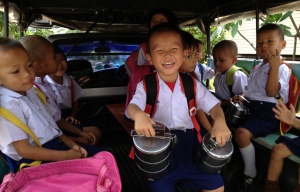
The second afternoon there, we rode in the back of the orphanage’s covered pickup truck to collect the children at school. This is done in two batches since there isn’t enough room for everyone in a single batch. This two-batch method works okay because the younger children finish school about thirty minutes before the older children. This young boy with the two lunch boxes was especially cheerful, a constant giggler. While almost all the children were friendly, they were also a bit shy and some would sit in the corner and hesitate to play. My impression is that their life experiences may have led to some emotional damage and they may hesitate to connect with others for fear of abandonment. Perhaps I am over-psychoanalyzing, though.

20130714-004


We also attended what could best be described as a day care. The couple responsible for the orphanage also set up a small outpost (a house and covered porch) on the other side of town, designed as a place to teach Burmese migrants to be community teachers. Most of the lessons they teach are Biblically-based but also include general life skills such as budgeting, parenting, etc. What they noticed was that children from the nearby families (all of whom are migrant laborers) would hang out at the covered porch and use it as a play space. So they engaged some volunteers to work as teachers and try to educate and feed the children every day.

IMG_7857

Since one of my Singaporean friends is a comic artist, he conducted a class for about forty children, teaching them to draw cartoon rabbits. The children enjoyed drawing and despite a lack of a common language, the instruction went well.

P1030830

All of these children speak only Burmese. Since their parents are mostly undocumented and are itinerant laborers, the children have no opportunity to attend school and, as such, will likely face a life of labor themselves. Not realizing at first that they didn’t have any formal schooling, I tried speaking to them in Thai but that wasn’t any more helpful than speaking to them in English. Here, I struggle to help one student sharpen his pencil with a cheap plastic pencil sharpener.

P1030967

The third place we visited is a secondary school or, more accurately, an official “learning center”. The school serves about 100 students, all of them the children of refugees or migrants. While licensed by the Thailand Ministry of Education, it isn’t an official school because they teach outside the proscribed curricula. Classes are conducted by five teachers in English and Burmese. A series of volunteer teachers also visit for month-long stints from universities in Hong Kong and elsewhere.

20130714-5

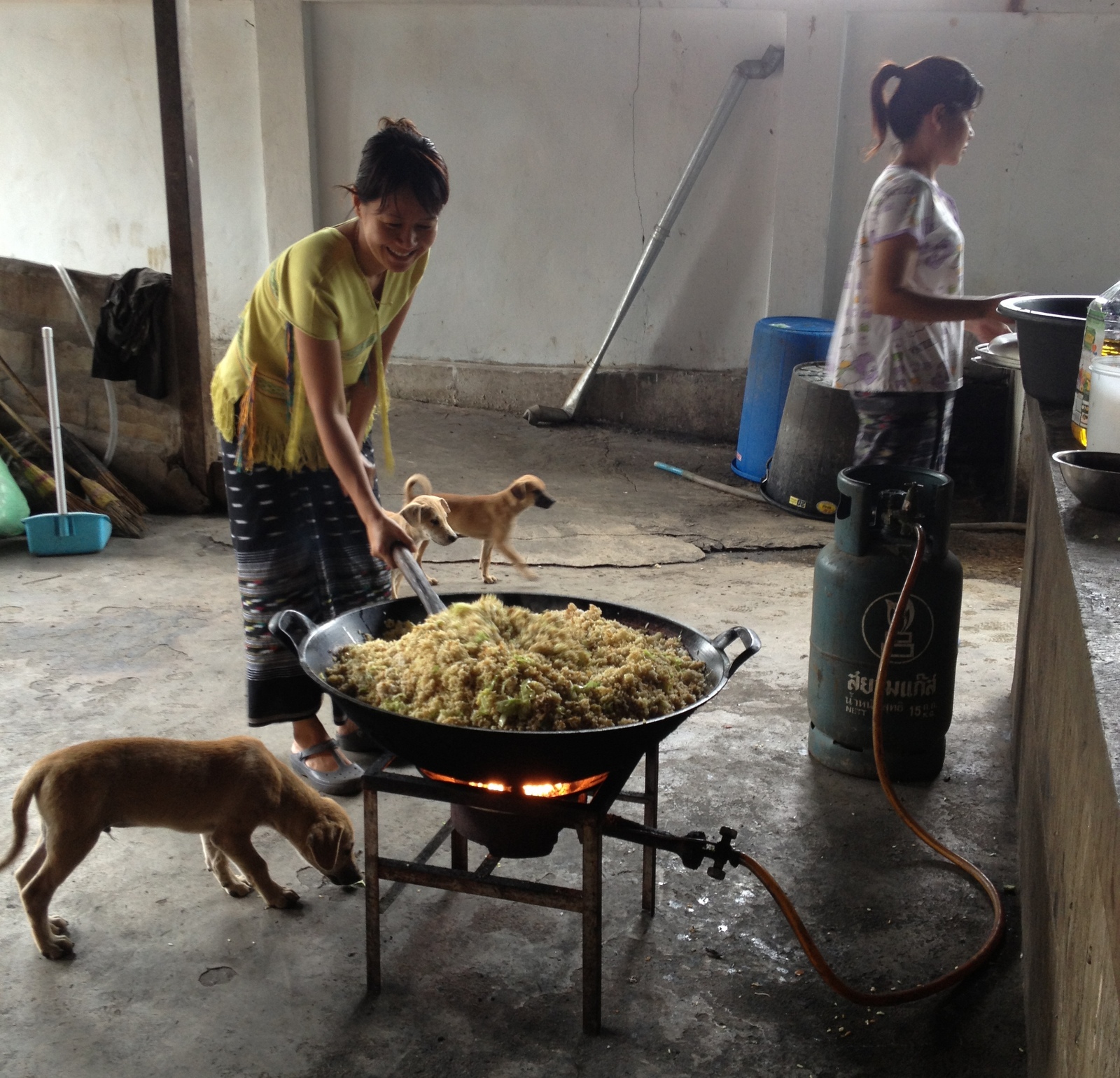
The school boards all of its students. It is located on the outskirts of the city, past an immigration and police inspection checkpoint. Most of the students are undocumented so it is not practical for them to come to school each day so, instead, they just live there. The teachers prepare food for three meals a day. Here is a large batch of fried rice, a very simple lunch. Most weeks, there is the budget to only have meat – chicken bones, for example – about once a week.

20130714-6

The school, along with the orphanage and day care, runs on a very tight budget. This picture is of an enameled metal bowl that is used in the school kitchen. It has been used so long that it has literally worn through in spots. Speaking with the schools’ volunteer director, a young European woman who has been there three years, the list of “nice to haves” include things like new bowls, plastic hangars, and sponges, but that they generally only have the money for necessities.
P1270084


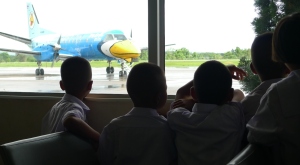
On the afternoon of our departure, several of the older children from the orphanage rode with us to the airport, a chance for them to see an airplane and wave goodbye. As for me, I think it is not “goodbye” but “until next time” because I plan on returning soon.

More importantly, I am going to look for ways to help, whether that is by gathering funds and supplies or by raising awareness. Yes, the world is full of people who need help. These three places seem to be very well-run, doing good work with minimal (maybe even non-existent) overhead, and strike me as a good place to try to make a difference.

 

Two Beautiful Shots of Bangkok

Turning away from the politics, the Xanga fundraiser, and all that serious stuff, I just wanted to share with you two pictures of Bangkok taken the past few days. This isn’t a particularly pretty city, but these two pictures do manage to capture the city’s nicer side.

Taken by visiting Singaporean friend David Chein (follow him on Instagram at davidchein), this is a view of Lumphini Park taken from the Dusit Thani Hotel. On the left side you see the Silom Skytrain line running past the headquarters of the Thai Red Cross. In the distance are the upscale hotels and offices in the Ratchadamri neighborhood. In the foreground is the statue of King Rama VI, which sits at the corner of Rama IV and Ratchadamri Roads. We have had strong winds the past few days so very little haze.
Late yesterday afternoon, I took this picture of Terminal 21, a mall, office tower, and service apartment complex located at the corner of Asoke and Sukhumvit Roads. With the setting sun behind it, the building took on a glow that looks just like a computer illustration. It was a real photo, though!

Pictures like this remind me that while Bangkok can be a bit scruffy sometimes, there is still beauty to be found.


Rainy Season in Bangkok

About six months of the year. That’s how long our rainy season lasts here in Thailand. Starting in May and concluding in October, nearly every day sees some precipitation. 

A typical Bangkok afternoon this time of year looks like this. Big, ferocious clouds darken the skies. They move quickly, forming close to the ground like wisps of steam in reverse. The wind begins to pick up, a sure sign that rain is imminent. In fact, with the picture above, while I had a good view at least a kilometer down the tracks, within ten seconds (literally) of taking this picture, the rain had started and within thirty seconds, the view had diminished to what you see in the following picture.

The rain came down with such force that visibility was reduced to just a few hundred meters. Anything beyond that was lost in the grey mists. Thankfully, I was at the Skytrain station and could sought shelter. 

The intensity of our storms is often matched by a surprising brevity. I boarded the train within two minutes of the storm starting. It took eight minutes to travel west four stations (less than six kilometers). I exited at Phloen Chit finding the rain finished, very wet pavement and large puddles the only signs of its visit. That is the nature of our rainy season – one corner of town will receive a downpour and another corner is enjoying sunshine.


In terms of volume, there are peaks at either end of the season. So far this year, we have had pretty normal rainfall. Look out for September, though! While this amount of rain would probably drive lots of people (except those from Seattle) crazy, I actually like the rainy season. Yes, there are the flooded streets and the torrential rains for which an umbrella does absolutely no good. But the cloudy skies offer a respite from the otherwise cruel sun and the breeze usually picks up, helping lower the ambient temperature.