Is there any doubt that the holidays are just around the corner? All over the Big Mango we’re seeing signs of the holidays:
Twinkling lights, which are already popular here, are in even greater abundance.
Gift baskets, the staple of New Year’s greetings especially in business, are being put together, cellophane wrapped and set out for sale. (Below left)
And the random ornament displays have been set out, including this huge deer head with psychedelic antlers which we spotted at the J Avenue “lifestyle shopping centre” on Soi Thong Lor. (Below Right)
Everywhere we go, Christmas music is playing. It is very festive and not just a little strange, considering that Christians make up less than one percent of this country’s population.
But here’s the deal: Buddhism doesn’t have any catchy holiday carols. Sure, there’s the chanting, but where are the Wan Makha Bucha carols? Sadly, there aren’t any.
We’re preparing for our sixteen day trip in the United States, for which we depart a week from Thursday. So much to be done beforehand and we have several projects that we would like to wrap up before that departure.
We’ll see. If there’s anything I’ve learned in Thailand, it is to not get my heart set on having something done by a particular date.
Today is the 81st birthday of His Majesty the King of Thailand, Buhmibol Adulyadej. Born in 1927 in Cambridge, Massachusetts, HMTK has reigned over the Kingdom of Thailand for more than 62 years, making him the longest-reigning current monarch in the world.
Those of you who haven’t been to Thailand may have a difficult time fully appreciating the level of respect Thais have for their fatherly monarch. His image appears on all the currency, there are portraits of the King and the Queen in almost every home and business, and the royal anthem is played before movies and all performances.
Unlike many countries where the leader’s visage is so widespread (what was that European country where the leader named one of the days after himself?), the Thai people’s affection seems very sincere and genuine.
This seems difficult for most foreigners to believe and I regularly encounter people – both expats and visitors – who insist on asking about “the truth about the King”, and usually do so in public and in front of Thais. Needless to say, this is highly taboo, not to mention illegal. If you want to show good manners while in Thailand, please don’t make Thais uncomfortable by asking them probing questions about the monarchy, especially in public and in front of other Thais.
After six decades of leading the nation, the King is seen as a beacon, something constant amidst the ever changing tides of Thai politics.
To that end, he annual birthday message, which he delivers on the eve of his birthday, is widely anticipated. What will he say? What guiding lessons will we receive? The anticipation was all the higher this year after the resolution of the airport seige just three days ago.
So it was with great disappointment that the public learned that His Majesty was feeling unwell and did not have the strength to make a public address. He sent two of his children, the Crown Prince Vajiralongkorn and the Crown Princess Maha Chakri, to receive the public’s well-wishes and to return them.
So we will wait with baited breath until HMTK is well enough to address his subjects.
This morning while out on an early morning bike ride, I came across a community event in a dead-end street down near the river. The local emergency corp and all their volunteers were celebrating HMTK’s birthday. After a short parade they made merit for the King, said an oath of loyalty to him, and then sang the royal anthem.
An update: The airport is still closed. The anti-government protesters attacked a police checkpoint and confiscated ten vehicles and the riot gear inside. But, in a telling twist, the protest leaders also had a face-to-face meeting with the police, asking for their increased protection. This after a bomb was thrown at their protest at Government House, injuring fifty people, four seriously.
Airports of Thailand, the semi-public company that runs Suvarnabhumi and Don Meuang airports, reached an agreement with the protesters to allow pilots from the various airlines to ferry the 88 airplanes that are stranded at the airports, out of the country. The protest leaders agreed to this because they didn’t want to be responsible for any vandalism that might happen to the planes.
Pro-government protesters gathered in front of Bangkok City Hall and they promise to take back the airport if the police can not or will not. There are calls for exposure of who is actually supporting the anti-government protesters, suggestions that they must be supported by very influential members of Thailand’s elite if they are allowed to act with impunity for so long.
Much seems to hinge on Tuesday’s Constitutional Court verdict in a case about voter fraud. Three parties, including the government majority party, the PPP, are facing dissolution. This might pacify the anti-government protesters who might then clear the airports. But the pro-government faction sees a potential “coup by court” and is already saying they will fight any miscarriage of justice.
Can it continue? Many observers say it will have to come to an end by Friday, December 5th – His Majesty the King’s 81st birthday. But who knows what will really happen?
But that’s just the headlines. The real story is what’s happening with the tens of millions of Thais who are not protesting. A poll published this morning shows that 92% of Thais surveyed think both sides should put their differences aside for the good of the country. 76% see it as “a national shame”.
A few days ago, Ajarn Yai, the former director of the school where I volunteered as an English teacher, called Tawn. She wanted to convey her apologies to me on behalf of the Thai people, but was too embarrassed to call me directly. She said that if I had any guests in town, I should bring them down to Samut Songkhram province and she would entertain them.
Ajarn Yai (“Ajarn Yai” means “big teacher” in Thai) asked whether Trish was still in town. She was relieved to hear that Trish had made it out in time and said that if Trish was still in town, she would have offered to have Trish stay with her for a few days, to take the burden off of me.
That’s sweet, isn’t it? And very telling.
Here’s the top-of-the-fold story in this morning’s The Nation, one of the two English-language papers here in Bangkok. They say a picture says a thousand words and in this case, it is probably more like a full novel about Thai culture.
What you see is a traditional Thai dancer (Tawn is pretty sure she’s a he, though) entertaining crowds at U-Tapao Airport. U-Tapao is a miltary base about 190 km (two hours’ drive) southeast of Bangkok, built by the Americans during the Vietnam War. It is being used for some flights to get stranded foreigners out of the country, but it has no commercial facilities and can only handle about 40 flights a day compared with Suvarnabhumi’s 700. They’ve had to bring in porta-potties so the crowds can relive themselves.
Passengers are checking in at one of the hotels in town, the Centara Grand, and are being bussed to their flights. They have to check in at least five hours before their flight. THAI Airways, as you can see, is making an effort to make the experience a little less painful, by providing some entertainment for the crowds. A story in The Nation also told about how THAI employees are pitching in to help with the chaos at the hotel check-in area, with flight attendants comforting passengers and employees’ mothers making food for the ticketing agents, who can barely leave their posts.
Tawn had to laugh when he saw the picture in the papger. “That’s very Thai,” he said. And it is true. It says so much about Thai culture. First, to their credit, the Thais are very gracious hosts. They try to make every experience pleasant and so by trying to entertain their guests and show some beauty, they are making the best out of an improbably difficult situation.
The flip side to that, the one that can make non-Thais jai rone (hot headed), is the sense that in a completely out-of-control situation, effort is being expended on some window dressing rather than actual solutions.
I’m an optimist, though, so I see things through the first point-of-view.
That said, Boon and David had to fight a chaotic crowd to get out on a flight at U-Tapao yesterday, Markus had to take a 10-hour van ride to Phuket to catch a special Lufthansa charter to Frankfurt, Anthony and Francis are still uncertain if they’ll be able to leave this evening on their re-scheduled flight, Brian is still stuck in Hong Kong and Ken is stuck in Chicago, both unable to return, and I personally know of at least eight people who have cancelled trips here.
Tawn and I agreed that if the airport is still shut down on December 18th when we are scheduled to fly to the US, that we’ll change out ticket to one-way out of the country.
After twelve days in Khrungthep, Trish wrapped up her trip. On her last night here, Trish had some unfinished business: a return trip to the Erawan Shrine. A Brahman shrine located on the property of the Hyatt Erawan Hotel, the Erawan Shrine is a popular destination for visitors and Thais alike.
The shrine’s reputation is for granting wishes. You come and make offerings and say prayers to each of the four faces of the statue of Brahma. As part of making a wish, you must state what price you are willing to pay if the wish comes true. Traditionally, wishers will make some sacrifice or suffer a hardship.
For example, before Tawn took his university entrance exams (in which he had to select which schools he would apply to), he promised that if his wish came true, he would walk all the way home from the shrine (a distance of about ten kilometers). The most common price to pay is to return to the shrine and hire a troupe of classical Thai dancers to perform for Brahma.
On her first visit two years ago, Trish gave offerings to Brahma and made a wish. Since her wish came true, she returned to the shrine and hired the dancers. When faced with the dilemma of how many dancers to hire – four, six or eight – she went for the full troupe.
Joining us was Biing, who was also on his final night in Khrungthep. As coincidence would have it, both Biing and Trish were scheduled on the same flight to Taipei, although Biing was staying in Taipei for a few days as Trish continued back to the US.
Tawn was under the weather and couldn’t join us, but we had a nice dinner at the Jim Thompson Cafe located off Sathorn Road.
This is the same “Jim Thompson” as the silk company, which provided a fitting end to Trish’s trip as she spent a lot of time at the Jim Thompson shops looking at and purchasing silk.
We had an excellent dinner and probably ate too much. Here’s a look at what we enjoyed:
From the upper left, clockwise: Appetizers – chicken wrapped in fragrant pandan leaves, crab cakes with mango sauce; roasted duck in red curry, deep-fried shredded catfish with lemongrass and green mango, stir-fried beef with black pepper sauce, and Northern pork and chili dip with vegetables; Desserts – rice dumplings with candied fruit, lychee and orange with shredded green mango; Homemade coconut ice cream.
Friday morning before driving Trish and Biing to the airport, Trish modeled some of her finished clothes. Unfortunately, we didn’t have time to shoot all of them, so she has promised to send me copies when she does her complete shoot in a month or so.
Many people expressed interest in more information about Trish’s company. As things get up and running, I will share those details with you.
So what’s next? No sooner has one guest left than more arrive! Sunday we had lunch with some of the usual suspects plus a trio of visitors from the US, friends of Markus and Stuart.
We had a wedding on Friday night (more about that later), a get together with one of Tawn’s university classmates who is in town from Australia, and I’m busy getting ready for Thanksgiving dinner, which we’ll hold next Saturday.
Let me go back into the details about our trip to Burriram province, with our friend Trish.
We went up to this province about five hours to the northeast of Khrungthep, to locate sources of silk for Trish’s new custom-made dress business. Many of Thailand’s provinces are known for their silk, but the Nakhon Ratchasima (aka Korat) and Buriram provinces are known for their high quality and simpler styles. Provinces in the north of the country have more decorative styles of weaving.
While there, we visited several silk shops and a factory, we had a brief visit with some of Tawn’s relatives, and we went to see some ancient Khmer ruins. Here are the details:
Silk, Silk Everywhere
After visiting a few different retail silk shops, Tawn was able to get hold of one of his cousins, who recommended a particular silk factory located in Pak Thong Chai (see map above) with whom she’s worked before. Tawn called the factory, which was not far away, and one of the employees met us at the silk shops to guide us there.
Located a kilometer back from the main road in a nondescript and unmarked set of warehouses, the factory was much different from what I had expected. I shot a lot of video footage and will find the time to edit it in the next week or so, but in the meantime let me share some photos with you.
The owner walked us through the entire production process and was happy to have me take photos.
Raw silk hanging in hoops before being dyed.
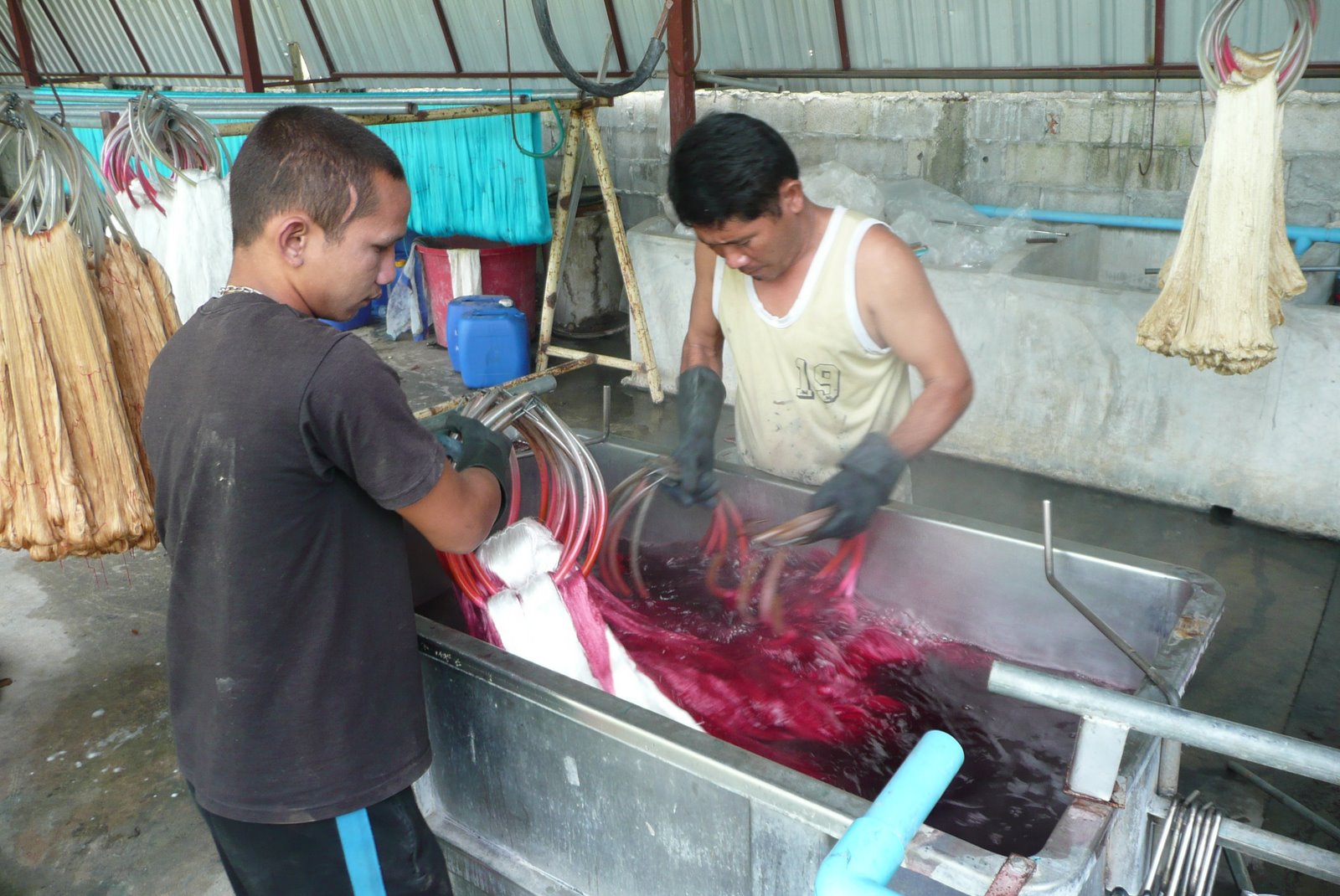
The silk is manually dyed, relying on the skill of the workers to match a particular shade.
A row of drying silk that has been dyed a brilliant turquoise blue.
Trish and Tawn watch the dying process.
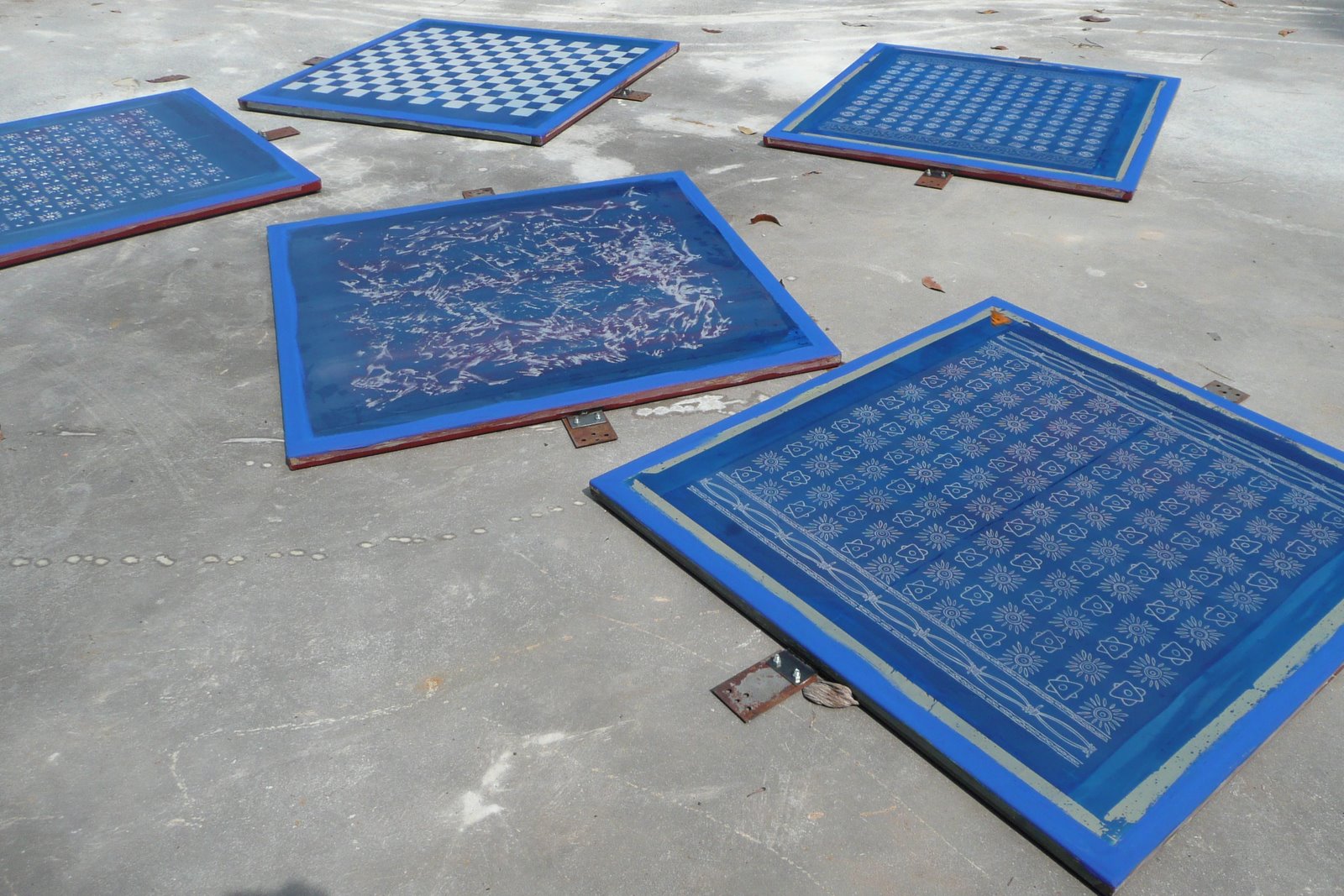
Custom made screens used to print patterns on the silk, hence the term silk-screening.
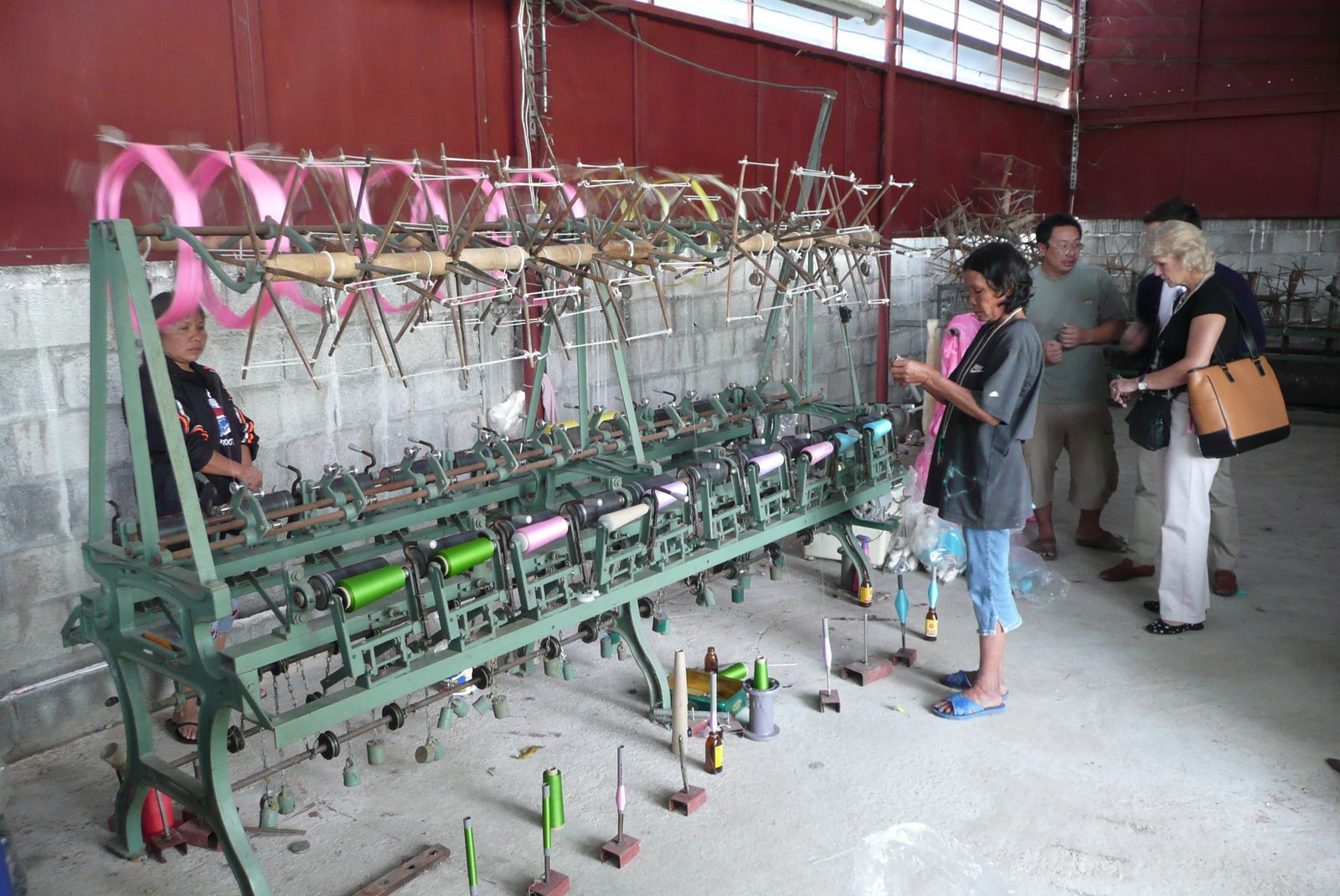
Dyed threads are wound onto spools.
The looms, which are automated but require the constant attention of workers.
The factory manager explains the process to Trish and Tawn.
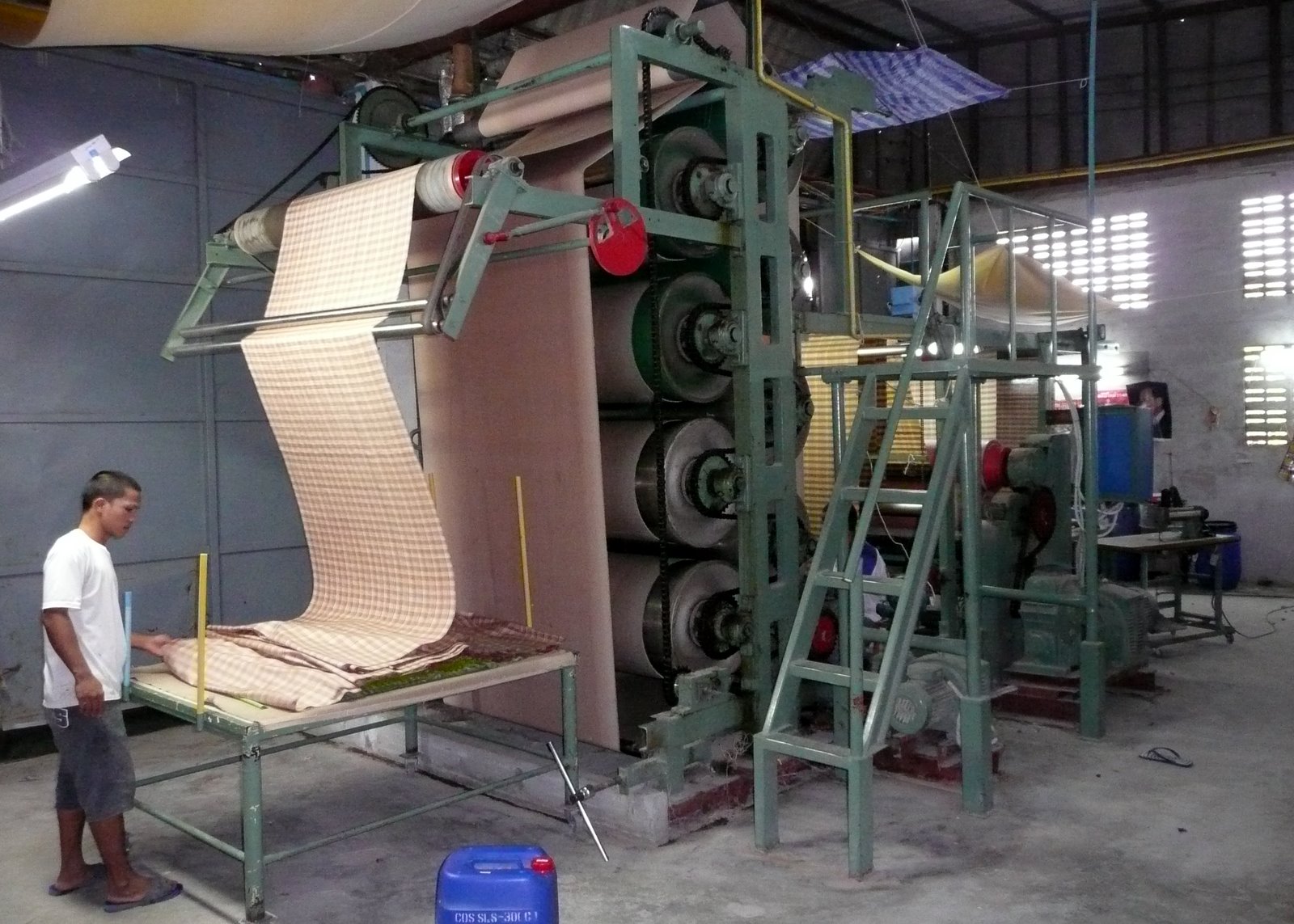
These heated rollers finish the silk, making it smoother to the touch.
Finally, sample batches of silk for Trish to sort through.
Here’s a video that runs down the process.
We spent three hours at the factory that first day, learning about silk, looking at different colors and patterns, and finally making clear what it was we were looking for.
By the time we left for Buriram, the sun was already setting.
Buriram
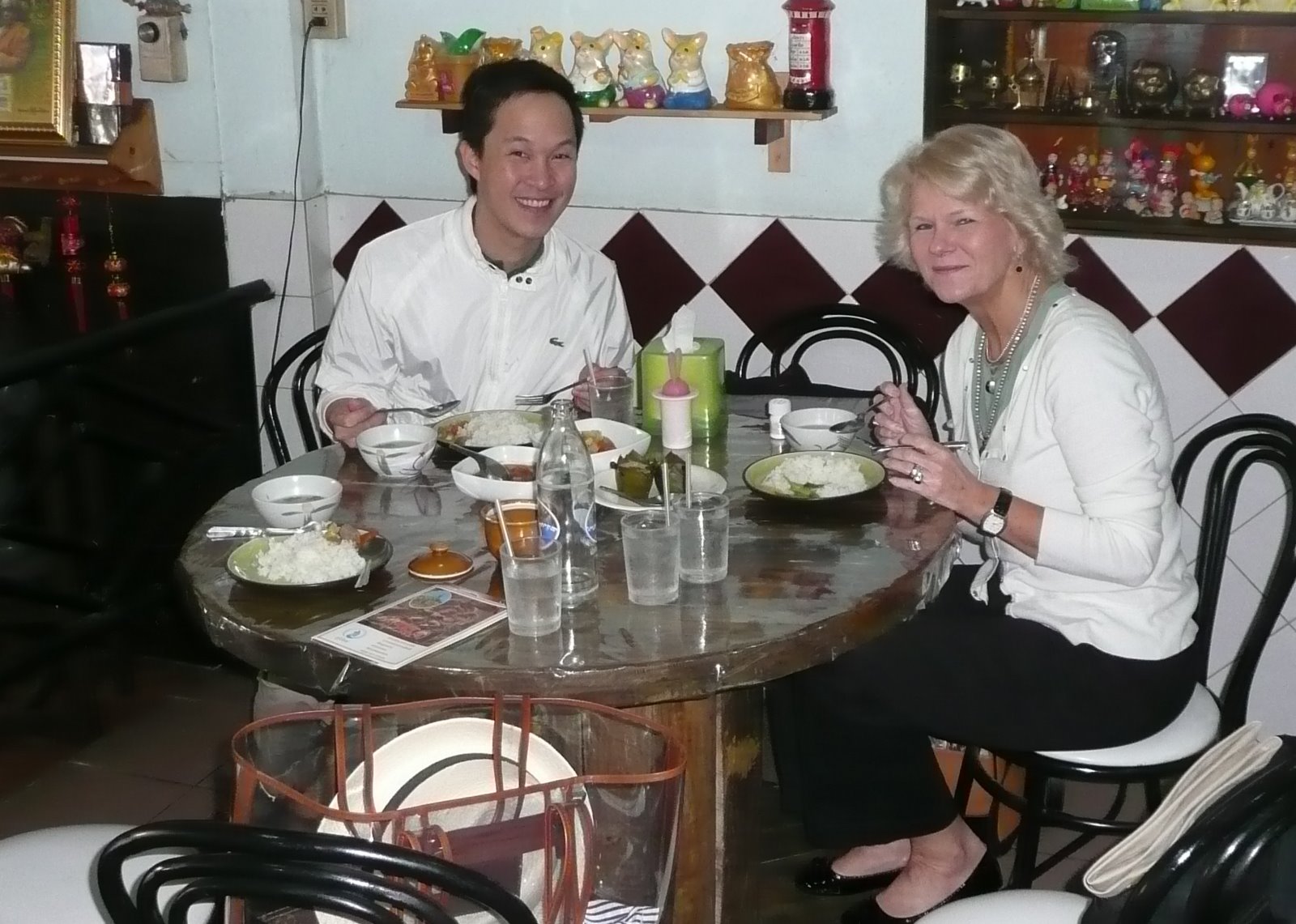
Saturday morning we started with an early breakfast at a restaurant owned by one of Tawn’s cousins. A typical Thai restaurant, there were shelves and shelves filled with kitchy collectables, below. Trish had her first authentic Thai breakfast, various gap khao (“with rice”) dishes including some fried fish, a curried fish mousse and mixed vegetables.
Our tour guide, a friend of Tawn’s cousin, met us at the restaurant. She is a retired primary school English teacher, so spoke English well enough to comfortably make corny jokes.
Our destination was Phnom Rung Historical Park, located just 30 km shy of the Cambodian border south of the main city of Buriram. This Khmer style Hindu temple dates back to the 10th century and is one of the best-preserved examples of Khmer architecture in Thailand.
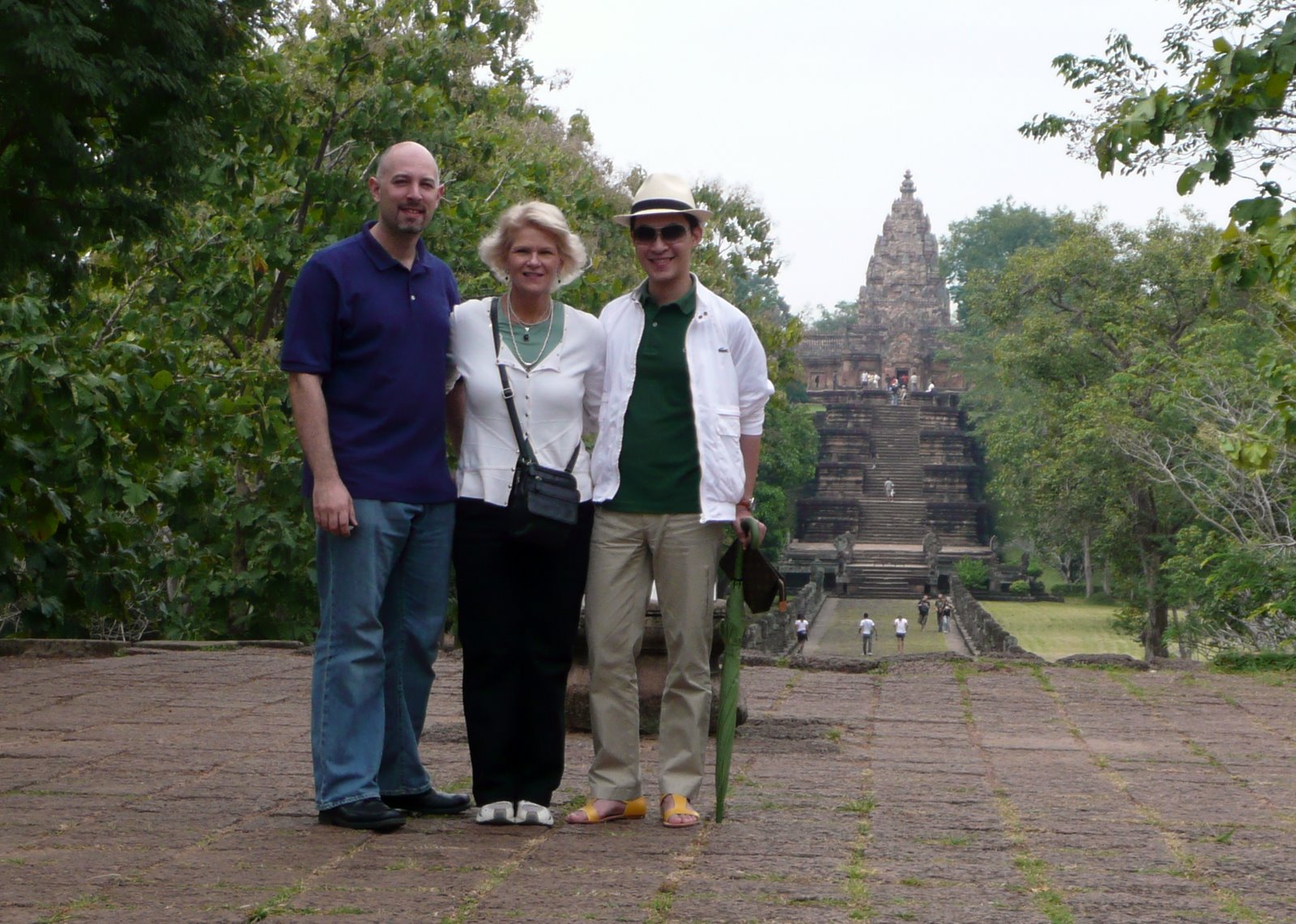
We stand at the far end of the promenade, a quarter-mile long processional walkway that connects the lower stairway with the main temple complex.
Standing in front of the main temple complex and the second naga bridge. You see two of the four pools of water that represent the four oceans and the raised platform represents the bridge between the human realm (between the four oceans) and the heavenly realm, where the temple is.
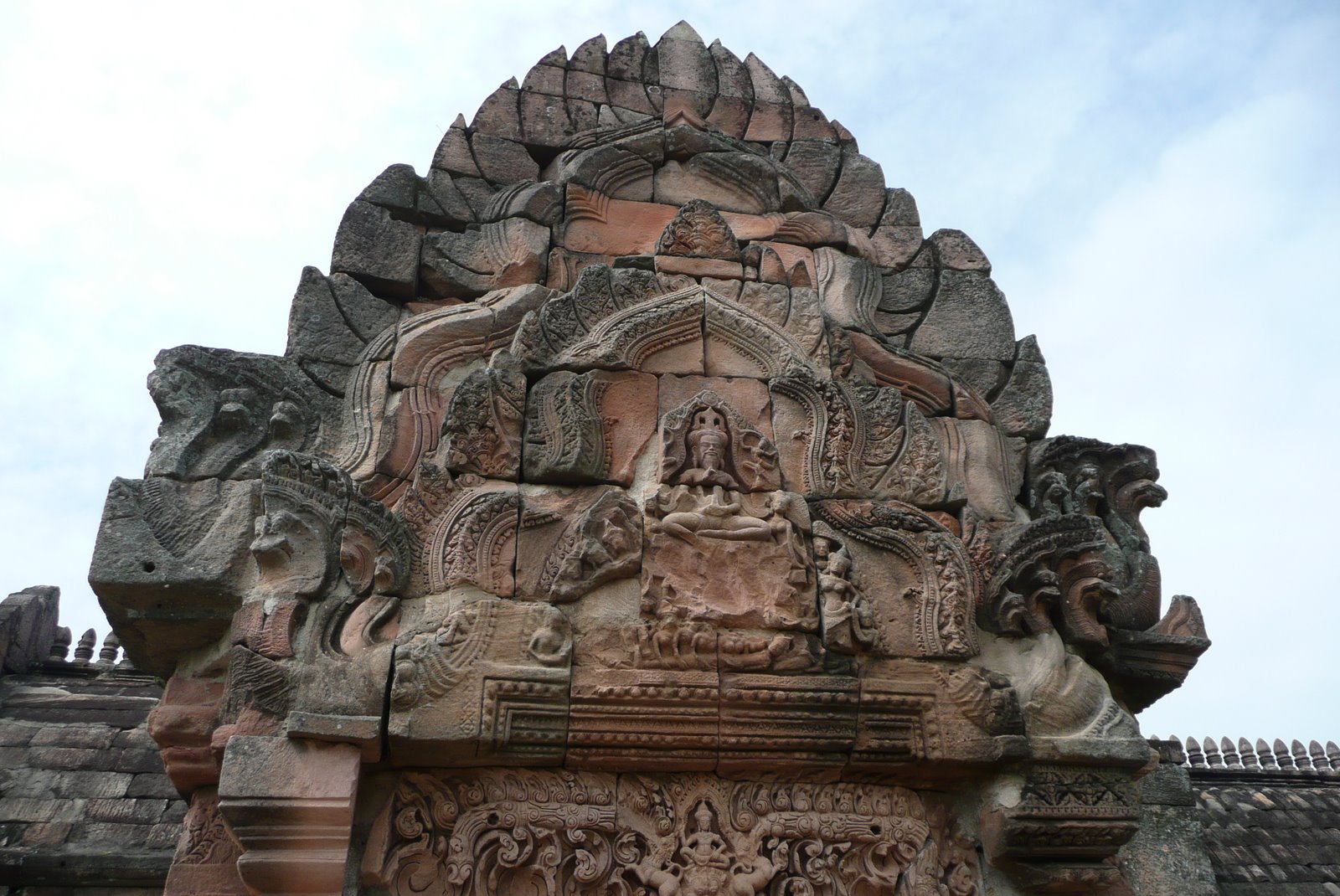
The amount of symbolism in the construction of the Hindu temples was amazing. This is the main tower, or prang. It is covered with depictions of gods, humans, hermits, snakes, dragons and all of manner of beings. Our tour guide spent about ninety minutes giving us the run-down on this temple and afterwards explained that she had exhausted maybe only ten percent of her knowledge about the temple.
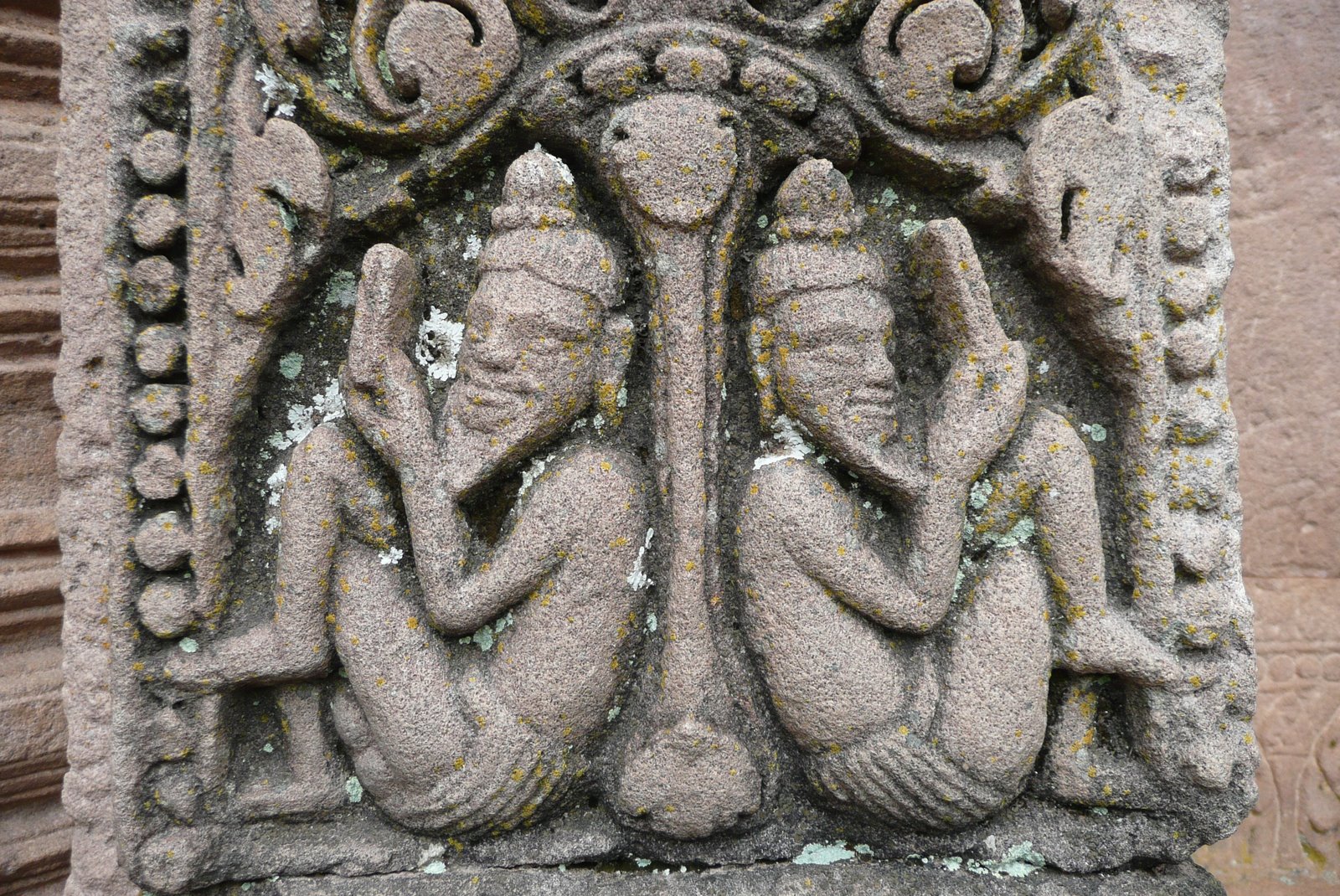
To give you an example of the sort of knowledge she had to share, she explained that this detail (it shows an area about the width of two hands) showed two hermits reading copies of Playboy magazine. One of the hermits, she said, was obviously not wearing any underwear.
Can you see which one doesn’t have any underwear? (Answer at the end of the post.) This was the type of humor we enjoyed all morning.
The construction of the temple was amazing. It is made out of sandstone and instead of carving blocks then putting them into place, they instead stacked all the blocks (which were not always regular sizes) and then carved away to reveal the detail they wanted.
In this picture, you can where the blocks were carved to make the steps. The block in the center top of the picture has many different faces as it was carved to be part of two separate steps as well as the adjacent wall. This made the construction all the more difficult.
Detail of the principle prang. This temple was primarily devoted to Shiva, one of the supreme dieties of the Hindu religion. Shiva is depicted in the center of this panel. Remember that with the way the temple was constructed, this was just a solid stack of limestone blocks. The artisans had to chisel away to make all the ornamentation. Because of that, mistakes could not be undone as there was no practical way to remove a block and replace it. I think that makes the detail all the more amazing.
Like most historical sights, there is a lot to digest and after a few hours, a break is needed. Since we had only a limited time in the province that weekend, we wrapped things up and dropped our guide off in the main town of Buriram just after noon.
Back in Town
After a quick bite of bami moo daeng – egg noodles with barbeque pork – we stopped by a local coffee shop for a latte. So far we had consumed only Nescafe, which isn’t real coffee even though it seems to be the national coffee drink of Thailand.
We found a “real” coffee shop that had espresso machines, but when we asked for lattes the young lady said they couldn’t do lattes as they didn’t carry fresh milk. Strangely, though, they offered cappuccinos. Tawn inquired how they made cappuccino with no milk and she pulled out a pitcher of sweetened condensed milk.
Really wanting my afternoon latte (which my Italian cousin will no doubt shake her head at, as espresso drinks with milk are strictly for the mornings, right?), I asked whether we could comandeer her espresso machine. Like most Thai employees, she was a bit overwhelmed by the confrontation but didn’t say no.
Next door was a pharmacy that had a refrigerator of bottled drinks, including individual cartons of milk. I bought two, poured them into a glass measuring cup, and started frothing the milk while she pulled espresso from another machine.
Thankfully, I do have some training on this. Back in the days when I managed movie theatres, we had cafes that featured Starbucks equipment and coffee. As such, we had access to expert training and so I learned how to froth milk like nobody’s business. I’m all about the velvety foam.
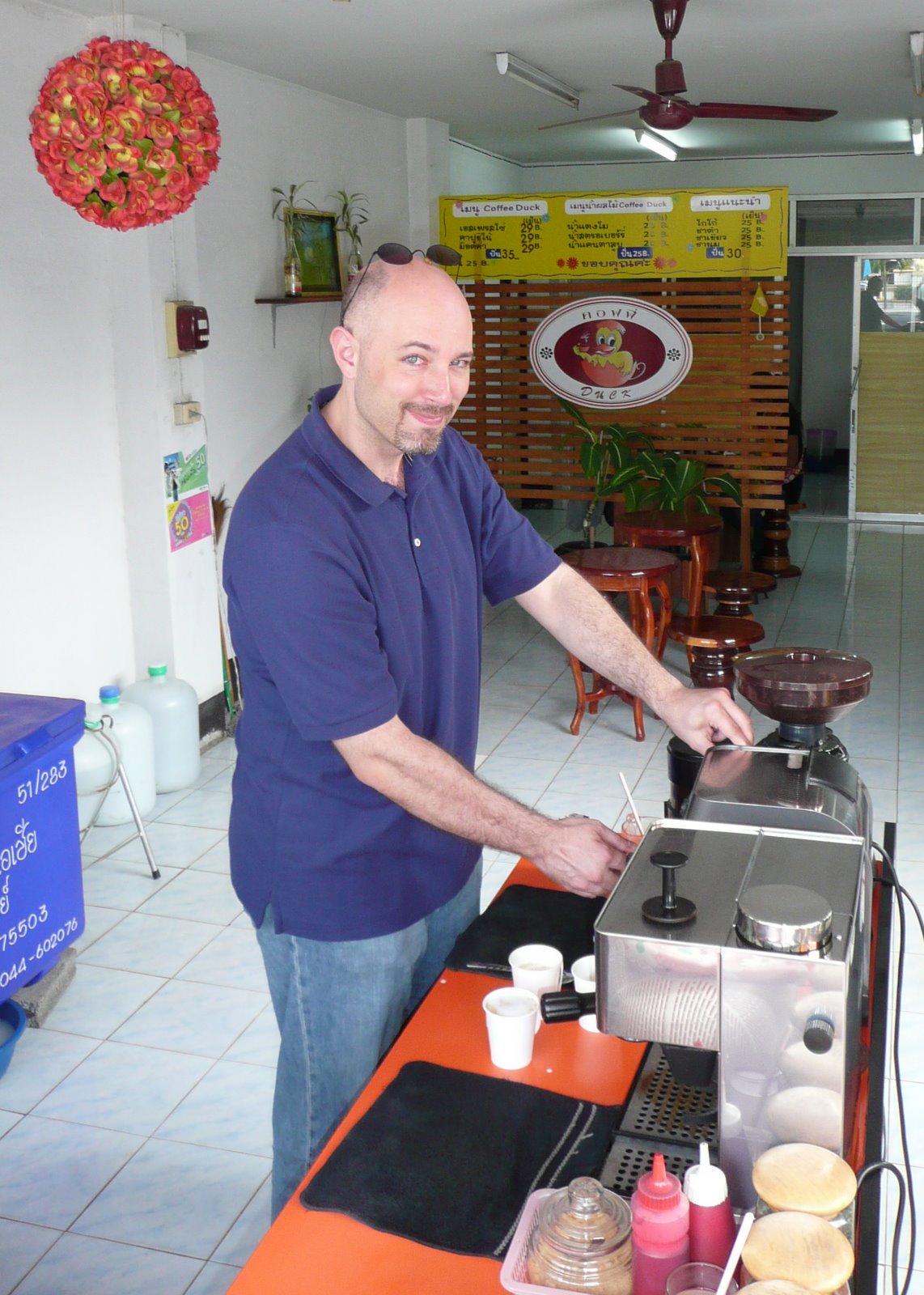
Ten minutes later, we had a trio of nearly perfect lattes. Along the way, Tawn had kept imploring the young lady to pay attention so she could learn how to do this, but she didn’t seem to want anything to do with our milk steaming.
As we left, she was no doubt glad that we were out of her shop. We tipped her well though and I walked away with the cocky satisfaction of someone who has brought civilization to the natives. Ah, the espresso drinker’s burden.
We stopped at one final silk shop after lunch. While Tawn and Trish ooh’d and aah’d over the beautiful textiles, I was busy watching a pair of city maintenance workers install a new street light.
It was pretty amazing. They pulled up in a pickup truck, a pair of lights in the back. A bamboo ladder was leaned against the concrete electrical pole and a young man climbed up. He slid a mounting onto the pole, fastened it into place, and then his coworker climbed up the ladder and handed the light fixture to him.
It took a few minutes for him to slip it into place, strip the wires and push them into one of the passing power lines. Try as he might, though, the light wouldn’t illuminate.
Thankfully, they had a second lamp in the truck, so he unfastened the lamp and changed it out. We left before the second lamp was installed, so I wonder if he had any success. One thing that caught my attention, though, was just how little in the way of safety equipment they had. No helmet, no protective gear, and he wore only flip-flops on his feet.
Occupational safety and health administration? Nope.
Uncle’s House
We stopped by Tawn’s grandfather’s house. Tawn’s father is the ninth of twelve children and the old family compound is now owned by his oldest uncle, the fourth child.
After years of hearing Tawn tell stories about his childhood visits to stay with his grandparents, it was fascinating to finally see the place. Tawn’s uncle and several cousins graciously welcomed us and we sat around a table, eating mooncakes and drinking water and visiting.
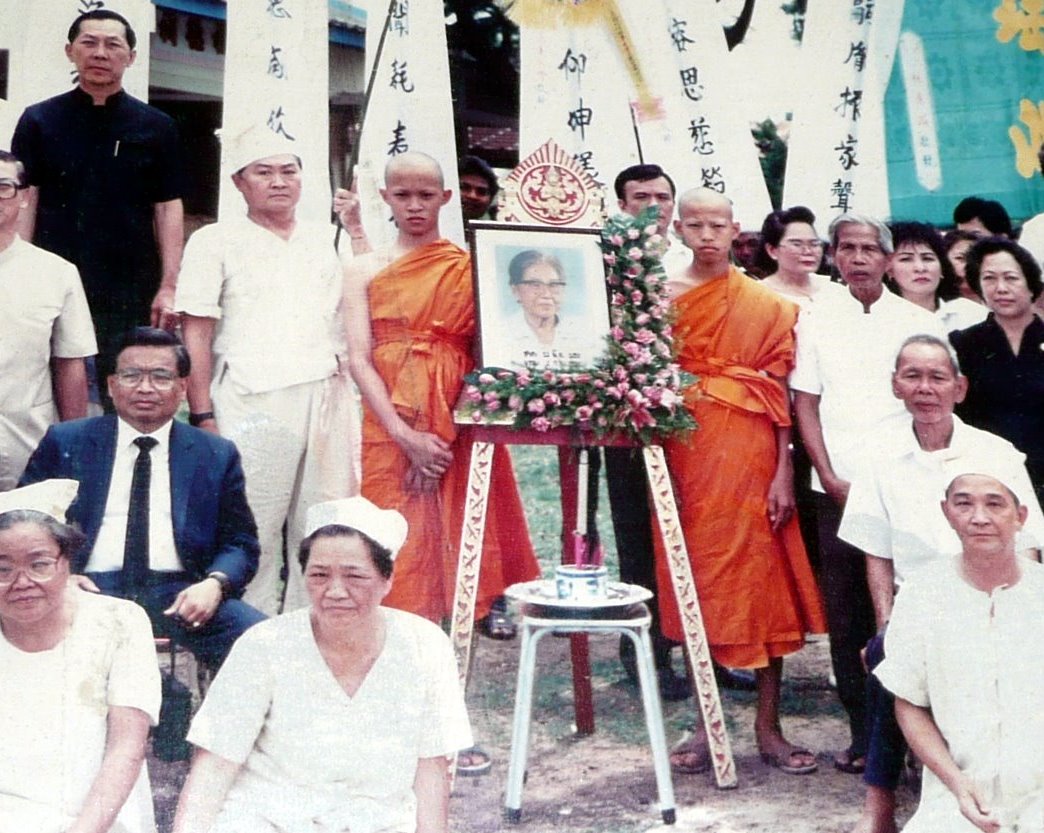
The most fascinating thing on the wall: a picture taken at the funeral of Tawn’s grandmother. It was a panoramic portrait of the more than three hundred family members who gathered at her cremation. Tawn and one of his cousins went into the monkhood for a day to earn merit for their grandmother. Tawn’s the one on the left.
Tawn, who was maybe 13 at the time, doesn’t look too happy about his new haircut. This was the only time Tawn has been a novice in the Buddhist monkhood.
Speaking of teenagers, Tawn has a second cousin, Toy, a fifteen-year old who will be going to the US as an exchange student next August. We visited with him, giving him a chance to practice his English. Tawn suggested that we could coordinate a trip to the US while he is there so that he has the opportunity to visit other parts of the country besides the one where his host family is located. He has not been assigned a specific location yet.
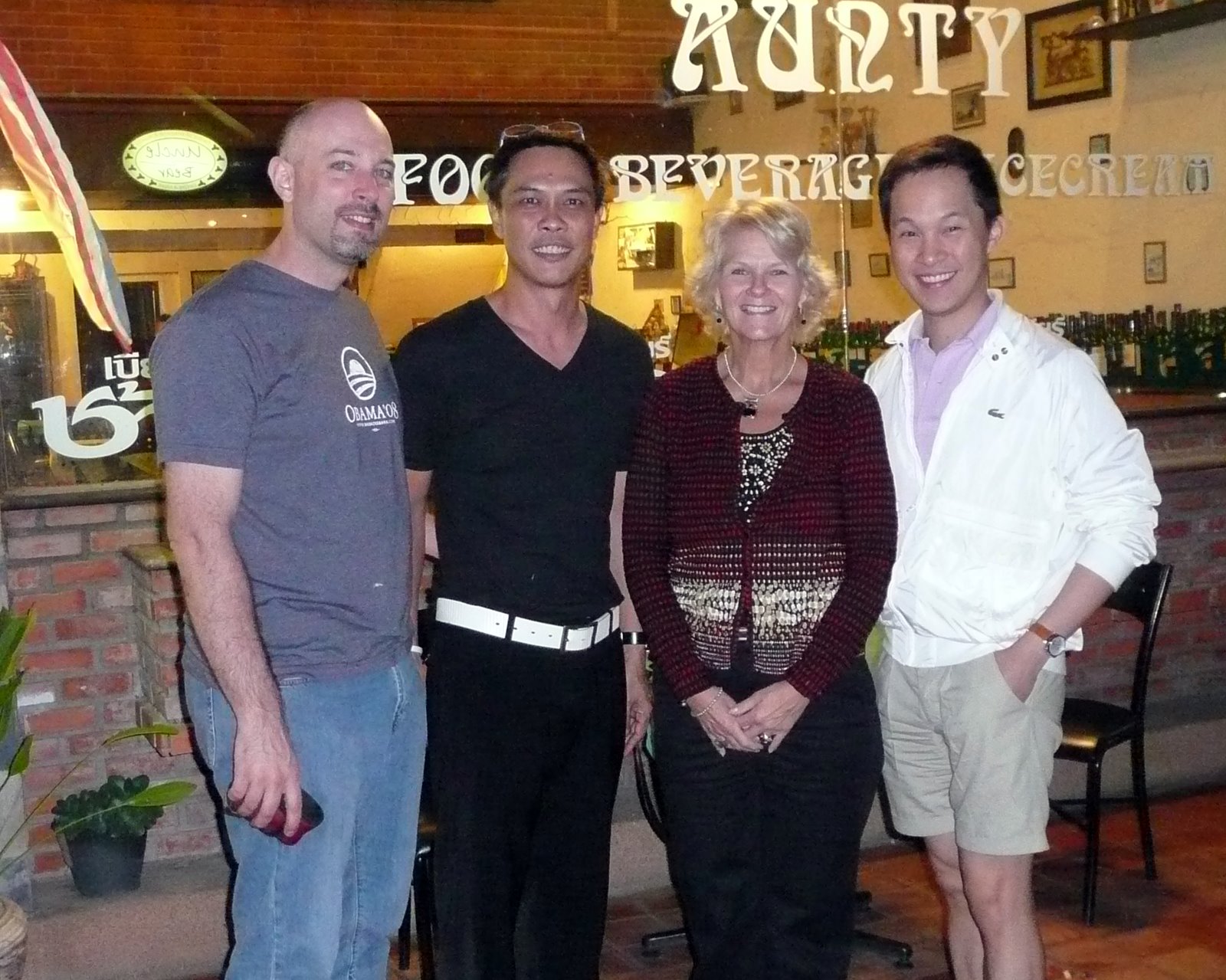
In the evening, after a few hours of relaxing at the hotel, we met another of Tawn’s cousins, Mee, for dinner at his restaurant. Mee has visited us in Bangkok before and it was very nice to see him again. His restaurant serves Thai food with slightly modern twists and everything was delicious.
The “Aunty” in the restaurant’s sign refers to Mee’s mother, not to Mee!
Birthday Burger
Sunday was my birthday. We started the morning with a quick hotel breakfast and then stopped at another coffee shop (this one had milk) for lattes before hitting the road.
Next door to the coffee shop/bakery is a bookstore. Just inside the door of the coffee shop is a sign. If reads, “Full stomach already, but is your brain full? Books and journals, please go this direction.” Quite clever.
We stopped back by the silk factory for another two and a half hours. The owner had arranged for us to peruse a broad range of colors and we finally made some purchases. Unfortunately, after returning to Khrunthep, Trish discovered that some of the silks were not two-ply as we had been told, but only one-play. Tawn is working with the factory owner to fix that.
Our final stop on the way in was Chokchai Farms, Thailand’s largest cattle operation. There was a huge crowd as people went on farm tours, ate at the steak house, and bought ice cream. We decided to stop for a steak burger to celebrate my birthday.
The burgers were pretty tasty, although they had way too much mayonaise on them, which seems to be a Thai thing. Trish claims this was the first burger she has had in fifteen years. Glad we were able to knock her off the wagon.
Video of the experience.
Afterwards, we had some ice cream, bought some snacks, and I tried to milk a huge cow. Look at its expression!
We returned to Khrungthep a bit after sunset, pretty exhausted after our weekend up in the northeast.
Answer: The hermit on the left is blowing in the breeze.
The three-day cremation of the late Princess Galiyani Vadhana, the King’s sister who passed away in January, took place this weekend with nearly round-the-clock coverage on all the TV stations.
One channel broadcasts in English and that provided some interesting (and repetitive considering things proceeded very slowly) coverage.
Here are a few pictures from the events just to give you an idea of the grandeur given to such a ceremony, a good illustration of the love Thais have for their royal family.
Left: the royal urn was transported from its resting spot at the Grand Palace to the site of the cremation, the adjacent royal field known as Sanam Luang.
The urn is the traditional shape used to hold the royal body or bodies of high-ranking monks. As I understand it from online coverage, the Princess’ body was in a more traditional (although elaborately decorated) coffin and this urn was only for ceremony.
I was asked in a previous post why there was such a long time between the death of the Princess and her cremation. In Thai tradition, a body was usually kept at the temple for 100 days before being cremated. This allowed the spirit time to leave the body and move on to the next life. Especially if the death was sudden and unexpected, Thais believe that the spirit may have a hard time letting go of the body.
This also gives the family and friends time to grieve before saying a final farewell at the cremation.
In contemporary Thai society, this period of time is regularly shortened to seven or fewer days. But in the case of the late Princess, much more time was allowed. This gave more than a million people the opportunity to come pay their final respects (the section of the Grand Palace in which her body has laid in state has been open only to mourners since January) and allowed the Brahmin priests to choose an auspicious date for the cremation.
Khru Kitiya, my Thai tutor, was down at Sanam Luang along with thousands of other people. She shared several stories with me yesterday, including how after waiting for several hours to see the King’s motorcade pass by, she nearly missed him as she was fiddling with a broken strap on her shoe.
Below, an aerial view of the procession as it heads from the Grand Palace.
Above, one of the thousands of people lining the route to pay their final respects to a much-loved princess.
Below, a nighttime view of the cremation complex, in the foreground, with the Grand Palace behind it.
On Friday evening, members of the royal family came to pay last respects to the Princess, making merit for her by donating robes to Buddhist monks.
Saturday morning there was more royal merit making followed by the ceremonial cremation. This was a symbolic cremation in which fires were lit and flowers made of sandalwood were burned.
Below, their Majesties the King and Queen pay their final respects before the King lights the pyre during the ceremonial cremation.
The actual cremation ceremony began late Saturday night (about 9 pm) and various entertainments were held – traditional Khon dancing, for example – as its the Thai custom to signal the end of the mourning period.
Above: taken at sunset just before the actual cremation started in the golden tower in the middle. The chedis in the background are at the Grand Palace.
Early Sunday morning the royal family returned to the site. With the Crown Prince acting on his father’s behalf, royal relics were collected and placed in an urn, then the remaining ashes were placed in another container to be interred at the royal cemetery. Interestingly, the ashes were laid out on a silk cloth in the shape of a body, looking a bit like a grey gingerbread man.
The Prince selected bone fragments with his bare hand, placing them in the urn, being sure to take pieces from each section of her body. It was quite interesting to watch this being broadcast live on television.
The Bangkok Post has a four-minute video montage of images from the ceremony here. Nicely done.
Needless to say, this is just a fraction of what we will see when the sad day comes that His Majesty the King passes away.
Note: I wasn’t planning on doing a full entry on this but found many interesting pictures that I thought were worth sharing. I’ll continue with the rest of the Buriram trip in the next few days.
Sorry for the delay in entry. We are up in Burriram province right now, in the northeast of the country about six hours by car.
This evening is the cremation ceremony for His Majesty the King’s sister, Princess Galiana Vadhana, who passed away in January. The highly formal ceremony, with its roots in Brahminism and Buddhism, started yesterday. The entire nation is watching or, in many cases, participating.
Temples across the country are holding a simultaneous ceremony with monks at these temples leading chanting for the late princess. Subjects are placing sandalwood flowers in a replica of the royal pyre that will be lit this evening in Khrungthep’s Sanam Luang, the parade ground adjacent to the Grand Palace.
Everywhere we go, the televisions are playing pool coverage of the events. It is unlike anything the country has seen since the passing of his mother in 1995. Something that exceeds the grandeur of Princess Diana’s funeral in both scope and breadth.
Last Wednesday we celebrated Loi Krathong at Brent’s riverside house. I’ve written about this holiday before here and there’s additional information here, so won’t go into a lot of detail about it now.
Here’s a two-minute video of it:
We arrived to find that Phrae, the niece of Brent’s maid, was there in traditional Thai costume. Right, she introduces Matthew to Trish.
Matthew is an American who with his partner Sean, operate a jewelry design company called MCL Designs. They sell at Nieman-Marcus and Bloomingdales and, coincidentally, they may be in Kansas City on business soon. That’s where Trish lives, so perhaps they will have the opportunity to meet again there.
Matthew and Sean spoke extensively with Trish, examining her business model and offering suggestions and thoughts. It turned out to be a very useful evening for her. Can you write off a dinner party at someone else’s house?
Loi Krathong occurs on the twelfth full moon of the lunar year, which usually falls in the middle of November. I was able to get a nice picture of the State Tower with its golden dome shining beneath the full moon.
There was a nice group of people present and we had the opportunity to make some new acquaintances. From left to right, Brent, Matthew, Anne (a bag designer – she and Tawn had a lot to talk about!), Sean, Trish and Tawn. The Shangri-La Hotel stands in the background.
In addition to the fine pasta dinner we were treated to a splendid view of the fireworks. The Oriental, Peninsula and Shangi-La hotels coordinate a fireworks display, launched from three barges in the middle of the river. Because of our angle, my pictures didn’t get as full a view as I’d like, but you get the idea:
Above, the Peninsula Hotel and the riverfront are blinded by a pair of explosions. Below, the barge in front of the Shangri-La Hotel.
There was a lot of smoke blowing downriver, which I think makes photographing fireworks difficult.
Afterwards, we headed down to the river, took a short cruise on the Peninsula’s shuttle, then launched our krathong – the rafts filled with a candle, incense and flowers. Below, Trish, Phrae and Tawn light the candles and incense.
Below, about to launch the krathong. Don’t fall into the Chao Phraya River!
It was a very fun evening and, I hope, a memorable one for Trish.
I carry my camera with me just about everywhere I go, because you never know what interesting, blog-worthy things you will see. Case in point: as Tawn and I were driving down Soi Phom Phong (Sukhumvit 39) we saw a group of laborers driving piles for the construction of a guard shack.
No large pieces of machinery for these construction workers. No pile driver banging away with an incessant “clang”, “clang”, “clang.” Instead, the scene was all smiles and song.
I pulled the car over and walked back to take some pictures and shoot some video. Here, in 90 seconds, is a taste of Thai pile driving.
At the Paragon shopping mall there is a photo exhibit on display, the results of a nationwide contest. The contest was held on the occasion of His Majesty the King’s 80th birthday last year and the photos were judged on different themes. There was a category of pictures specifically honoring the Thai’s devotion to their king. Another category was of general “life in Thailand”. Another was for nature photos.
The lighting wasn’t great, so I was limited as to which pictures I could capture with my camera. Here are a selection of the more interesting shots. The first two and the final one were noted finalists in the contest.
This first one is particularly interesting. Titled The Father’s Son, it was selected as an example of how people take His Majesty’s “Sufficiency Economy” theory very literally – to the extent of squeezing out the final drop of toothpaste from a tube. This picture appealed to me because that’s exactly what my father taught me when I was a child, to the extent of cutting the tube open to get every last bit out. How’s that for fiscally prudent Midwestern values?
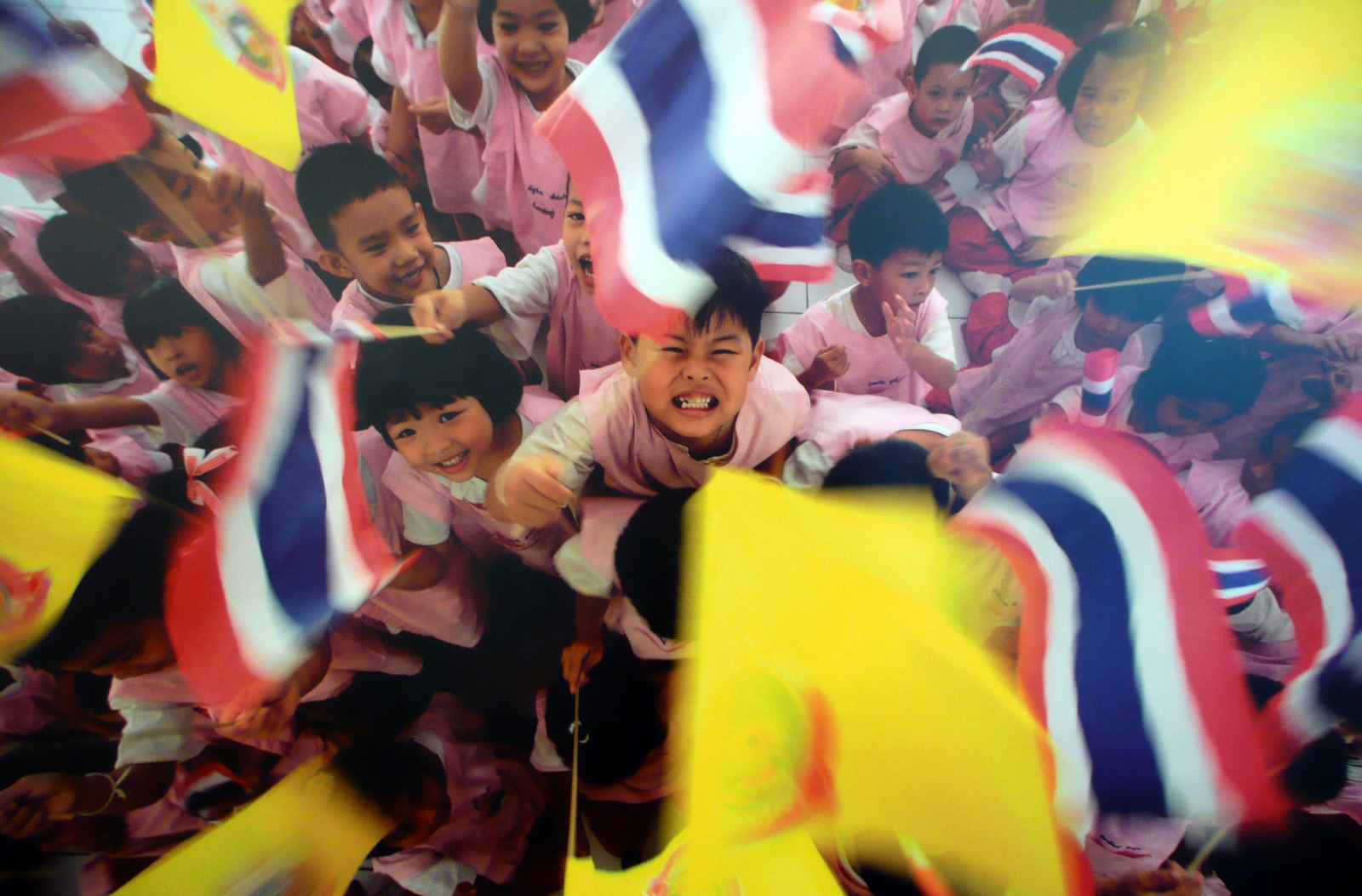
This second photo shows a gaggle of preschool / kindergarten aged children wildly waving the Thai national flag and the yellow flag of King Rama IX.
Above, a special celebration around Songkhran (the Thai new year) at the largest Buddhist complex in Thailand, located on the outskirts of Khrungthep (Bangkok).
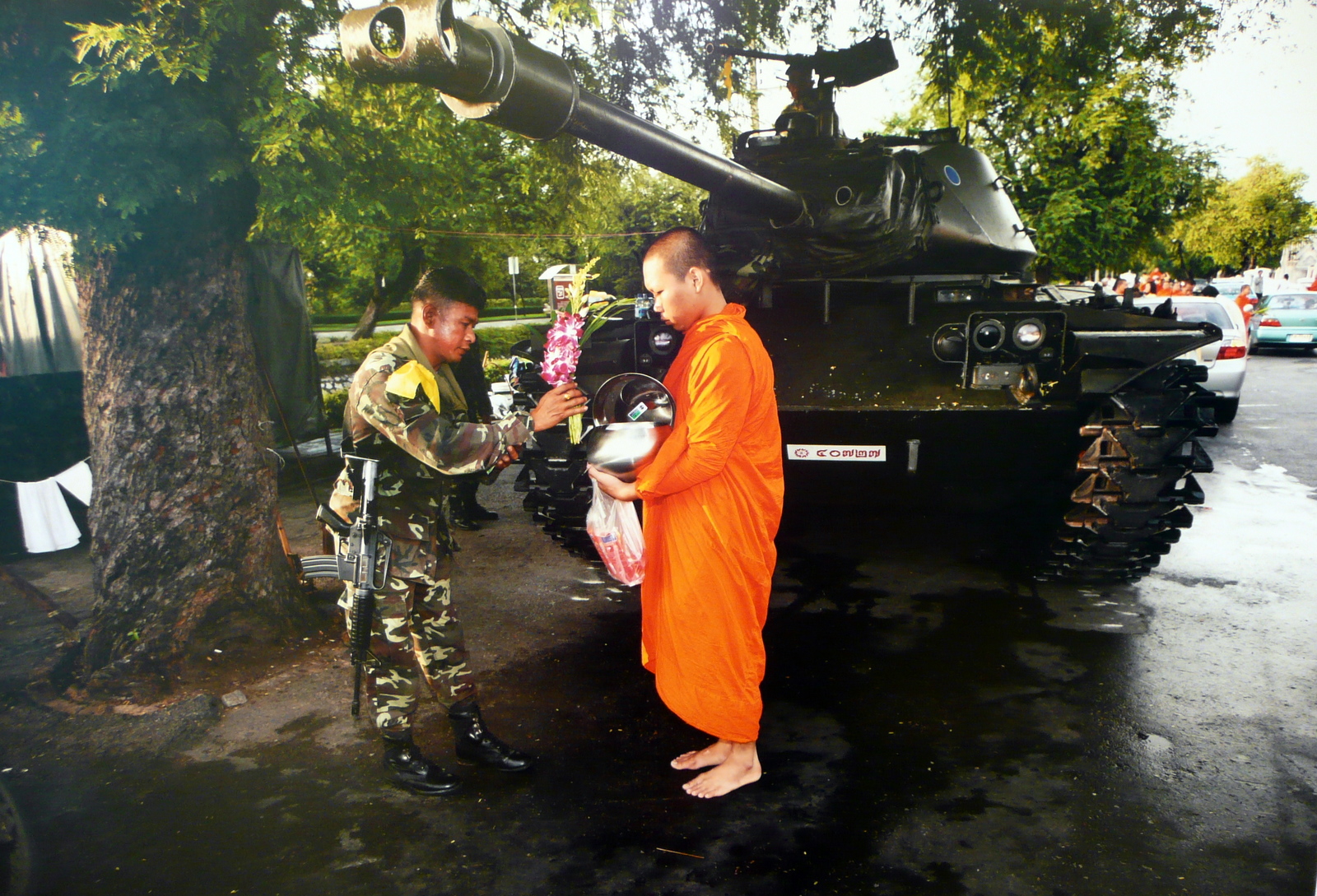
Above, a monk collecting alms from a soldier not long after the coup in September 2006.
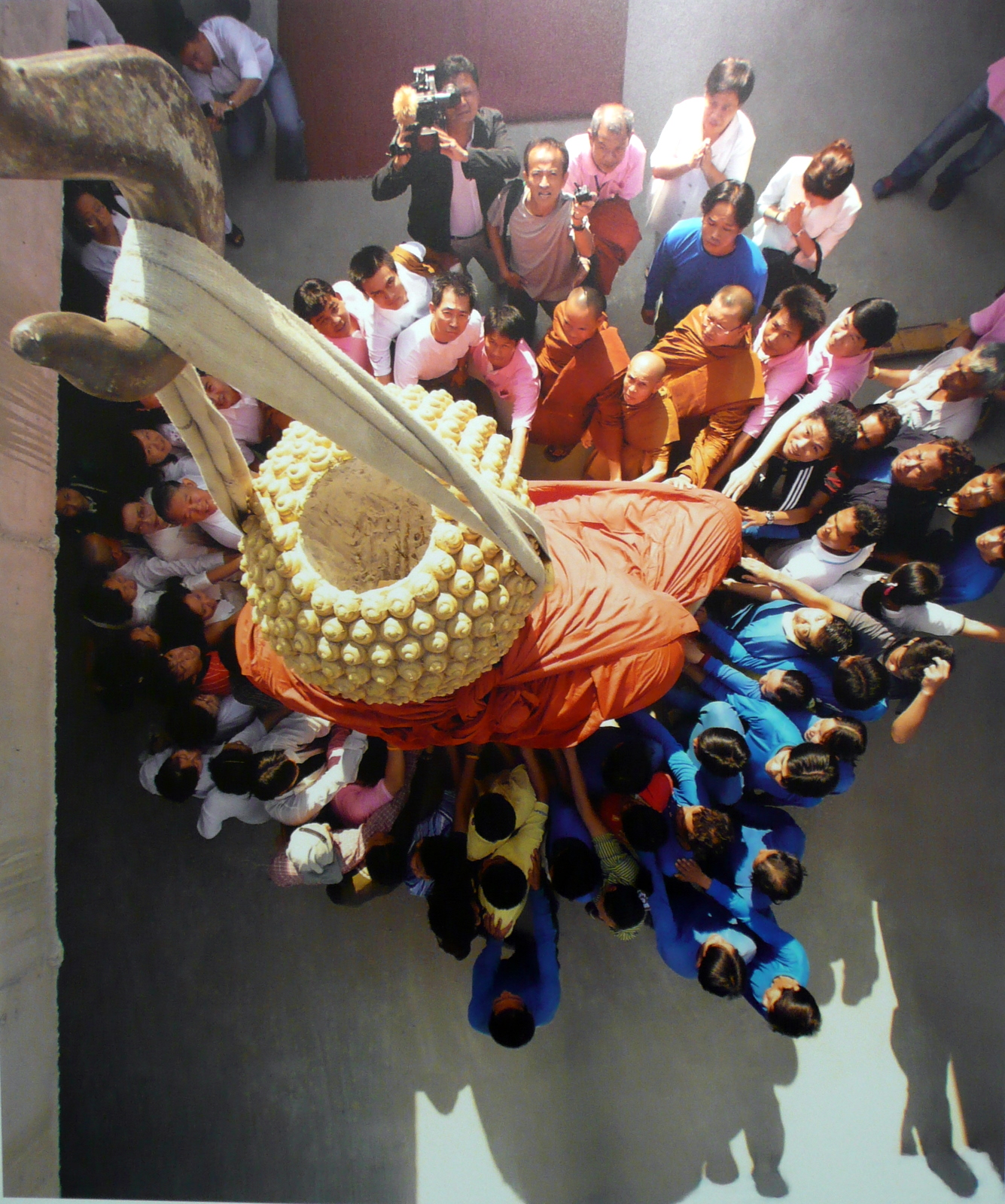
The lighting was poor, so I didn’t capture this one very well, but the actual picture is very sharp. It is taken at the installation of a new Buddha statue at a temple, where community members and workers have a “laying on” of hands during a blessing. Interesting angle.
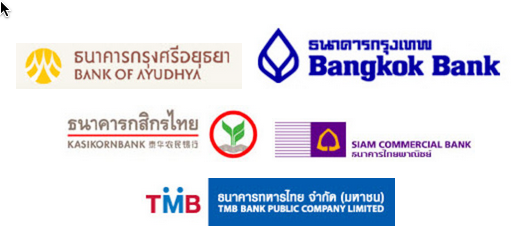
Thai banking institutions have undergone quite a cosmetic transformation in the past few years. Hardly surprising in one of the globe’s cosmetic surgery capitals where an afternoon bite can easily be preceded by a nip and tuck. Within the last five years, the Thai banks have gone from boring to beautiful, with new logos, vibrant color schemes and careful marketing and promotion.
Siam Commercial Bank, the 100-year-old original Thai bank, has its royal purple. TMB, the Thai Military Bank, has a patriotic red and blue color scheme with an umlaut that is intended to represent two people working together (or two soldiers holding hands in a don’t ask, don’t tell sort of way). Ayudhya Bank has a very “We Love the King” yellow for its color. Kasikorn Bank, previously known as Thai Farmers Bank (“kasikorn” being an older word for farmer) has adopted a fertile green color and brands itself as K-Bank.
The competition between the banks is fierce and each works hard to convince consumers that they have something to offer you besides the miserable 0.25% interest rates. (Which climbs to 3% if you lock at least 5 million baht into a 3-year certificate of deposit.)
Recently, K-Bank has launched a new campaign emphasizing how customer-friendly they are. (In full disclosure, K-Bank is one of the two banks where Tawn and I have accounts, the other being the Singapore-owned UOB. Yes, I am a Thai farmer.)
When you enter a K-Bank branch, there are complimentary bottles of K-Bank water to quench your thirst.
And as the weather is so warm here, you might need to freshen up after entering the branch. If so, please feel free to help yourself to the K-Bank moist towelettes.
But the K-Bank hospitality doesn’t end there. There are also K-Bank condoms, free for the taking. Yes, you probably saw that one coming, didn’t you?
The thing about the “K-Condom” is that there is a terrible double-entendre lurking in plain sight. The Thais have borrowed the word “cock” from English as a slang for, well, you know…
Since “cock” is a very harsh sounding word, they us the word เค (pronounced “kay”) as an abbreviation, much in the same way as in English we euphemistically refer to the “F-word”. So that makes the K-Condom very much like saying the cock condom, which to a gaggle of juvenile boys would be hilariously funny.
(Have I mentioned that Thai comedies are quite sophomoric in terms of what is considered funny? Bodily humor is considered the pinnacle of wit.)
Anyhow, after a week of politics both Thai and American style, I thought we deserved a laugh. Have a good weekend.


















 christao408