
What’s it Like to Live in Thailand?

In the past year using Facebook, reconnecting with old friends, colleagues and classmates, several people have asked me upon learning that I live in Thailand, “What’s it like living there?” I’ve given short, snappy answers (“Well, the Thai food is amazing!”) in lieu of anything more thoughtful. This morning I took a stab at coming up with a better, more substantive answer to that question. What is it like living here?

Part of the reason for not coming up with a better answer in the first place, is that it is difficult to succinctly explain what life is like anywhere – especially when it is very different from life in the questioners’ hometowns. I get up, eat breakfast, work, watch movies, etc. It is the same and, yet, very much not the same.

On Language

The most overriding feature of living in Thailand is the different language. I’ve been here three-and-a-half years and have studied Thai all except two months of that time. It is hard to explain just how big an effect operating in a different language environment can have.

In my home (I work from home) I am immersed in a language in which I’m hyper-fluent. I look at a page of English text and meaning jumps out at me. Comprehension requires no effort.
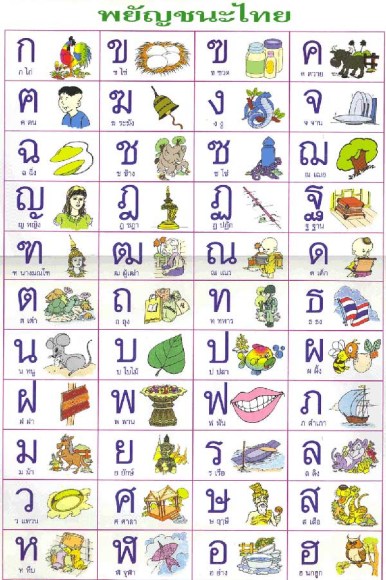
2009-03-03 01

Above: the Thai consonant chart. Each consonant is related to a specific word, similar to “A-Apple, B-Boy” except the word is used consistently with that consonant.

When I step out of my home, I am immersed in a world that is as inaccessible as my English world is accessible. I see the printed Thai script but unless I specifically make the effort to find the words and their meaning, it is just a collection of now-familiar characters: 44 consonants representing 21 sounds, 18 vowels, four tone marks.

The best analogy: playing one of those hidden-word games where words are buried in a grid of letters. That’s how it is when I see Thai: When I look, I see a bunch of Thai characters. I have to look much closer to find the words. Finding the meaning requires yet another step, as I’m at the stage in building my vocabulary where I recognize that I’ve seen a word before, but am uncertain of its meaning.

It is much the same with conversation. If someone is speaking to me and I know what subject we’re talking about, then I am generally okay. I won’t know all the vocabulary, but I can follow along and even contribute a bit. If it is a random conversation into which I stumble, I’ll likely be lost, recognizing some words as they pass by but as unable to grasp onto them as I am unable to board a rapidly-moving train.

That’s the first and most significant aspect of my life in Thailand. I realize, upon rereading what I’ve written so far, that it may sound like a complaint. It isn’t. In truth, Tawn or any other Thai is likely very impressed with my progress. I’m well ahead of 95% of the expats who live here. But I’m also well behind the top 1-2% who are truly fluent in Thai.

Mai Pben Rai

The second notable answer to the question has to do with understanding the Thai mentality – heavily rooted in Buddhism – and the Thai way of looking at the world. Some illustrations:

Mai pben rai – literally, “it’s nothing”. This phrase is constantly invoked by Thais to indicate a “no worries” approach to life. You’re running late for class? Mai pben rai. Stuck on a flooded street? Mai pben rai. You forgot to run an errand? Mai pben rai. Not interested in completing the job as promised? Yes, you guessed it: Mai pben rai.
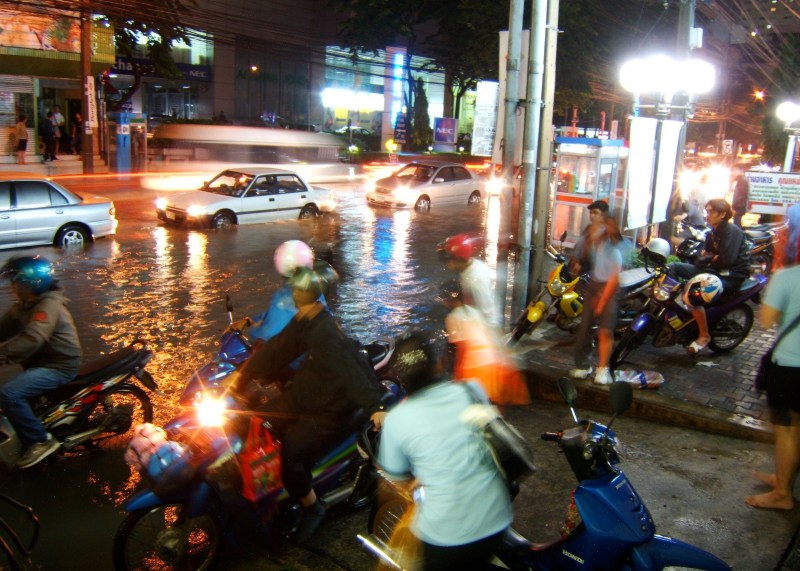
2009-03-03 02

Above: Flooded street leaves you stranded for hours? Mai pben rai!

At first, this can be infuriating. In many (especially Western) cultures, we make a big deal out of things such as being on time, doing what you promise, following up on details, etc.
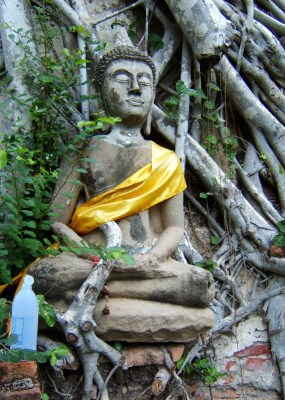
2009-03-03 03

But Thais subscribe to the belief that you shouldn’t sweat the small stuff. And, it seems, nearly everything is small stuff.

The upside to this is that you learn to be much more sanguine about the world, much more accepting about the truth that our sense of control over most aspects of life is largely an illusion. Stuck in a traffic jam? Mai pben rai – don’t worry, you can’t control the traffic. Unable to watch a film you badly wanted to see? Mai pben rai – maybe it will be available on DVD soon. Caught in a rainstorm without an umbrella? Mai pben rai – just duck into a restaurant for a snack.

Thai culture’s Buddhist roots, with its emphasis on the impermanence of all things, is seen everywhere. From the lack of city planning to the way that most plants are potted rather than being planted into the ground to the quality of sidewalk construction, Thais are wired for short-term thinking.

2009-03-03 05

The Land of Smiles

The Tourism Authority bills Thailand as “The Land of Smiles”. Try telling that to a load of commuters on the un-air conditioned number 38 bus line in Bangkok.

Seriously, though, two features of life here are illustrated by the concepts of suphap (“polite”) and sanuk (“fun”). Thais believe that, regardless of how they think or feel on the inside, the exterior should be polite and pleasant. Why should everyone else suffer just because you are feeling down? Keep a smile on your face and be pleasant to others.
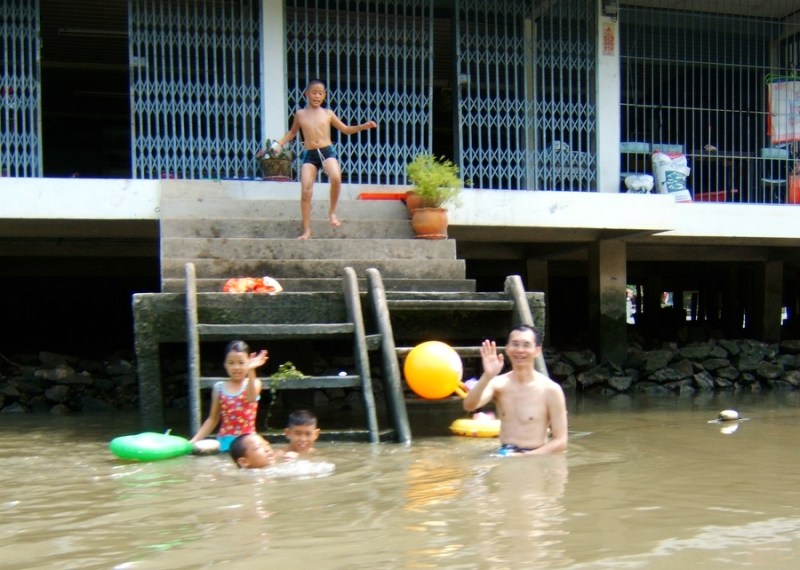
2009-03-03 04

Above: Friendly and polite locals wave as we pass by in a boat.

At first a foreigner might mistake those smiles for happiness, agreement, being pleased, etc. Eventually, most learn that Thai smiles have a hundred meanings, only some of which are positive. .

Upon learning this, some foreigners disdain this outward veneer of pleasantness as being artificial. It is hard to explain adequately but perhaps it helps to see the Thai perspective on things:

A Thai walks into a store in Los Angeles and the cashier smiles broadly, asks how her day is going, asks where she’s from and how she likes the weather. The Thai is used to walking into a store in the other City of Angels and being greeted with a pleasantly soft “Sawatdii kha” and the prayer-like wai in which the palms of the hands are placed together in the center of the chest. To an Angelino, the Los Angeles cashier seems very friendly. To the Thai, that same cashier is being over-familiar.

But here’s the contradiction: in the west, if you walk up to someone on the street to ask for directions, their initial reaction will likely be apprehensive and guarded. Especially in an urban environment, they may well wonder if they’re being taken advantage of.

Here in Thailand, when we stop a person on the street and ask a question – “Hey, uncle, do you know where I can find that famous noodle shop with the tom yum broth?” – we get a friendly smile and helpful directions.

I’ve observed this among Thais, so it isn’t just a Thai-foreigner thing.
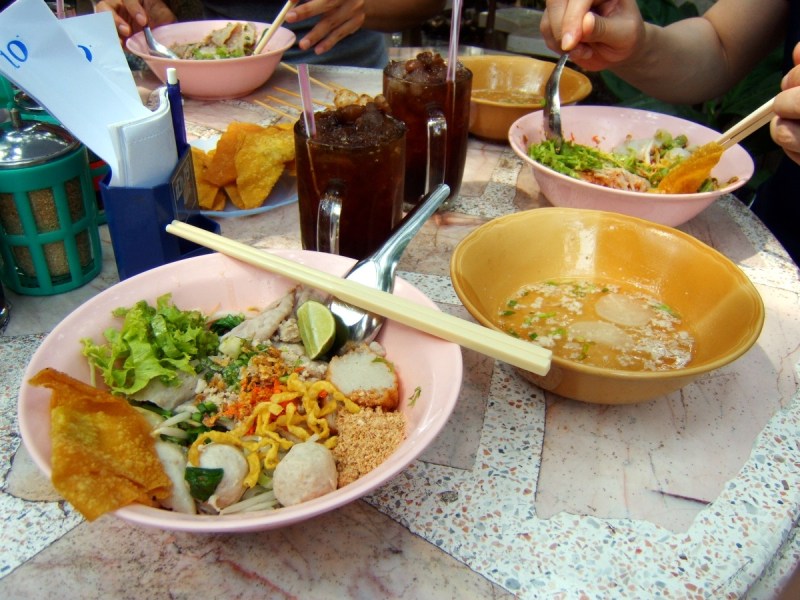
2009-03-03 06

The Food

Even though my original snappy answer to the question was that Thai food is really good here, it actually is one of the true answers: Thai food really is better here.

When I lived in the US, I thought Thai food was good no matter which restaurant you went to. “Bad Thai food?” I thought, “Surely there is no such thing.” Of course, once I moved here, I realized that there are few Thai restaurants in the US worth eating at unless it is a case of severe gaeng kiaw waan withdrawal.

But beyond that, Thailand has much more healthy, fresh, inexpensive food readily at hand than in the US (and maybe many other places in the west). You’re in the US, it is 3:00 pm and you want a snack. What are your options? Donuts, burgers, fries, tacos, ice cream? None of which are good for you nor really that satisfying.

In Thailand, a bowl of noodle soup, a plate of spicy green papaya salad, a stick of grilled fish balls in sweet chili sauce, or a bag of fresh fruit are readily available on most any street corner, are relatively healthy and are very inexpensive.

Sure, Starbucks’ venti mocha frappaccino with extra whipped cream and McDonald’s hamburgers are available here (and the growing incidence of childhood obesity testifies to that fact) but there are so many readily available, healthier options, options that I miss when I’m back in the west.
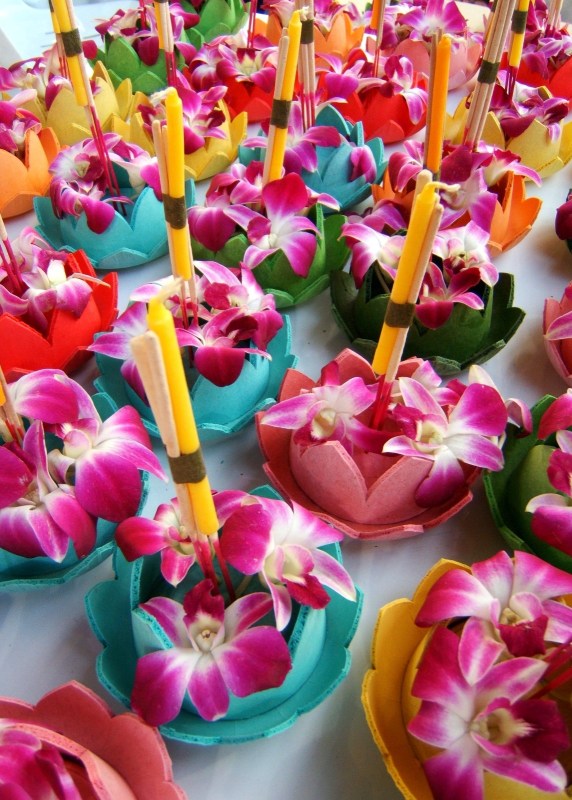
2009-03-03 07

Beauty and the Good Life

The French have their joie de vivre, the Italians their la dolce vita. Thais, too, are all about ease, comfort and enjoyment of life. Even with some of the world’s worst traffic, Bangkok residents make enjoying life a priority. There is always something fun happening, things are festively decorated, and thinking too much about your cares and worries is discouraged.

People interact more with each other and their surroundings here than in the west. People are more playful, too, but not in the sarcastic or mean-spirited way you see in the west.

There is great beauty. Thai temples and Brahmanist spirit houses are elaborately and colorfully decorated. Fairy lights – what North Americans call Christmas lights – are used to dress up the landscape for no reason other than the sheer fun of having little twinkling lights strung up in the trees.

Flowers are very inexpensive, very beautiful and very bountiful here. Every market and many street vendors sell beautiful blossoms and fragrant jasmine garlands. Again, in line with the Buddhist belief in impermanence, potted plants decorate sidewalks and balconies, rearranged endlessly and replaced when they die.

2009-03-03 08

Thais take great care to keep things (including themselves) looking neat and clean even in the midst of the city’s chaos and pollution. Even from the working class houses lining the murky Saen Saeb canal, carefully-groomed residents emerge on their way to work, shirts neatly pressed and great thought given to what handbag (probably a knock-off sold at a discount mall) to carry.

The Social Ladder

Thailand has a very hierarchical society: When two Thais meet, they try to determine who is higher than whom on the social order. This ranking has great effect on all aspects of their subsequent relationship: how to address each other, who serves whom at the table, who pays the bills, who walks out the door first, etc.

This chafes western egalitarianism and takes a long time for foreigners to get used to and understand. It is hard to overestimate how important it is for Thais to understand where they are on this hierarchy.
2009-03-03 09

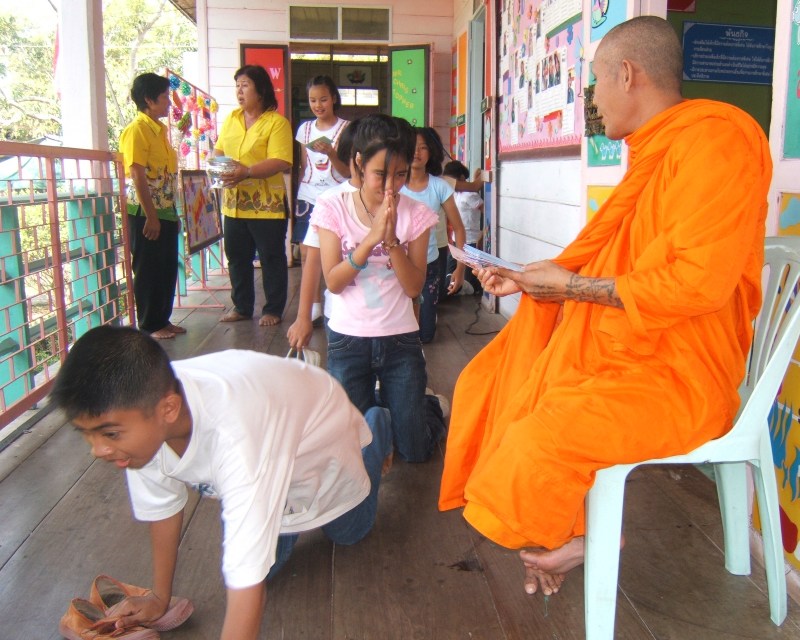
Above: Students behave appropriately, approaching the monk on their knees then crawling past him. Females are especially careful to avoid coming into direct contact with him.

The ways in which this impacts foreigners are numerous and subtle. One expat incorrectly explained to me that foreigners, being guests, always rank highly, just below politicians, royalty and monks. He couldn’t have been much more wrong.

Foreigners are in their own category, separate and measured by another standard, namely, the extent to which you understand and play by the Thai rules.

What’s the practical effect of this? On the Skytrain, for example, I move out of the way for those above me on the social ladder – elders, for example – but not for teenagers.

When I walk past puu yai – literally “big person” or “adults” – who are having a conversation, I duck my head ever so slightly, showing my respect by not towering over them.

2009-03-03 10

Above: Even the leaders of the September 2006 coup were careful to visually emphasize that they knew their place – still below the monarchy.

Remember the scene in the musical “The King and I” (banned in the Kingdom of Thailand) in which Anna Leowens and the King of Siam debate over how high she should hold her head in comparison to the king? It is the same thing – your head you should be lower (or, at least, bowed a little in respect) as you pass by or sit with someone who is of a higher rank than you.

When speaking with monks, I should hold my hands in a wai at my chest. When hanging out with peers in my age group, I can relax and not be so concerned as we’re equals. When teaching at the school and helping a student with his work, he offers me his seat and then kneels next to me as I explain the assignment. Everyone has his or her place in the hierarchy and that place is relative to the people with whom you are interacting.

Small things? Maybe, but ones that show that you know your place in the order of things.

At the very top of the order are the religion and the monarchy. Pictures of His Majesty King Rama IX adorn nearly every house and place of business.
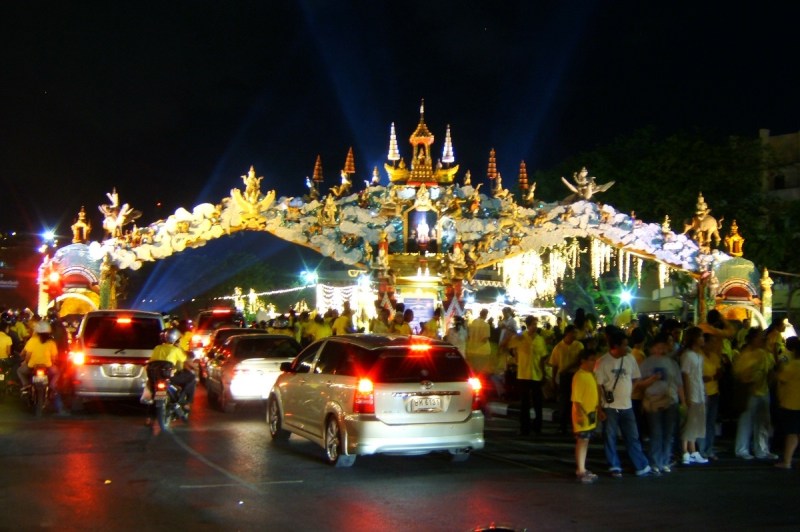
2009-03-03 11

Above: Street decorations celebrating the 60th anniversary of the King’s reign.

At the start of movies and concerts, the audience stands for the royal anthem. If a royal motorcade passes, people stand quietly and respectfully at the side of the road and, if it is the king or queen passing, bow at the waist as their car goes by.

One important facet of this respect for the monarchy is that you don’t – don’t – discuss the affairs of royalty. You don’t ask Thais what they think of the Crown Prince or Crown Princess. You don’t speculate as to who will succeed the King. You don’t debate the merits of a constitutional monarchy or the appropriateness of still having (and enforcing) lese majesty laws.

Even with a Thai with whom you think you’re close, you are best advised to leave this topic alone.

My Final Answer

The final answer to the question of what it is like to live here lies in an additional Thai concept: samruam. Roughly translated, “restrained”. It is related to the previously-mentioned concept of suphap – “polite”.

The thing that keeps this culture going is the emphasis on external appearances, most significantly, keeping up a polite and appropriate appearance and being restrained in your behavior.

For example, Thais believe that the feet – the lowest part of your body – are the dirtiest and least polite part, too. Resting your feet (especially with shoes on) on furniture or the wall, pointing your feet towards someone or an image of the King or the Buddha, or touching someone, moving something or gesturing with your foot, are all hugely mai suphap – impolite.

In fact, the slang term for “foot” is muu farang – foreigner’s hand. That’s because westerners are more inclined to push, gesture and touch with their feet – actions the Thais associate with being coarse and unrefined. In other words, being a foreigner.

You see this in the way people sit in public: feet flat on the floor or, if a woman crosses her legs (not very suphap), it is done with legs tightly together and the foot pointed down. On the Skytrain last week, I observed a foreigner sitting with his legs stretched out across the aisle, pointed towards a lady on the other side of the car. Had he not been absorbed in the pictures on his phone, he might have noticed the dirty looks other passengers were giving him.

Samruam – restraint – is related to suphap. Thai culture is about moderation in behavior, voice, feelings, etc. Thais are fun-loving people but rarely boorish, loud or obnoxious. Thais get upset but rarely do you see public bursts of anger.

The recent prime minister, Samak Sundaravej, caused quite the stir because of his famous outbursts. When questioned by a female reporter once, he avoided answering by accusing her of not having enough sex. In general, prime ministers aside, losing your temper diminishes your public standing. To berate someone publicly is an invitation to revenge.

Thais dress modestly. When a foreigner is sitting at a restaurant on a sunny day and takes off his shirt to enjoy the sun, Thais are taken aback. (I’ve witnessed this. I wanted to say something but restrained myself – confrontation is seen as even worse than being not samruam.) Women in spaghetti strap tops are assumed to be bar girls or sex workers. If they are foreigners, the fact that their foreigners (again, course and unrefined) is their excuse.

2009-03-03 12

Above: Even at the Erawan Waterfall, Thais are dressed with relative modesty. Only foreigners and young children show bare shoulders.

On the surface, this may sound prudish. But to really understand it, you have to remember that in Thai culture, it is important to keep up appearances. Loud, obnoxious, revealing and unrestrained clothing/behavior/manners don’t keep proper, considerate appearances up. They make life less pleasant for everyone else.

And that’s an important part of life here. That’s why, despite the heat and humidity, I rarely wear shorts (even cargo shorts) out of the house. And when I do, it is only for Saturday morning errands in the neighborhood, never out for dinner.

Conclusion

So what is life like here? Living in the environment of a different language makes it very challenging but opens worlds of understanding. The mai pben rai attitude is more relaxed, less worried, and occasionally frustrating when you want to get something done.

Politeness, appropriateness and fun are values that influence all aspects of life and behavior, generally making social interaction smoother and more pleasant. Knowing your place in the hierarchy of society makes you more considerate of others and, in return, you receive more respect from others, too.

Finally, from food to flowers to music, life here has a lot of good things to offer, even when they aren’t expensive or are surrounded by a chaotic environment.

I hope that I’ve given you a bit of an answer to what life is like here. As you can probably see, it is hard to describe it succinctly. The only short answer I can think of is:

“Requires different operating instructions.”

Random Saturday

For the first time this year, rain fell in Krungthep.  After several days of increasingly hot and increasingly humid weather, the clouds built and the wind fell still.  Then, on the way home from my Thai lesson, the wind picked back up and the temperature dropped several degrees.  Halfway down the soi, riding on the back of the motorcycle taxi, the first drops fell on me.  There was that smell: the first rain of the season evaporating on the oily, dusty pavement.


We have several ferns on our balcony, very pretty ones.  Tawn and I are having a debate as to the cause, but about three weeks ago all the fronds turned yellow and fell off.  In the following days a dozen new fronds sprouted and took their place.  Tawn thinks that this is just the season when ferns drop their fronds.  I think he overwatered (there was an inch of standing water in the saucer below the pots) and killed the fronds.  Any fern experts available to help settle this matter?

P1140481

On Saturday we went to the travel fair at Queen Sirikit Convention Centre.  I tell you, if you have some free time in the next month or so, there are some amazing deals to be had.  25,000 baht to Australia on Singapore Airlines.  33,000 baht to London.  All sorts of deals on resorts here in Thailand.

Unfortunately, our travel plans for the next two months are already booked, so we couldn’t take advantage of these deals.

We did, however, find some ninjas at the Yokoso! Japan booth.  These were real Japanese and they even spoke Thai, too.  Impressive, huh?  Probably not real ninjas, though.

P1140482

There is something odd about the stereotypes the Japanese tourism authority is trading in.  But if it gets people to visit (like we are in April) then I guess it works.

Best “must-see” item from the brochures: the Ramen Museum in Yokohama.


Stuck on Thong Lo

The north end of Thong Lor (Sukhumvit Soi 55) gets really backed up with traffic, especially on weekend afternoons.  Lots of shoppers going to lots of shops and sometimes you end up sitting for several minutes.  Yes, these moments of stuck traffic give me amazing opportunities to really see this fascinating neighborhood in which I live.

P1140485 The street is about 3 km (2 miles) long with a Skytrain station at the south end.  There is a special transit system, a fleet of aging Mercedes Benz busses that spew coarse black smoke, that run up and down the soi, picking up riders at the Skytrain station, several stops along the way, until terminating at the khlong (canal) pier on the north end of the street.

These bright red unairconditioned busses park at the north end of the street when they are not in use.  While sitting in traffic, I watched as two men refueled one of the buses in the most ad-hoc manner: gravity-fed through a rubber hose connected to a plastic fuel jug.

The color and the composition both spoke to me but I was equally fascinated that the younger man was smoking while doing this.  I wondered if I kept the camera ready, would I be able to capture a good picture of the explosion without losing my life in the process?

I never found out as traffic started moving and there was, to the best of my knowledge, no explosion.

Also along the street, which is known for its abundance of wedding boutiques, I saw a plant vendor pause in the shade in front of a window displaying a wedding gown.

P1140489

Again, a wonderful contrast that exemplifies this neighborhood: it is called the Beverly Hills of Bangkok, but at the same time all segments of the socioeconomic spectrum are represented here, both living and working.  That is something I really like about Krungthep: there is a huge gap between the haves and have-nots, but the gap isn’t physical.


KL The End

And so, dear reader, the weekend in Kuala Lumpur came to an end.  After walking around the city, finally exploring some of the sights, watching domes being scrubbed and taking in the majestic phallicness of the Petronas Towers, we returned to the hotel, freshened up, packed our bags, checked out…

and had two hours to kill before our driver was schedule to arrive.

Not wanting to get sweaty again and a bit hungry from our explorations that morning, we walked back to the Pavilion mall.  Here is the outdoor dining area that I was talking about – “the catwalk” along which people stroll or sit and sip coffee, to see and be seen.

P1140440  

Ignoring all our Lonely Planet sensibilities – local food only! – we stopped at an Italian restaurant along the catwalk called, originally enough, Michelangelo’s.  They had a reasonably priced set lunch and since our flight wouldn’t put us back into Krungthep until after dinnertime, a late lunch seemed reasonable.

P1140442 P1140443

Mushroom soup for me, Caesar salad for Tawn.  A simple pizza to share.

P1140444

A seafood pasta dish for Tawn (sorry for the lousy exposure) and a hearty ossobuco for me.

P1140450 P1140451

After some coffee, a short walk back to the hotel as the first drops of afternoon rain started to fall.  Below, the thing I like best about KL: beautiful old trees shading the sidewalks.

P1140455

We made good time to the new Kuala Lumpur International Airport, a gorgeous white elephant an hour south of town.  Air Asia flies from the cheapskate… er, low-cost, terminal which is an additional 20 km drive from the main terminal. 

Upon checking in we dealt with the challenge of explaining to the agent that while we had paid to reserve a seat (something new for Air Asia), we would like to pay the difference to the higher fee to reserve an exit row seat (250 baht versus 50 baht).  She didn’t understand what we wanted to do, so we ended up sitting in our original seats.  Not too bad, but legroom is tight so a few extra centimeters would have been appreciated.

P1140463

Smooth flight back to the Big Mango as we watched a beautiful sunset over the Andaman Sea.  Good to be back home.


Seeing the Touristy Stuff in KL

I manage to make a three-day trip to KL seem like a month, don’t I?  Here’s our final day in KL.  We decided to actually get a little bit of sightseeing in, since Pong had driven us around the evening before and we had a better idea of how the city was laid out.

First, though, breakfast at a cute bakery called The Loaf, located in The Pavilion mall.  While it wasn’t Tartine by any stretch, the baked goods were pretty tasty and the selection was broad.  Here’s a look at what pretty things were on display:

P1140380-1 P1140381 P1140382
P1140383 P1140384 P1140388

From there we took the monorail several stops south into the city.  This is a good way to see the city as it is elevated and views are largely unobstructed.  We alighted at the Majarajalela station (I’m sure I mispronounced that when buying the tickets, but we got there alright) and then walked into Chinatown.

First we stopped at the Chan See Shu Yuen temple, which is a Chinese clan association building for, I assume, the Chan family.  Pretty building with a fascinating bonzai tree in the courtyard, which sits upon an old Singer sewing machine base.

P1140391  

Continuing north a few blocks past the old chophouses, we arrived at Jalan Petaling, a covered street that looks a little like the Fremont Street Experience in Las Vegas, minus the LED light display.  The vendors and shops had the typical collection of things that you find everywhere in Asia. 

P1140395  

We continued west along Jalan Hang Lekir, passing a few interesting boutiques including one called Peter Hoe, which offers textiles, home decor, and a nice selection of batik on the corner of Jalan Hang Lekir and Jalan Hang Kasturi.  Cute place, worth a visit.

We stopped by the General Post Office which, according to my little guide, was open on Sundays.  Unfortunately, it isn’t.  So I returned home with stampless postcards and will have to mail them (once written) and some extra ringgit, to Andrew in Penang and ask him to post the cards for me.

This section of town, near Independence Square or Dataran Merdeka) has some fantastic examples of Islamic architecture, both in traditional forms as well as more modern ones.

P1140414-1

Above, the dome of the Textile Museum is washed, its stripes reminiscent of the duomo in Siena, Italy.  In the background is (what I understand to be) a former government building, although the government has relocated itself to a new city 30km south of KL, near the new airport.

What is fascinating is how the more modern building’s screens echo the lines in the older, more traditional building.  These are motifs that are reflected again and again throughout the city.

We walked a bit further before catching the subway three stops to the KL City Centre area, home of the Petronas Towers.  No longer the tallest buildings in the world, they are still very impressive, especially at night.

P1140426

I had initially hesitated to come see the towers, even though Ken had told me there was a park at the base of them.  For some reason I thought the space would be tacky but, other than the high-end mall incorporated into the base of the tower, the park is actually very nice and there are some great areas to sit in the shade, enjoy the fountains and take in the view.

We were quite sweaty by this point so returned to the hotel to freshen up before our 2:00 check-out.  Tomorrow, I’ll conclude our visit.


Cafe Culture in KL

For most of our trip to KL we ate, hung out at cafes and generally avoided the touristy must-see places.  Had we done this in Krungthep, we’d think of ourselves as wasting away our time.  But since we were on holiday in another city, it was quite alright.

Very close to our hotel was the Pavilion Mall.  This very large, very high-end mall is equivalent to Paragon in Krungthep except that it has a very nice open-air space that is lines with restaurants and cafes.  Lots of outdoor seating and – I swear! – the largest concentration of gay men I’ve seen anywhere in Southeast Asia.  The area is apparently nicknamed “The Catwalk” for reasons that quickly become obvious.

P1140325

Outdoor dining is something largely missing in Krungthep, especially middle- and upper-tier restaurants.  Streetside noodle vendors are a baht a dozen, of course.  There was a nice Illy “Espressamente” Cafe situated at the end of the catwalk.

The menu included a wide range of little bites from panini to olives to cheeses.  From upper left, clockwise: olives, air-cured beef, and fresh cheese served with toasts; “arancita” fried rice ball with beef inside; a latte made with heart; grilled panini sandwich.

P1140332 P1140330
P1140328 P1140322

In the afternoon, we went to Central Market, a restored two-story market with many small vendors selling trinkets and souvenirs, some very local and others looking like the same things you can find at any market in Asia.  Next door were some art galleries so we stopped in to see an exhibit.

P1140353

Below, Icsse KHOR Chin Tin’s “Snow Falls in Malaysia?  Who Knows?” – mixed media on canvas.

P1140338

Mohd Iqbal Badaruddin’s “Unforgotten” – mixed media and silkscreen on canvas

P1140340

CHIANG Lup Hong’s “Seven Deadly Sins” – ink and acrylic on paper

P1140343

Detail of “Seven Deadly Sins”

P1140345

Azmi Aris’ “Bersatu Padu” – acrylic

P1140349

Hudri Hayat’s “Kepulangan II” – oil on canvas

P1140355


Many thanks to Pong, Otto and Han’s friend, who introduced us to the gallery.


Dining on Jalan Alor

This trip hasn’t included a lot of sight seeing.  And we realized after the fact that we know a number of people here whom we forgot were here.  So apologies to those we didn’t see on this trip.  We’ll be back, though, as KL seems a comfortable and laid-back city, even if there aren’t a lot of must-see sights.

First off, the view from the hotel room.  We could see one half of one of the two Petronas Towers.

P1140378

The view itself isn’t super impressive.  But the towers are and they really are amazing at night, visible from all over the city, popping up in the background when you least expect them.

P1140300

On the advice of some of Tawn’s KL office colleagues, we ventured over to Jalan Alor (jalan = street), a long block of hawker centers and open-air restaurants that cover a wide range of ingredients and styles of cooking.  In front of each restaurant are touts, holding menus and assertively selling you on why their restaurant is the place you should eat.  Not unlike the touts you would expect to find in a red light district which, we discovered, is nearby.

P1140287

After walking nearly the whole length of the street, we ran the gauntlet back to the beginning, settling on one of the first places we saw.  There was a large selection of individual vendors, so we felt like the variety would be very good.  We ordered a lot of food, too much for two people, and ate well.

P1140303

Spicy squid served in a chili sauce.  Not so spicy as to be intolerable, but with a nice kick.

P1140306

Chicken satay with a tasty fresh peanut sauce.  Juicy meat with a nice smoky flavor.

P1140309

Eggplant stir fried with ginger.

P1140312

Skate wing fried in banana leaf, served with lime and chili sauce.  Never had skate wing before.  Interesting texture as, like shark, there’s a lot of cartilage.

P1140313

Fried noodles with seafood and veggies.  We could have lived without this just because we already had so much food.

P1140317

By the time we finished, the sun had set and the streets were filling with people.  On the way back to the hotel we stopped at a cinema to see what was playing, ending up watching Slumdog Millionaire, which has yet to open in Krungthep.  Very nice film, well made.


I headed down to Kuala Lumpur today, and easy flight at just over two hours long.  Tawn will join me Friday and we’ll spend the weekend here.  I took Air Asia for the flight, the “Southwest Airlines” of Southeast Asia.  I’m not a big fan of the airline: 29″ pitch is a bit tight for me (I’m 6′ tall) even if the flight is only a few hours.

But the price can’t be argued with: 4300 baht including taxes versus 6900 baht on Malaysia and 10000+ baht on THAI.  I don’t want to contribute to this race to the bottom by flying based on price alone, but a 50% premium isn’t justifiable for two or three more inches of leg room for two hours.

While I generally don’t find our new airport to be that attractive, I did find one angle from which is looks nice:

P1140239

It was a very humid day in Krungthep and while boarding, the air conditioned air was condensing inside the cabin, creating a fog-like effect that was really funny.  You felt like you were walking through clouds just to get to your seat!

P1140247

The picture doesn’t do it justice, though.  Please view the video below for the full effect.

While waiting to push back, an Aeroflot IL-96 pulled up alongside us.  Aeroflot is the remnant of the U.S.S.R.’s sole carrier and the IL-96 was the last Russian-built plane they added to their fleet.  In years since, they have bought aircraft from Boeing and Airbus.  The 96 is an interesting bird: not a very long fuselage but huge wings.  It is designed to fly long routes with medium passenger loads, although it not the most fuel-efficient plane out there.

P1140257

Arriving in KL at the Low Cost Carrier Terminal, I was struck by how much outdoor walking they have you do.  All covered walkways, but it was quite a hike to get to the terminal.   Along the way, beautiful views of the airplanes.  Of course, they are all Air Asia planes so it gets boring real fast.

P1140280

I’m staying at the Novotel in central KL, quite close to the Petronas Towers.  In fact, I can see one (vertical) half of one of the towers from my room.  I can’t wait to show Tawn!

The area nearby the hotel is quite a popular stretch.  Lots of outdoor seating at restaurants and cafes for cuisine from around the world.  Very nice, actually.  I don’t understand why Krungthep doesn’t have anything like this?  KL is very similar weather to Thailand, so that’s no excuse for not having outdoor seating.


Thai Sakura

The longer I stay here, the more aware I become of the changing seasons.  This requires a much higher level of attention because the changes are more subtle than in regions further from the equator.

Expats in Thailand often jokingly refer to the three Thai seasons as “hot,” “hotter” and ‘damn hot”.  This year we enjoyed the coolest winter in a decade and so the transition into ruuduu rone,  literally “hot season”, is more pronounced than in the past few years.  Likewise, the springtime burst of blossoms is more noticeable, too.


Above is an example of dtonmai chompoo pantip.  They are everywhere in Krungthep this week.  While less delicate and refined than the Japanese sakura (flowering cherry trees) that blossom each March and April in the land of the rising sun, these Thai sakura give us a week or two of beautiful and festive color.  Our soi is littered with pink blossoms.

In other news, we have a neighbor somewhere in our condo complex – a few stories above us, I think – who seems to really like stinky tofu.   Once or twice a day they start frying it up, turning on their kitchen fan to vent the smell, which then pushes it into our kitchen.

To say that it is overpowering is an understatement.  While I appreciate that everyone has a different sense of taste and I don’t claim to the be arbiter of what should and should not be prepared, every day is a bit much.  Tawn has climbed the stairs to try to figure out who the offender is.  But the problem is, since the smell is vented into a central air shaft, you can’t smell it out by the front doors of the units.

So the mystery remains.  Might be time to go talk to building management and have them post a “no durian or stinky tofu” memo.

Tawn and I are off to Kuala Lumpur this weekend for a few days, our first time.  May not have a lot of entries over the next few days but I’ll update as soon as I can.

Dell Laptop Repair

I’m having the strangest experience.  I’m sitting in my living room here in Krungthep, Thailand and across the dining table from me, a Dell computer technician is taking apart my Latitude 610 laptop, replacing the LCD and the mother board.  All under warranty at no cost to me.

I know that Dell hasn’t had the best customer service reputation but, except for the fact that the conversations have had to be entirely in Thai (you’d laugh if you heard the translation of how I explain the problems my laptop is having), their service has been pretty amazing.

Of course, the repairs are still underway.  We’ll see what happens when he’s done!

This is my work laptop, provided by my employer back in the US.  Hopefully my IT department doesn’t read this as their suggestion was to ship the laptop back to them.  Last time I sent a laptop FedEx between continents the cost was ultimately north of $400, thanks to various “customs charges” and “convenience fees” that get charged here on the Thai side.

The problem (most of you may not want the technical details, so you can skip down a paragraph or two) is that the external video signal cuts out intermittently.  To spare my eyes, I use a 17″ LCD monitor resting on a small altar table that straddles the laptop keyboard.  In essence, a homemade docking station.  But the image cuts in and out and some tests suggest that the problem is the computer, not the monitor.

Also, when using the built-in LCD, sometimes the image jumps for a second and I’ve had a few stop errors in the past week, leading me to believe that bad things are coming

My in-house IT guy’s response: if it isn’t a company external monitor, it isn’t my problem.  Thanks.

So I called Dell’s local service number Friday and explained in a rudimentary way what the problem was.  The agent took my information and said he’d have a technician call on Monday.  Monday morning I received a call, which I had to forward to Tawn once it became a little complicated.  But by the late afternoon the technician arrived with two boxes in hand: a replacement LCD and a replacement motherboard.

Since the computer was still under warranty, they figured the safest thing to do was just switch all the potential trouble parts out.  Makes sense, right?