A friend is visiting from Japan. And like the countless friends and friends-of-friends and colleagues-of-friends (and so on) that visit each year, he asked for some suggestions of what to see, where to eat, and where to sleep. Having been asked that question countless times before, I sent the PDF lists I have.
It occurred to me that I should be using this website for that purpose. After all, it is much easier to keep the pages updated and much easier for people to check in instead of passing around a PDF that is likely to be out-of-date the minute it is received.
So this evening I took some time to transfer those lists to the website. This all-purpose page may be of interest to you or someone you know. It has links to a page showing all the must-see sights in Bangkok for a first-time visitor; many of the recommended restaurants; and many of the recommended hotels at different price points.
One of these days, I will create a page showing the “hidden gems” of Bangkok – the things you should do if you have already seen the main attractions or want a different perspective on life here.
So please feel free to visit these pages, provide your comments and feedback, and share them with friends, friends-of-friends, and so on.
Thailand is a country that likes its “collect stamps” cards. Patronize a business ten times and get a free coffee, or the like. When it comes to coups d’etat, it seems to have a similar proclivity. Depending on your count, this is the 17th, 18th, or 19th coup since Thailand became a constitutional monarchy in 1932. For me, I have collected two “coup stamps”. After my fifth, I get a free t-shirt.
The last coup was in 2006. A link to some of my entries about it is here. As for why Thailand has so many coups, there is an interesting article here. And if you want some insight into what is going on and what the next steps may be, the Economist has a useful article here.
As soon as the coup happened, and even when martial law was announced two days earlier, I was flooded with messages from friends who were worried for my safety. Thank you to everyone for your concern, but I’m afraid the important message is this:
The words “coup” and “martial law” seem to prompt a visceral response, aided and abetted by the media showing close-up photos of soldiers, protesters, and political violence. In reality, the political violence over the last six months has been limited – only 28 people killed. Not to minimize the importance of that loss of life, but we regularly have bus crashes on the road here that take that many lives.
Considering the size of the country, and even the size of the city, political violence in Thailand is not sufficient reason to be alarmed or for governments to issue travel alerts warning their citizens not to travel to Thailand.
The last thing this country needs is for its economy (which is teetering on the edge of recession) to be further damaged by tourists staying away. It is an excellent time to visit the country – the weather in the early summer has cooled a bit from the Songkhran highs but the full monsoon has not yet arrived. Plus, hotel prices are amazingly low because… well, because of the political unrest.
I would ask you to help me be a de facto ambassador for Thailand. As you hear people talk about the country, let them know that your friend Chris lives there and assures them it is okay to visit. And, if anyone you know is considering travel here, urge them to come! They can always contact me for recommendations!
New Year’s Eve was spent at the China Club, a retro-chic private club in Hong Kong, for music from the early 1900s, atmosphere from all over the place, and food that was mostly Cantonese.
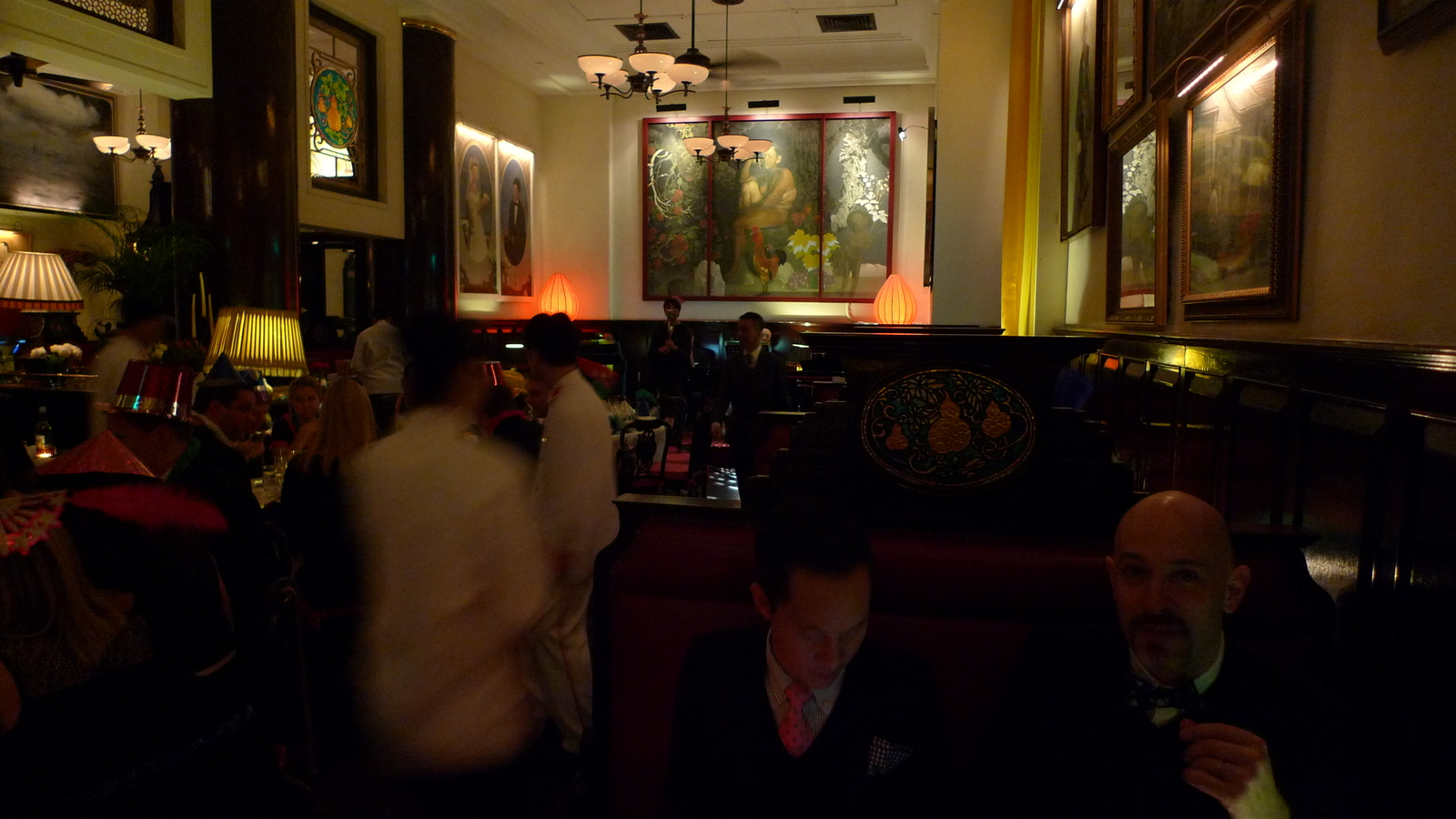
Tawn and I dressed to the nines. We didn’t realize that the theme for the night was for Great Gastby-ish dress, otherwise we would have worn some vintage crushed velvet dinner jackets. I’m proud that I achieved one of my 2013 resolutions: being able to tie my own bow tie without watching the YouTube video to guide me. Success!
The interior of the club, which occupies the top three floors of the old Bank of China building, has the feel of a Chinese tea house but with loads of contemporary art on the walls. It was a happening place with lots of young professionals crowding the tables. Someone needs to remind these young men that gentlemen do not remove their jackets at the dinner table.
The menu is mostly Chinese, with an emphasis on Cantonese cuisine, the style indigenous to Hong Kong. We did order a few variations, though. Appetizers began with these deep fried prawns with foie gras, wrapped in tofu sheets, which featured large, fresh prawn meat.
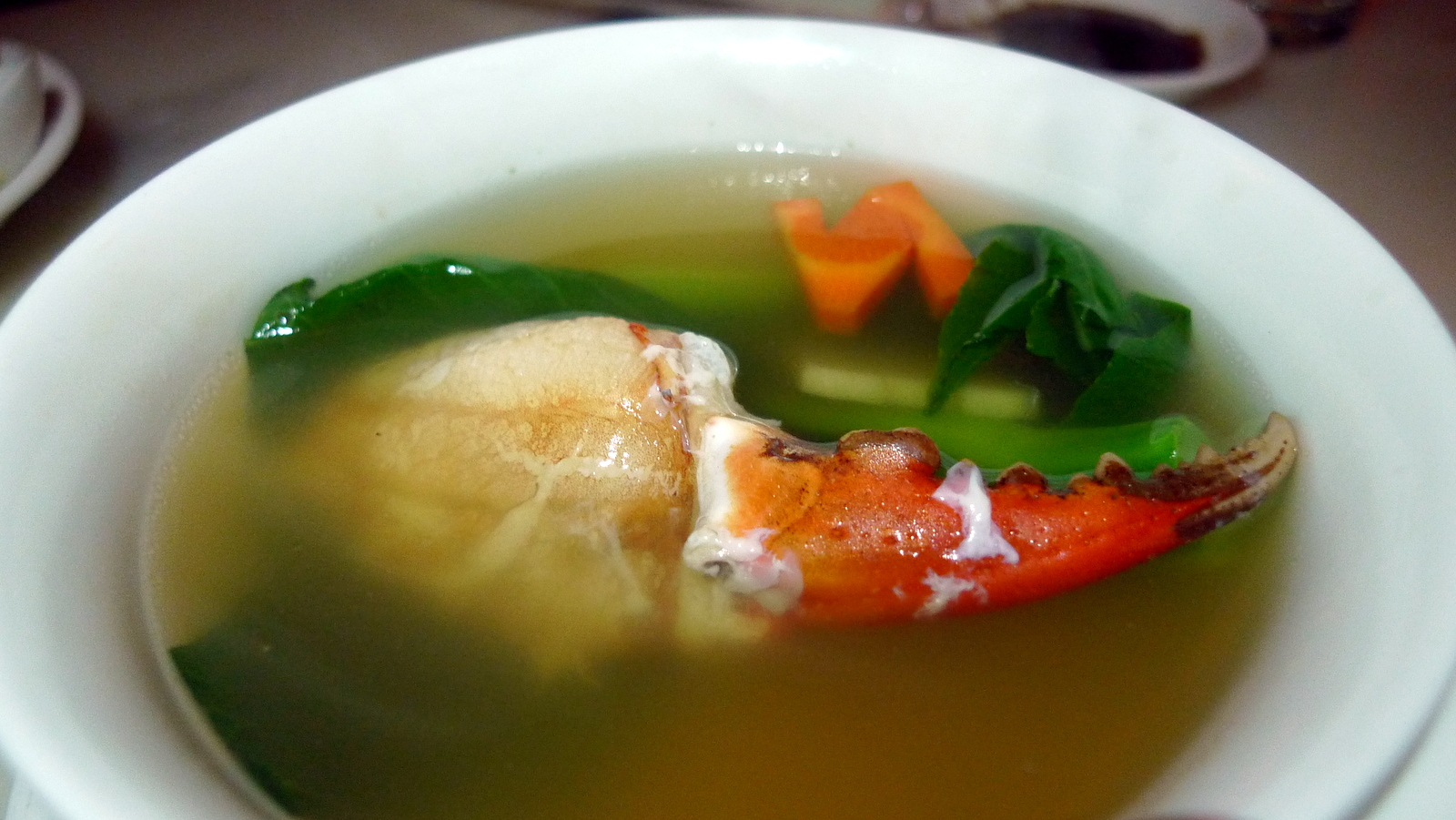
Soups are usually available per-person, that way everyone can order what they want. One of our friends had this crab claw meat (one perfect, unbroken piece) served in a lovely consommé broth with vegetables.
The other friend and Tawn both ordered the sweet and sour soup, a classic that was very nicely done. (Yes, I tried a bite of everything!)
I tried one of the special soups, which was braised beef brisket in hand-pulled noodles. The brisket was nicely tender and flavorful while the noodles had a pleasant “al dente” texture.
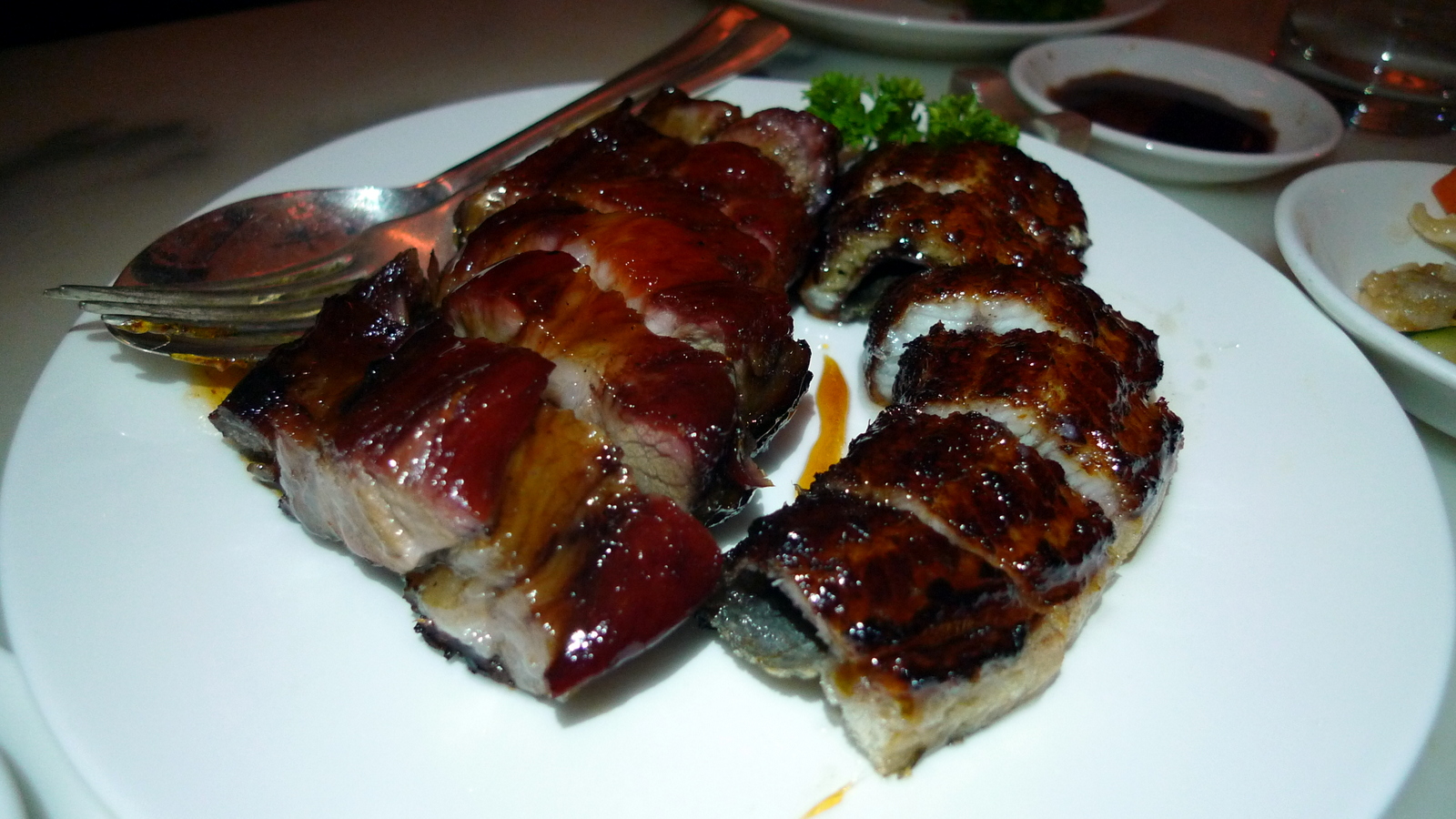
One of the recommended dishes was the charsiu, or roasted, honey-glazed pork belly. This staple of Cantonese cuisine is succulent and, when done well, is the perfect balance of flavors and textures. The chef did a good job with this and another plate would have been welcome
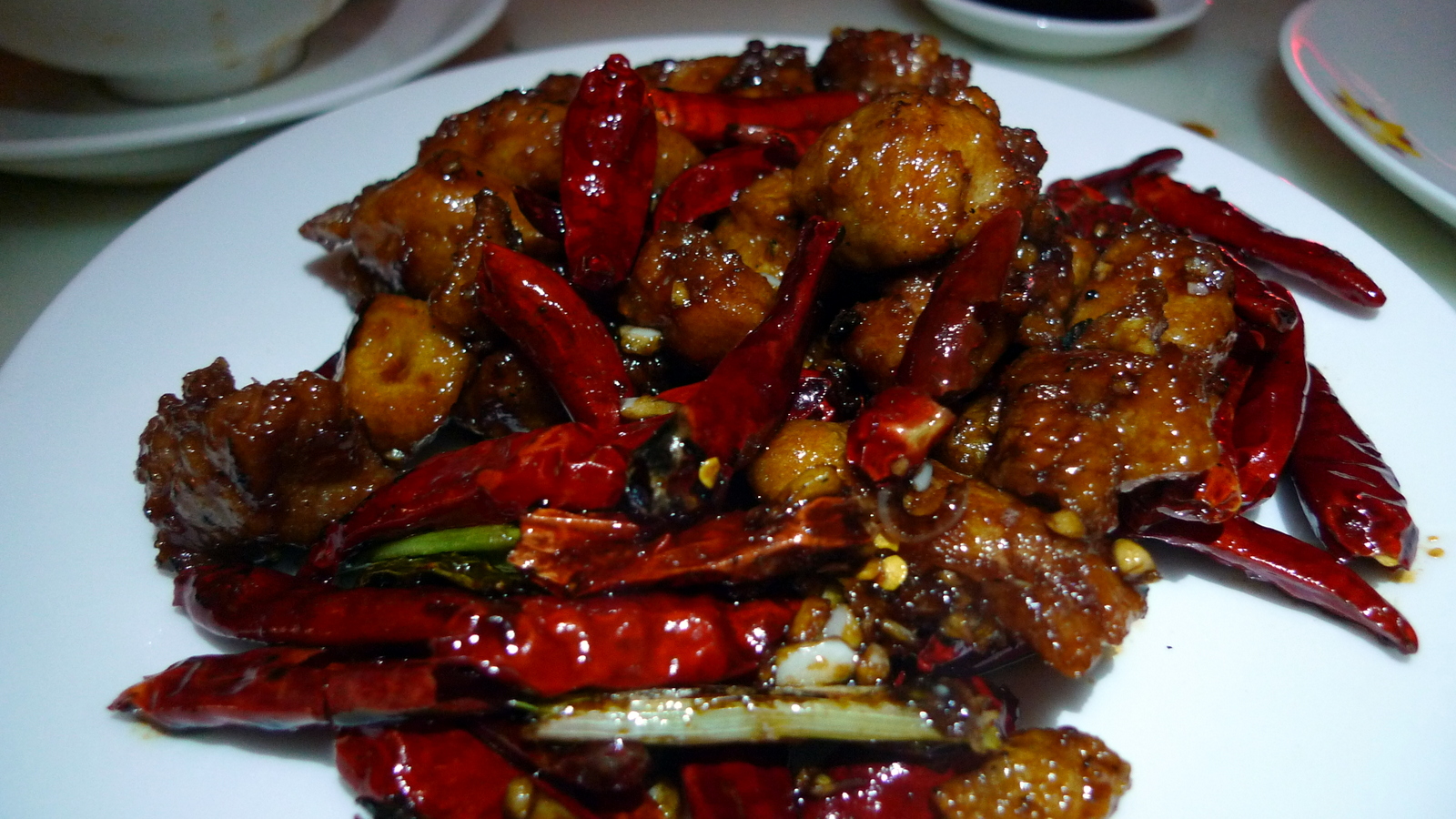
This is a Szechuan style dish: sautéed diced chicken with garlic, star anise, chilies, and spring onion. It isn’t as hot as you might imagine and was one of my favorite dishes.
For variety, I ordered another Szechuan dish: dan dan noodles. This dish has a spicy chili sauce made with preserved vegetables and minced pork served over noodles. This particular version had a lot more sauce than usual and the sauce had less of the tongue-numbing Szechuan peppercorns than I have experienced in other versions. Nonetheless, it was enjoyable.
Sautéed lotus root, sweet peas, water chestnuts, and various fungi served in a nest made from deep fried taro root. This was a wonderful example of the clean flavors, simple preparation, and elegant presentation of Cantonese cuisine. Of course, it can also be heavy and oily when poorly done.
I ordered this dish as an appetizer and it arrived near the end of the meal. Familiar to people who dine at Vietnamese restaurants, it is chopped shrimp made into a paste, formed around sugar cane, and deep fried. Always tasty.
We concluded the meal with some fried rice, this one a mixture of different meats and vegetables. As with most Chinese banquets (although this meal was ordered a la carte), the rice is served last so that you do not fill up on it during the meal.
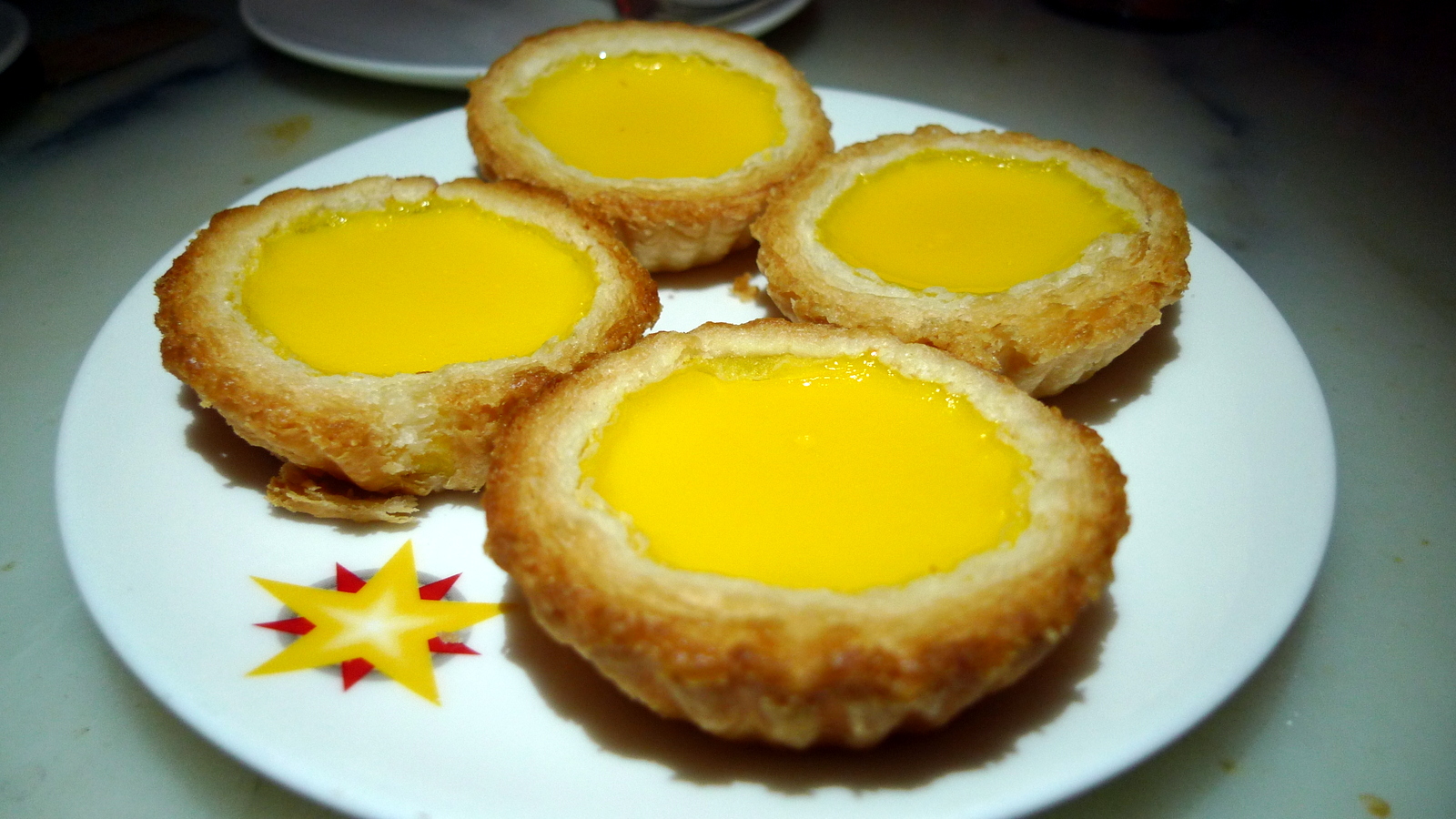
For dessert, we shared a few items that didn’t photograph well plus these lovely egg custard tarts. With a very flakey and not-too-oily crust, the tarts were a nice conclusion to the meal.
We also inexplicably received fortune cookies. I say “inexplicably” because these are an American invention and not authentic in the least. To top it off, there seems to be a trend of fortune cookies increasingly reading like “advice” cookies. As one Chinese friend pointed out, the quality of writing must be suffering because the fortunes are now outsourced to a factory in China. Ha!
All in all, China Club was a good meal and a fun place to dine on New Year’s Eve. For more info, here’s their website. Note that the club is members-only so to go, a member needs to make reservations for you.
While in Chiang Mai a few weeks ago with visiting guests, I made a stop at the Four Seasons resort for afternoon tea. The resort is located about a thirty-minute drive north of town, which only enhances its feeling of being in the middle of nowhere. The resort is gorgeous and the afternoon tea is a worthwhile splurge for an hour or two of pampering yourself.
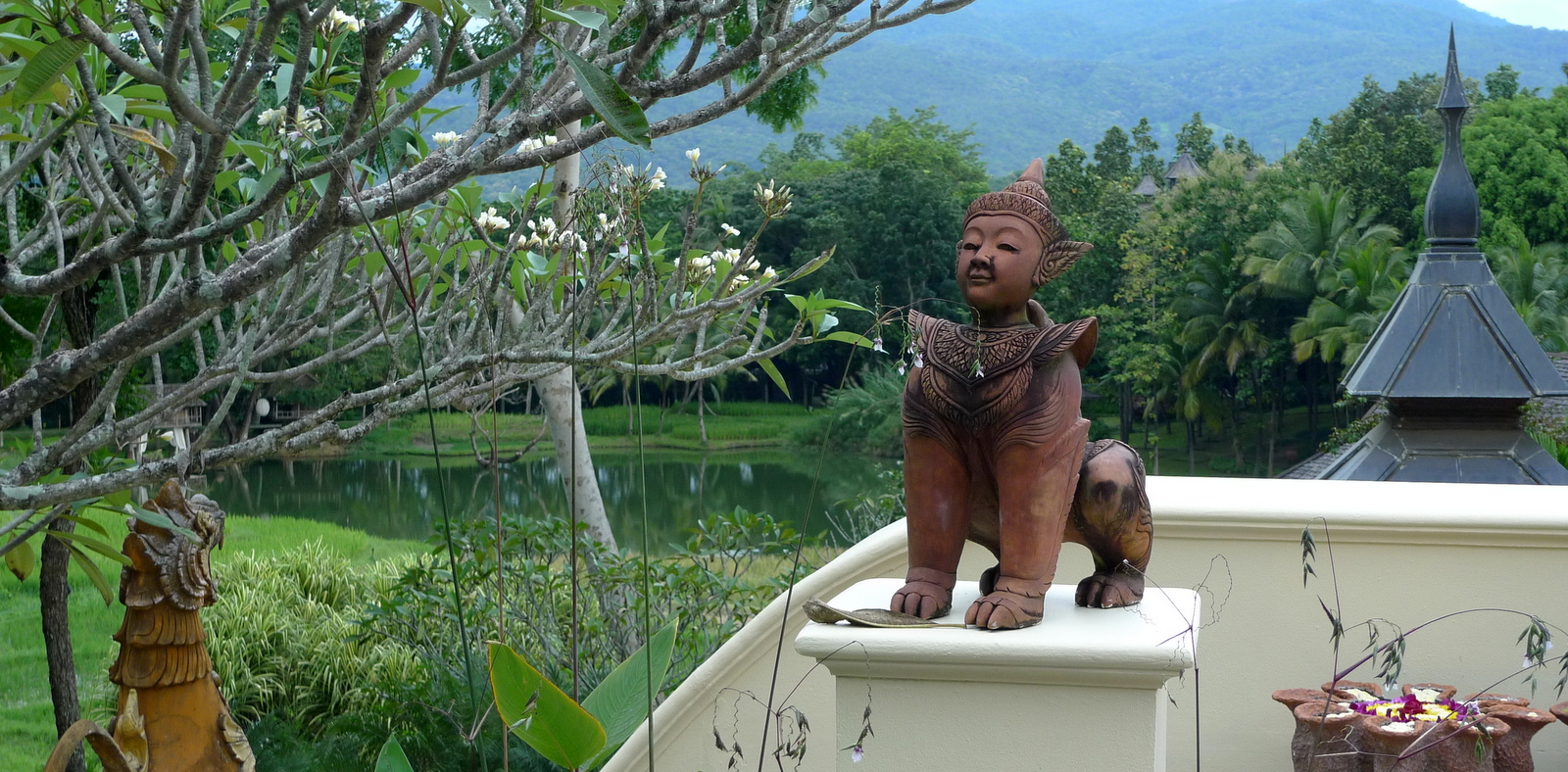
The resort is arranged around a pond designed to look like a Northern Thai village complete with rice paddies. The only buildings you see are those belonging to the resort and with the mountains in the distance, you could easily be forgiven for thinking you had been transported to some magical Thai Brigadoon. At 5:00, the “farmers” (resort employees dressed in traditional Northern Thai farmer’s clothes) paraded across the paddies to the rhythm of a gong, “returning” to the village, a touch that was a bit kitschy but also fun.
Trish, Allen, and I pose for a picture at the Sala Mae Rim restaurant. We didn’t make reservations but fortunately were able to get a prime table, perhaps because it was the midst of rainy season and the slowest time for tourists. We ordered one tea set (designed for two) plus an extra pot of tea, which was more than enough food for the three of us. The total price was approximately US$50, more than I would usually spend but certainly a worthwhile treat while on holiday.
The top plate in the tea set featured mango sticky rice with a palm sugar floss; crisp water chestnuts in sweet coconut milk; Parisian macaroons, and chocolate truffle cake.
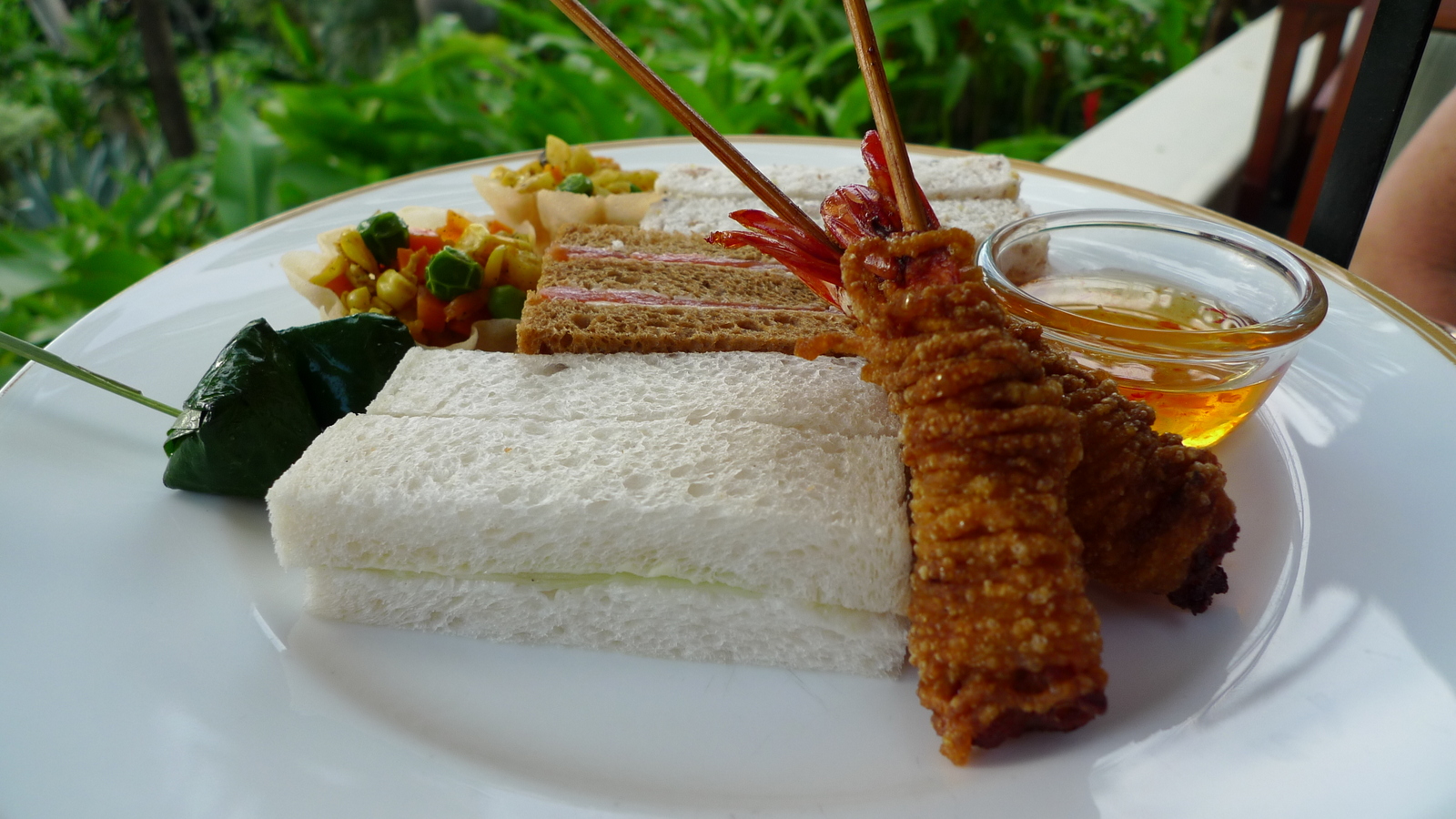
The middle plate in the set featured finger sandwiches (ham and cheese, cucumber, and smoked salmon); fried shrimps wrapped in egg noodles, miang kham (a Thai snack of betel leaves wrapped around savory fillings); and krathong tong (literally “golden baskets” – crispy shells filled with minced chicken and shrimp).
The final plate in the set featured kaffir-lime and raisin scones, served with clotted cream and strawberry jam. All the food was fantastic and the portions were more than adequate for the three of us.
After almost two hours of indulgence, we finally left paradise to return to the city. Without a doubt, the Four Seasons is on my list for future visits. While it may be too far away from the city to actually stay at (unless you specifically want to escape from the world), it is worth a visit for tea.
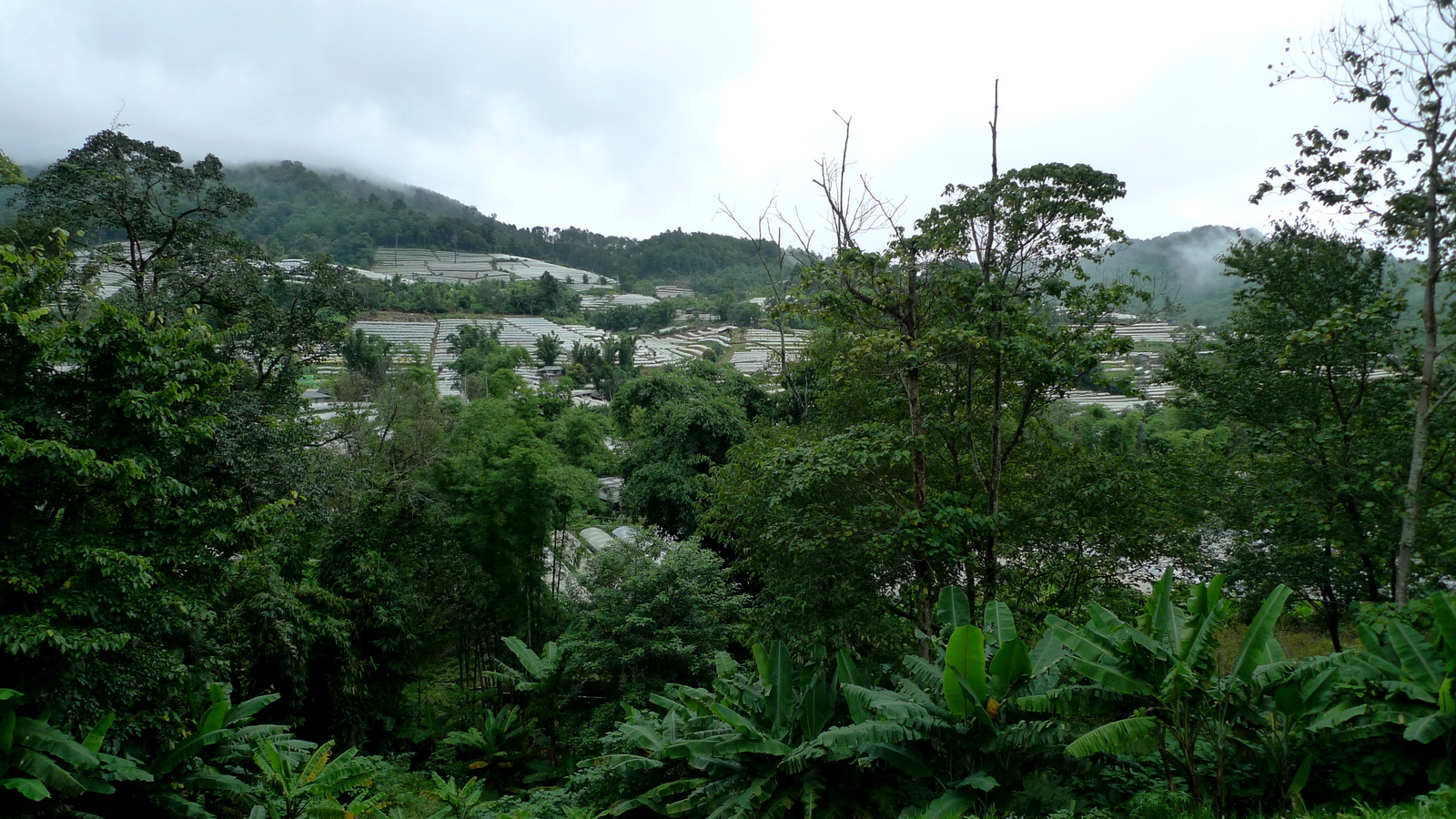
While up in Chiang Mai with visitors last week, I took several pictures that I want to share. It is the height of rainy season and the surrounding countryside was particularly verdant.
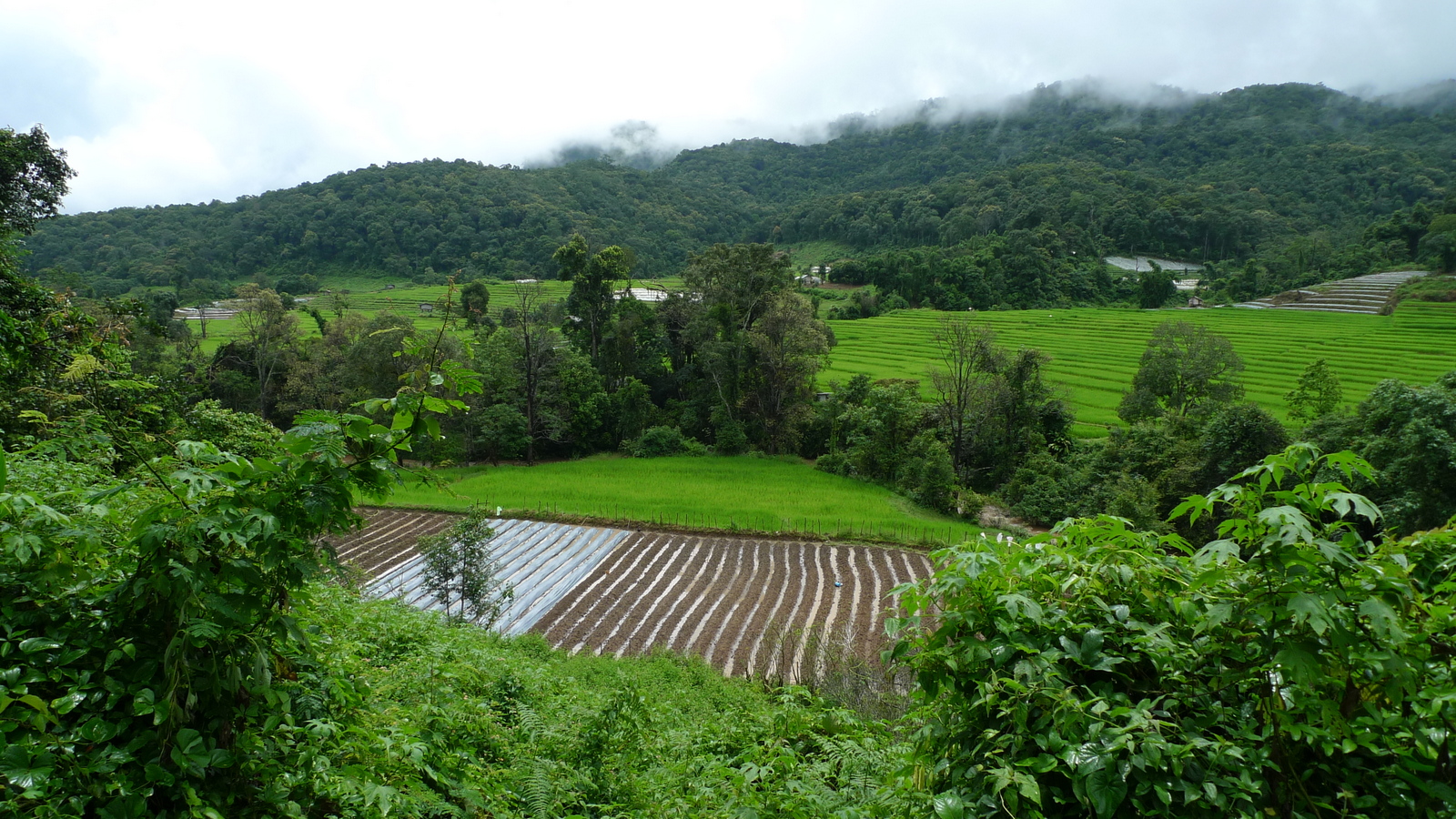
On the way up Doi Inthanon, Thailand’s highest mountain, we pulled over to snap this picture of rice paddies terraced in a small valley.
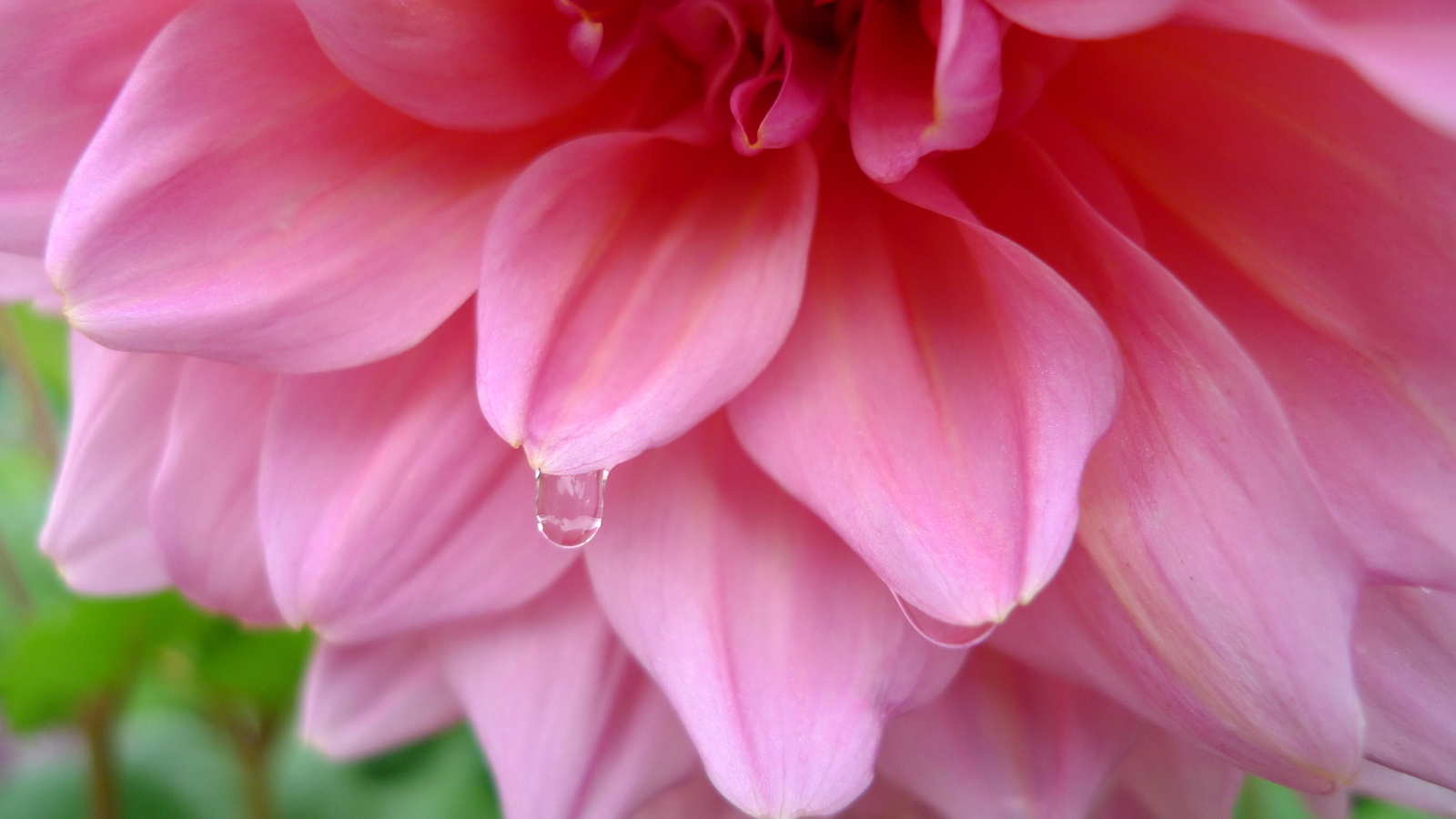
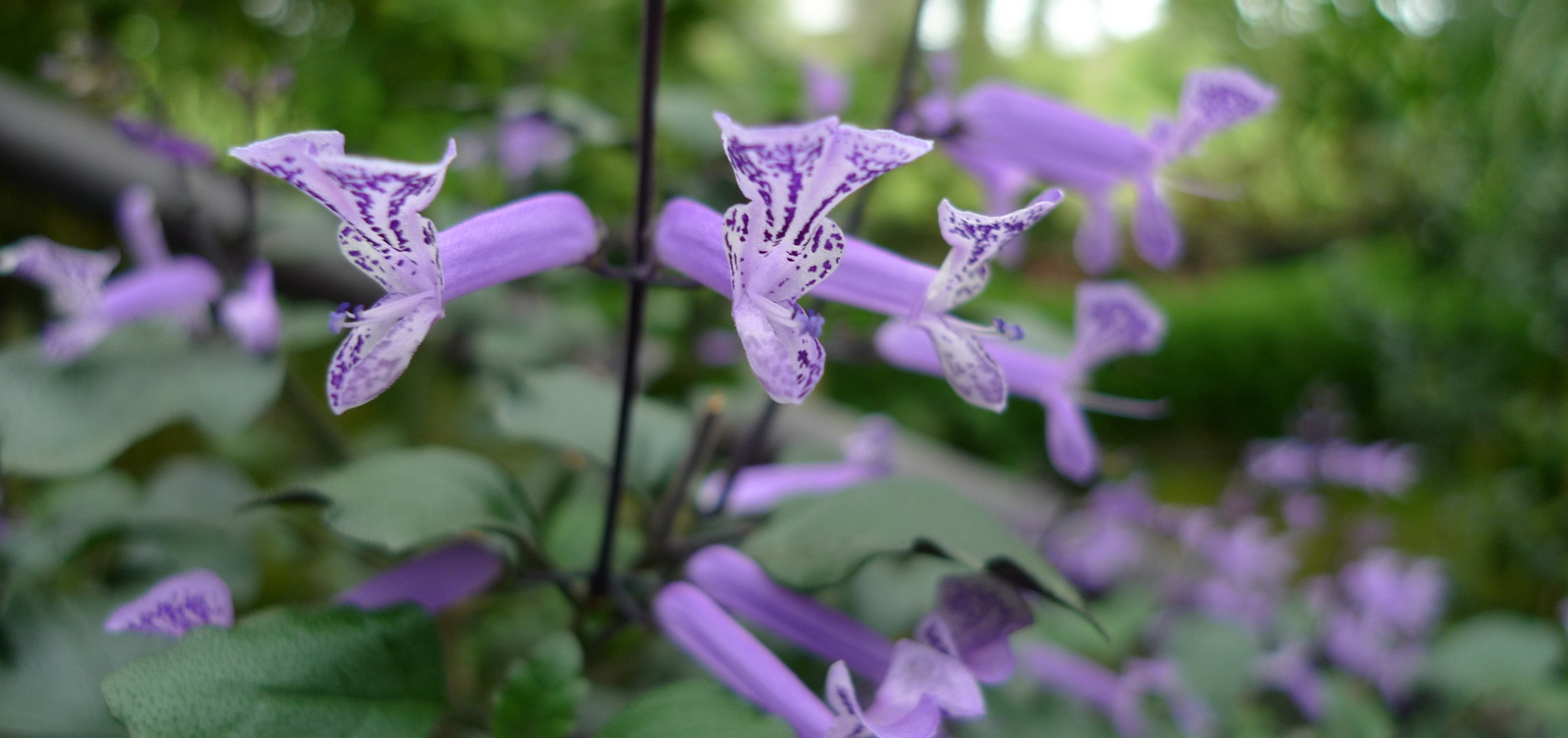
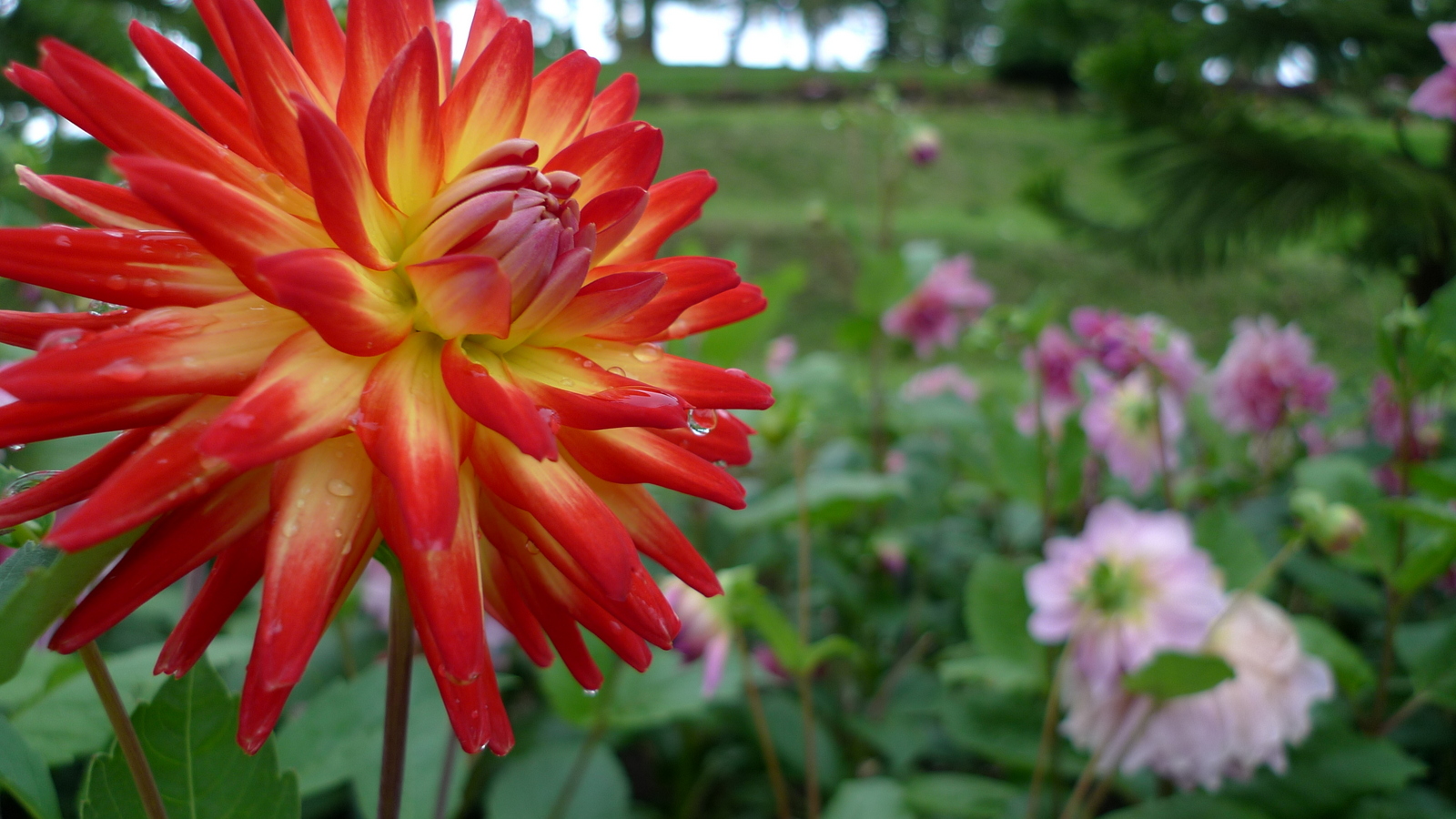
Further up the mountain, we visited the Royal Agricultural Project, which over the last few decades has helped local hill tribes transition from growing poppies (which were used to make heroin) to growing a wide variety of fruits, vegetables, and flowers. The higher elevation provides a climate suitable for select vegetables that could otherwise not be grown in Thailand. The pictures of flowers below are from the display gardens at the project.
By visiting during the weekdays of the rainiest month of the year, we enjoyed not only the beautiful flora but also the smallest crowds of tourists I have ever seen. In fact, “crowds” is not the correct term. “Handfuls” would be more apt.
We also visited Doi Suthep, the mountain immediately to the west of Chiang Mai, which houses a spectacular temple with a golden chedi, or stuppa. This is the second time I’ve visited the temple on an overcast and damp day. The effect is interesting because the gilding is not as bright as on a sunny day, but it contrasts beautifully with the grey skies. In the above picture, I focused on a row of bells the line the temple buildings. Bells are purchased with donations and the donors can write wishes or prayers on the metal leaf hanging from the clapper.
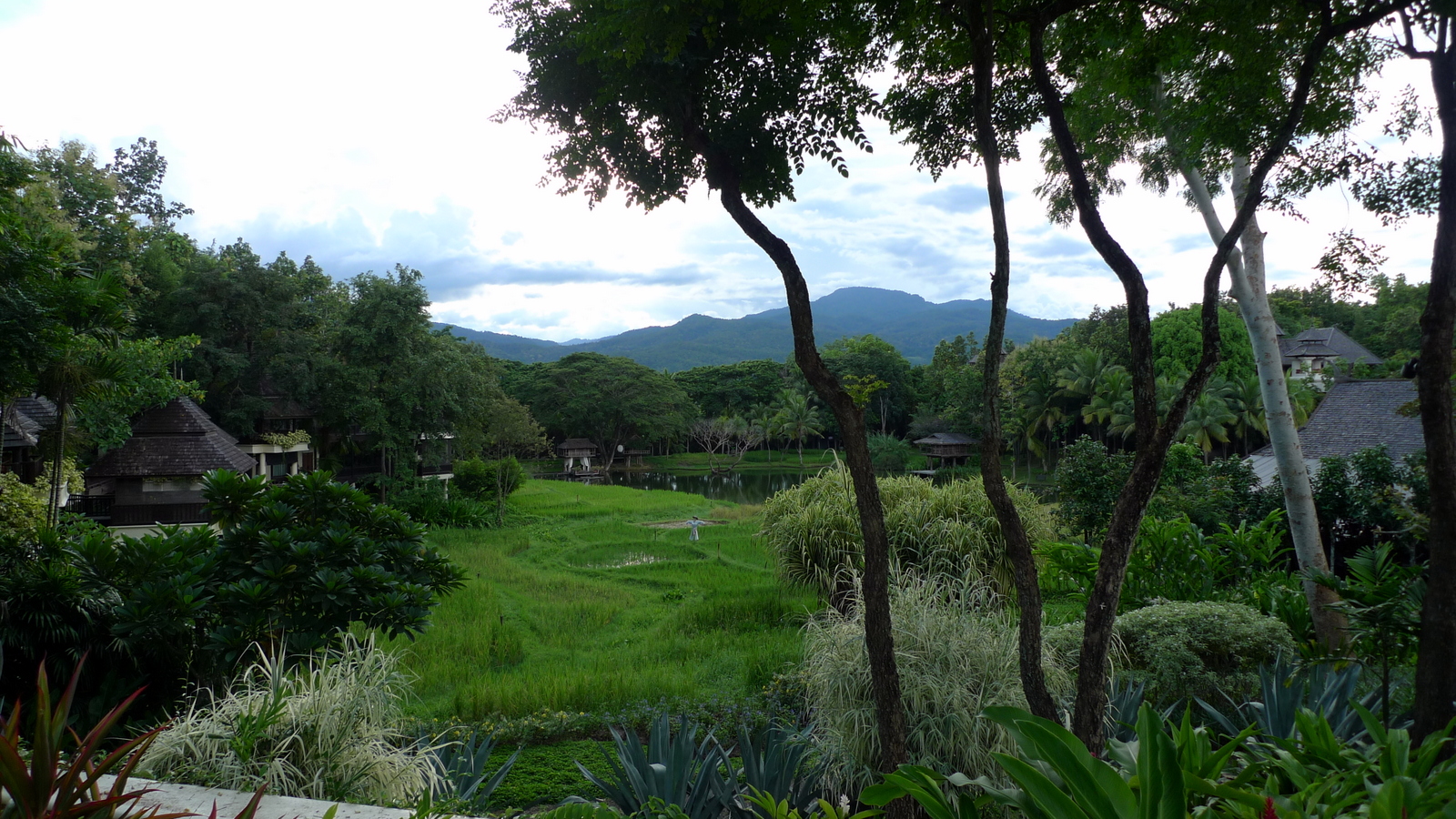
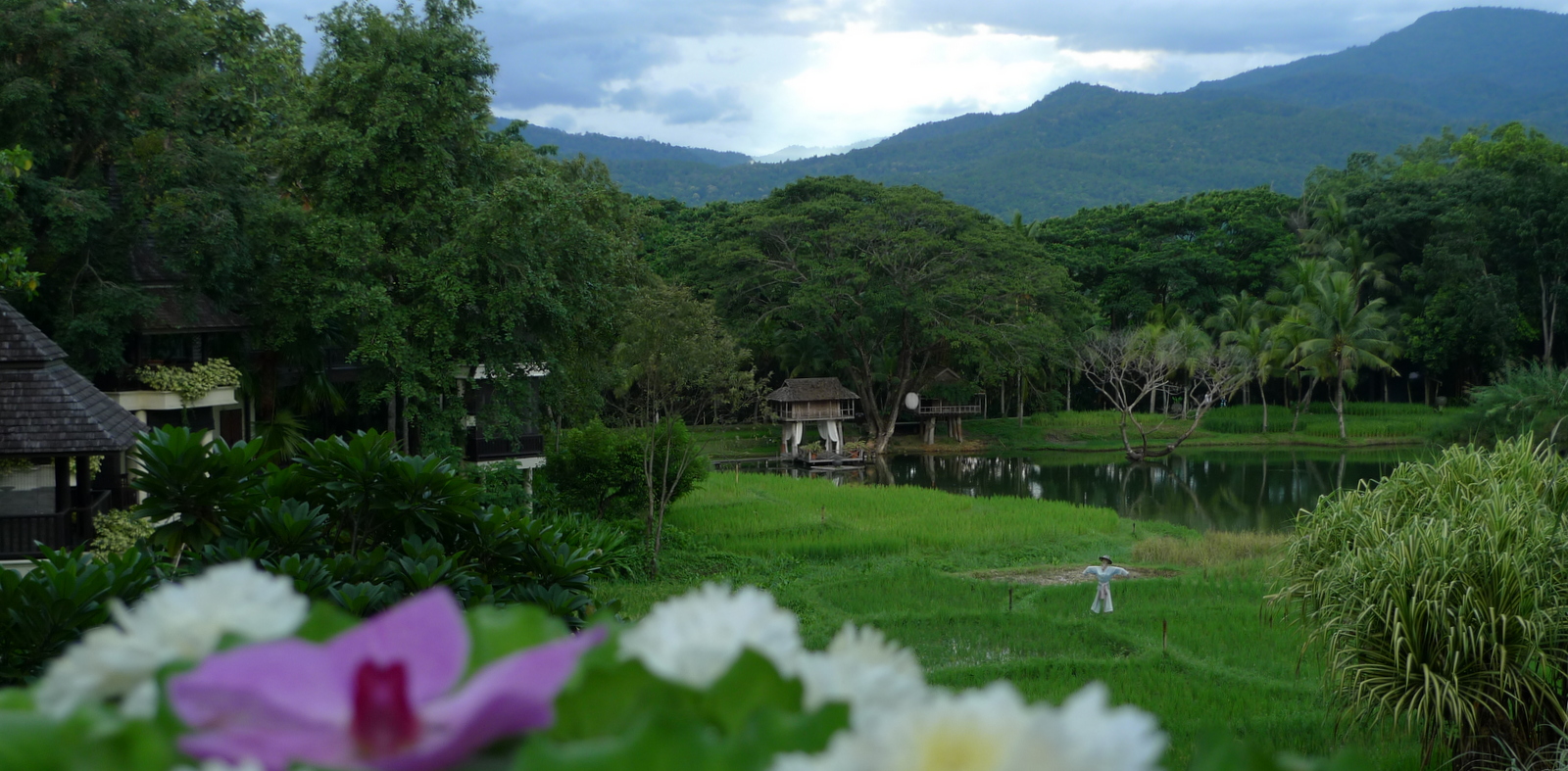
On our final afternoon, we drove north of Chiang Mai to the Four Seasons Resort to enjoy afternoon tea overlooking their property, which is designed to look like a rice farming village. I’ll share the pictures of the gorgeous tea service in another post but wanted to share this view of their pretty property.
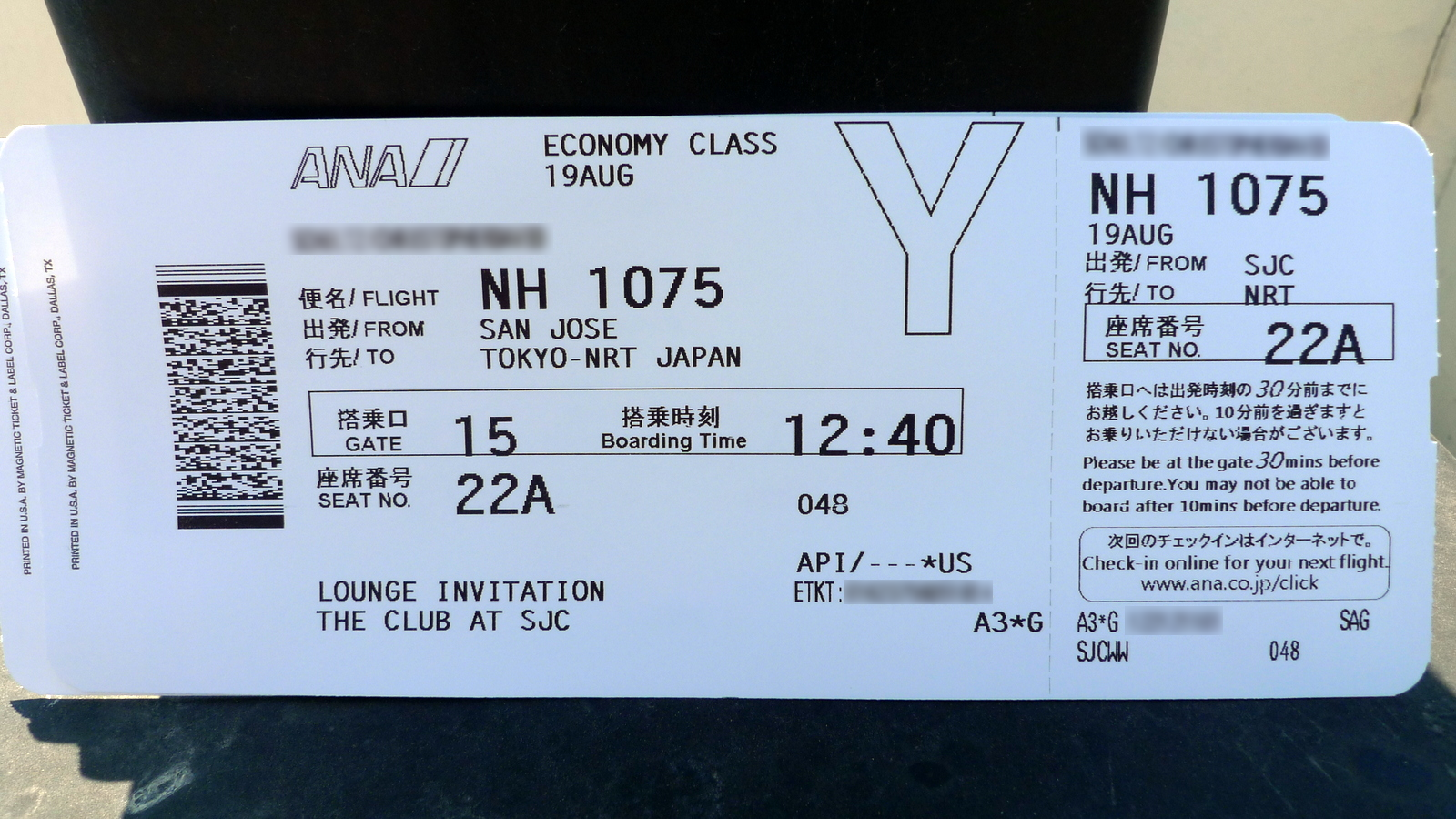
This is the story of my first flight aboard the Boeing 787 Dreamliner, traveling on All-Nippon Airways (ANA) flight 1075 from San Jose, California to Narita airport in Tokyo, Japan. An 11-minute video version of this trip report is embedded here if you would prefer to watch instead of read.
The Dreamliner is a revolutionary wide-body aircraft. Made largely with composite materials, it is about 20% more fuel efficient than the older 767 aircraft it is designed to replace. Despite a four-month grounding earlier this year because of electrical problems, the aircraft has performed very well for its initial customers and is opening new “long and thin” routes like San Jose to Tokyo that could not previously have been served profitably.
I arrived at the airport plenty early to watch the inbound aircraft land, which arrived about twenty minutes late. Having grown up in the San Jose area and able to remember the days when the airport was a much smaller operation, it is exciting to see this cutting-edge plane regularly scheduled to fly here.
ANA operates from terminal A. Now nearly a quarter-century old, I still recall terminal A as the “new” terminal compared to the 1960s era terminal C that was only recently demolished. As a child, I relished the opportunity to walk across the tarmac and climb a set of stairs to board the airplane. To me, that made air travel much more exciting. These days, the two terminals at San Jose are modern and entirely enclosed. Certainly the facilities are nicer but the travel experience is also more sterile.
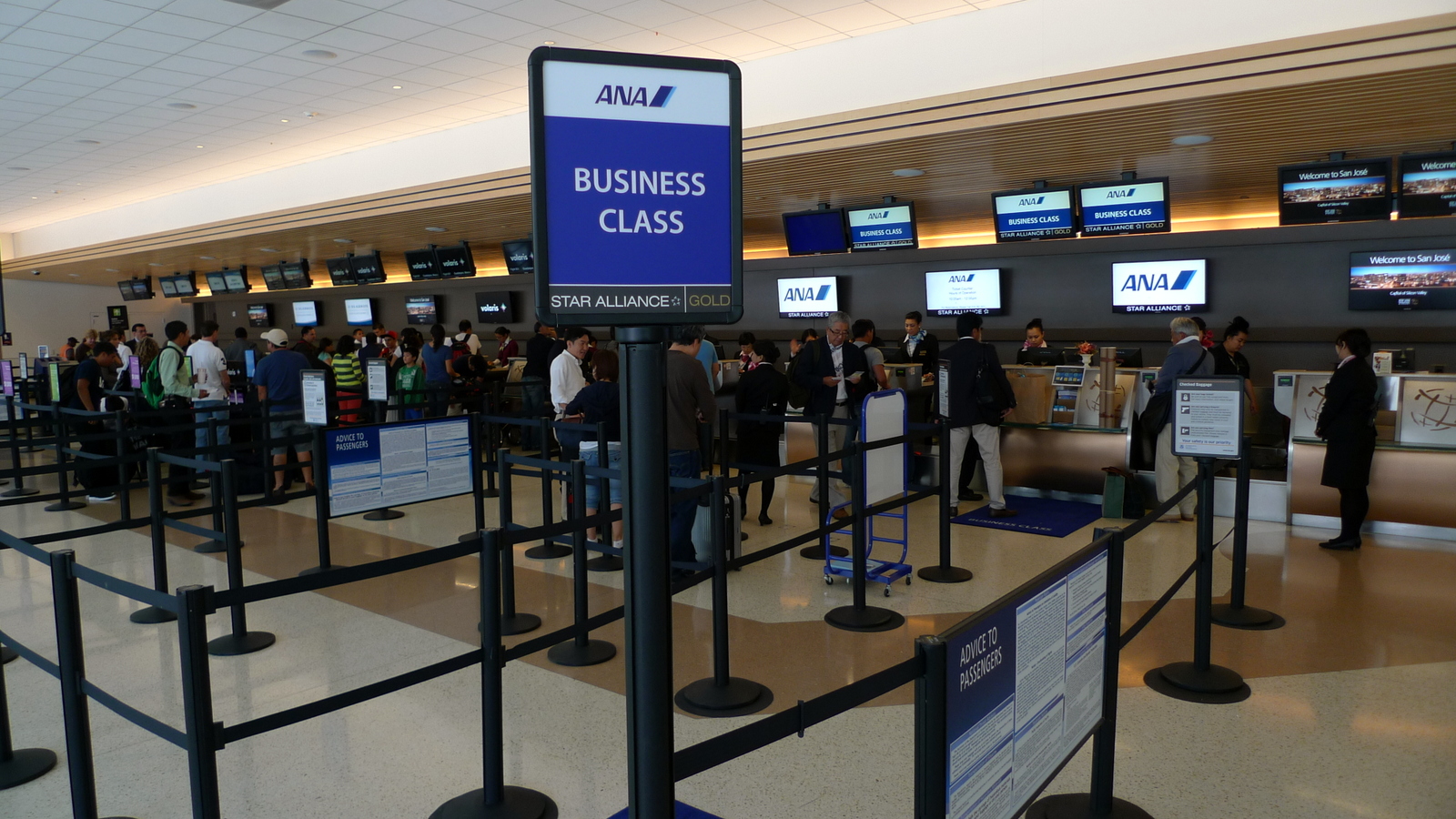
ANA has a small counter space but lots of employees working check-in. As a Star Alliance gold level member, there was no wait and I was efficiently checked in by a friendly agent. While the agent did not appear to be of Japanese heritage – several of the staff members were – she displayed all the appropriate cultural training such as receiving and handing documents with both hands. This was a nice touch and leads me to believe that instead of relying on contract employees, ANA is using its own staff.
Boarding pass in hand – a window seat in the second row of economy class – I headed up the escalator to the security screening area. The terminal has a single consolidated screening point and while there weren’t that many people in line, the process took a bit of time. In particular, the crew of Mexican budget airline Volaris seemed to be holding up the line, unfamiliar with the TSA’s screening procedures. It took several of the flight attendants multiple trips through the metal detector before they finally removed all of their metal items.
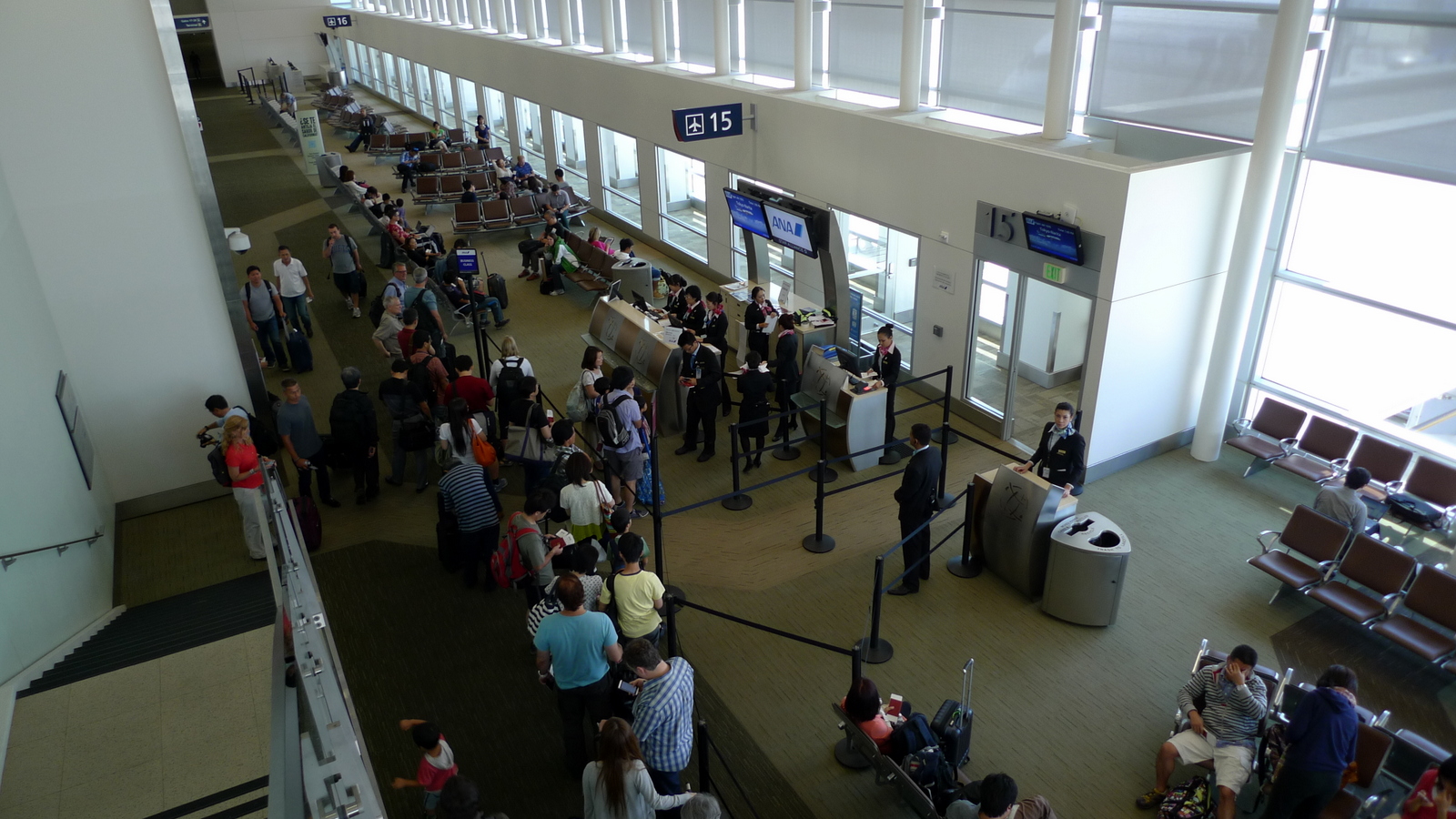
Today’s flight operated from gate 15, one of two gates connected to the International Arrivals Area. This section of the terminal is essentially the connector between terminals A and B. There are few amenities but the windows offer a good view of the tarmac. Unfortunately, the sterile corridor leading to the customs and immigration area means you look out through two sets of windows.
I spent plenty of time taking pictures of the Dreamliner. It is a unique-looking airplane, with an asymmetrical nose. The plane’s proportions make it looks smaller than it actually is, perhaps because it looks unusually low to the ground for so large an aircraft.
After taking plenty of pictures – something lots of other waiting passengers were also doing – I headed to The Club at SJC, a private lounge that ANA uses for its premium customers. The Club is the only lounge at SJC, where the only dominant airline is Southwest.
Located upstairs from the departure gate, the lounge offers limited views of the tarmac but has two large seating areas, workspaces, and a decent selection of food and beverage. They also have a single shower room, so I freshened up before the flight.
It was nearing time to board. ANA operates the San Jose service with a 787 in a very low density configuration, only 158 passengers in a plane that can easily seat more than 220. Because of this, the gate area was not crowded.
After the highest level members of ANA’s frequent flyer program were boarded, Star Alliance Gold members were invited. A single jetway is used at this gate but with so few passengers boarding, it isn’t a problem. I was welcomed aboard warmly and directed towards my seat.
Business class, divided into two cabins, seats 46 people in alternating rows of 1-1-1 and 1-2-1 seating. All seats have direct aisle access and a lot of privacy. The problem with this arrangement is that it isn’t very friendly for couples traveling together. I know that privacy is something that a lot of premium customers value highly, but I prefer arrangements that are a little less cubicle-like.
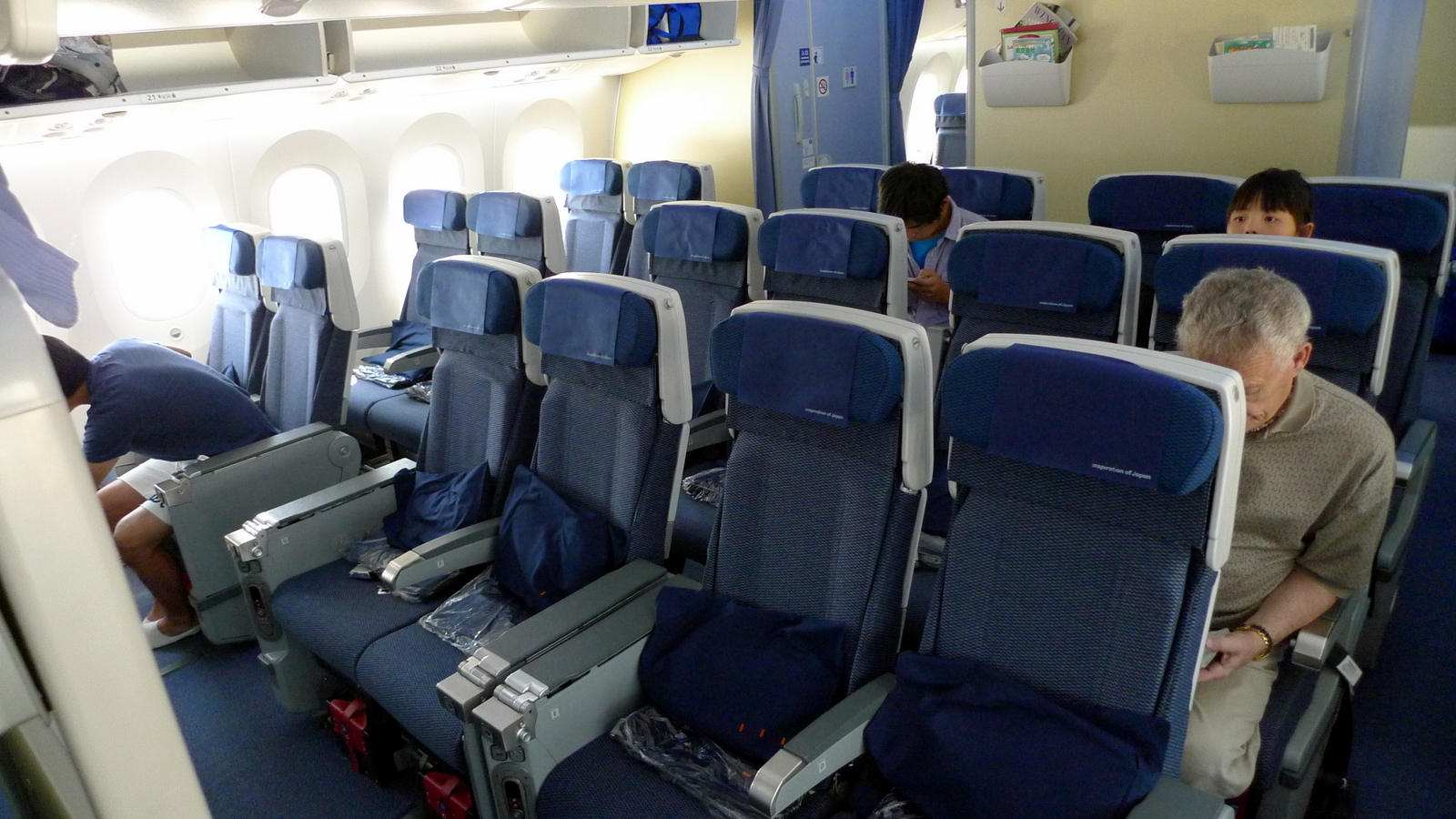
A small economy class cabin of just three rows sits behind business class and the mid-cabin lavatories. In another configuration, this area has premium economy seating with 38” legroom and only seven seats across. I can understand why they made that choice: there is nearly a foot of empty floor behind the last row in this cabin. Even without installing premium economy, they could have added a few more inches to each of these three rows.
The design of the overhead bins offers plenty of room to store roll-aboard bags placed on their side. The bins also pivot into the ceiling, making for a very open cabin when they are closed. This being a low-density seating configuration, lots of storage space remained even after everyone had boarded.
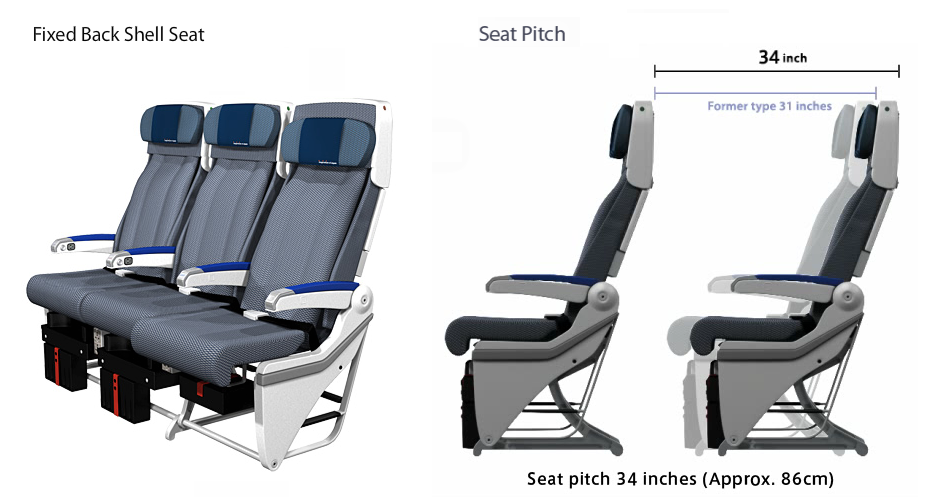
ANA uses fixed-shell seats in economy, where instead of reclining back into the row behind you, your seat slides forward. I like this arrangement because my personal space remains fixed. With 33 to 34 inches of seat pitch, ANA’s Dreamliner offers several more inches of legroom than most competitors including joint-venture partner United Airlines. My one complaint with these seats is that the headrest doesn’t move up and down and, perhaps because it is designed for Japanese customers, it manages to fall at my neck rather than the back of my head.
The inflight entertainment system is an “on-demand” system with touch screen controls. The selection of movies, TV shows, games, and music is extensive – plenty to keep you occupied on your flight. The system was also one of the more responsive that I have used. When you touch the screen, it reacts promptly. The overhead passenger service unit features a new design and it was nice to be on a wide-body airplane with personal air vents.
Boarding was complete in about fifteen minutes and soon enough we had pushed back and the safety demo was finished. As the engines spooled up – a higher pitch whine than I’ve heard before – the ANA ground staff lined up to send us off with a wave. Being a small airport, we reached the departure end of runway 30 R in just a few minutes. Number one for takeoff, we pulled onto the runway and launched into our roll without a stop.
Our departure followed an interesting path, indicated in green on the map. We leveled off at 5,000 feet and maintained that altitude across the south end of the bay, towards Woodside.
Meanwhile, aircraft were circling wide on our left (yellow on the map), cutting behind us to line up for arrival on runways 28 L and R at San Francisco. While I am confident the air traffic controllers were keeping a close watch on us, the other aircraft came a lot closer than you usually see from your window. It was nice to have such a good view! As we approached Half Moon Bay, we resumed our climb, joining the westbound route across the Pacific.
About forty minutes after departure, inflight service began with hot towels – real cloth towels – followed by a beverage service with snacks.
The snacks were simple – rice crackers – and the selection of beverages included complimentary wine, beer, and spirits. The crew was friendly and helpful and there were no difficulties in communicating with them in English.
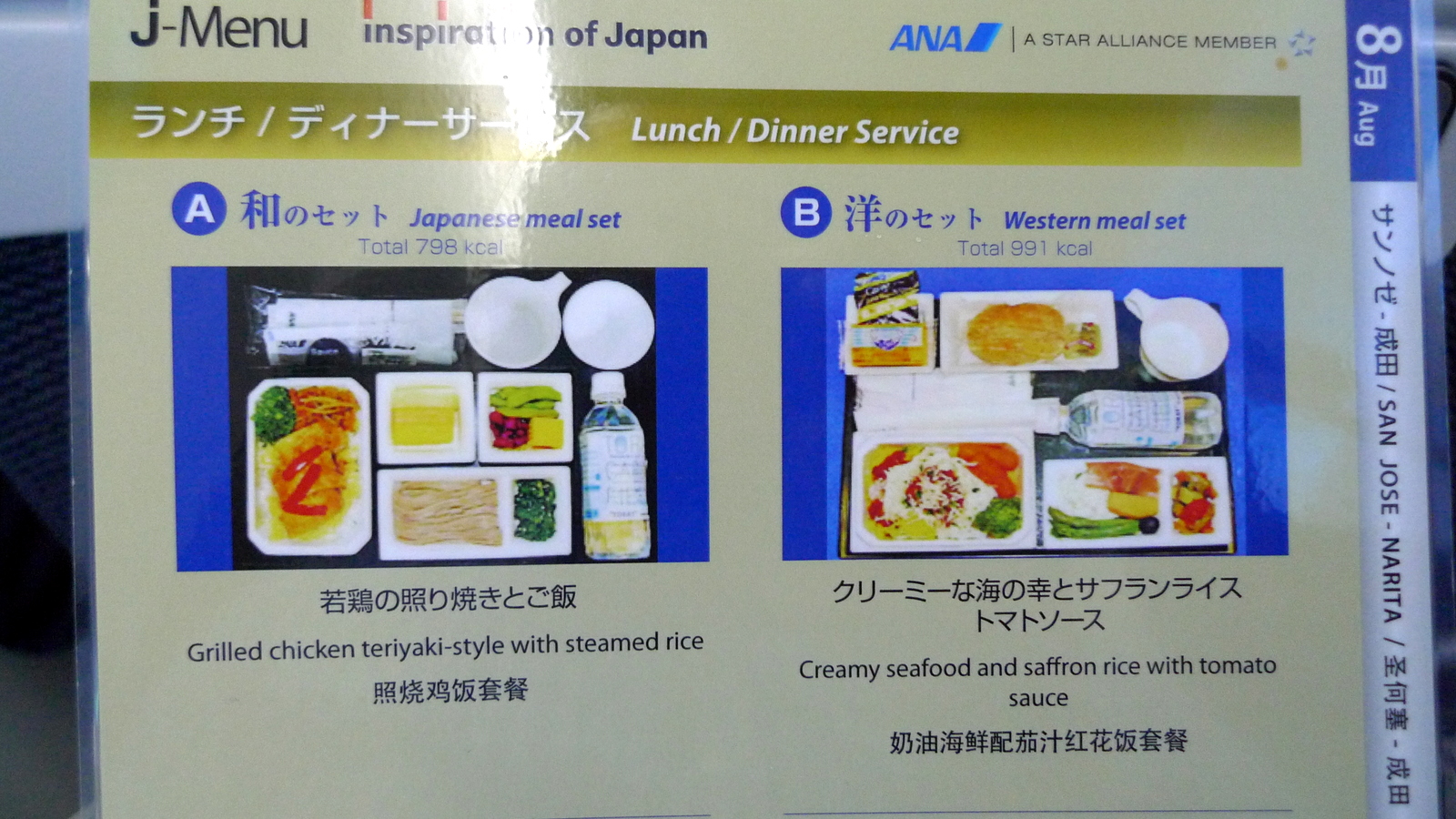
An in-seat menu card described the general service while the specific meal choices for today’s flight could be read on the inflight entertainment system and also on laminated cards the flight attendants had on their carts.
For dinner, I chose the Japanese option – a chicken teriyaki dish served with cold soba – buckwheat noodles. The portion was generous and the food was tasty. The dinner also included miso soup served from a pitcher.
Afterwards, flight attendants distributed Häagen-Dazs ice cream – a simple and satisfying dessert. Since the meal was served with metal cutlery, I could use an actual spoon to scoop the rock-hard ice cream instead of the flimsy plastic one contained inside the ice cream container’s lid.
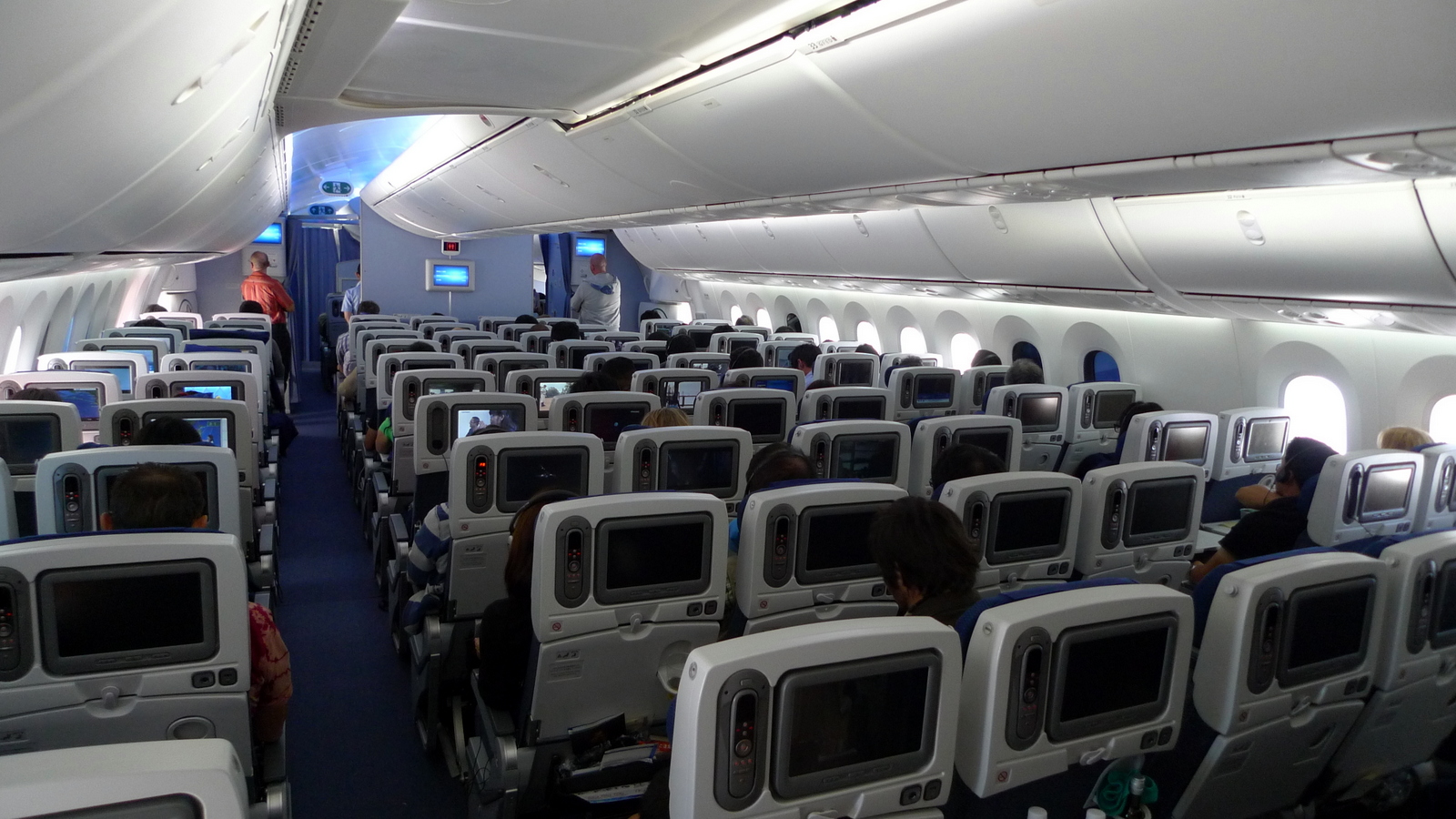
After lunch, I walked around the mostly-full cabin. You can see the windows, which are about thirty percent larger than conventional airplane windows. Truthfully, this didn’t make as big an impression on me as I thought they would. Sure, the windows were large, but the biggest effect was that it made the cabin look narrower. I’m not sure if that makes sense, but because I am used to a standard-size window, as I looked across the width of the cabin and mentally estimated the width, the wall looked closer to me than it really was. Instead of shades, the windows use LCD controls for different levels of shading. Above, you can see two of the windows at the maximum-dark setting.
The rear cabin has eleven additional rows of economy class seats. As you can see, the cabin has a spacious feel and the 2-4-2 arrangement is quite pleasant. Unfortunately, ANA is moving towards a 3-3-3 arrangement like most operators so the comfortably wide seats will be a thing of the past. I can understand the economics but will say that as a customer, I will go out of my way to fly an 8-abreast 787 instead of a 9-abreast configuration.
The other thing I noticed is that the screens on the entertainment system are coated in such a way that they are not visible unless viewed almost straight-on. For example, I couldn’t tell if the person seated next to me had his screen on until I leaned over to look. This would seem to be a good thing, minimizing extraneous light and also giving greater (although not complete) privacy in what you are viewing.
The galley and entrance to the crew rest area are at the rear of the cabin. This arrangement is nice because it gives the crew plenty of space to work and minimizes the number of passengers congregating in this area. Instead, the congregate mid-cabin by the lavatories.
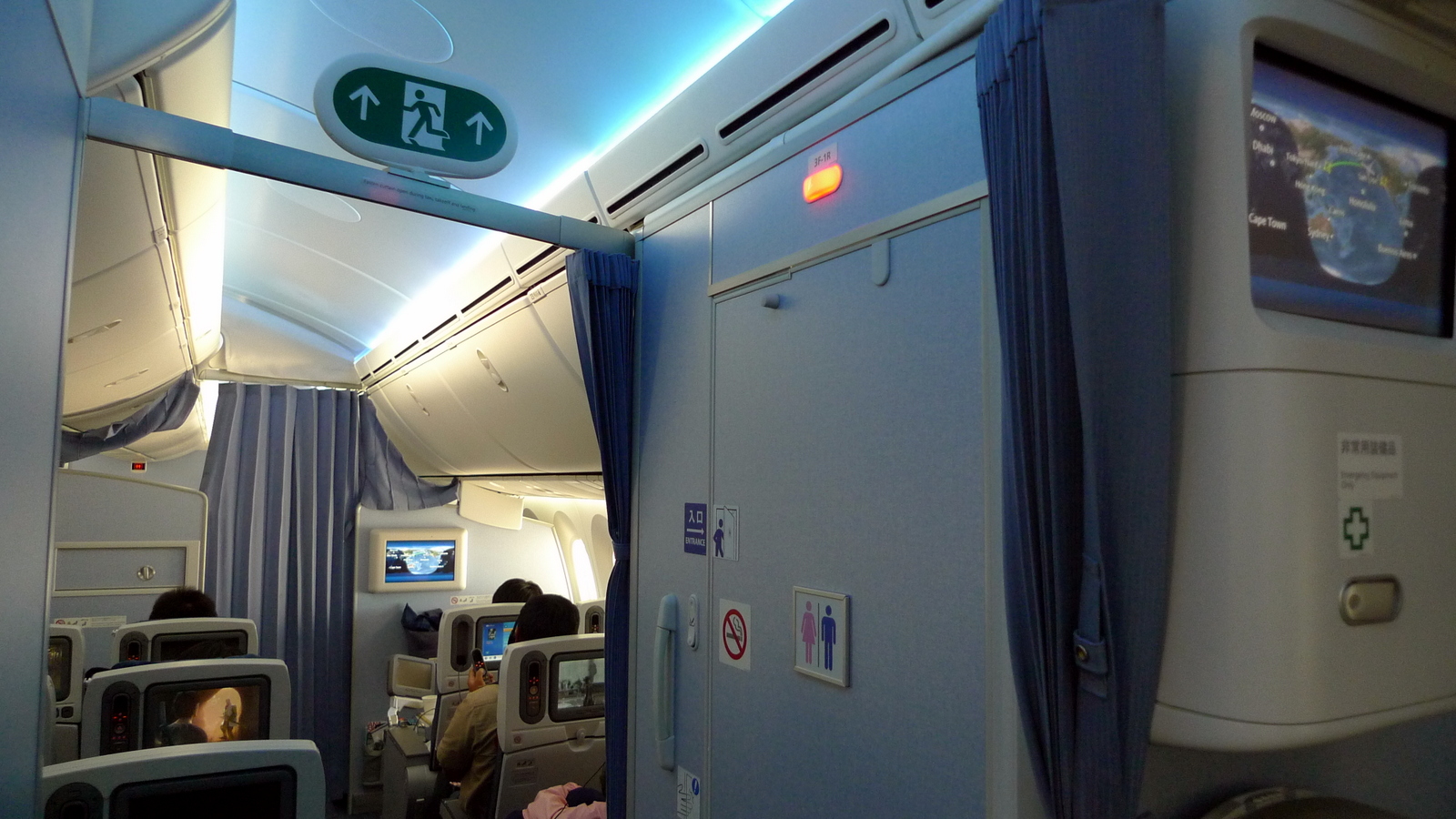
Three lavatories are in the middle of the economy class cabin, located by doors 3 left and 3 right. I didn’t get a picture or video of them, but the doors are hinged in an interesting way. Instead of pivoting on a hinge at one side of the door or folding in half, the door slides and pivots into the toilet, lying flat against the side wall. This improves the accessibility of the lavatory although isn’t intuitive. I noticed several people pushing and pulling the door before they figured out how it moved.
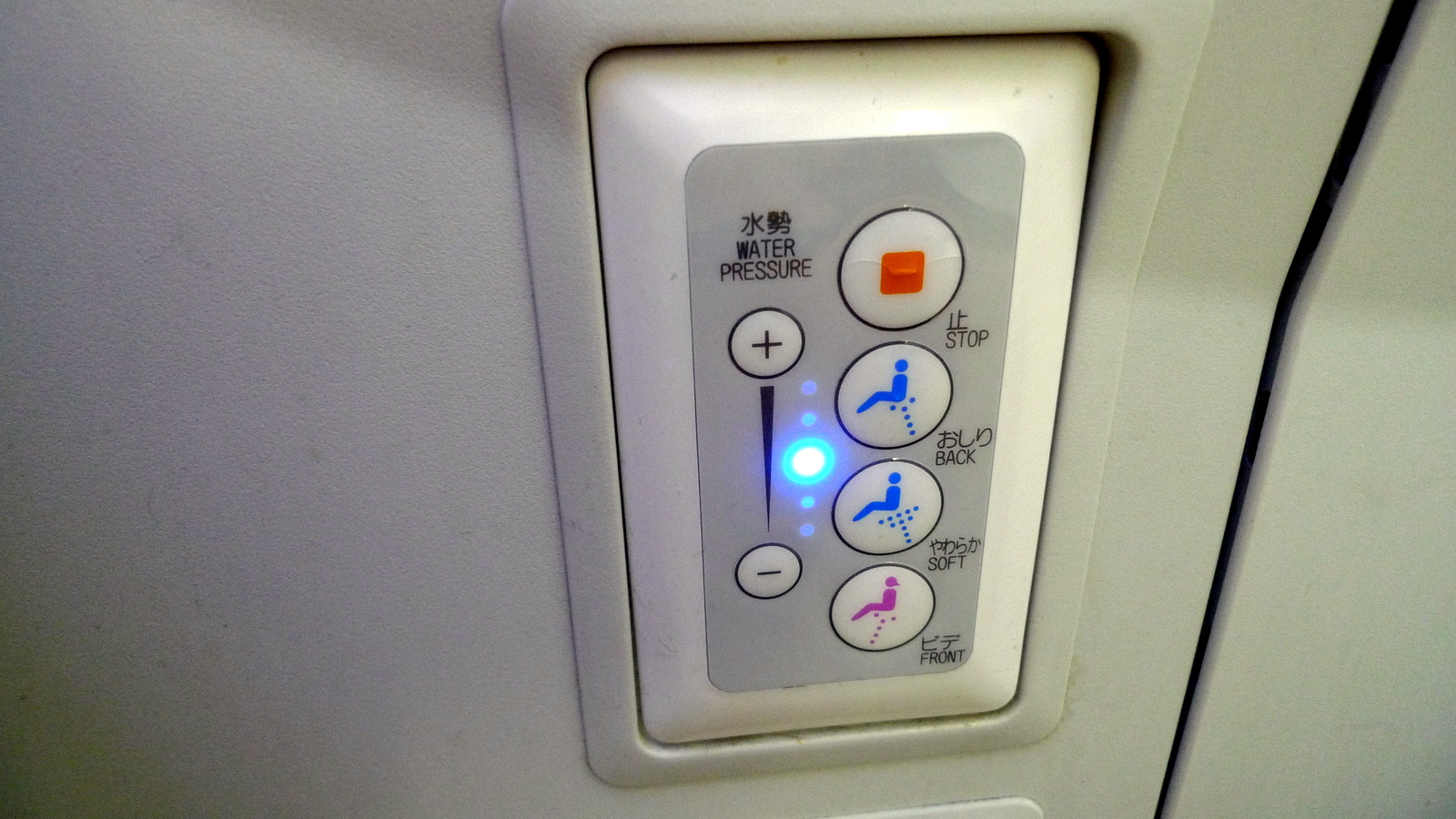
The lavatories are high-tech on ANA featuring lots of buttons, including for the automated bidet, in case you need to wash your bum afterwards. When you press the flush button, the toilet seat cover is automatically lowered. Oddly, though, the flush happens while the cover is still lowering. Lavatories were kept clean with flight attendants tidying them throughout the flight.
The LCD shading for the windows is interesting. Instead of having physical shades that you pull shut, there are two buttons that allow you to increase the tinting along five settings from nearly transparent to nearly opaque. It seems that the most transparent setting still seems to have a light tint to it, or at least that was my impression.
At its darkest, you can still see through the window although little light passes through. That may not make sense when I write it, but when you look at the windows from the side, they appear to be completely opaque. When you look at the windows straight-on, you can see through them as if they were very dark sunglasses. Mid-flight, which was still full daylight outside, the cabin was dark although not as dark as with physical window shades. If I’m not mistaken, I think the flight attendants were able to master set the windows to the darkest setting although individual passengers could modify the settings for their own windows, making them more transparent as they wished.
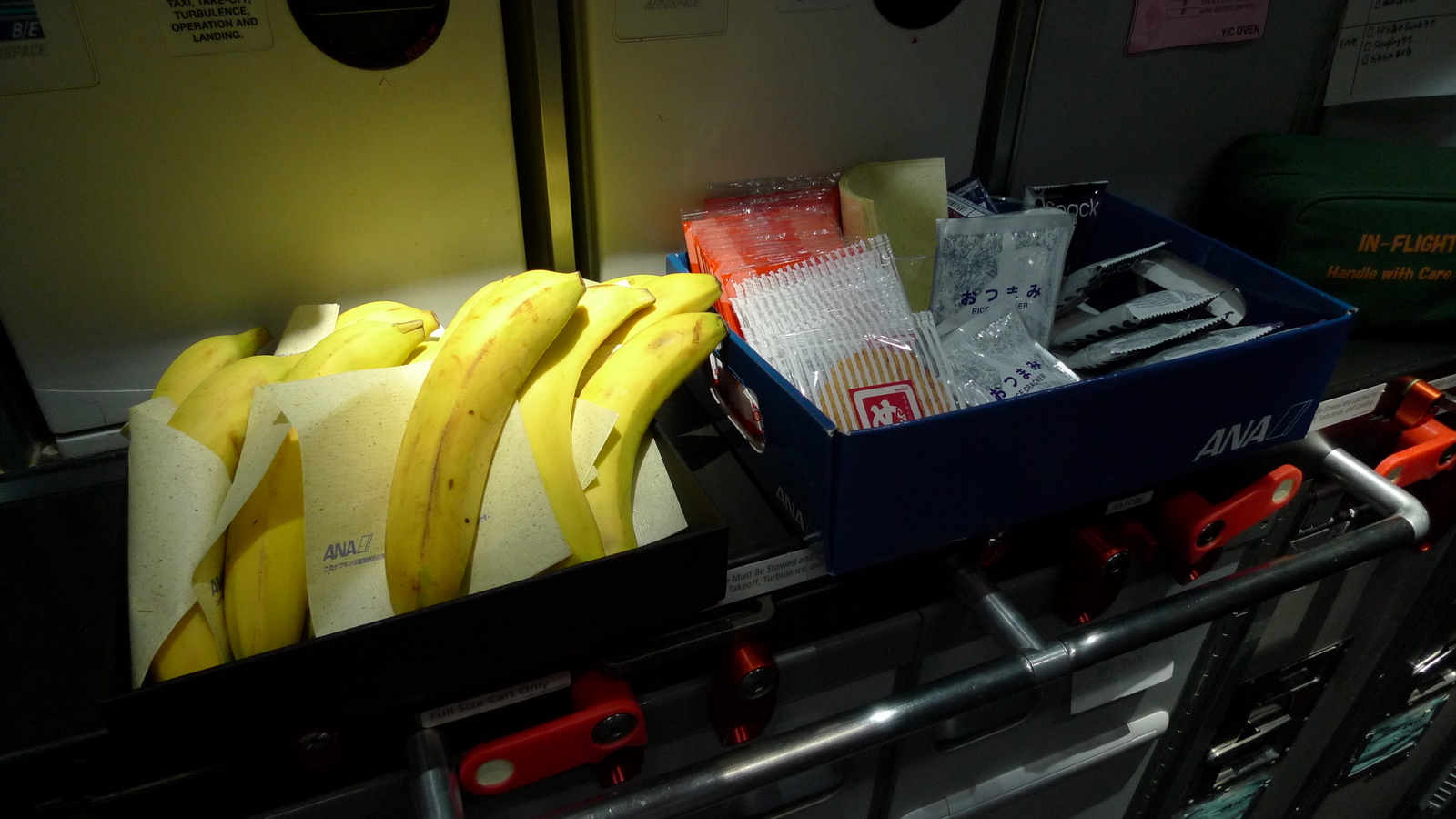
Snacks and beverages were available in the galley throughout the flight. The selection was basic – some crisps and crackers along with bananas.
About two and a half hours before landing – just a little early, in my estimation – a second meal service was offered. Unlike lunch/dinner, which had clear “Japanese” and “Western” options, the choices for the breakfast were less distinct.
I had the chicken cacciatore, which was pretty tasty. The portion size was smaller than the previous meal, but considering that we had eaten just five hours ago, that was okay.
One feature of the Dreamliner is that its cabin is pressurized to the equivalent of a 6000 foot elevation instead of at 8000 feet, as found in most airliners. Also, humidity levels are slightly higher, about 15% versus less than 5% normally. My impression was that the cabin was a bit more comfortable than normal. I travel frequently across the Pacific and find I get very dried out. The effect could just be psychological but on this flight, I felt less dehydrated.
The rest of the flight was smooth as we descended into an overcast northern Japan and landed on-time in Narita. As we approached the airport, there was a lot of other traffic and on our turns there was always a good view of other planes. The rice paddies were also vibrant green and just starting to turn golden yellow.
Again, thanks to the low-density configuration, it took just a few minutes to deplane. My nine hour, forty-five minute flight aboard the ANA Dreamliner left me with a positive impression of both the airplane and the airline.
All things considered, I would go out of my way to fly ANA in general and the Dreamliner in particular on future trips. Additionally, flying out of San Jose was a very convenient option so I will keep that in mind for future trips to and from the Bay Area.
Tuesday evening, I returned to Bangkok after a twelve-day trip to the United States to renew my Thai visa. This trip, like ever other trip I make by myself, always finds me a bit awash in melancholy. This time, the waves came while eating noodles in the lounge at Narita Airport in Tokyo.
I have been traveling by air since I was a month old. Over the years, I have come to associate air travel with so many things: adventure, family, friends, romance, and escape. On each trip, the moment comes when I feel like I am in transit, literally suspended between points in my life. The idea that I am part of a larger network, knowing friends and family around the globe, excites me. At the same time, I feel disconnected and not at home anywhere in particular.
It is an interesting sensation and one that, the more I experience it, the more inviting it becomes. Maybe there is a point where I cease to be grounded at all and am forever flitting about the globe.
A fourteen hour layover in Seattle was my first stop in the United States. Arriving about 9:30 in the morning, I took the convenient light rail into downtown and conducted my most important business: drawing a money order and then mailing it, and my inch-thick Thailand visa application, to the Thai consulate. After a long wait, a surprisingly helpful postal employee walked me through the steps of buying the money order, properly addressing the express mail envelopes, and then packing everything correctly.
After a browse around the Pike Place Public Market and lunch at a cute French restaurant nearby, I visited the Seattle Art Museum to see “Future Beauty: 30 Years of Japanese Fashion“. This exhibit, which runs through Labor Day weekend, has more than 100 dresses from Japanese designers such as Issey Miyake, Kenzo Takada, and Rei Kawakubo. These designers revolutionized the way we think of fashion. I only wish Tawn could have attended the exhibit, which he would have found fascinating.
In the afternoon, I went to my aunt and uncle’s house and spent time with them and my cousins. Their daughter is about a year old and I last saw her in March at my grandparents’ 75th wedding anniversary, so it was nice to see how much she has grown since then. My uncle prepared some excellent wild salmon on the grill, so I was well-fed.
My red eye flight departed Seattle about midnight, heading east to a rainy Cleveland. A two-hour connection allowed me time for breakfast and a shoe shine before I caught my flight into Kansas City.
The next several days in Kansas City were spent visiting family members, attending football (soccer) games and gymnastics lessons, and the like. Four and a half days was enough time to see everyone, catch up, and then move one before wearing out my welcome. Unfortunately, no time for a side trip to Omaha or Quincy, though.
Last Thursday I made a last-minute trip back to the United States to renew my Thai visa. Searching online, I was able to find a combination of dates and routes that were reasonably affordable.
The trip was booked on United Airlines through Tokyo. While I consider most Asian airlines to be a better experience than US-based airlines, I have to say that United’s revamped economy class product was acceptable, better than it used to be. Sadly, their Boeing 747s have not had the revamp. The Boeing 777 fleet, though, has audio-video on-demand and power outlets at every set of seats. The flight attendants are still kind of surly, though.
In Tokyo, I was joined by a group of thirty or so Korean primary school children on their way to a Tae Kwan Do competition in San Francisco. One of the group, 11-year old Jun, was seated between me on the aisle and another guy in the window seat. It made for an interesting flight. He was more outgoing than I would expect, talking with both of us throughout the flight and asking lots of questions. Even when I put on my eye shades and tried to sleep.
My fellow traveler and I looked out for Jun, getting snacks for him from the galley and sharing some snacks we had brought on board. An interesting thing that I assume is a cultural trait, when I offered him some granola bars that I had just opened, he declined to break off a section for himself. Instead, I figured out that he was waiting for me to break off a piece and offer it to him. He then broke a piece from that one and offered it to the guy sitting in the window seat.
After about seven hours of flying, awake the whole time, Jun’s energy ran out and he crashed hard asleep. Contorted in his seat in a strange position, I managed to wake him up for the second meal service since he had complained of being hungry. He was so bleary he could scarcely decide what entree to eat. He fell back asleep and didn’t wake up until we pulled into the gate and I shook his shoulder. Poor kid – hope he didn’t have to complete the following day!
I will be in the United States for ten days. Have already gathered some good food pictures and will share them in the next few days.
While in Taipei for Andy and Sugi’s wedding banquet, I visited a cute little patisserie called Boîte de Bijou (“Jewel Box”). Both visits were to their second location on AnHe Road in the Da’An district, just across the street from Far Eastern Plaza mall. The first visit was fantastic. The second visit was a disaster.
This location is not very large but has a stylish, modern decoration that mostly showcases the beautiful pastries they create. You can select many of your own items and fancier, more delicate items (cakes, for example), can be selected at the counter.
Indoor seating is limited to one communal table and a half-dozen seats at the counter at the coffee bar. With beautiful marble-lined walls and a great view of the barrista, who is preparing most of the dishes on the menu, the counter is a good place to be.
The pastries are fantastic. Beautiful, well-executed, and nicely presented. This blueberry tart featured beautiful ripe berries and inside the tart was a hidden pocket of jam.
This pistachio cake was beautiful to look at and had a delicate foamy texture with a cookie crumb base and a raspberry filling.
A surprise find was kouign amann, a Brittany-style pastry that has been gaining popularity worldwide. It is made similar to croissant dough except that sugar is sprinkled on each layer as it is folded and rolled out, making for a sweeter, more caramelized treat. The kouign amann here was a little tough and not as special as the other desserts.
Andy, Sugi, and I had a very pleasant afternoon break while Tawn was back at the hotel, taking a nap. Sadly, when I returned with Tawn a few days later, eager to share this cute little find with him, we ended up with a bad taste in our mouth.
Most of the seating at Boîte de Bijou is in an outdoor patio. When we arrived the second time, all the tables were occupied except one. Tawn sat down and I went inside to order pastries. As those were being prepared, I went to the coffee bar to order some drinks. The (manager? supervisor? random employee?) asked me where I was sitting and when I said we were sitting outside, she said that there was no room outside. I assured her we already had a table and even walked outside with her to show that Tawn was already sitting at the table.
In the next sixty seconds, my pleasant feelings about this patisserie melted away like spun sugar in a warm mouth.
“Oh, that table is reserved,” she said. When we asked why there was no sign or any other indication that the table was reserved, she simply repeated that the table was reserved. When I asked where we should sit instead, she replied that they were full. “But I’ve already ordered our food,” I explained. “We’re busy today,” was her response.
I understand that there was probably a bit of a language barrier. We didn’t speak Mandarin and English is probably not her first language. But for so classy a shop, there was absolutely no class to their service. No apology, no attempt to accommodate us, nothing. The ideal solution would have been something like, “I’m so sorry we forgot to put a sign on that table. Since you’ve ordered your food already, could we prepare it to go and I’d be happy to give you your drinks for free to make up for your inconvenience.”
Instead, she seemed uninterested in helping us, so we decided to leave. No food, no payment, just walked out the door, abandoning our pastries.
So if you make it to Taipei, there’s a really cute patisserie down a small lane. But before you go, be aware that their customer service lags behind their baking skills.




























 christao408