Two of the best croissants in Paris

France is known as a food-lover’s paradise and Paris is the capital. So it is expected that once in Paris, I would seek out many of “the best” food experiences. Of course, “the best” is an enigma, but I did turn to a number of resources including the excellent Paris by Mouth website. First on the list was to seek out some of the best croissants.

Tout Autour du Pain

As we were staying in Le Marais, an historic district that straddles the third and fourth arrondisements in Paris, we chose a nearby top-10 winner: Tout Autour du Pain. A fifteen-minute walk from our apartment near Centre Pompidou, Tout Autour (formerly known as 134 RdT) was two locations around the corner from each other.

IMG_1002

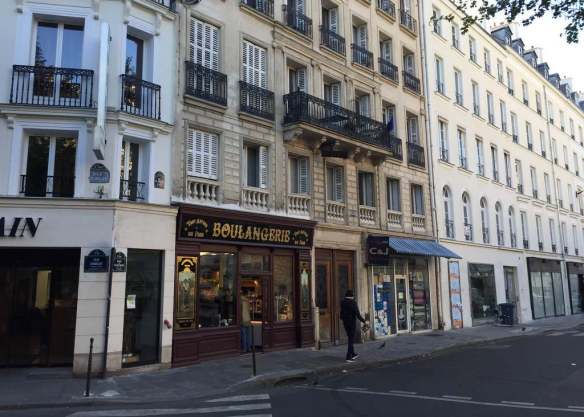
The store front fits neatly into the row of buildings at a tiny roundabout composed of a single tree. Next to it sits the Hotel Americain. The inside of the shop has room for only a half-dozen customers at a time and there is no place to sit and linger: it is a functional place.

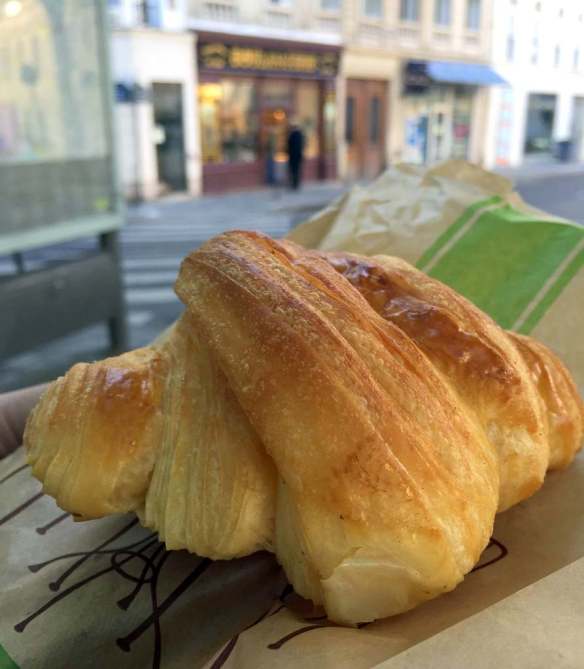
We ordered two regular croissants and one ham and cheese croissant, taking them outside to a bench facing the roundabout.

IMG_1007

There we enjoyed one of the finest, most complex croissants I’ve had. It was not as neatly shaped as most croissants, a bit lumpy to look at. The exterior was crisp, crunching underneath the weight of your bite. The layers were distinct but the interior was pillowy and slightly resistant. The flavor was a tad saltier than normal, which allowed me to appreciate its flavor without the need for butter, jam or any other accompaniment. In short, it was a great croissant.


Du Pain et Des Idées

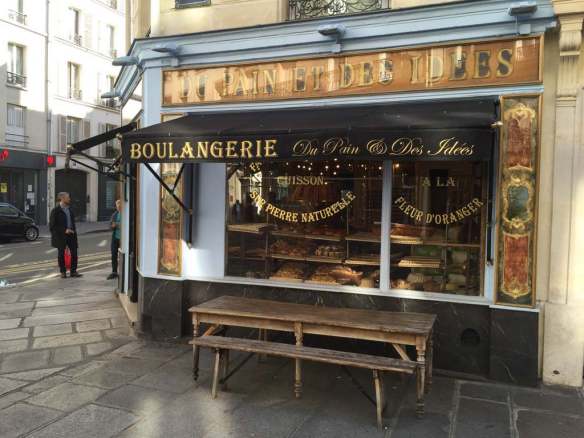
We stopped by another of the award-winning croissant bakers after a breakfast choice in the Canal Saint-Martin neighborhood was closed due to a public holiday. Called Du Pain et Des Idées (the bread and the ideas), it is on another corner in a otherwise typical block of houses and shops.

IMG_1108

It is a far cuter shop, though, looking a bit like it was designed by central casting at a movie studio. Racks of freshly baked goods line the windows and you can smell the bread baking, luring you into the shop. One of their specialties are these huge loaves of bread, which are sliced into large blocks and sold individually.

The older gentleman running the shop is welcoming and was patient with those speaking English and with my poor French. I tested the limits of his patience, though, when I ordered two croissants (and an apple tart). He confirmed the order in French but I wasn’t listening closely… and he proceeded to load up two bags with a dozen croissants! (I forgot to deux and douze are similar…)

When I saw what he was doing, I apologized and clarified my order. There was the briefest roll of his eyes before he said “Pas de probleme” and set the large bags aside.

IMG_1119

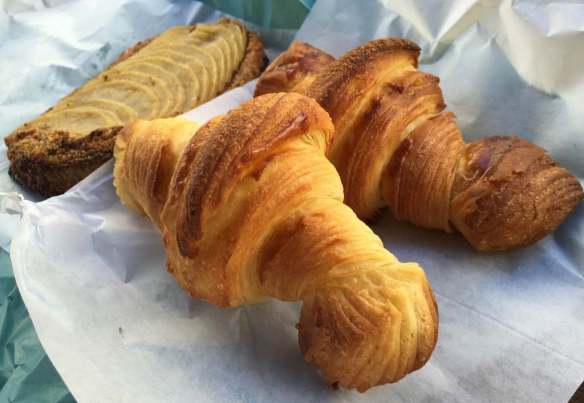
Sitting on the bench outside in the cool but pleasant morning air, we had our first look at the comely croissants. The layers are very distinct as is the twisted, knot-like shape of the pastry. When you bite into these croissants, they shatter sending shards of crumbs about and attracting the attention of a particularly aggressive peg-legged pigeon. The inside is soft but not as much as at Tout Autour. I would argue that the croissants are also less salty.

Now, I understand that I am spoiled with riches to be nit-picking the differences between various Parisian croissants. But such is my lot in life.

We also picked up an apple tart, which was wonderfully caramelized and luscious. In short, both are worth a visit: Tout Autour for the croissants themselves but not for the atmosphere; Du Pain especially for the atmosphere.


Mon retour à Paris

Some fifteen years after my previous trip to Paris with Tawn, we are together here again. It wasn’t a planned trip for me. He was to be here as a tag-on to a work trip to Italy. In fact, I was supposed to be in Manila this week, delivering training. However, the fates intervened, my training was cancelled, and I decided to purchase an inexpensive ticket for five nights in Paris.

IMG_0883

Paris is different this time. I’ve lived abroad for more than a decade and have traveled much more, so am much more confident than on our first visit. That, combined with the twin miracles of Google maps and Google translate, combined with the convenience of smart phones, has made navigating so much easier.

IMG_0767

My French, which I thought completely lost, seems to be somewhat intact. A few days of cramming with the help of the Duolingo app restored enough of the synaptic connections to allow me to communicate in French to a passable degree. What shocked me, though, was how much more English-friendly Paris has become in fifteen years.

While my experiences had never confirmed the stereotype of the rude Parisians unwilling to speak English, fifteen years ago not speaking some French was a handicap. Today, though, I found that nearly everyone was tolerant of my shaky French and both willing and able to supplement with English when need be.

IMG_0851

The other difference I have observed is how much more diverse Paris has become. This is a city of color and it has been made all the more vibrant for it. Near our Air B-n-B rental across from Centre Pompidou, there are a number of great-smelling Middle Eastern restaurants. Asian and Asian-fusion restaurants are numerous. And the African diaspora is well-represented, too.

Funnily enough, two Parisian stereotypes were still in evidence aplenty: the horizontally-striped sailor shirts and the baguettes carried underarm on the way home at day’s end. These kept appearing with such frequency that I suspected we were victims of a ruse by central casting!

I will try to share more about the trip, along with my overnight stay in Istanbul on the way here, which was a magnificent experience.


From a Land Down Under

After several months of a gradual easing-in, my work travel has increased considerably. At turns wearying and exhilarating, the travel presents interesting opportunities for reflection. 
Today I am writing from Melbourne Tullamarine Airport, waiting to board a trans-Tasman flight to continue a two-week stint of training in the Southern Hemisphere. The first week in a suburb east of Melbourne was trying: first time delivering a pair of classes and faced with a more senior and more skeptical audience than I have previously faced. 

  
In the end, the senior most participant stood to thank me on behalf of the class, sharing that he had been especially resistant at the start of the week but had come to reassess his way of managing and would embrace new ideas to be more of a leader.  That thrilled me. 

Another nice part of this trip has been the opportunity to spend two weekends down here with friends and their families. The weather is perfectly autumnal, the crisp coolness contrasting with Bangkok’s peak heat. 

Over time, I will learn how to make these trips more effective so their impact on the home life isn’t as great. As with everything, their is a measure of good and bad in it, and what you make of it is more a matter of how you choose to view it. 

Sky Lane at Suvarnabhumi Airport

There are a lot of times when infrastructure in Bangkok leaves me underwhelmed. But sometimes, the planets align and we have a piece of infrastructure that impresses. Such is the case with the recently-reopened “Sky Lane” bicycle track around Suvarnabhumi Airport.

IMG_8260

The 23.5-km (14.6-mile) track opened originally in late 2014 or early 2015 and was so well-received that they closed it for five months to upgrade it, with the corporate sponsorship of Siam Commercial Bank. The track reopened in November and is been a big success. Some highlights of the project:

  • The track is double-width, striped with a passing lane and distance markers every quarter-kilometer, and paved to international standards
  • More than 600 light poles allow for after-hours riding. Currently the track opens at 6:00 am and last entry is 7:00 pm; I understand you can ride until 10:00 pm
  • Four sets of clean, large men’s and women’s restrooms are located in each quadrant of the track
  • Entry is controlled by snap bands with RFID chips, which can be obtained for free by registering with a photo identification
  • There is a 1500-space parking lot with security guards, lighting, closed-circuit cameras and plenty of room to safely on- and off-load bicycles and change gear
  • There is also a shorter 1.6-km training track near the parking lot, allowing families and those who need a shorter route to ride; this track has a parallel jogging track
  • I have made three trips there so far, all in the morning. Arriving at 6:30 this morning, the parking lot was busy and hundreds of riders were already on the track. Despite this, the facility did not feel crowded.

One thing you discover is that out in the open fields on the outskirts of Bangkok, there is a stiff breeze! Along one side of the track, it was easy to average a speed of 30 km/hour. On the other side, heading into the wind, it was tough to stay much above 20 km/hour!

IMG_8261

As the track surrounds the airport, I enjoy the opportunity to watch the planes. There are a few good vantage points, although you are set back from the action, not right up against it. There are a few early morning arrivals and departures of larger jets and I suppose a true enthusiast could time his or her riding with the schedules of the most interesting airlines.

There appears so be some construction near the entry of the Sky Lane, presumably for some shops and hopefully restaurants. I’ve read on the website that bike repair facilities will be coming, too. Bicycle rentals would be an obvious addition, I hope.

All in all, this is a world-class facility that gives the every-growing cycling community a safe space to ride. If you have the opportunity and are so inclined, I would encourage you to check it out.


Thai street food: khanom tang taek

There was a time when I wrote a lot more about Thai street food. In the years since I had to stop working from home and started getting a real job, I’ve had a lot less time to write – but rest assured I haven’t stopped enjoying Thai street food! In the past few months, I’ve discovered a tasty treat that I had not encountered in more than ten years here: a snack named after a broken barrel.

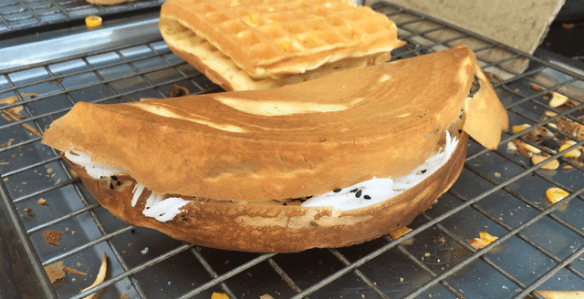
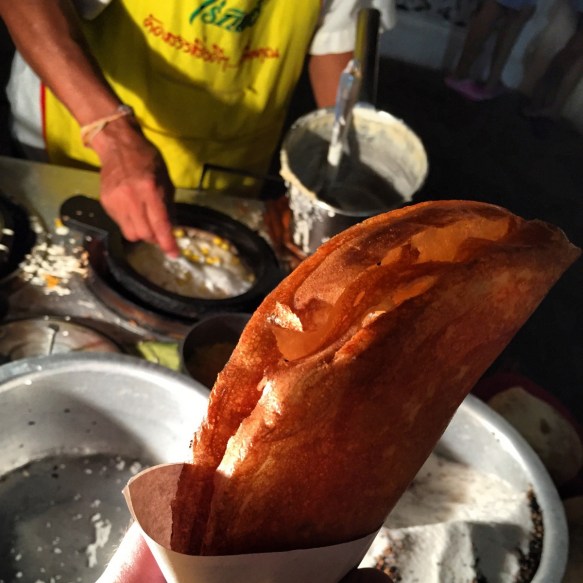
Called “khanom tang taek” this snack is basically a pancake cooked in a deep pan, filled with shredded fresh coconut, black sesame seeds and sugar.

IMG_8098

Baked until crisp, it is folded in half (the breaking of the “barrel”) and served while still warm.

IMG_8092

It isn’t the fastest treat to make, perhaps one of the reasons you see so few street vendors making it. But the flavor and texture and wonderful and I count myself lucky to have a vendor who is regularly found at lunchtime across the street from my office.


Dinner at L’Atelier de Joël Robuchon Bangkok

Joël Robuchon is one of the most successful chefs in the world, with a chain of eponymous restaurants in major cities around the globe. Last month, I had the opportunity to dine at the Bangkok branch of his “L’Atelier de Joël Robuchon” chain, literally the artist’s workshop of Joël Robuchon. It is widely considered Bangkok’s finest restaurant and I could see how that argument is made.

Let me share a bit about the experience, which was exquisite. I’ll preface this by sharing that four friends of ours generously gave us a certificate for the seven-course tasting menu with wine pairing, so we did not pay for this meal out of pocket. Additionally, Tawn knows the executive chef here in Bangkok, so let him know we would be coming, ensuring particularly attentive service. That said, I believe that this is a fantastic experience for anyone and a good value for the money, for an extremely special occasion.

IMG_7033

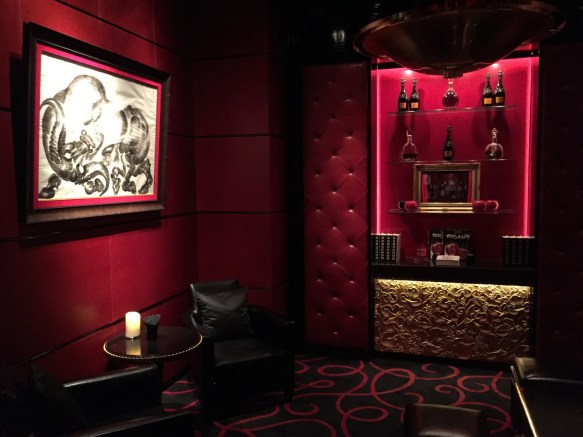
The restaurant is located a few floors up in the Mahanakorn Cube, a small shopping complex adjacent to the construction site for what will soon be one of tallest and most spectacular buildings on the Bangkok skyline. As you enter, you step into a small, darkly lit but richly decorated sitting room and are greeting by polite staff.

IMG_7231

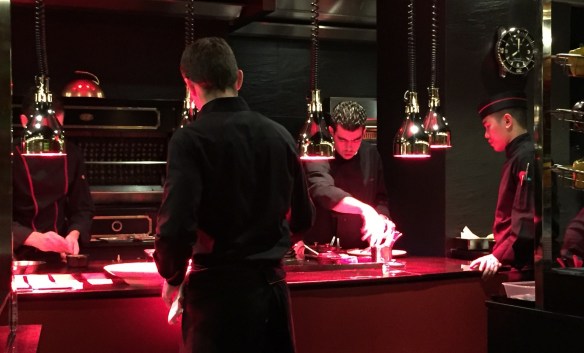
The entire room is laid out as a long counter seating perhaps 30 people. There is a small private function room in the back. The layout is evocative of a sushi bar and thus the diners’ attention is drawn towards the kitchen and service staff. This reinforces the idea that the restaurant is an artist’s workshop: you are hear to observe the craft.

IMG_7106

We were seated at the middle of the counter with a direct view of the main cooking station. This also allowed us additional attention and interaction with the chef as well as the rest of the staff. There is a very good ambiance and you can tell that while the team takes their work seriously, they have fun and enjoy working with each other.

IMG_7053

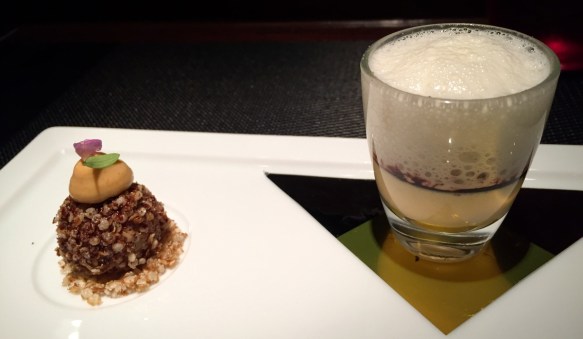
The amuse bouche, a pairing of crisp and soft quinoa and a mouse with smoked piquillo peppers. Interesting pairing of textures and flavors just to whet the appetite.

IMG_7056

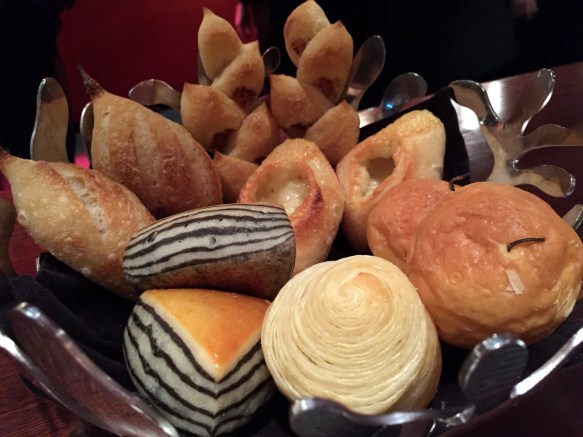
The breads are baked in-house by their pastry chef and the large bread bowl is refreshed throughout the meal, not that you particularly need to fill up on bread.

IMG_7063

Such is the attention to detail that the design of some of the rolls match the bread plates.

IMG_7073

Le caviar imperial de sologne – a surprise of Sologne Imperial caviar served on a lobster broth gelee with dainty dots of cauliflower puree. The flavors were very clean and the detailing was meticulous.

IMG_7081

Underneath the caviar is a thin disk of crab meat. And that is a flake of edible gold leaf in the middle. This was a good example of where beautifully balanced flavors and technique are amplified by the thoughtful presentation.

IMG_7086

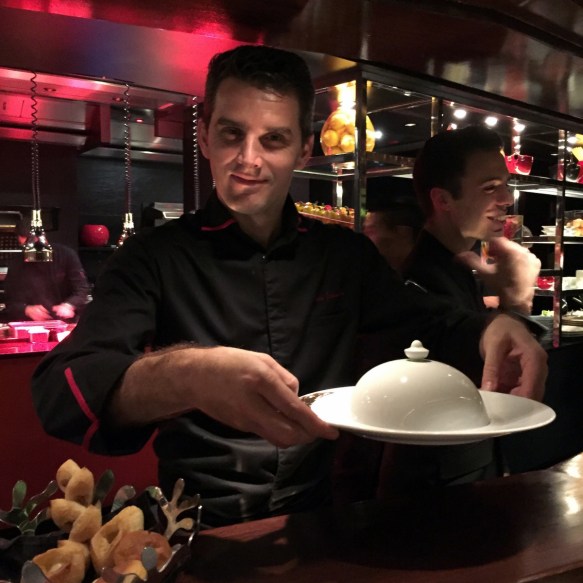
Executive chef Olivier Limousin and his staff playfully presents the next course. He is a bon vivant and gracious host.

IMG_7102

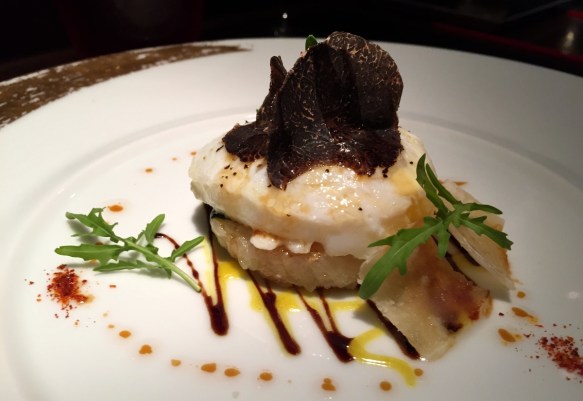
La truffe noire – the black truffle. A poached egg with black truffle, perched atop a cake of risotto with shaved parmigiano reggiano cheese. A nice combination and another artful presentation, although I would argue the risotto was a tad under-seasoned.

IMG_7114-001

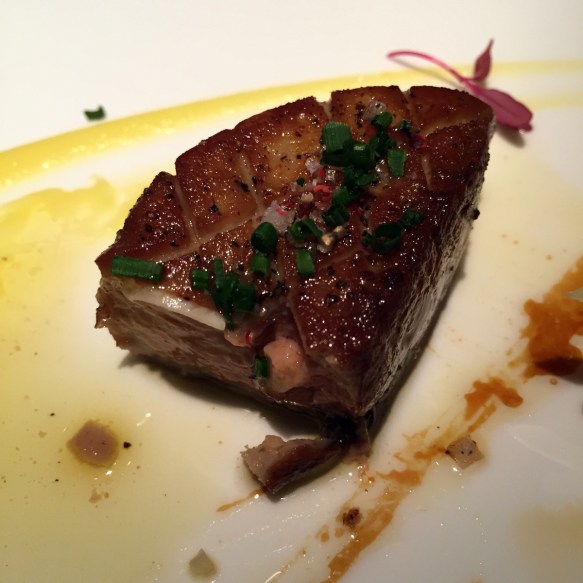
Le foie gras de canard – pan fried duck liver, roasted tangerine with chopped rosemary and a mango sauce. This was a very simple pairing, proving that simple flavors, executed well, can be amazing.

IMG_7119

Close-up detail of the cross-hatches on the surface of the foie gras, letting the fat render beautifully. Coarse salt and chives were the perfect addition to the rich main ingredient.

IMG_7129

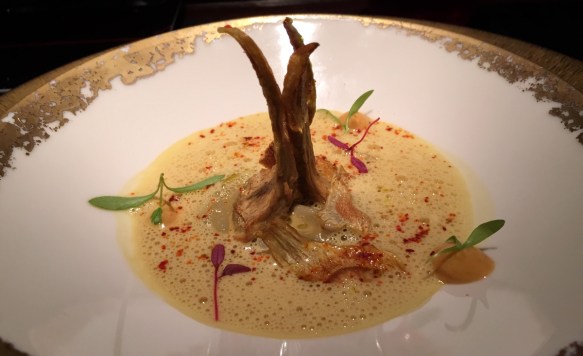
Roasted artichoke on a thin puree of artichoke, served with chickpeas cappuccino scented with tumeric. This was a dish that surprised on two counts: not only was the dish itself very unctuous, but it was beautifully paired with a wine that made a beautiful transformation after a bite of the dish. Artichoke is usually kills most wines.

IMG_7140

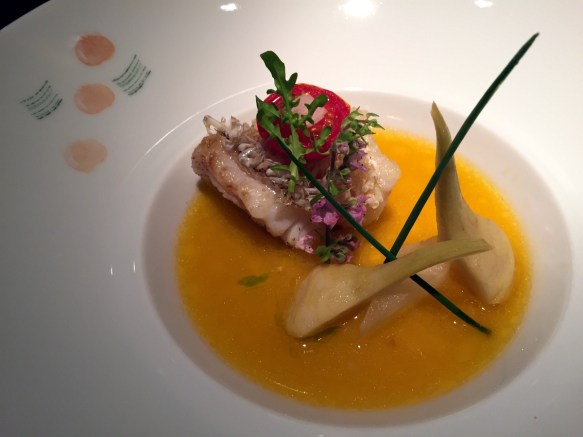
The fish course was a black cod, marinated with miso served with a pumpkin veloute with chestnut and black truffle.

IMG_7148

Close-up of the fish, you can see how the scales appear to have been fried and turned into crunchy bits, which were distracting. I loved the flavor of this dish, particularly the broth. I didn’t identify it as a pumpkin veloute with chestnut and black truffle. It seemed much more like a butter and orange sauce, but maybe my palette was off.

IMG_7166

There was a dish of lamb chops with mashed potato that was exquisitely prepared. It is such a simple, rustic dish and yet so satisfying to eat.

IMG_7168

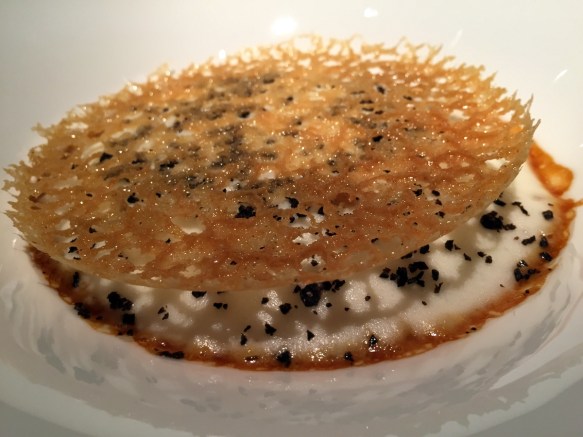
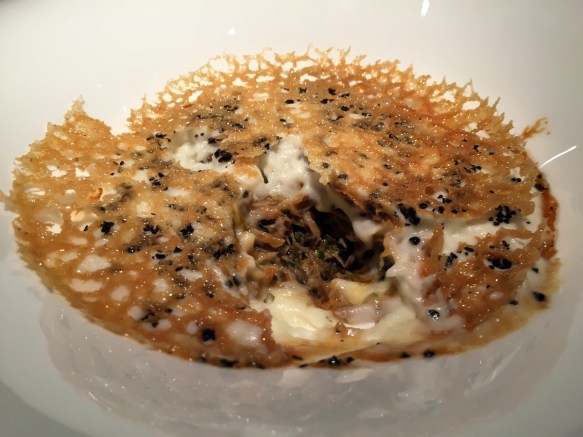
Likewise, the confit of Challans duck with potato mousse and black truffles with a parmesan crisp. It was beautiful to look at and satisfying to eat. I should mention that the lamb chops above and the duck confit were an either/or option: Tawn ordered one and I ordered the other, although we shared the dishes.

IMG_7174

A look at the confit duck hidden buried under the potatoes.

IMG_7176

A view of the “sushi” display cases along the counter: this one decorated in a wintry scene with powdered sugar and vanilla beans.

IMG_7182

The parade of desserts began with a gelee of Japanese Amaou strawberries with pink Champagne granite and meringue.

IMG_7192

A deconstructed picture so you can see the gelee and granite below the meringue.

IMG_7198

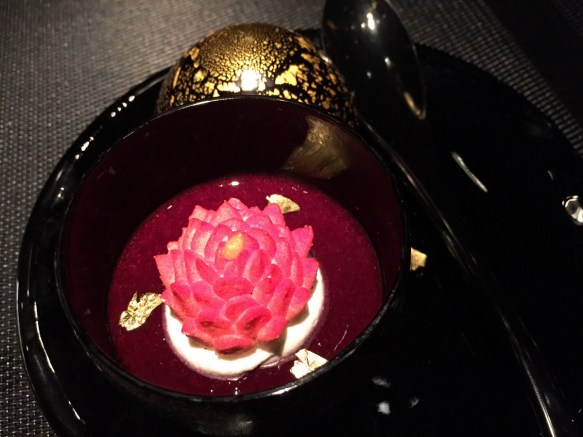
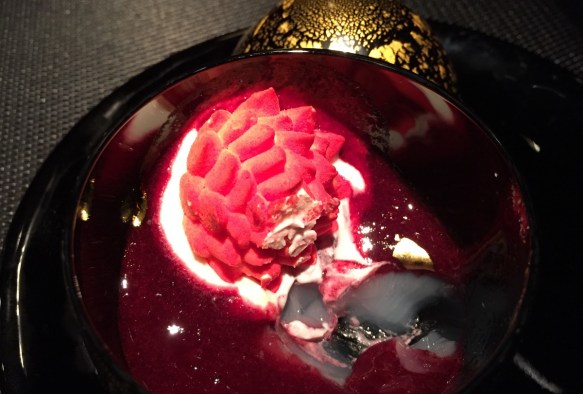
Then, in a Japanese black lacquered bowl, they served a gelee made from the Japanese soft drink Calpis (vaguely like a yogurt) covered with supreme of lychee, a raspberry coulis and a delicate flower meringue filled with raspberry.

IMG_7207

This photo shows more about the structure of the dessert, although it doesn’t do it justice. Very tasty treat.

IMG_7216

A few petits-fours were served, filling us beyond the bursting point.

IMG_7219

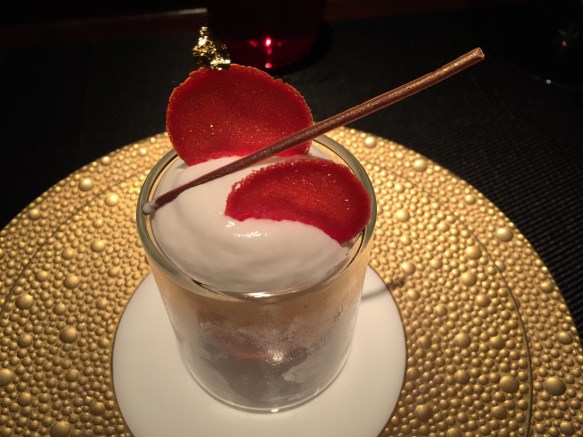
After we had called for the check, yet another dessert arrived, a chocolate and raspberry mouse, with a candle – a treat from the chef to celebrate our anniversary, which was the reason for the meal.

IMG_7222

The dainty little doily is edible.

IMG_7228

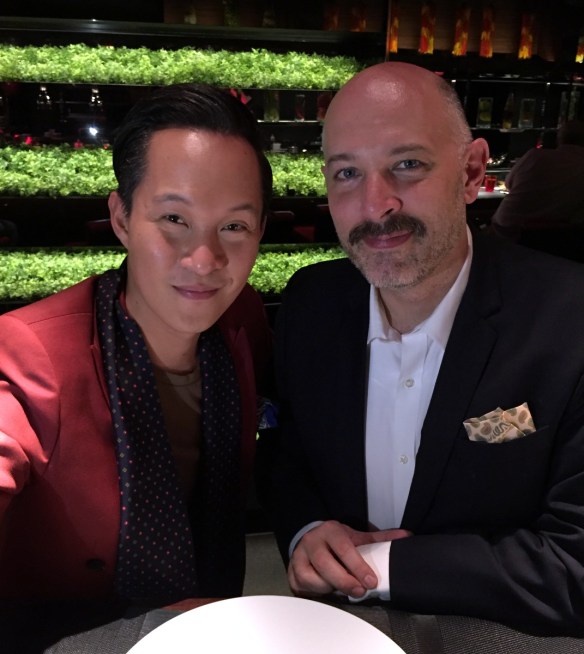
The staff took a picture of us at the end of the meal, looking much too bloated, I suspect!

Overall, it was a tremendous treat and at nearly four hours, quite an adventure. As for the question of value, this will always be a matter of opinion. The seven-course menu is 7,500 baht with a supplement of 4,000 baht for wine pairings. (A five-course option is 5,000 with 3,000 for the wine.) It is safe to say this is the most expensive meal we’ve ever eaten!

The decor, ambiance, hospitality, service, wine pairing, plating, flavor, technique and experience were all remarkable. For a very special occasion, it is an extravagant treat and you get you money’s worth. For less special occasions, there are thankfully less expensive lunch sets and there is also an a la carte menu.

As to the question of whether L’Atelier de Joël Robuchon is the best restaurant in Bangkok, I would say it is. You may or may not be able to afford it and you may or may not find it worth spending the money on, but the overall experience is better than anything else in town.


Street Food on the King’s Birthday

His Majesty the King of Thailand, Bhumibol Adulyadej, turned 88 this past Saturday and the entire country was out to celebrate. His Majesty’s birthday is also Father’s Day, making it a celebration for the entire family. Together with my food writer friend Chow (follow her blog Bangkok Glutton), we took some new friends, recent arrivals to the city, out for their first street food crawl.

IMG_4501

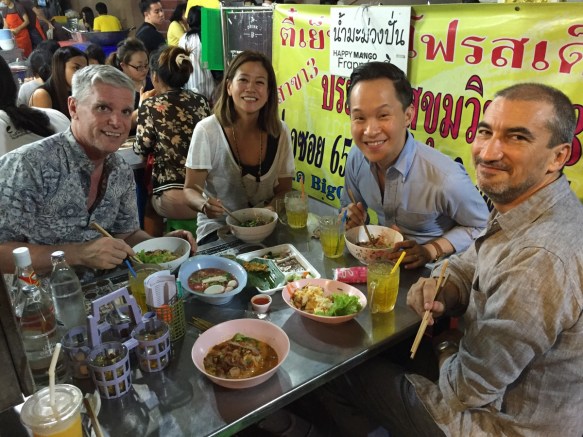
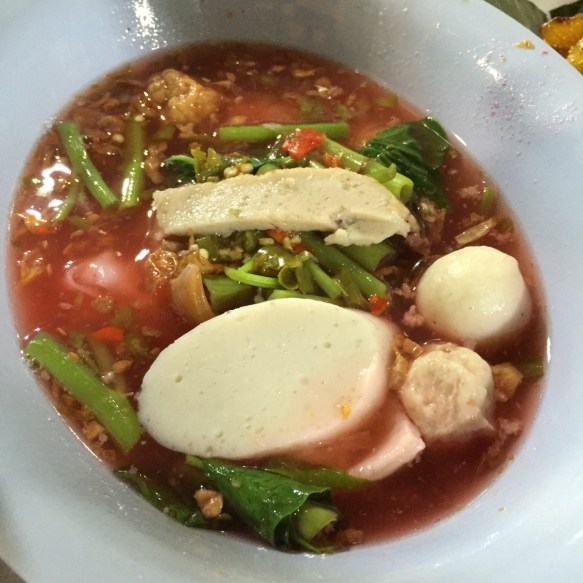
Our main stop was Yen Ta Fo Rot Sadet, located on Mahachai Road in the old part of the city, also known at Rattanakosin Island. This stall specializes in yen ta fo, a type of fish noodle soup made with a broth flavored with red fermented bean curd. They also sell a variety of other noodle dishes.

IMG_4511

Our guests on the two sides, along with Chow and my husband Tawn. For first-timers, they were taking it all in stride and were not at all picky are delicate about the environment, cleanliness, plastic stools, etc. This is a good sign for their future as street food aficionados!

IMG_4510

The yen ta fo itself has this color that is a bit unsettling: bright pink, which comes from the fermented bean curd. The whitish items are a variety of fish cake and fish balls. The greens add a nice contrast. Their broth is nicely balanced: sweet and sour, spicy and salty all in the correct amounts.

IMG_4517

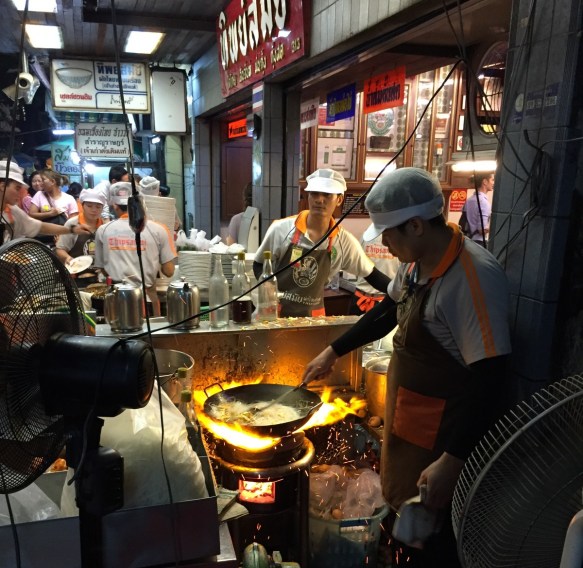
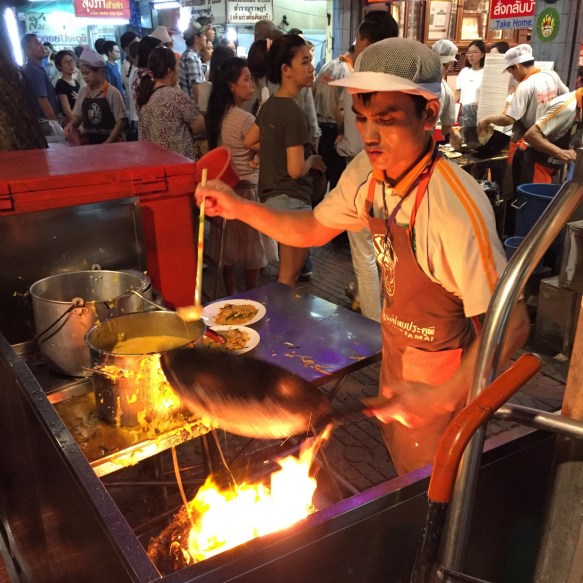
From there, we walked up the street to Thip Sa Mai, which is probably the most famous Thai street food vendor. Famous for their pad thai served wrapped in a thin omelet, the lengthy queue outside their shop has reached ridiculous lengths.

IMG_4575

We enjoyed a look at their scalding hot woks, from which another serving is turned out every fifteen seconds. (Click here to see a video of it!)

IMG_4543

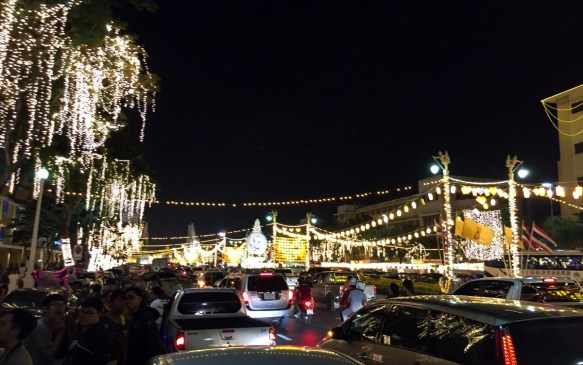
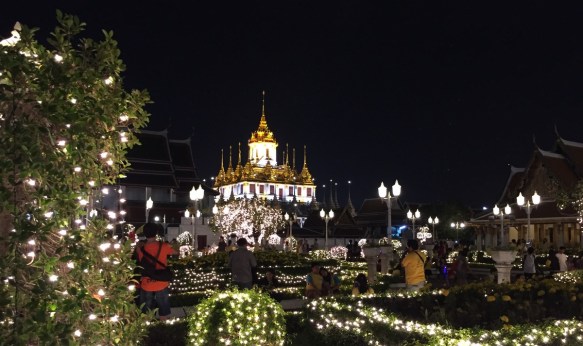
We then walked down to Ratchadamnoen Avenue, or the “royal path,” which is modeled on Avenue des Champs-Élysées in Paris. It was festively decorated with beautiful lights and crowded with families strolling along it. The streets were packed as people cruised to view the decorations celebrating His Majesty’s birthday.

IMG_4528

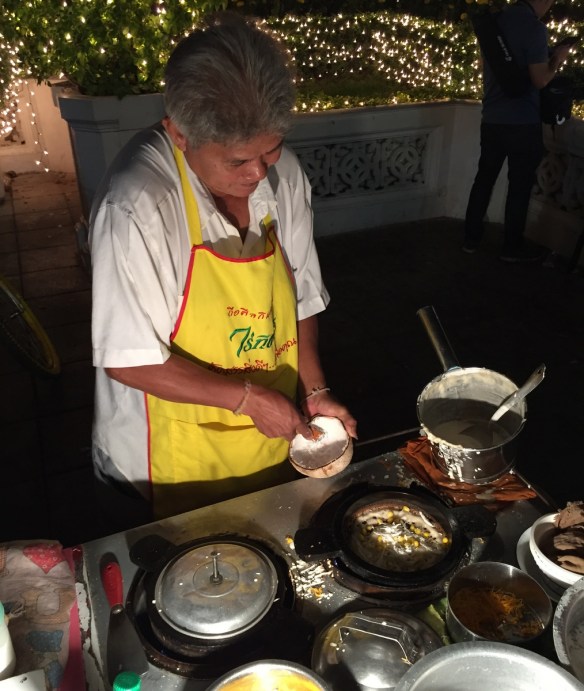
There were numerous vendors selling snacks and treats of all sorts including this gentleman, who was selling khanom tang taek, or bankruptcy treats as “tang taek” means “broken bucket,” a euphemism for bankruptcy. This is a rare dish to see these days, a thick pancake filled with freshly-scraped coconut meat and sugar with black sesame seeds in it.

IMG_4574

The end result is crispy and chewy at the same time, with savory coconut meat inside. This vendor also had kernels of sweet corn added, for additional flavor. It was a really interesting dessert. (A bit more about it and a video can be found here.)

IMG_4527

Lovely view of Loha Prasat, or the metal castle, one of only three ever built in this style anywhere in the world and, if I understand correctly, the only one still extant.

IMG_4559

We walked down to the Democracy Monument to another famous shop, this one for desserts. There is a variety of sweet and savory toppings to be added to your dessert, which is then covered with shaved ice, syrup, and coconut milk.

IMG_4561

The dessert’s heritage is very much Chinese, something very similar to what you will find in many Asian countries.

And that concluded our street food adventure and a fantastic celebration of Father’s Day and the birthday of His Majesty the King. A happy occasion all around!


Responding to the Fear about Muslims

Do you receive emails forwarded from relatives expressing shock about “Islamic extremism” and concern about the influence of Muslim immigrants on “Western values”? If so, you are not alone.

You realize that their concern is misplaced, hysteria whipped up by media and politicians who need fear to drive ratings and reelection. You want to do more than just roll your eyes in exasperation. You want to help them take a step back, gather their breath, and climb down from the ledge.

This is the situation I’ve found myself in and I feel like it is time to do some research and provide some tools to help all of us respond to the fear about Muslims and Islam that is so pervasive in the west right now.

This will probably turn into a multi-part series and I encourage you to share your thoughts about how to help people avoid being sucked into the hysteria that I would describe as “radial Islamophobia”.

Islamophobia

“Us versus them” is as old as humanity

The first thing I would say is that we should acknowledge that, by our very nature, humans are tribal creatures and are prone to an “us versus them” mentality. This has served us well over thousands of years – to an extent – but has served us poorly, too.

When you are exposed to something that appears different from what you are familiar with, it is no surprise that you might feel uncomfortable with it. You might be shocked, offended, or at the least a bit uncertain. Is it safe? What does it mean? How will it affect me? These are all reasonable questions.

By acknowledging that these feelings are natural, perhaps we can then move on to explore them. What are they based on? Are those feelings reasonable, when we exposure them to the bright light of fact?

This step is important, because blaming people for feeling uncomfortable with difference will only make them defensive. So let’s begin by empathizing a bit and acknowledging that things that are unfamiliar can make us uncomfortable or uncertain.

Once we do that, we can have a constructive conversation about history.

We are doomed to repeat our history unless we learn from it

Nativism, the political position of generally being anti-immigrant, has a long history. For this entry, I will focus on the United States, as that is my country of origin. Here’s an interesting passage written by a well-known American:

“Few of their children in the country learn English… The signs in our streets have inscriptions in both languages … Unless the stream of their importation could be turned they will soon so outnumber us that all the advantages we have will not be able to preserve our language, and even our government will become precarious.”

The grammar certainly is more elegant than anything Bill O’Reilly or Donald Trump could muster! In fact, these are the words of Benjamin Franklin, written about German immigrants in the 1750s. [source]
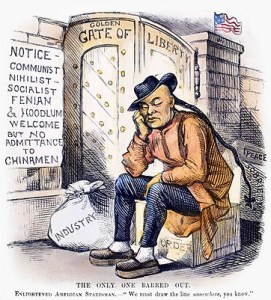
chinese-exlcusion

A political cartoon from the early 1880s after the Chinese Exclusion Act was signed

There have been successive waves of anti-immigrant sentiment in the history of the United States: Germans, Italians, Irish, Chinese, Poles, Russians, Chinese, Japanese (remember the internment camps?), Vietnamese, Mexicans, and Latin Americans have all been the target. And those are just nationalities. There have also been significant and sustained anti-Catholic and anti-Jewish periods.

All of these waves have been fueled by the same rhetoric involving some or all of the following: they will use up all our benefits, they refuse to learn our language, they steal jobs that would otherwise go to deserving Americans, they overpopulate our country, they will replace our culture and laws with their own, they will undermine our values.

Sound familiar? This is the same rhetoric being used with the current anti-Muslim propaganda. For more than fifteen generations in America, we have been making the same claims about the sky falling.

Muslims have been arriving here since the 17th Century, long before the colonies became the United States. A simple reading of history should be enough to help us be less hysterical.

[Interesting learning resource: a PBS lesson for grades 7-9 titled A Cold Reception: Anti-Immigrant Sentiment in the United States]

But things are different today!

Which brings me to my final point: we only need to turn on the news or search the internet to know that things are different now. Yes, we have had waves of anti-immigrant sentiment that were just misplaced fears, but things are different today. The beheadings, the jihads, the terrorist attacks, the hijabs! Al Qaeda, ISIS, ISIL, Sunnis, Shias!

The imagery we see is fearful and the attacks on civilian targets are horrific. Extremists who want to provoke us are tremendously media savvy, especially effective at using social media to shock, scandalize, terrorize, and recruit.

The thing we need to ask, though, is whether what we are seeing is in any way representative of reality. First, do these extremists represent the Islamic faith? Second, how significant is the threat posed by these groups?

To answer the first question, consider when in the world have the actions of deranged individuals ever been representative of larger groups of which they are a member, even when they claim to be representatives of the group? The answer is, never. We don’t consider the recent racially-motivated shooter at a Charleston, South Carolina church as representative of white Americans despite his self-identification as a white supremacist. Likewise, just because someone claims to represent Islam doesn’t mean they do.

KareemShahMother

The mother of U.S. Army Specialist Kareem Rashad Sultan Khan, who died serving in Iraq

To answer the second question, let’s consider the media environment in which we live: the news media is inherently drawn towards the sensational because the only way to attract and retain an audience is to capture their attention with stories that are extreme, different, or engaging. A video of a religious zealot threatening to overthrow America is much more sensational than a video of normal, everyday, law-abiding citizens doing household chores and getting on with life.

What we see in the media (and, by extension, what politicians and everyone else talk about) is the sensational. Because of a number of cognitive biases, we over-estimate the frequency or representativeness of an event based on how easily we can recall such an event or how emotional charged that event may be.

Case in point: since 2001, more than 450,000 people have died in road accidents in the United States. Depending on how you count, there have been less than 200 terrorism-related deaths in the United States in that time. (You may argue with how exactly to define a terrorism-related death, but the point remains, the risk of death by terrorism in the United States is significantly lower than the risk of death by lightning strike.)

Politicians are especially guilty of this. They can say the most inaccurate things and get away with it, because they know that riling people up and playing to their base fears will increase their media coverage and, quite often, their poll numbers.

[To learn more about how not to be ignorant in a world with personal bias, news bias, and outdated and incorrect information, watch this fascinating 19-minute Ted Talk.]

People talk about Muslims taking over countries and changing the very culture and composition of the land. But look at the facts for a minute: in France, the Western European country with the largest Muslim population, is about 10% Muslim. That’s the same percentage as Christians in Egypt and in Indonesia, the world’s most populous Muslim country. In the United States, Muslims make up only about 1% of the population. The amount of population change necessary to become a majority in France, let alone in the United States, is preposterous. Immigration rates and birth rates of immigrants pose no threat at all of Muslims taking over western nations.

I-AM-AMERICA_RidzDesign

Concluding thoughts

There are countless other points that can be made, separating the rhetoric of fear from the reality. I would encourage you to share the above points with your worried loved ones who forward you Islamophobic rants.

I also suggest that you encourage them to do some fact checking. The key to good fact checking is to recognize all of the potential assumptions and biases in your source data, and then to set out to test those assumptions and biases. Look for multiple independent sources, particularly reliable sources.

I also suggest that you encourage them to shift their cognitive biases: go visit Islamic community centers or otherwise get to know your local Muslim community. As you learn more, you will come to see that they are not the “other”. They are you and me and just like every other American around us.

[Further reading: 10 Reasons we Shouldn’t Fear Islam]

Again, I encourage your contribution to a constructive conversation. Let me know your ideas about how we can help people broaden their understanding and deal with fear in these uncertain times.
 

Visiting Tong Hua Night Market in Taipei

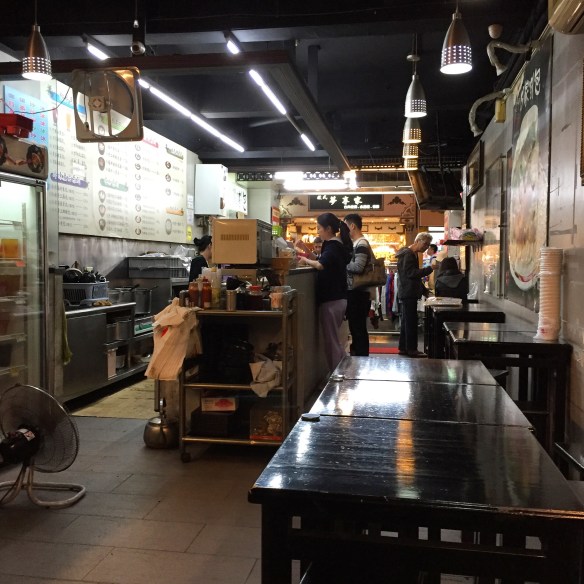
Last week I was in Taipei on business. One of my rules of business travel is, whenever possible, to explore the city and eat at least one meal out and about, so I come away with at least some sense of the city. Thankfully, Taipei is a familiar city and I was fortunate to have two friends join me for a trip to the Tong Hua Street Market in Da’an District.

image

The objective of this visit was to locate a popular restaurant that serves gua bao, the steamed buns filled with braised pork belly and other goodies that I’ve previously tried making and have enjoyed at Little Bao in Hong Kong.

image

Thankfully, one of the local HR team members did some research for me and found a helpful article on the Lauhound food blog. The target restaurant was Shi Jia Gua Bao, a local chain famous for their gua bao.

image

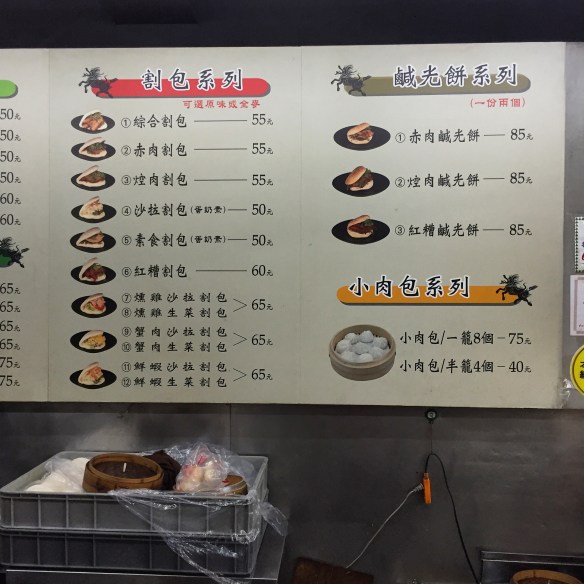
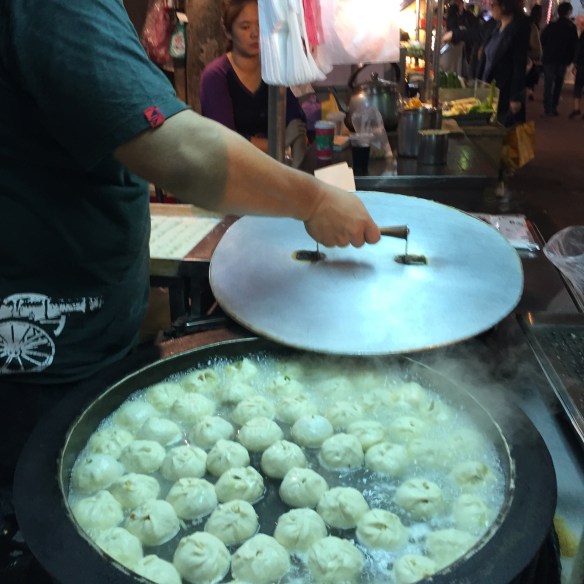
The menu is limited: basically there are steamed gua bao with a few different types of fillings, a baked bagel-like bun with a more limited selection of fillings, and the Taiwanese version of xiao long bao, a steamed pork bun.

image

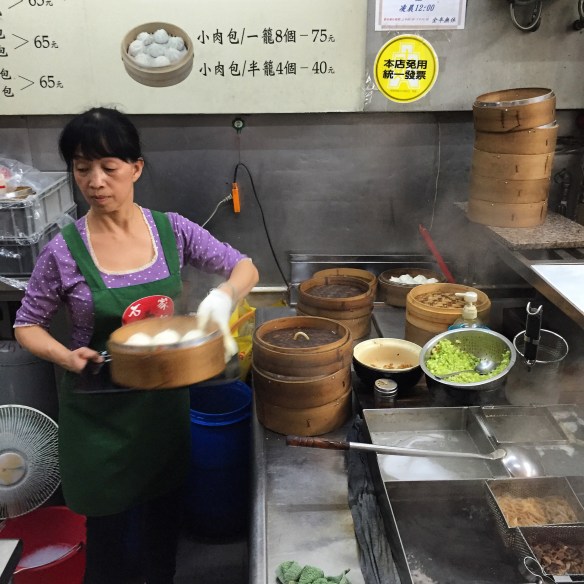
The shop manager was friendly and more than happy for me to take pictures. Vats of steaming buns and all the ingredients sat at the ready, ensuring us of a freshly-made, high-quality meal.
image

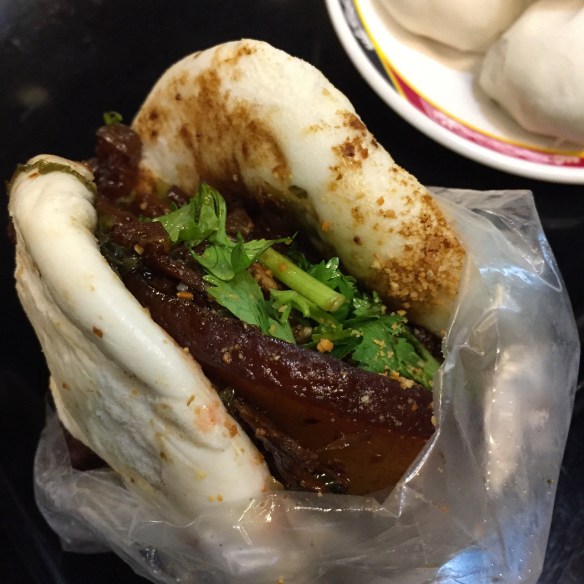
The basic gua bao features both slices of fatty belly and slices of leaner meat. The size of the bao is larger than I have seen at some places: about the size of a McDonald’s hamburger. While a little messy to eat, the flavor was rich and satisfying.

Prices range from 50-65 New Taiwan Dollars, or less than US$2. Quite a bargain for the quantity and quality of food.

image

The baked version, somewhat akin to a bagel, was not as enjoyable. While filled with the same tasty ingredients, the baked bun was dry and brittle, leaving me thirsty. Better to stick with the steamed version.

image

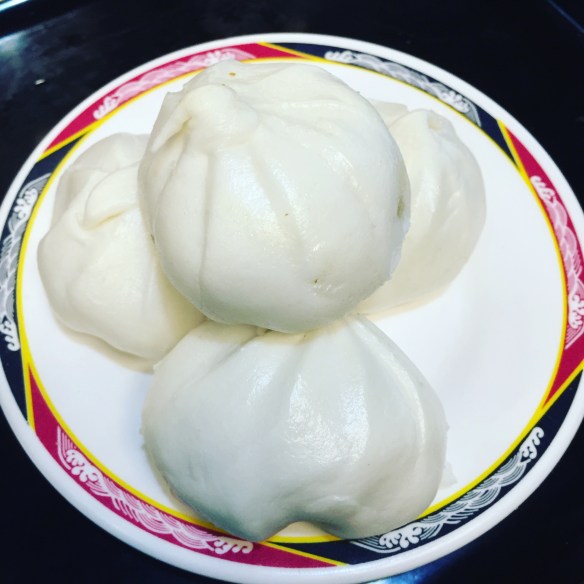
Another interesting item was the xiao long bao. The Shanghainese version with which I am familiar (think of the ones at Din Tai Fung restaurant) feature as paper-thin noodle skin and the filling includes not only pork but a cube of flavorful gelatinized stock that melts when the bun is steamed, producing hot soup that will gush all over if you do not eat it carefully.

In contrast, the traditional Taiwanese version is made with a thicker bread dough so there is no stock inside, as it would only be absorbed by the bread. This was much less satisfying, although the pork filling was tasty enough.

image

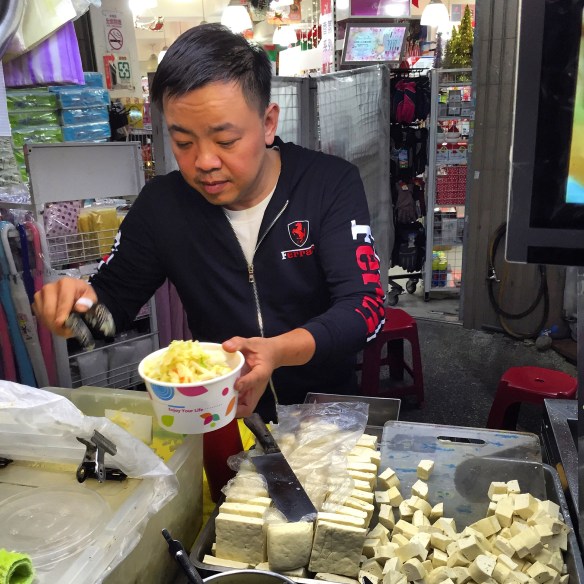
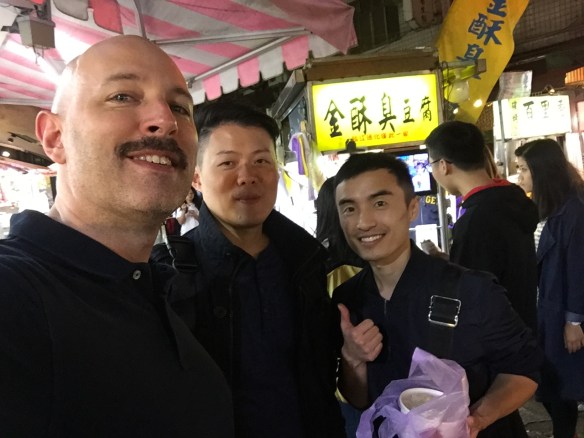
Wandering through the rest of the market, we encountered a stinky tofu vendor. The tofu was stinky, not the vendor! Made by fermenting the tofu in a brine that can contain all manner of ingredients, the smell of stink tofu is as strong as that of blue cheese. It sparks similar responses, with some people loving it and others repulsed by it. Also similar to blue cheese, the flavor and the smell are different.

image

Here, the tofu is served lightly deep fried with a healthy dose of chili oil and pickled cabbage as a garnish. It was a very satisfying dish to try, although the bottom pieces, thoroughly soaked in the chili oil, were blindingly spicy.

image

My friends Nathan and Andrew (aka loserstepaside here in WordPress) join me at the Tong Hua night market. The stinky tofu was Andrew’s idea.

image

At the far end of the market was a vendor selling sheng jian bao, a pan-fried bun that I fell in love with in Shanghai, where I ate several times at Yang’s Buns.

image

The skins are moderately thick, not as much as the gua bao but not so thin as gyoza. However, like gyoza they are fried on a cast iron pan that is filled with a generous amount of water, covered, and allowed to steam. The cover is removed after about five minutes and the remained of the liquid boils off.

image

The sheng jian bao are served in a box of ten or a bag of five, sprinkled with sesame seeds and, in some places, chopped green onions.

image

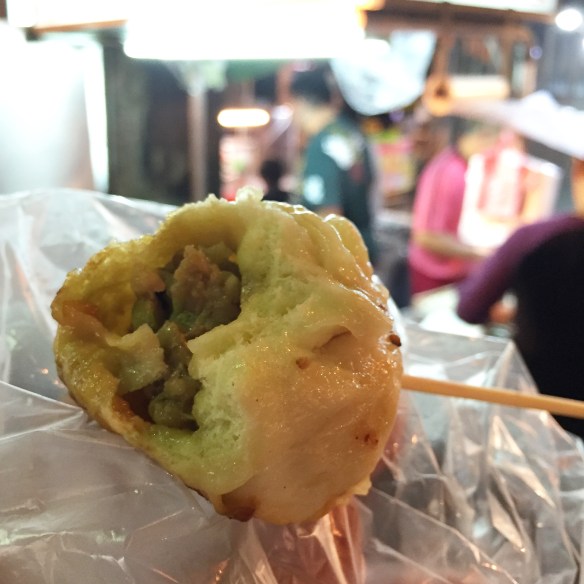
The insides are still steaming hot and the pork, ginger, and green onion filling is juicy and salty. These are a mess to eat but worth it, as the combination of crunchy bottom, pillowy soft wides, and warm, juice filling is too much to resist.

All in all, the Tong Hua market will give you many great things to see, do, and eat!

Also known as the Linjiang Street Night Market, located near Xinyi Anhe MRT station.

THAI from Bangkok to Taipei

My second trip for the new job, and my first where I am working (as opposed to undergoing I boarding) is to Taipei. I will facilitate three days of workshops for the local team. 

Here is a quick photographic tour of my flight over. 

 
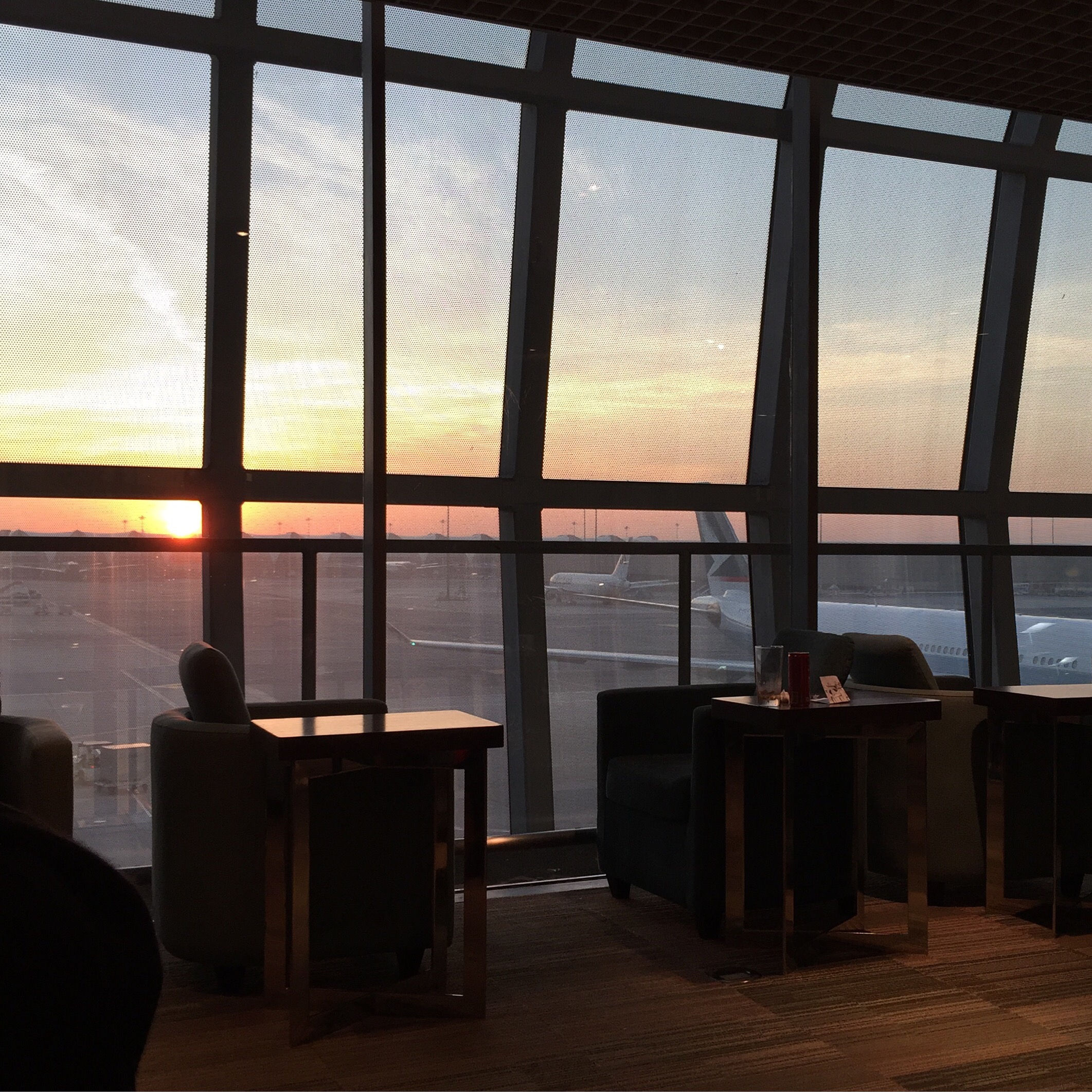
My flight was scheduled for 7:15am, meaning an early departure from home. I made it to a very crowded Thai Airways Royal Orchid lounge where I enjoyed a bit of breakfast. 


From my seat I watched the first sliver of orange on the horizon erupt into a rising fireball as a Cathay Pacific Airbus A330 pushed back for the early Hong Kong departure. 

  
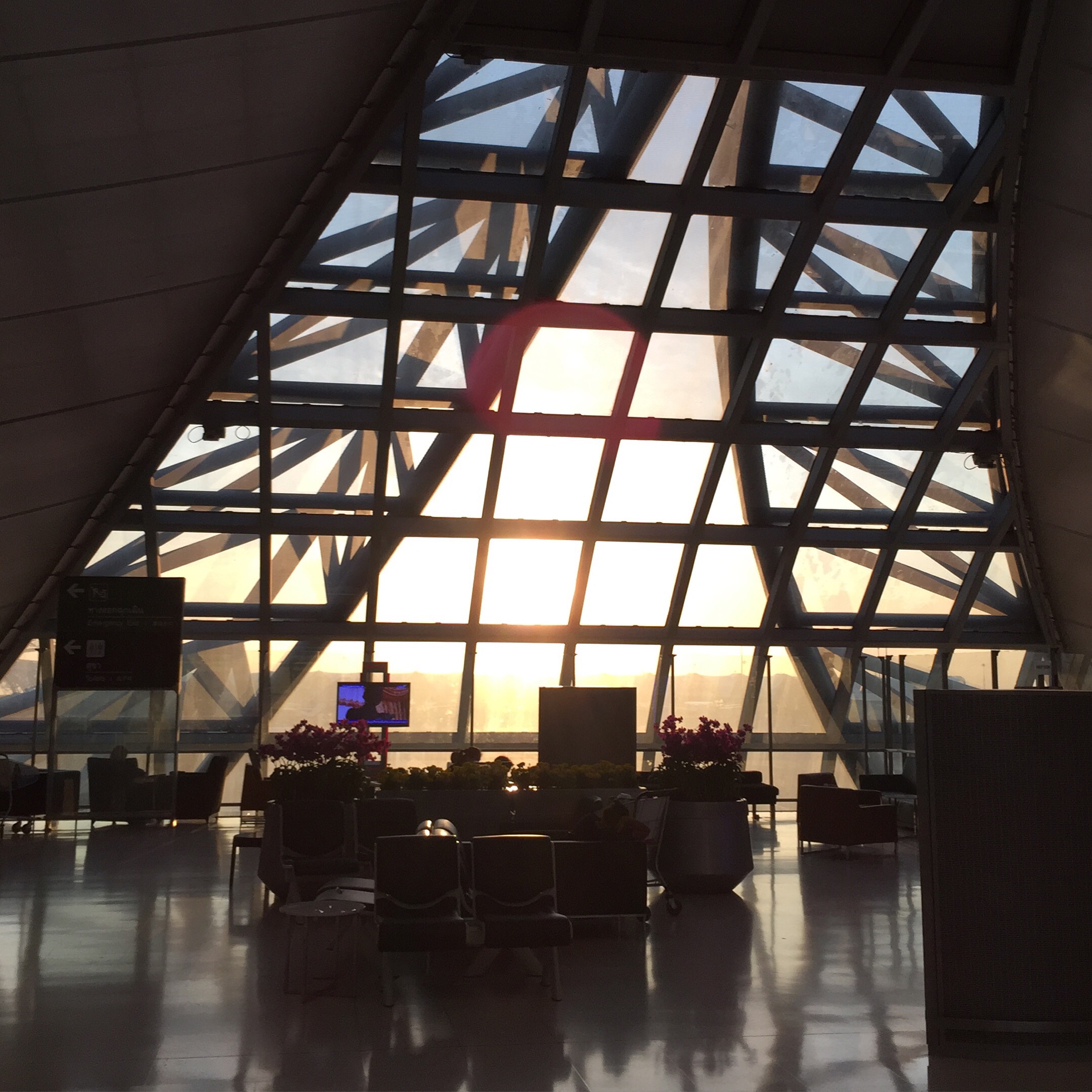
By the time I walked to the gate, the concourse was bathed in a warm light. As a morning person, I find this a peaceful and pleasurable time of the day. Even when traveling. 

  
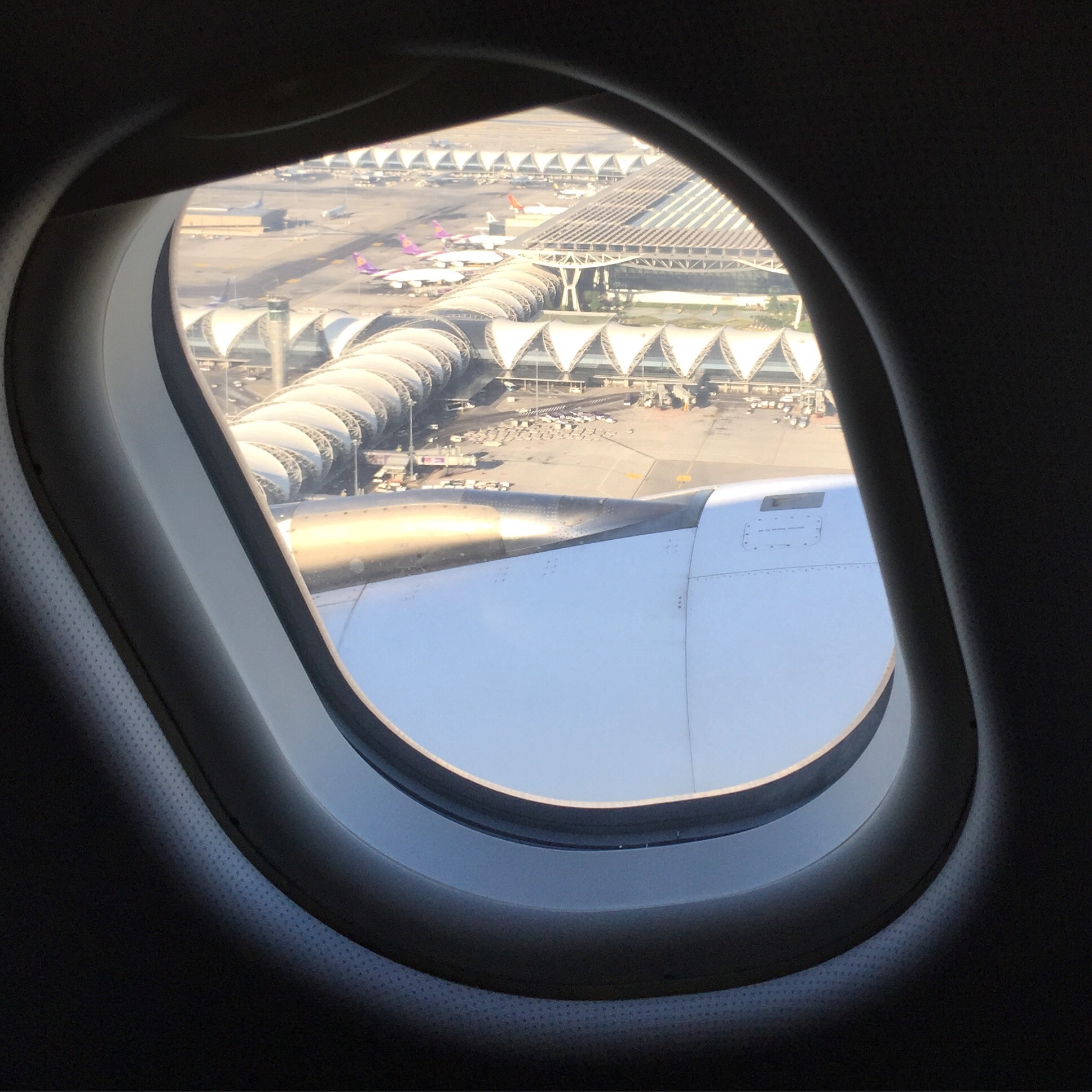
Despite being the hometown airline, THAI still uses remote gates for many departures. This means boarding a bus and driving a few kilometers across the airport. I enjoy it as it afforded me a chance to snap this photo of an Airbus A380 in the distance. 

  
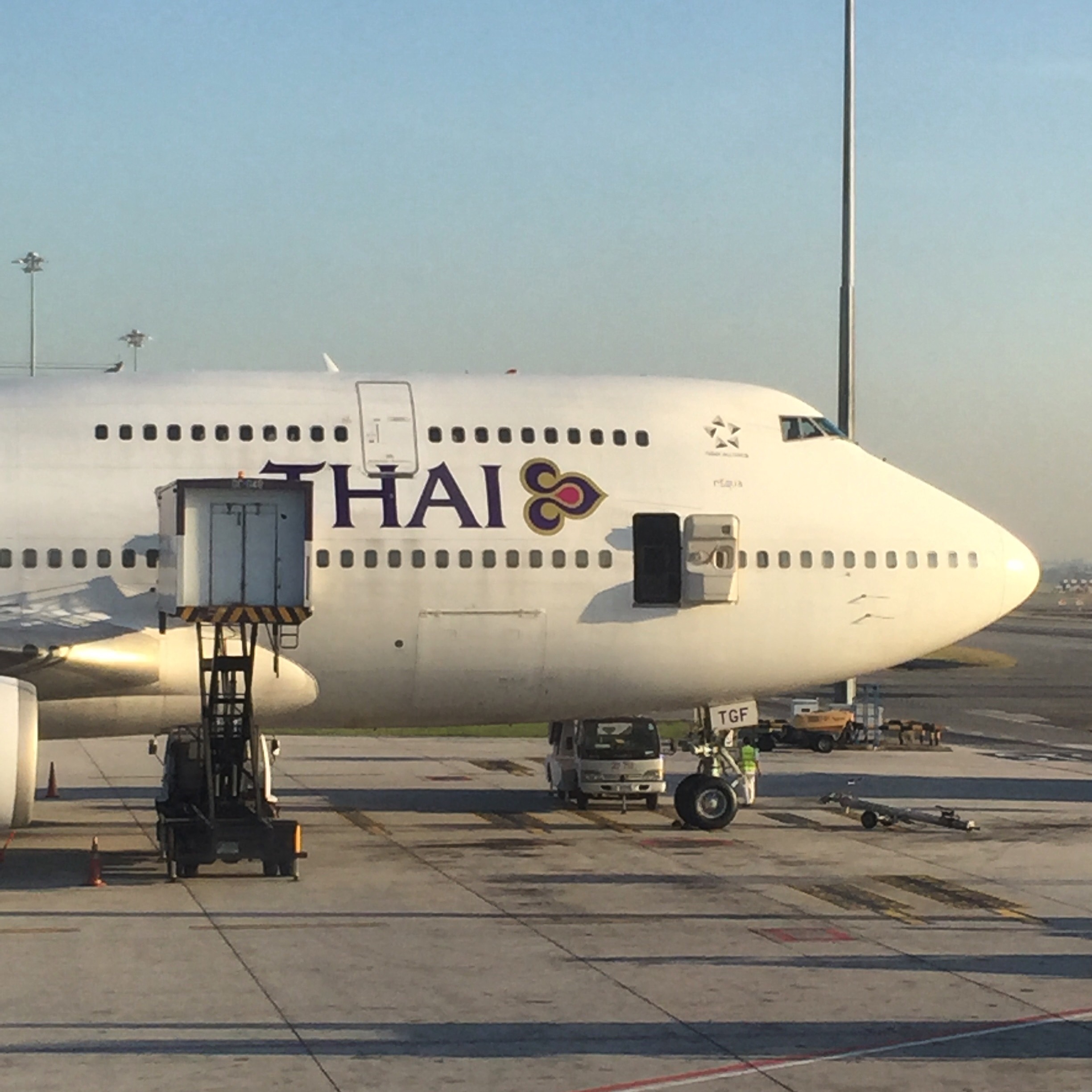
And this Boeing 747-400 parked at the stand next to ours. 

  
To protect passengers from the sunlight – or perhaps to stymie our photo-taking – the boarding stairs are covered in a plexiglass canopy. 

  
Our climb out of the airport was smooth. I had an aisle seat so needed to be creative to get my picture. 

  
The choices of inflight meals were pancakes or fried rice with chicken. I had the rice. It was fine but nothing memorable. 

  
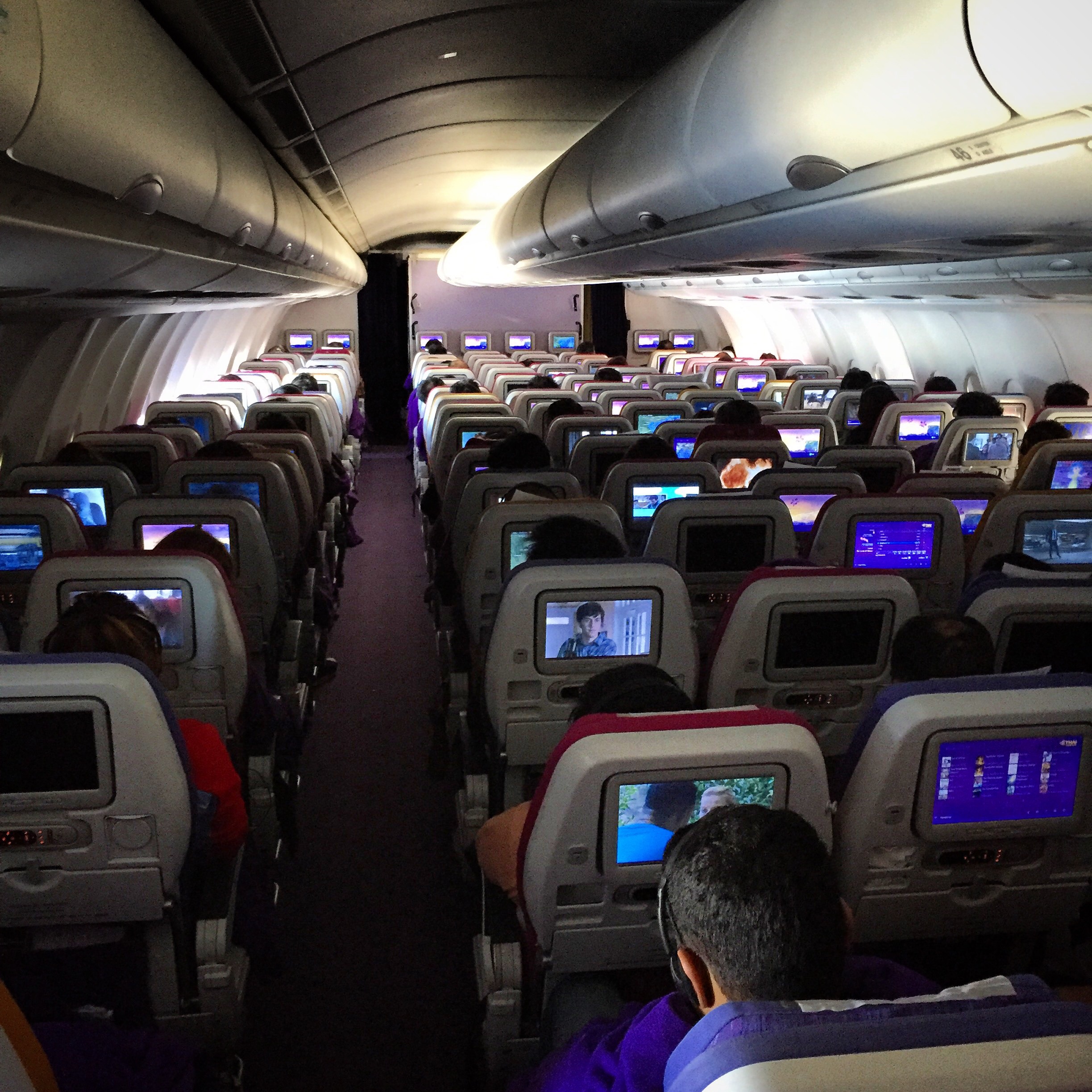
The rest of the 3-hour flight was smooth. I watched “Good Will Hunting” again. Enjoyable movie and glad they show some classics. The seat buckets are a bit uncomfortable. By the end of the flight my tail bone was already aching.  

All in all, the flight was uneventful, the hard product (seat, food, entertainment) was acceptable but not extraordinary, the soft product (customer service) was friendly but not outstanding.