Biking in Prachinburi

Right before heading to Japan, Stuart and I completed a biking adventure up to Prachinburi province, northwest of Krungthep (Bangkok).  We had talked about doing a combined train-bike day trip just for the experience, so with the clock ticking before his move to Phuket, we decided we had better get this trip done.

(It is worth noting that this entry is actually a month old but I didn’t get a chance to edit the video until this past weekend.)

P1140864
A view of the station from a bridge heading into the old city.

We started early on Sunday April 5th, leaving the Thong Lor area about 6:30 am for the 10-km ride to Hualamphong Station, the main rail station in the city.  Stuart has ridden the Thai rails before but this was a first for me.

P1140867
The lovely Italian Neo-Renaissance exterior of this station.

Hualamphong is a big station and was teeming with travelers even at this early hour on a Sunday.  While Stuart watched the bikes I went to buy tickets and inquire about what to do with our bikes.  Even with both of us speaking a fair amount of Thai, this process wasn’t very clear.

P1140870  
Interior of the station waiting area – crowded even on a Sunday morning.

The ticket agent directed us to somewhere near track two for our bicycles.  Once we entered the track area it wasn’t clear where we were going so we stopped at an information kiosk.  The agent there vaguely waved towards the far end of the station.  Eventually, walking way down the tracks, we found the cargo area.

There, they checked out tickets and then explained that our particular train wouldn’t have a cargo car on it, so we were going to have to carry out bikes into the passenger car.  They then pointed to the other end of the tracks, indicating that we needed to go pay some surcharge to do that.

We walked back up the track and eventually fond another kiosk where we paid for “excess baggage”.  For our 122 km journey the fare was a whopping 26 baht per person, each way.  That’s right, less than one US dollar.  The baggage fee for the bicycles was something like 80 baht per person.

P1140873
Stuart and his bike share space with another passenger.  These two benches are meant to seat four people.

We eventually got everything straightened out and got on our train moments before it was supposed to depart.  Had we known how crowded the train would be, we would have boarded earlier.  As it was, we had to remove the front wheels from our bikes in order to make them fit.  Fellow passengers, who were mightily inconvenienced by our bikes, were very gracious about it.  Next time, we need to make sure there is a cargo car on our train.

P1140890   
A young boy enjoys the view from the window seat.

The train tracks snake through the heart of Krungthep, affording a front-row view of the belly of the Big Mango.  Needless to say, it isn’t the prettiest of views.

P1140892
One of the smaller stops within Krungthep complete with banana trees.

There are vast areas of low-income housing and many markets which are built right up to the edge of the tracks.  What is amazing is how vibrant life in this communities is: there is an entire world going on right next to the train tracks, paying no attention to the iron intruders that cut through their towns.

P1140902

The entire train was third-class seating, unassigned and un-air conditioned.   With the breeze and fans, the trip was fairly pleasant.  Vendors walked up and down the aisles with snacks and beverages, so it wasn’t much worse than a flight on one of these low cost airlines.

P1140907
Eventually, we found ourselves outside the city, spilling into the rice paddies that are a familiar sight in the central region of Thailand.

P1140917
One has to wonder at the lack of safety gear.  There was nothing to prevent people from falling between the engine and the train or out of any of the doors, all of which were open to the passing landscape.

At each stop we picked up more passengers until the train was near capacity.  Most everyone stayed on for the first two hours until we hit Chachoengsao Junction, where the northeastern and easter lines split.  At this station about two-thirds of the passengers disembarked, after which we had enough room to spread out and not worry about people getting greasy as they walked past our bikes.

P1140914

Our stop, Prachinburi Province, was an additional hour past Chachoengsao.  By this point it was nearing 11:30.  We offloaded our bicycles and watched as the train pulled away.  Checking our time, we had five hours before the return train arrived, and about 80 km planned on this hot day.

After a light meal in a small restaurant across the parking lot from the station we set out.  Frankly, there wasn’t a lot of memorable sights.  An “ancient city” was hard to find, or at least what we did find wasn’t very exciting.  It ended up being an ancient water storage pond with carvings of elephants along the side.

P1140931

It was cool in a sort of, “oh, that’s interesting” way.  But not in a “wow!” sort of way.

One stop that ended up being fun was the largest and oldest Bodhi tree in the kingdom: Ton Pho Si Maha Pho.  It is located across from a temple way out in the outskirts of the province.

P1140937

It is actually a beautiful tree and of course is well-venerated.  They say that some 2000 years ago, Phrachao Thawanampayadit, the ruler of Mueang Si Mahosot during the Khmer empire, sent his representatives to India to bring back a branch from the bodhi tree in Buddhgaya, India, under which Buddha attained enlightenment.  This is ostensibly the tree grown from that branch. 

Across the street in a temple, we encountered a group of novice monks.  During the summer months when school is out of session, parents will send their sons to the temples.  This time spent in the monastery is meant to gain merit for the parents’ future life, but sometimes I think it is more a form of summer school, just to keep the sons out of trouble.

P1140939

The young monks enjoyed the distraction of two bicycling farang and had many questions for us.  One was particularly fascinated with Stuart’s iPhone.  We visited for about fifteen minutes, drank some water that they offered, and then continued.

Along the ride, I was making great efforts to stay hydrated.  I had my 2-liter Camelback water pack with me.  But what I forgot was that staying hydrated is only half the battle.  After a while the water was warm and my body temperature was climbing.

After some 60 km, as we were working our way back around the loop to the provincial capital, I had to stop several times to cool down, buying ice-cold water at some stores and not just drinking it but holding the bottles to my neck to bring my temperature down.  Truly, by the end of about 80 km, I was frighteningly close to heat exhaustion.

P1140942

We made it back to the station about fifteen minutes before the return train, thoroughly wiped out from the ride.  The trip back was spent mostly staring, zombie-like, out the windows.  The good news was that this return train had a cargo car so we didn’t have to manage our bicycles during the ride.

P1140945

Along the way, we had fun with some “hanging out the door” shots.

P1140953

We also saw some exciting sights like large bonfires next to the track.  I guess burning is the most effective trash disposal option out here in the middle of nowhere. 

P1140958

By the time I returned home some 14 hours after leaving, my legs were red.  Not with sunburn, mind you: I had been very liberal in my reapplication of sunblock.  The red was from the dust of the volcanic soil in the northeast region.  Riding the road had left me covered with it from head to ankle!

All in all, it was a fun trip.  Exhausting, yes, but sometimes it is pushing yourself to the limit that helps you know what you really are capable of.  Here’s a video of the trip, mostly focusing on the train portion of it.
Dining in Bangkok: Tonkatsu Raku Tei

Tonkatsu 1 Last weekend Tawn and I took a little time to get out of the house, run some errands, and see some friends.  This, despite the heavy load of work.

BK Magazine, a free English-language newspaper, published a list of what they consider to be the best five or six tonkatsu restaurants in town.  Japanese make up the largest expatriate population in Thailand and we live in the heart of the Japanese section of town.

Not too surprisingly, there is some really good and affordable Japanese food to be had.  In fact, every time I head back to the US, one of the things I specifically don’t want to eat (besides Thai food, natch) is Japanese food.

We decided to try one of the recommended restaurants: Tonkatsu Raku Tei, located in the basement level at the Citi Resort service apartments on Sukhumvit Soi 39.

When you walk in, it becomes very clear that Tonkatsu Raku Tei (Hey! They have the same initials as former Prime Minister Thaksin’s political party… conspiracy?) is the real deal because all the other diners are Japanese.  That’s a good sign, right?

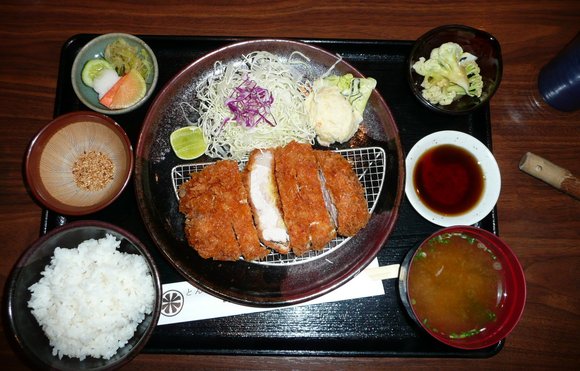
What I really wanted to try was the tried and true standard of all tonkatsu: rosukatsu, made from fillet of pork loin, with a thin layer of fat along the side, breaded in panko breadcrumbs, and lightly fried.

P1090794

Served with two homemade tonkatsu sauces, an original flavor and a really good spicy one that tastes a bit like barbecue sauce but without the tomato, the tonkatsu was tender and not too oily.  The pork itself was a bit bland, although moist, and served as a neutral carrier for the sauces’ flavors.

One lesson we learned – sadly, after the fact – was that the sesame seeds in the bowl on the left and meant to be ground up, using the wooden pestle on the far right of the picture that we mistook as a chopstick rest.  Oh, silly us!


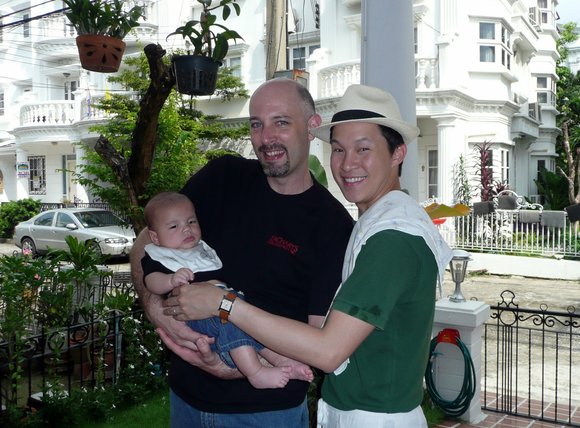
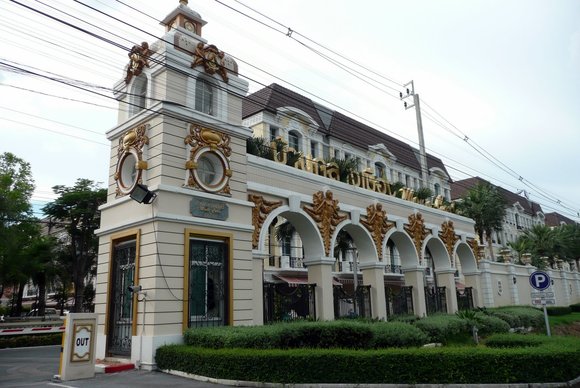
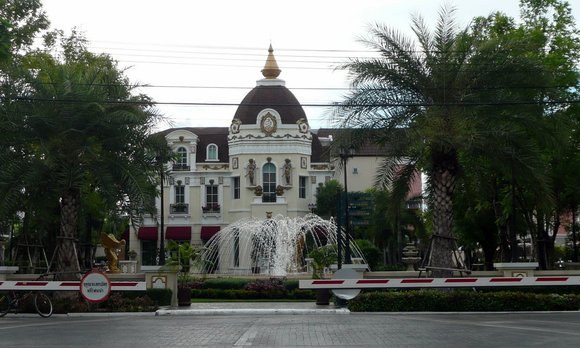
After lunch, we stopped by Scott and Jum’s house to see their new baby.  They live in an interesting townhome development that is very Grecco-Roman in its design.   Too bad I didn’t get a wider picture so you could fully appreciate the number of columns that adorned each building.

P1090802

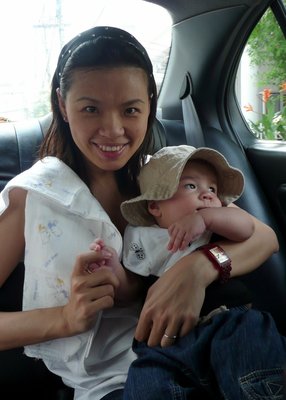
P1090805 The baby, whose name I’m not sure how to spell correctly so I won’t try here, is very cute.  He’s a mixture of Thai and American heritage so has blended features.

He’s so low-key.  He didn’t really mind who was holding him, but apparently really hates being cooped up indoors and his fussing quiets when he is brought outside.

We drove Jum and baby over to a gathering of former United Airlines colleagues.  Tawn flew with UA for a few years around the turn of the century.  (That sounds old, doesn’t it?)  Sadly, we just received news that as part of their further cutbacks, United will be closing their Bangkok flight attendant base for the second time since the 2001 attacks.

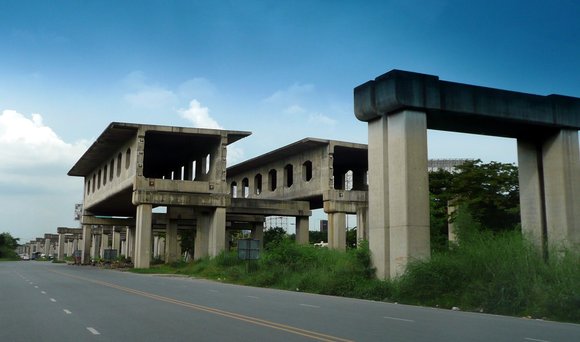
The colleague’s house at which the gathering was held is up near the old airport.  It took a bit of driving to get to and we were confused and overshot it by a few kilometers.  Along the way, we passed the remnants of the elevated rail line that was originally going to run from the center of the city up to the old airport and then on out to the Rangsit area.

The project, which was operated by a Hong Kong-based conglomerate called Hopewell Holdings, ran into problems in the late 90s and the contract was canceled by the Thai government.  Due to the inability of the project to ever really gain traction, it became largely derided as the Hopeless Project.  All that remains of the project are a significant number of columns running along the Don Meuang Tollway.

P1090809

P1090816

A sign of optimism, there were several housing estates built along the Hopewell right of way (which has a still-operating train line underneath it), including this slightly over-the-top property called Monte Carlo:

P1090812

P1090811

So the trip to see Tawn’s colleagues was a good use of time if for no other reason than it allowed me to get an up-close look at the Stonehenge of Thailand.  Every so often, there is talk of reviving the project or using the surviving infrastructure to build the extension of the airport link (which is still another year or more away from opening) to connect both the old and new airport.

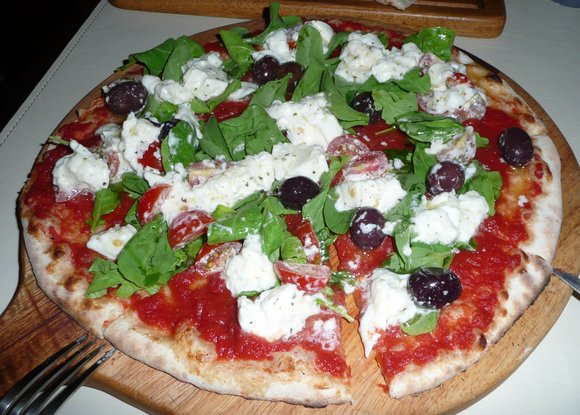
One final thing to leave you with, a very nice pizza I ate at Bacco restaurant, just at the other end of the soi from us.

P1090777

I think the restaurant makes its own ricotta cheese.  It was so good!


Civil engineering update: Airport Link

For you civil engineering buffs, here’s an update on some of the work happening at the Suvarnabhumi Airport Rail Link construction site.  First, a little background:

The Airport Link is a 28.6 km (17.7 mile) mostly elevated train way that will serve as the eastern half of the “Light Red Line” in Khrungthep’s master transit plan.  The western half of the line is a planned extension north to connect to Don Meuang domestic airport, with no specific time frame in which that will occur.  Started in 2005, construction of the eastern half is expected to be finished sometime in late 2008, with recent news reports puting the construction at a 70% completion rate as of this point.  Both local and express services will be offered on the line. 

P1020198

Above: “We apologize for any inconvenience as we build the maintenance complex for the airport train.”  The picture is of the delivery of the first of nine Siemens Desiro class 360/2 trainsets arrives in Thailand.

The express train will run from the Makkasan City Air Terminal (at the corner of Phetburi and Asoke Roads, where you will be able to connect with the MRT subway Blue Line) to the basement level of Suvarnabhumi Airport in 15 minutes.  It is expected that you will be able to check in for flights at the Makkasan CAT, receiving your boarding pass and handing over your checked baggage, just like at the Airport Express terminal in Hong Kong.

The local train will run from the Phaya Thai station, (where you will be able to connect with the BTS Skytrain Sukhumvit Line), stopping at Ratchaprarop, Makkasan, then at four additional stops before arriving at the airport.  The total trip time for the local service will be 27 minutes.  The initial plans had several additional stops along the lines, including one at Royal City Avenue, a popular nightlife and entertainment district.  It appears that those stops will not be built at this time but just based on my own visual assessment of the construction in the RCA area, it looks like the tracks are being constructed in such a way that a station could be added in the future. 

The Airport Link’s maintenance yard and depot will be in the Soonvijai district, an area on the north side of Phetburi Road from roughly Thong Lor to Ekkamai.  Bangkok Hospital is located just to the west of this area and Tawn’s parents live just on the other side of Ekkamai Road, to the east of this area.

Sunday morning while running errands I stopped to snap some photos of the construction:

P1020050

Above: From the Ekkamai Road flyover, looking west.  On the left is the Soonvijai train station with a train stopping momentarily before continuing on to Hua Lamphong Station.  On the far side of the buildings that face the train station is Phetburi Road.  Bangkok Hospital is the white building on the right hand side of the picture, behind the construction site.  The elevated track is clearly visible on the left and the ramp where trains will exit and enter the main line is being built along the elevated track in the center of the picture.  The maintenance sheds are under construction in the center and right side of the picture.

Below: Taken from the other end of the above picture and looking to the east, you can see the construction of the exit/entry ramp where trains will connect with the elevated line (right) via the ramp (center).  The Soonvijai station is on the right side of the ground-level rail line, now occupied as the train has left the station.

P1020192

Below: Turning around from the above picture and looking west along the tracks, towards Makkasan Station.  The Royal City Avenue sign that is blocked by construction is a bit deceptive.  Before construction started, there was a frontage road along the rail tracks that you could drinve from the area where the picture was taken (which is essentially the entrance to Bangkok Hospital) to the entrance of the RCA entertainment district about 300 meters to the west.  That road is gone and, I assume, will not reopen.

P1020195

P1020201

Above: A look inside one of the mainenance sheds, where you can see the rails have been laid and the catwalks that will run along the side of the trains have already been installed.

For more information, 2bangkok.com maintains a space dedicated to this project.