
 Friday evening I tagged along with Tawn as he met some of his university classmates for dinner. This group all studied abroad and are very “worldly” in terms of being willing to try new things and broaden their tastes in music, food, art, and the like.
That said, we returned to our Thai roots for dinner, choosing a restaurant at Central World Plaza called Kum Poon, which features upscale Issan cuisine.
Issan is the northeastern region of Thailand, adjacent to Laos and Cambodia. Poorer than the rest of the country, Issan is viewed by other Thais much in the same way that the southern United States is viewed by other Americans.
While people from Issan are sometimes stereotyped as being lazy or backwards, the truth is that many aspects of Thai culture, including food and music, trace their roots to this region. Not all, of course, but many.

The restaurant is very pleasant with subdued lighting, two large artificial trees, and bamboo poles lining the walls. The effect of the spot lights filtering through the leaves is one of eating outdoors in the moonlight. Service is reasonably attentive and very friendly.
Issan cooking is often classified into a few main categories:
The first category has two types of salad, tam and yum. Tam means “to pound” and the salad is made by putting the ingredients in a large mortar and pounding them with a wooden pestle. Most common is the som tam, a salad of shredded green papaya that is pounded with other ingredients Yum means “to mix”, so the ingredients are just mixed in a large bowl. Certain seasonings regularly appear in these salads: lime juice, fish sauce, tiny dried shrimps, palm sugar, chilies, and sometimes tamarind paste.
The second category is laab (sometimes written “larb”), a dish made of cooked ground meat (often pork) that has shallots, ground toasted rice, lime juice and fish sauce.
The third category is yang – grilled meats. These are often served with sticky rice, khao nieaw, a highly glutinous form of rice that can seem a little undercooked to someone who has never tried it before.
Okay, now that you’ve had your introduction to Issan food, let’s take a look at the many dishes we enjoyed. My new “gorilla” tripod came in handy.

For starters, Issan food comes with plenty of fresh greens as condiments. You eat these both for the textural contrast with the dishes, as well as for the cooling aspect against the sometimes fierce chilies. Cabbage, green beans and basil are standards along with some other greens you may not have ever tried.

Laab Gai Yang – Mixed two categories of Issan cuisine, this laab dish is made with gai yang – grilled chicken – resulting in two great tastes in a single dish. Notice the little specs: this is the ground, toasted rice. Adding a nutty flavor and a little crunch, uncooked rice is toasted in a pan and then ground before being added to the dish.

Gai Yang Khao Nieaw Tod – Grilled chicken served with deep-fried sticky rice balls. I’m not certain that deep-fried sticky rice is traditional or not – I think it may be a bit of an improvisation on the chef’s part – but these are so tasty. The chicken is moist and smoky.

Som Tam Kai Kem – A typical tam (pounded salad) made with shredded green papaya (tastes tart like a Granny Smith apple but not so sweet), tomatoes, and salty boiled eggs. The eggs are interesting because they are soaked in a brine for about a month before being boiled. Some dried shrimp are added for texture.

Laab Plaa Duke – This laab style dish, usually made with ground pork, is instead made from grilled, shredded catfish. It has lots of shallots and mint in it and, as you can see from the chilies, has a bit of heat, too.

Laab Hed – For you almost vegetarians, this laab is made with a variety of mushroom types and lots of shallots. The only thing keeping it from being vegetarian is the fish sauce, which adds the saltiness to almost every dish.

Tam Mamuang – Instead of being made with green papaya, this version of tam is made with green mango, which has a slightly more astringent flavor and a crisper crunch. Fresh shrimp are added along with the dried shrimp for more of a “sea” flavor.

Yum Woon Sen with Sai Grawk Issan – Yum style salad with cellophane noodles, mushrooms and sai grawk issan – Issan style pork sausage.

Kor Moo Yang – Grilled pork neck, thinly sliced and served with a spicy dipping sauce. This can be a tough cut but when cooked properly, the connective tissue melts away, making the meat even more flavorful.

Tam Sua – This tam is mixed with a type of mildly fermented rice noodles called kanom jiin. When eaten cold by themselves, you can taste a slight tanginess to the noodles.
As you can see, we ate quite a bit of food for just five of us. Even at a “upscale” restaurant like this one, the prices were still very reasonable. We walked out having only spent about US$10 per person.

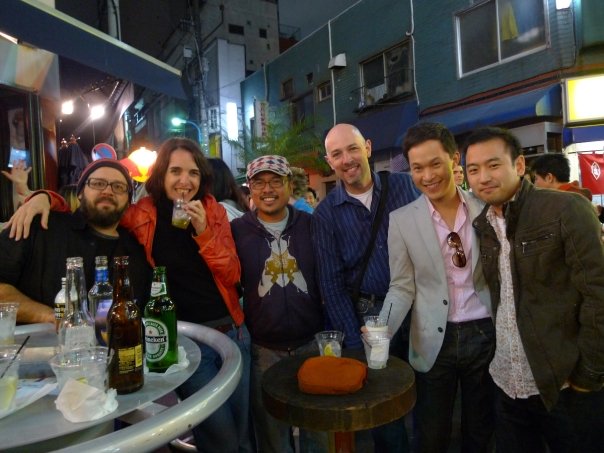
Left to right: Ko, Fluck, Pat and Tawn in front of the restaurant.
For dessert, we stopped by iBerry for some ice cream and brownies. Hardly authentically Thai but tasty nonetheless!

Have I whetted your appetite yet?













































 christao408