Coming Down off the Singapore High

It took me five days, but finally this afternoon I came off my Singapore high.  I no longer pine for the smooth pavement and large, shady trees of the Singaporean parkways.  I’ve made my peace with motorcycle taxis and the Thai post office.

It was while I was walking home from lunch with Stuart at J Avenue that I had this epiphany.  Full from my lunch at a favorite Japanese restaurant, carrying my groceries from Villa market in one hand and eating a single scoop of rich chocolate ice cream from Ummm… Milk (a local dairy products company) from a cone in my other hand, I stumbled along the side of the road, looking over my shoulder to avoid oncoming cars and motorcycles, and wondering whether I would make it home before the rain started to fall.

And it was at that moment that I realized: Krungthep is fine.  I don’t need any fancy city-state central planning.  I’m perfectly happy with my red shirt – yellow shirt political merry-go-round.

But before I let it all go, here’s one final picture from Singapore, snapped while we were driving to the IT mall.

P1140673-1

Above: A Chinese immigrant to Singapore pauses in the shade to read a text message.  I really like the composition.


The Thai Pickup

When you ask people to name the motor vehicle they most associate with Thailand, most will name the tuk-tuk, the (t)rusty three-wheeler that death-defyingly (and not always defyingly) careens through the congested streets of Krungthep.  But the tuk-tuk isn’t the most Thai of motor vehicles: the pickup truck is.

P1140529

Why are pickup trucks so popular here?  First of all, imported vehicles carry a tariff of about 100% or more, depending on weight and price tag.  Many brands of pickup trucks, particularly Toyotas, are built here in Thailand, making them much more affordable.  In fact, Thailand produces more Toyota pickups than any other country.

The other reason pickups are so popular is the sheer utility of them.  Why buy a sedan that only seats six or seven or eight when you can get fifteen or more into a pickup?  Yes, even the advertisements for Toyota pickups shown in the cinema have images of a truck transporting an entire team of child footballers, cheering their victory.  No mention, of course, that driving with people in the back of the truck is tremendously dangerous especially when those people are children.

Driving down the roads and highways of Thailand, we see no shortage of pickups filled to the brim with all sorts of cargo, all manner of people, and even some buffaloes.  Even on the hottest days people are huddled in the back, jackets draped over them to keep the sun off their bodies.

So as Tawn and I start thinking about replacing his nearly 12 year old Nissan sedan, maybe we should start thinking in practical terms and consider a pickup!


What’s it Like to Live in Thailand?

In the past year using Facebook, reconnecting with old friends, colleagues and classmates, several people have asked me upon learning that I live in Thailand, “What’s it like living there?” I’ve given short, snappy answers (“Well, the Thai food is amazing!”) in lieu of anything more thoughtful. This morning I took a stab at coming up with a better, more substantive answer to that question. What is it like living here?

Part of the reason for not coming up with a better answer in the first place, is that it is difficult to succinctly explain what life is like anywhere – especially when it is very different from life in the questioners’ hometowns. I get up, eat breakfast, work, watch movies, etc. It is the same and, yet, very much not the same.

On Language

The most overriding feature of living in Thailand is the different language. I’ve been here three-and-a-half years and have studied Thai all except two months of that time. It is hard to explain just how big an effect operating in a different language environment can have.

In my home (I work from home) I am immersed in a language in which I’m hyper-fluent. I look at a page of English text and meaning jumps out at me. Comprehension requires no effort.

2009-03-03 01

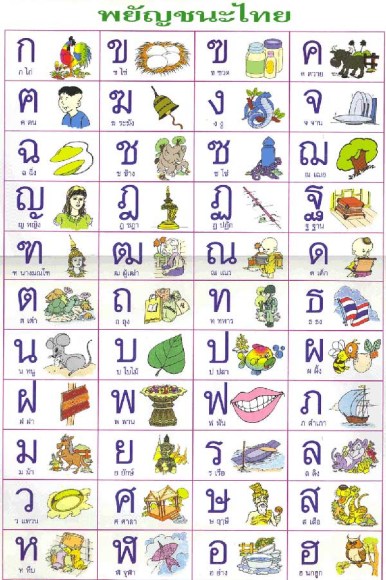
Above: the Thai consonant chart. Each consonant is related to a specific word, similar to “A-Apple, B-Boy” except the word is used consistently with that consonant.

When I step out of my home, I am immersed in a world that is as inaccessible as my English world is accessible. I see the printed Thai script but unless I specifically make the effort to find the words and their meaning, it is just a collection of now-familiar characters: 44 consonants representing 21 sounds, 18 vowels, four tone marks.

The best analogy: playing one of those hidden-word games where words are buried in a grid of letters. That’s how it is when I see Thai: When I look, I see a bunch of Thai characters. I have to look much closer to find the words. Finding the meaning requires yet another step, as I’m at the stage in building my vocabulary where I recognize that I’ve seen a word before, but am uncertain of its meaning.

It is much the same with conversation. If someone is speaking to me and I know what subject we’re talking about, then I am generally okay. I won’t know all the vocabulary, but I can follow along and even contribute a bit. If it is a random conversation into which I stumble, I’ll likely be lost, recognizing some words as they pass by but as unable to grasp onto them as I am unable to board a rapidly-moving train.

That’s the first and most significant aspect of my life in Thailand. I realize, upon rereading what I’ve written so far, that it may sound like a complaint. It isn’t. In truth, Tawn or any other Thai is likely very impressed with my progress. I’m well ahead of 95% of the expats who live here. But I’m also well behind the top 1-2% who are truly fluent in Thai.

Mai Pben Rai

The second notable answer to the question has to do with understanding the Thai mentality – heavily rooted in Buddhism – and the Thai way of looking at the world. Some illustrations:

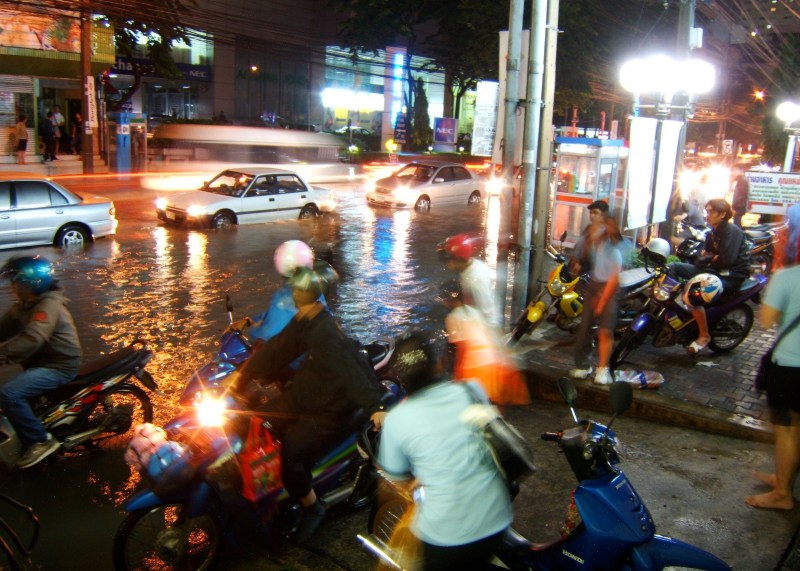
Mai pben rai – literally, “it’s nothing”. This phrase is constantly invoked by Thais to indicate a “no worries” approach to life. You’re running late for class? Mai pben rai. Stuck on a flooded street? Mai pben rai. You forgot to run an errand? Mai pben rai. Not interested in completing the job as promised? Yes, you guessed it: Mai pben rai.
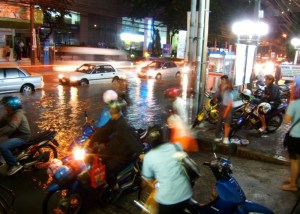
2009-03-03 02

Above: Flooded street leaves you stranded for hours? Mai pben rai!

At first, this can be infuriating. In many (especially Western) cultures, we make a big deal out of things such as being on time, doing what you promise, following up on details, etc.

2009-03-03 03

But Thais subscribe to the belief that you shouldn’t sweat the small stuff. And, it seems, nearly everything is small stuff.

The upside to this is that you learn to be much more sanguine about the world, much more accepting about the truth that our sense of control over most aspects of life is largely an illusion. Stuck in a traffic jam? Mai pben rai – don’t worry, you can’t control the traffic. Unable to watch a film you badly wanted to see? Mai pben rai – maybe it will be available on DVD soon. Caught in a rainstorm without an umbrella? Mai pben rai – just duck into a restaurant for a snack.

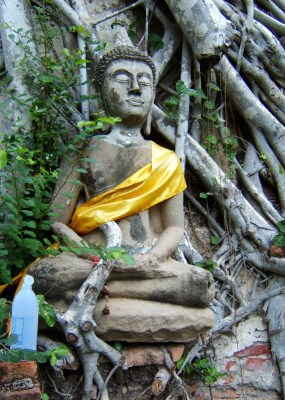
Thai culture’s Buddhist roots, with its emphasis on the impermanence of all things, is seen everywhere. From the lack of city planning to the way that most plants are potted rather than being planted into the ground to the quality of sidewalk construction, Thais are wired for short-term thinking.

2009-03-03 05

The Land of Smiles

The Tourism Authority bills Thailand as “The Land of Smiles”. Try telling that to a load of commuters on the un-air conditioned number 38 bus line in Bangkok.

Seriously, though, two features of life here are illustrated by the concepts of suphap (“polite”) and sanuk (“fun”). Thais believe that, regardless of how they think or feel on the inside, the exterior should be polite and pleasant. Why should everyone else suffer just because you are feeling down? Keep a smile on your face and be pleasant to others.

2009-03-03 04

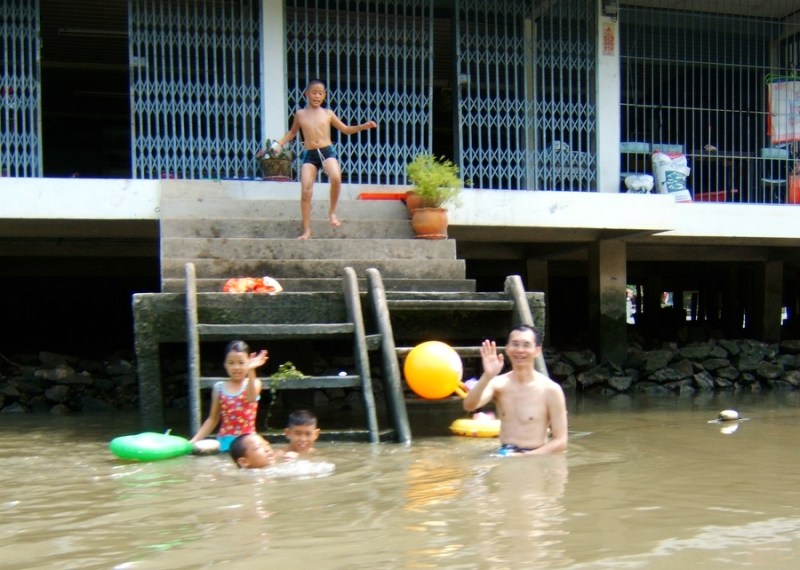
Above: Friendly and polite locals wave as we pass by in a boat.

At first a foreigner might mistake those smiles for happiness, agreement, being pleased, etc. Eventually, most learn that Thai smiles have a hundred meanings, only some of which are positive. .

Upon learning this, some foreigners disdain this outward veneer of pleasantness as being artificial. It is hard to explain adequately but perhaps it helps to see the Thai perspective on things:

A Thai walks into a store in Los Angeles and the cashier smiles broadly, asks how her day is going, asks where she’s from and how she likes the weather. The Thai is used to walking into a store in the other City of Angels and being greeted with a pleasantly soft “Sawatdii kha” and the prayer-like wai in which the palms of the hands are placed together in the center of the chest. To an Angelino, the Los Angeles cashier seems very friendly. To the Thai, that same cashier is being over-familiar.

But here’s the contradiction: in the west, if you walk up to someone on the street to ask for directions, their initial reaction will likely be apprehensive and guarded. Especially in an urban environment, they may well wonder if they’re being taken advantage of.

Here in Thailand, when we stop a person on the street and ask a question – “Hey, uncle, do you know where I can find that famous noodle shop with the tom yum broth?” – we get a friendly smile and helpful directions.

I’ve observed this among Thais, so it isn’t just a Thai-foreigner thing.
2009-03-03 06

The Food

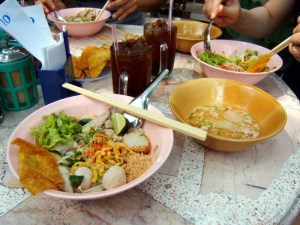
Even though my original snappy answer to the question was that Thai food is really good here, it actually is one of the true answers: Thai food really is better here.

When I lived in the US, I thought Thai food was good no matter which restaurant you went to. “Bad Thai food?” I thought, “Surely there is no such thing.” Of course, once I moved here, I realized that there are few Thai restaurants in the US worth eating at unless it is a case of severe gaeng kiaw waan withdrawal.

But beyond that, Thailand has much more healthy, fresh, inexpensive food readily at hand than in the US (and maybe many other places in the west). You’re in the US, it is 3:00 pm and you want a snack. What are your options? Donuts, burgers, fries, tacos, ice cream? None of which are good for you nor really that satisfying.

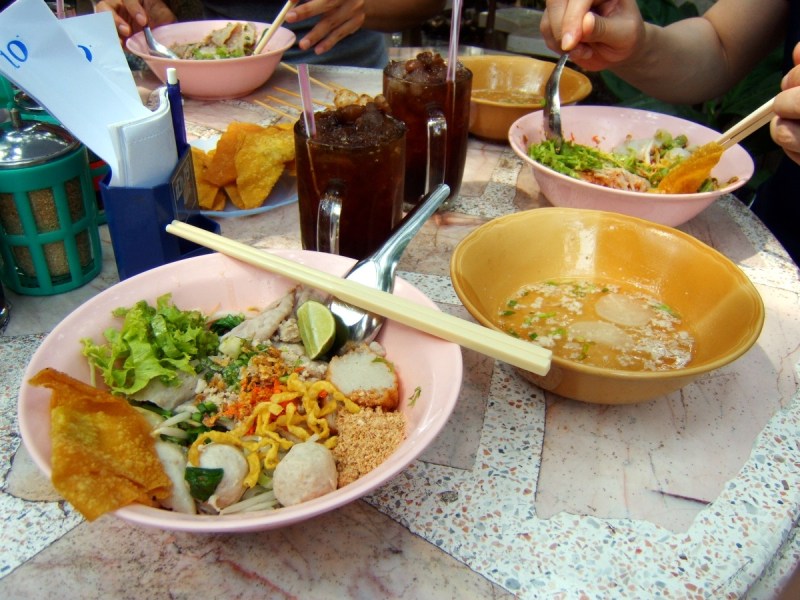
In Thailand, a bowl of noodle soup, a plate of spicy green papaya salad, a stick of grilled fish balls in sweet chili sauce, or a bag of fresh fruit are readily available on most any street corner, are relatively healthy and are very inexpensive.

Sure, Starbucks’ venti mocha frappaccino with extra whipped cream and McDonald’s hamburgers are available here (and the growing incidence of childhood obesity testifies to that fact) but there are so many readily available, healthier options, options that I miss when I’m back in the west.

2009-03-03 07

Beauty and the Good Life

The French have their joie de vivre, the Italians their la dolce vita. Thais, too, are all about ease, comfort and enjoyment of life. Even with some of the world’s worst traffic, Bangkok residents make enjoying life a priority. There is always something fun happening, things are festively decorated, and thinking too much about your cares and worries is discouraged.

People interact more with each other and their surroundings here than in the west. People are more playful, too, but not in the sarcastic or mean-spirited way you see in the west.

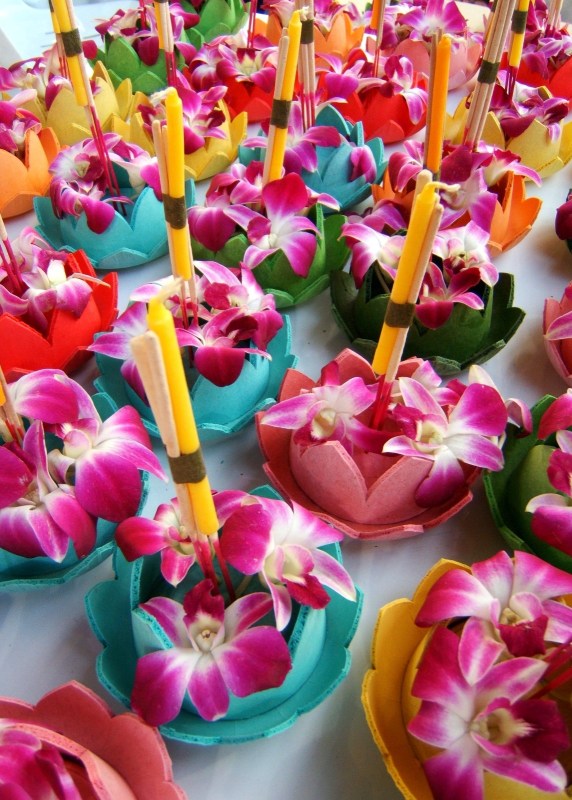
There is great beauty. Thai temples and Brahmanist spirit houses are elaborately and colorfully decorated. Fairy lights – what North Americans call Christmas lights – are used to dress up the landscape for no reason other than the sheer fun of having little twinkling lights strung up in the trees.

Flowers are very inexpensive, very beautiful and very bountiful here. Every market and many street vendors sell beautiful blossoms and fragrant jasmine garlands. Again, in line with the Buddhist belief in impermanence, potted plants decorate sidewalks and balconies, rearranged endlessly and replaced when they die.

2009-03-03 08

Thais take great care to keep things (including themselves) looking neat and clean even in the midst of the city’s chaos and pollution. Even from the working class houses lining the murky Saen Saeb canal, carefully-groomed residents emerge on their way to work, shirts neatly pressed and great thought given to what handbag (probably a knock-off sold at a discount mall) to carry.

The Social Ladder

Thailand has a very hierarchical society: When two Thais meet, they try to determine who is higher than whom on the social order. This ranking has great effect on all aspects of their subsequent relationship: how to address each other, who serves whom at the table, who pays the bills, who walks out the door first, etc.

This chafes western egalitarianism and takes a long time for foreigners to get used to and understand. It is hard to overestimate how important it is for Thais to understand where they are on this hierarchy.

2009-03-03 09

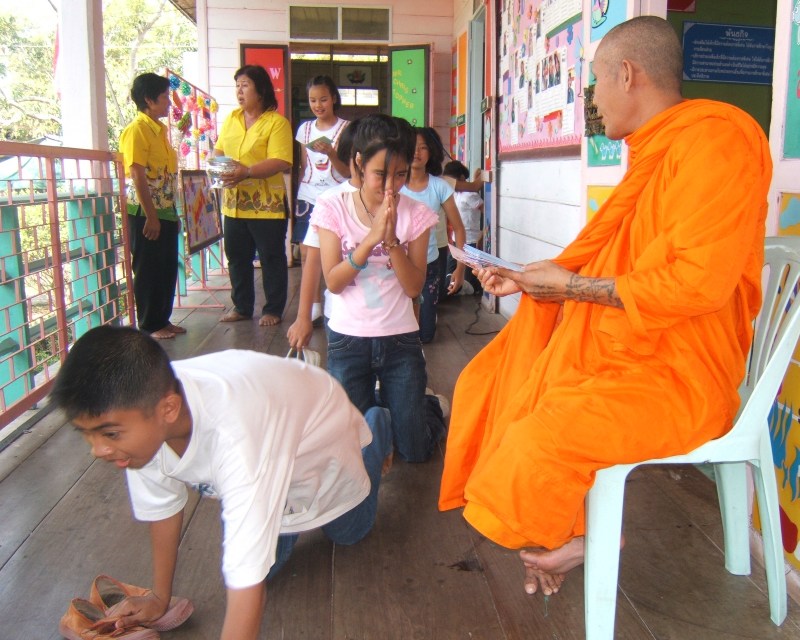
Above: Students behave appropriately, approaching the monk on their knees then crawling past him. Females are especially careful to avoid coming into direct contact with him.

The ways in which this impacts foreigners are numerous and subtle. One expat incorrectly explained to me that foreigners, being guests, always rank highly, just below politicians, royalty and monks. He couldn’t have been much more wrong.

Foreigners are in their own category, separate and measured by another standard, namely, the extent to which you understand and play by the Thai rules.

What’s the practical effect of this? On the Skytrain, for example, I move out of the way for those above me on the social ladder – elders, for example – but not for teenagers.

When I walk past puu yai – literally “big person” or “adults” – who are having a conversation, I duck my head ever so slightly, showing my respect by not towering over them.

2009-03-03 10

Above: Even the leaders of the September 2006 coup were careful to visually emphasize that they knew their place – still below the monarchy.

Remember the scene in the musical “The King and I” (banned in the Kingdom of Thailand) in which Anna Leowens and the King of Siam debate over how high she should hold her head in comparison to the king? It is the same thing – your head you should be lower (or, at least, bowed a little in respect) as you pass by or sit with someone who is of a higher rank than you.

When speaking with monks, I should hold my hands in a wai at my chest. When hanging out with peers in my age group, I can relax and not be so concerned as we’re equals. When teaching at the school and helping a student with his work, he offers me his seat and then kneels next to me as I explain the assignment. Everyone has his or her place in the hierarchy and that place is relative to the people with whom you are interacting.

Small things? Maybe, but ones that show that you know your place in the order of things.

At the very top of the order are the religion and the monarchy. Pictures of His Majesty King Rama IX adorn nearly every house and place of business.

2009-03-03 11

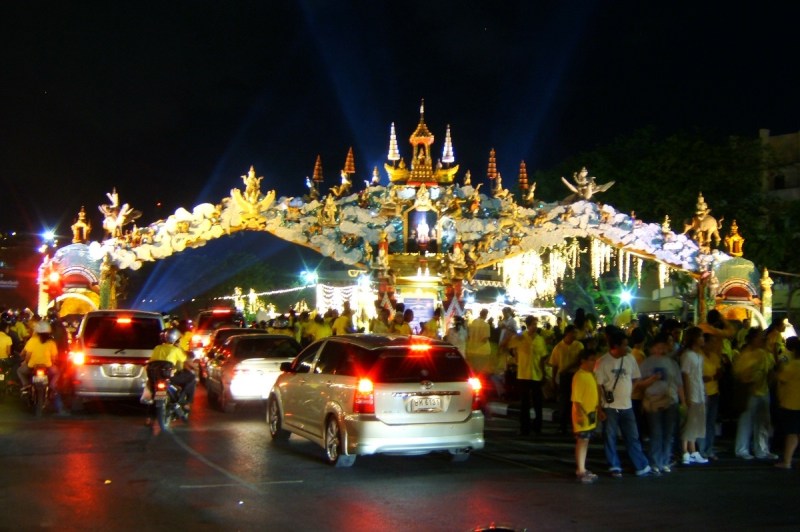
Above: Street decorations celebrating the 60th anniversary of the King’s reign.

At the start of movies and concerts, the audience stands for the royal anthem. If a royal motorcade passes, people stand quietly and respectfully at the side of the road and, if it is the king or queen passing, bow at the waist as their car goes by.

One important facet of this respect for the monarchy is that you don’t – don’t – discuss the affairs of royalty. You don’t ask Thais what they think of the Crown Prince or Crown Princess. You don’t speculate as to who will succeed the King. You don’t debate the merits of a constitutional monarchy or the appropriateness of still having (and enforcing) lese majesty laws.

Even with a Thai with whom you think you’re close, you are best advised to leave this topic alone.

My Final Answer

The final answer to the question of what it is like to live here lies in an additional Thai concept: samruam. Roughly translated, “restrained”. It is related to the previously-mentioned concept of suphap – “polite”.

The thing that keeps this culture going is the emphasis on external appearances, most significantly, keeping up a polite and appropriate appearance and being restrained in your behavior.

For example, Thais believe that the feet – the lowest part of your body – are the dirtiest and least polite part, too. Resting your feet (especially with shoes on) on furniture or the wall, pointing your feet towards someone or an image of the King or the Buddha, or touching someone, moving something or gesturing with your foot, are all hugely mai suphap – impolite.

In fact, the slang term for “foot” is muu farang – foreigner’s hand. That’s because westerners are more inclined to push, gesture and touch with their feet – actions the Thais associate with being coarse and unrefined. In other words, being a foreigner.

You see this in the way people sit in public: feet flat on the floor or, if a woman crosses her legs (not very suphap), it is done with legs tightly together and the foot pointed down. On the Skytrain last week, I observed a foreigner sitting with his legs stretched out across the aisle, pointed towards a lady on the other side of the car. Had he not been absorbed in the pictures on his phone, he might have noticed the dirty looks other passengers were giving him.

Samruam – restraint – is related to suphap. Thai culture is about moderation in behavior, voice, feelings, etc. Thais are fun-loving people but rarely boorish, loud or obnoxious. Thais get upset but rarely do you see public bursts of anger.

The recent prime minister, Samak Sundaravej, caused quite the stir because of his famous outbursts. When questioned by a female reporter once, he avoided answering by accusing her of not having enough sex. In general, prime ministers aside, losing your temper diminishes your public standing. To berate someone publicly is an invitation to revenge.

Thais dress modestly. When a foreigner is sitting at a restaurant on a sunny day and takes off his shirt to enjoy the sun, Thais are taken aback. (I’ve witnessed this. I wanted to say something but restrained myself – confrontation is seen as even worse than being not samruam.) Women in spaghetti strap tops are assumed to be bar girls or sex workers. If they are foreigners, the fact that their foreigners (again, course and unrefined) is their excuse.

2009-03-03 12

Above: Even at the Erawan Waterfall, Thais are dressed with relative modesty. Only foreigners and young children show bare shoulders.

On the surface, this may sound prudish. But to really understand it, you have to remember that in Thai culture, it is important to keep up appearances. Loud, obnoxious, revealing and unrestrained clothing/behavior/manners don’t keep proper, considerate appearances up. They make life less pleasant for everyone else.

And that’s an important part of life here. That’s why, despite the heat and humidity, I rarely wear shorts (even cargo shorts) out of the house. And when I do, it is only for Saturday morning errands in the neighborhood, never out for dinner.

Conclusion

So what is life like here? Living in the environment of a different language makes it very challenging but opens worlds of understanding. The mai pben rai attitude is more relaxed, less worried, and occasionally frustrating when you want to get something done.

Politeness, appropriateness and fun are values that influence all aspects of life and behavior, generally making social interaction smoother and more pleasant. Knowing your place in the hierarchy of society makes you more considerate of others and, in return, you receive more respect from others, too.

Finally, from food to flowers to music, life here has a lot of good things to offer, even when they aren’t expensive or are surrounded by a chaotic environment.

I hope that I’ve given you a bit of an answer to what life is like here. As you can probably see, it is hard to describe it succinctly. The only short answer I can think of is:

“Requires different operating instructions.”

Stuck on Thong Lo

The north end of Thong Lor (Sukhumvit Soi 55) gets really backed up with traffic, especially on weekend afternoons.  Lots of shoppers going to lots of shops and sometimes you end up sitting for several minutes.  Yes, these moments of stuck traffic give me amazing opportunities to really see this fascinating neighborhood in which I live.

P1140485 The street is about 3 km (2 miles) long with a Skytrain station at the south end.  There is a special transit system, a fleet of aging Mercedes Benz busses that spew coarse black smoke, that run up and down the soi, picking up riders at the Skytrain station, several stops along the way, until terminating at the khlong (canal) pier on the north end of the street.

These bright red unairconditioned busses park at the north end of the street when they are not in use.  While sitting in traffic, I watched as two men refueled one of the buses in the most ad-hoc manner: gravity-fed through a rubber hose connected to a plastic fuel jug.

The color and the composition both spoke to me but I was equally fascinated that the younger man was smoking while doing this.  I wondered if I kept the camera ready, would I be able to capture a good picture of the explosion without losing my life in the process?

I never found out as traffic started moving and there was, to the best of my knowledge, no explosion.

Also along the street, which is known for its abundance of wedding boutiques, I saw a plant vendor pause in the shade in front of a window displaying a wedding gown.

P1140489

Again, a wonderful contrast that exemplifies this neighborhood: it is called the Beverly Hills of Bangkok, but at the same time all segments of the socioeconomic spectrum are represented here, both living and working.  That is something I really like about Krungthep: there is a huge gap between the haves and have-nots, but the gap isn’t physical.


Dell Laptop Repair

I’m having the strangest experience.  I’m sitting in my living room here in Krungthep, Thailand and across the dining table from me, a Dell computer technician is taking apart my Latitude 610 laptop, replacing the LCD and the mother board.  All under warranty at no cost to me.

I know that Dell hasn’t had the best customer service reputation but, except for the fact that the conversations have had to be entirely in Thai (you’d laugh if you heard the translation of how I explain the problems my laptop is having), their service has been pretty amazing.

Of course, the repairs are still underway.  We’ll see what happens when he’s done!

This is my work laptop, provided by my employer back in the US.  Hopefully my IT department doesn’t read this as their suggestion was to ship the laptop back to them.  Last time I sent a laptop FedEx between continents the cost was ultimately north of $400, thanks to various “customs charges” and “convenience fees” that get charged here on the Thai side.

The problem (most of you may not want the technical details, so you can skip down a paragraph or two) is that the external video signal cuts out intermittently.  To spare my eyes, I use a 17″ LCD monitor resting on a small altar table that straddles the laptop keyboard.  In essence, a homemade docking station.  But the image cuts in and out and some tests suggest that the problem is the computer, not the monitor.

Also, when using the built-in LCD, sometimes the image jumps for a second and I’ve had a few stop errors in the past week, leading me to believe that bad things are coming

My in-house IT guy’s response: if it isn’t a company external monitor, it isn’t my problem.  Thanks.

So I called Dell’s local service number Friday and explained in a rudimentary way what the problem was.  The agent took my information and said he’d have a technician call on Monday.  Monday morning I received a call, which I had to forward to Tawn once it became a little complicated.  But by the late afternoon the technician arrived with two boxes in hand: a replacement LCD and a replacement motherboard.

Since the computer was still under warranty, they figured the safest thing to do was just switch all the potential trouble parts out.  Makes sense, right?

When the News is For Sale

I fired off a letter to the editor this morning when I discovered that The Nation had used a quarter of today’s front page to give free advertising for the opening of “Chicago: The Musical” in the Big Mango.

Tawn, as a PR professional, admired the success of whichever agency handles that account, but was shocked at how blatant the placement was.

Nation 2009 You will recall that a few weeks ago, I took to task one of the paper’s columns, “Ask the Pros”, for asking the owner of a beauty clinic that performs colon hydrotherapy (enemas by another. sexier name) to play the role of unbiased expert in responding to a reader’s questions about the safety and efficacy of colonics. 

But this seems to have reached new levels of journalistically unprofessional conduct.  A quarter of the front page with the following caption: “BEC-TERO Entertainment paid more than Bt100 million to bring Broadway’s ‘Chicago: the Musical’ to Bangkok.  The play took the stage last night at the Muangthai Rachadalai Theatre in The Esplanade shopping complex and runs until February 22.  The 50-strong cast is led by Michelle DeJean and Terra C. MacLeod.  Tickets cost Bt1,000 up to Bt4,000 each.”

Now, I want you to know, I am a fan of the musical Chicago.  In fact, Tawn and I are joining a group of friends to watch the show on Saturday.  So it isn’t that I dislike musicals or don’t believe that coverage of a new musical’s opening isn’t news.  I am pretty certain, though, that we have more pressing things to report on the front page.

You may not have heard, but there is actually quite a bit of real news going on here in Thailand: 

  • We have a police investigation into the New Year’s Day pub fire (resulting in 64 deaths) that is revealing some alarming things about public safety, tax evasion, and corruption of public officials.
  • We have a new Prime Minister (our fourth in a year) who is trying to steer the ship of state in rough political and economic waters. 
  • We have a nationalized airline that is bleeding money while giving its employees large bonuses and raises. 
  • We have an Agriculture Ministry that is requiring that tumeric, lemongrass, and ginger (among other things that farmers use as organic and safe pesticides) be listed as hazardous substances, a move that undermines organic farming and opens the doors for the large chemical companies.

Any one of these – plus a dozen more – could have provided some much-needed news reporting, investigation and analysis.  But the editors felt that the biggest news in the Kingdom was the opening of an expensive show from Broadway.  One of several shows that open here every year.

I’ll let you know if the editor deigns to respond to my letter.


Day trip to Pattaya

First of all, let me make this clear to those of you who might think we’re running around enjoying adventure after adventure: these blog entries are not chronological.  Instead, there is a delay as I process photos and videos and then I arrange entries to provide some variety.

With that administrative tidbit out of the way, let me share a day trip we recently took to Pattaya, the beach side city of sin located less than two hours to the southeast of Krungthep.  I’d never before been to Pattaya because its scuzzy reputation (although the beaches are supposedly gorgeous) kept me disinterested.

“I wonder how long it will be before we see our first fat farang on a scooter with a tiny Thai girl behind him?” Tawn asked as we pulled into town.  Within two minutes, we had our answer.

We didn’t go to Pattaya to explore the town or even to try and dispel my perceptions.  Instead, we went to exchange some silk that Trish had purchased from the factory in Nakhon Ratchasima province that, upon inspection once we returned to Krungthep, turned out to be 1-ply instead of the 2-ply for which she had paid.

The factory owner has a retail shop at a recently opened faux floating market in Pattaya, so we arranged to meet her there to do a swap.

While there, Tawn wanted to find a boulangerie that had opened recently and had been featured in Thai Vogue.  It looked very cute in the magazine but of course we left home without noting its address and location.

Using the tiny internet browser on Tawn’s phone, I was able to find another boulangerie called, appropriately, Le Boulange.  Turns out it is the cousin (or sister location?) of one on Convent Road in Krungthep, owned by a real Frenchman.  The Pattaya location is just a modest storefront and is mostly a bakery, producing for stores and hotels in town.

P1130830 While there, we witnessed the chef talking with a French expat and his Thai fiancée about a wedding cake.  In this case, the expat was much closer in size to the Thai and they were not riding a motorbike. 

The sandwiches – only available combination is baguette de jambon et de fromage (ham and cheese) were très authentique.  A robust crust that fought you back when you bit into it and a wonderful textured crumb.  And for only 35 baht (about $1) for a mini baguette, a real bargain.

Left, Tawn poses with his baguette as a local woman looks on.  Or, at least, pretends not to.

The desserts were less spectacular, but what can you expect?  At least we enjoyed a good lunch.

The chef came over after settling wedding cake decisions and asked how our lunch was.  Answering him in English, he quickly apologized and explained in French that he only spoke French and Thai.  So we continued the conversation in Thai, since neither Tawn nor I remember enough French.

Afterwards, with the disinterested local’s directions, we drove to the outskirts of the city to Talat Naam Si Pak – the Four Regions Floating Market.  Floating markets are very much a part of central Thailand’s culture, as the myriad waterways in this flood plain made waterborne transportation the easiest way to get around until the 20th Century introduction of the traffic jam.

For the tourists – and, most noticeably, for the Thai tourists – Pattaya now boasts an entirely artificial floating market that runs from dawn till dusk, every day.  Located to the south of town around an manmade lake, the shops and boardwalks connecting them are ostensibly divided to represent the four regions of the county.

P1130837

Sadly, there is little to distinguish the regions as the building are identical except for tiny emblems on the roof line meant to evoke the different regions.  From a central cooking area, vendors paddle their boats around the “canals”, offering authentic Thai food (and two-litre bottles of Pepsi products) for sale.  The Thai tour groups we saw seemed to love it, setting up mats and eating in the shade, reveling in a near-cultural experience.

P1130838

While wandering about, we located the Silk merchant’s shop.  As it turns out, she changed plans and decided to come to Pattaya the following day, but had not called Tawn to tell him.  When Tawn tried to call her, she didn’t answer.  After explaining the situation to the clerk in the shop, the clerk called the merchant, who answered the phone promptly.

The clerk then handed the phone to Tawn as he proceeded to read her the riot act in a polite, nice way – as Thais can do so well.

She promised to bring the correct fabric to us in Krungthep the following day, so we left the single-ply fabric and a sample of what the correct fabric should be.  Needless to say, she never showed up or called Tawn, and we’re now two weeks later with no resolution.

We decided not to waste any more time at the floating tourist trap, but on the way back to the car park we found something endearing: a pen of baby goats and one sheep, all three months old.  They were the center of everyone’s attention, young and old alike, and for twenty baht you could feed them a bottle of milk.

Here’s a brief video showing the scene as Tawn fed them… and plotted to shear the sheep so he could make a wool coat!

We were back in Krungthep just after sunset, delayed by my exploration of the route near the airport that Peter, Stuart and I would ride the following day.


Chris the Handyperson

P1130703

P1130702 A few Sunday mornings ago, I was sitting at the computer working on something, when all of the sudden a large crash! came from the kitchen.  I looked over and saw nothing amiss.

It wasn’t until I opened a cabinet later in the morning to get my oatmeal pan that I saw the problem: the top anchor of the shelves had detached from the wall, right. 

Under the weight of the pots and pans, the shelves were leaning away from the wall and stressing to the bottom anchor, too.  I quickly removed everything from the shelves and placed it on the counter, eliciting quite a shocked look from Tawn when he woke up later in the morning and sauntered, bleary-eyed, into the kitchen.

“What happened?” he asked.  “Are you cooking something?”

When our handyman installed the the Haeffle wire swing-out shelves, he behaved in the manner most familiar to Thai handymen: pure improvisation.  The corner of the cabinet to which the anchors attach isn’t truly 90 degrees.  Instead, it has a lip.  As a result, one side of the anchors does not have a flush surface into which the screws can go.

P1130698 I noticed this during the original installation, but the handyman assured me it wasn’t a problem and shooed me away.  That was back in the days when I still trusted a Thai handyman’s words.  No more.

His solution was to create a small piece of wood to fill the gap, gluing together several layers of the veneer used on the cabinet until they were thick enough to fill the gap. 

He then screwed the anchor into that glued veneer.  But the layers of veneer were never actually attached to the structure of the cabinet – just sort of clamped to the lip of the cabinet!

Left, the top anchor of the shelf, still screwed into the layers of veneer that are glued together.  Notice that the holes on the left have been stripped out by the heads of the screws, as the shelf pulled away from the wall.

This left me with a bit of a dilemma: how to repair this problem?  Calling the handyman back didn’t seem a very good idea, but the essence of his fix – finding something to fill the gap created by the cabinet frame’s lip – was sound.  I just had to figure out what to put in there and where to find it.

Unlike life in the United States, Canada and other western nations, Thailand doesn’t have any Home Depot, Lowe’s, Orchard Supply Hardware or even Ace Hardware stores.  With the exception of some completely useless “Home Pro” stores that sell lightbulbs and sinks, all of our hardware is sold from small mom-and-pop (mostly pop) stores.

The first thing I needed was some wood.  Again, no obvious place to go if you need a few small lengths of wood.  But I recalled that in the old city, the area surround the Golden Mount temple is a woodworking district, handcrafting teak doors.  We headed there after brunch with friends.

It was already mid-afternoon.  Many of the shops were closed and the few open ones looked to be closing soon.  At the first shop, a grizzled old Chinese-Thai man listened as Tawn explained the problem and looked around his shop.  He wanted to sell us a length of teak wood – about 3 meters long (10 feet) – when all we needed was about 15 cm ( 6 inches).

We walked down the soi to a shop where they were still out on the sidewalk, sanding a beautiful teak door.  The trio of men listened as we explained the problem and one started rummaging around the shop, wonderfully crowded with pieces of wood of all sizes, and found a few small scraps.  We tried them out and found a width that was a close fit, then he cut it down to the desired length, leaving us with two 15-cm pieces.

“How much?” Tawn asked the owner.  He laughed with a half-toothless smile.  “If I wanted to sell it, I would sell it for 10,000 baht (US$285).  But I’ll just give it to you.”

We thanked him profusely and walked away with our two pieces of wood that, given the difficulty we were expecting to encounter in finding a solution, we would probably have gladly paid 10,000 baht for.

Returning to our neighborhood by canal taxi just a few minutes before 5:00, we rushed to a hardware store around the corner, just as they were pulling their wares inside from the sidewalk.  We explained what we were looking for – longer screws with larger heads and maybe some washers, too – and the owner browsed the shelves lined with tattered paperboard boxes of various sized hardware until he found eight of each item we were looking for.

Back at home, I pulled out the power drill and started the fix.  First, screw the piece of wood to the cabinet lip, creating a flat surface and ensuring that there is something solid for the shelf anchor to mount to.

P1130731

This was a little difficult as I couldn’t face the work area head-on but had to hold the drill from the side.  Not so good for my neck.

Next, with Tawn holding the anchor and the shelves in place, I screwed the anchor to the cabinet, starting with the side that had the new piece of wood.  This processes worked pretty well, and although the wood split near the bottom screw, it seems to have a firm hold as the screws I used for the anchor actually sank through the stop-gap piece of wood and into the cabinet frame itself.

P1130732

I decided that before loading things back into the now-secure shelf, I should reconsider just how much weight I was putting on it.  This required a complete reorganization of the kitchen cabinets, moving several heavier items (especially dry goods – flour is much heavier than a skillet) to the cabinets above the countertop.

P1130739

The resulting arrangement – which is more organized in real life than it appears in the photo above – places heavier pots and pans on the lower shelf and lighter items on the higher shelf, including the backup stash of vodka in the Absolut disco bottle!

Meanwhile, I used this opportunity to tidy up all my other cabinets and complete a labeling project I started when we first moved in.  This is similar to how my maternal grandparents have their cabinets organized – lots of plastic storage containers, each with a printed label.  This sort of anal retentiveness actually appeals to both Tawn and me.  Arranged from left to right as you look at the area above the stove:

P1130738 P1130737 P1130734

The big white thing in the center cabinet is the overhead vent for the cooking surface.

So there’s another project done by Chris the handyperson.


Happy Year of the Ox

Growing up in one of the most diverse areas of California, Santa Clara County (what we called it before it became “Silicon Valley”), I was privileged to have a large number of friends who are Chinese or of Chinese heritage.  Privileged because this afforded me a literal seat at the table for various cultural holidays and festivals, none of which was more enjoyed by me than the lunar new year!

HAPPY_2009_Pt_2_Otto_Fong
Illustration courtesy of Singaporean cartoonist (and friend and all-around good guy) Otto Fong.

We are starting the year of the ox, specifically the year of the Yin earth ox.  Raymond Lo, a professional Feng Shui practitioner, advises:

The Year of the Ox, 2009, in the Hsia calendar, is symbolized by two elements – with earth sitting on top of earth. So is the same element on top of each other.  According to the cycle of birth and destruction, which governs the interrelationship between the elements, earth and earth are like brothers and sisters and so they do not have birth nor destructive relationship with each other.  They can be friends and they can be competitors. Therefore, earth sitting on earth does not give sign of conflict.

The Earth on top is Yin earth which symbolizes a garden, and garden gives sense of harmony and peace and relaxation. The Ox underneath is actually matching with the picture of a peaceful field with ox eating grass.  As such, I anticipate this elemental relationship will bring a year of more harmony and peace in international relationships and it is a year for healing and cure and relaxation from the turbulent time the world has experienced since 2001.  It is a time for rebuilding and reconstructions from the damage brought by war and natural disasters, and the financial tsunami of 2008, and also a time to seek peace settlement and to narrow the differences between different culture, religious believes and begin to care for one another, and make some achievement in solving the global warming issue.  It is a year of pure earth element and the theme for this year should be caring for our planet earth.

So to all of my friends who celebrate the lunar new year – and to everyone else as well – best wishes for good health, happiness, prosperity and peace in the coming year!


P.S.

As a little aside, if you scroll down Mr. Lo’s predictions and overview of the year of the ox, there’s this random tidbit:

The Earth element is also associate with homosexuality. It so happens many famous homosexuals is born on the day of earth – this includes Leonardo Da Vinci, Michael Angelo, Tchaikovsky, George Michael, Boy George, Andy Warhol, Tracy Chapman, K.D. Lang. Rosie O’Donnell etc. As such, there could be more issues in this aspect in 2009. It is not really clear how earth element is linked with homosexuality. Perhaps earth is an element of more neutral nature, compare against the other four, water and fire, wood and metal.

Strange, strange, strange…


A visit from the country mice

Another first: Ajarn Yai, the retired director of the country school where I used to volunteer as an English teacher, came to the big city to visit me.  For more than a year, she has said she would come see our new house.  But I was actually surprised when she called last week to tell me that she and another retired teacher from the school would visit on Monday.

P1130512 With the worry that most people save for visiting in-laws, I tidied up the house, prepared some small snacks and brewed both iced and hot tea.  It took several phone calls to clarify driving directions and I finally had to wait downstairs to wave my arms when they drove down the street.

In the back of her former student’s pickup truck (he had agreed to drive her) were gifts for me and Tawn: two dozen coconuts and a dozen large bags of palm sugar made on the student’s plantation.  Additionally, she had a large bag of a local snack mix that includes tiny dried fish, rice crackers and peas.

The visit was interesting: I showed them around the condo, which Ajarn Yai pronounced beautiful but then went on and on about how it must be so expensive.  Houses in her town are much less expensive, of course.  Houses in her town are also at the end of an unpaved trail behind a temple, several kilometers from the town itself.

I served tea, invited my guests to sample the different snacks, and tried to carry the conversation mostly in Thai.  The other teacher and the driver sat on the sofa much in the same way you might sit on your Victorian Aunt Millie’s lace doily lined sofa: musn’t muss things up!  The atmosphere felt kind of stilted and I never was able to convince anyone to snack, although they liked the tea.

After a few minutes, Ken arrived, which livened things up considerably. 

We headed to lunch at a local Thai restaurant.  I had originally thought it might be nice to take them for Japanese or Italian, but am glad I didn’t as that would have been a fish way too far out of water.

At the restaurant, everyone had menus but deferred to me – the farang and the youngest at the table – to order.  I tried to see what everyone would like or if there was anything catching their interest, but kept being deferred to.

I ordered as best I could, trying to remember what Tawn has taught me about creating the proper balance of Thai dishes.  When the food arrived, which was delicious and plentiful, the Thais ate with uncharacteristic timidity.  Normally, when I eat with the teachers at a restaurant in Samut Songkhram, appetites are hearty and people serve others and themselves, eating with gusto.

Monday afternoon, however, it was a very “refined” dining experience.  They seemed to enjoy the food and ate plenty in the end, though.  I tried to engage the other teacher in conversation, but she wasn’t very responsive.  Ajarn Yai did relax a bit and we ended up having a good conversation, mixing Thai and English and translating for Ken as necessary. 

Tawn laughed when I told him about the experience.  He explained that both the other teacher and the former student were there to make sure Ajarn Yai had a good time; it was her trip, after all.  So he wasn’t surprised they were so quiet and kind of “melted” into the background.  He also pointed out that the restaurant, which I consider to be just a mid-range restaurant, would be very high end by their standards.  So their “discomfort” was the same thing I might exhibit when I go walking in to the fancy home of some friend’s well-off parents.

All in all, though, it was a nice visit and I’m glad she made the effort.  Ajarn Yai still harangues me about taking her to the United States.  Maybe one day.  If she felt out of water just on this short visit to see me in Krungthep, imagine if we were in the US.