While in Chiang Mai a few weeks ago with visiting guests, I made a stop at the Four Seasons resort for afternoon tea. The resort is located about a thirty-minute drive north of town, which only enhances its feeling of being in the middle of nowhere. The resort is gorgeous and the afternoon tea is a worthwhile splurge for an hour or two of pampering yourself.
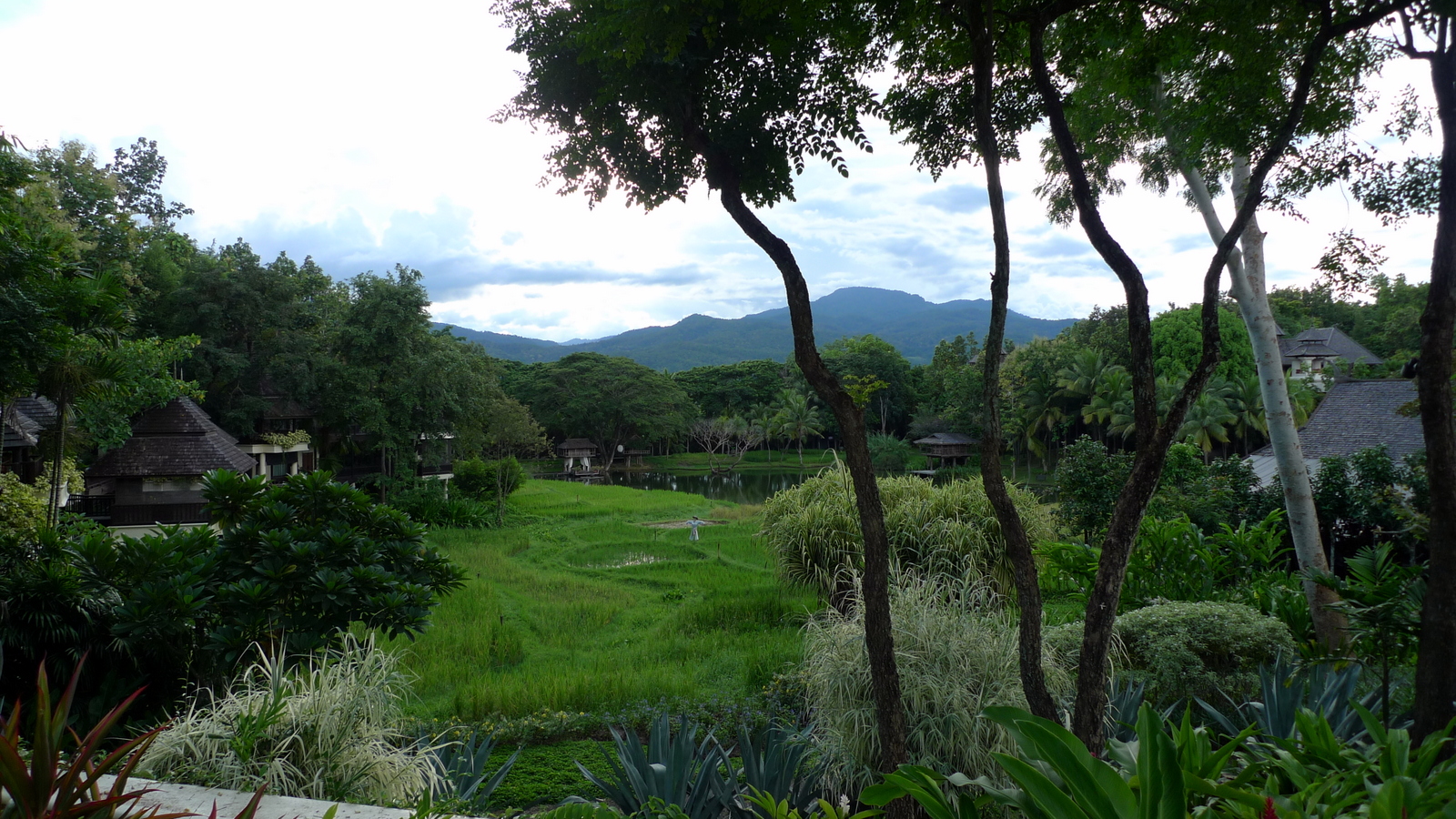
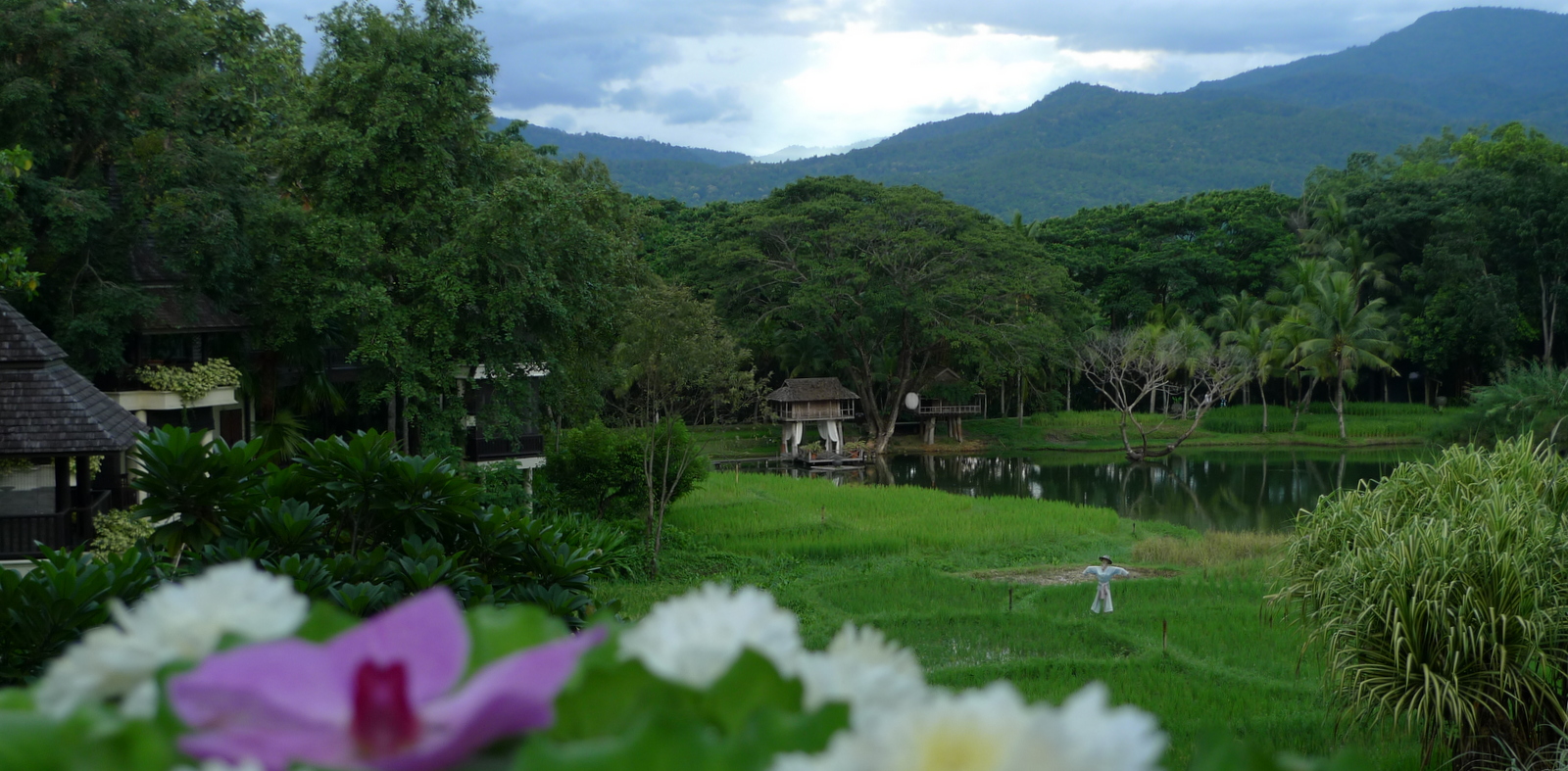
The resort is arranged around a pond designed to look like a Northern Thai village complete with rice paddies. The only buildings you see are those belonging to the resort and with the mountains in the distance, you could easily be forgiven for thinking you had been transported to some magical Thai Brigadoon. At 5:00, the “farmers” (resort employees dressed in traditional Northern Thai farmer’s clothes) paraded across the paddies to the rhythm of a gong, “returning” to the village, a touch that was a bit kitschy but also fun.
Trish, Allen, and I pose for a picture at the Sala Mae Rim restaurant. We didn’t make reservations but fortunately were able to get a prime table, perhaps because it was the midst of rainy season and the slowest time for tourists. We ordered one tea set (designed for two) plus an extra pot of tea, which was more than enough food for the three of us. The total price was approximately US$50, more than I would usually spend but certainly a worthwhile treat while on holiday.
The top plate in the tea set featured mango sticky rice with a palm sugar floss; crisp water chestnuts in sweet coconut milk; Parisian macaroons, and chocolate truffle cake.
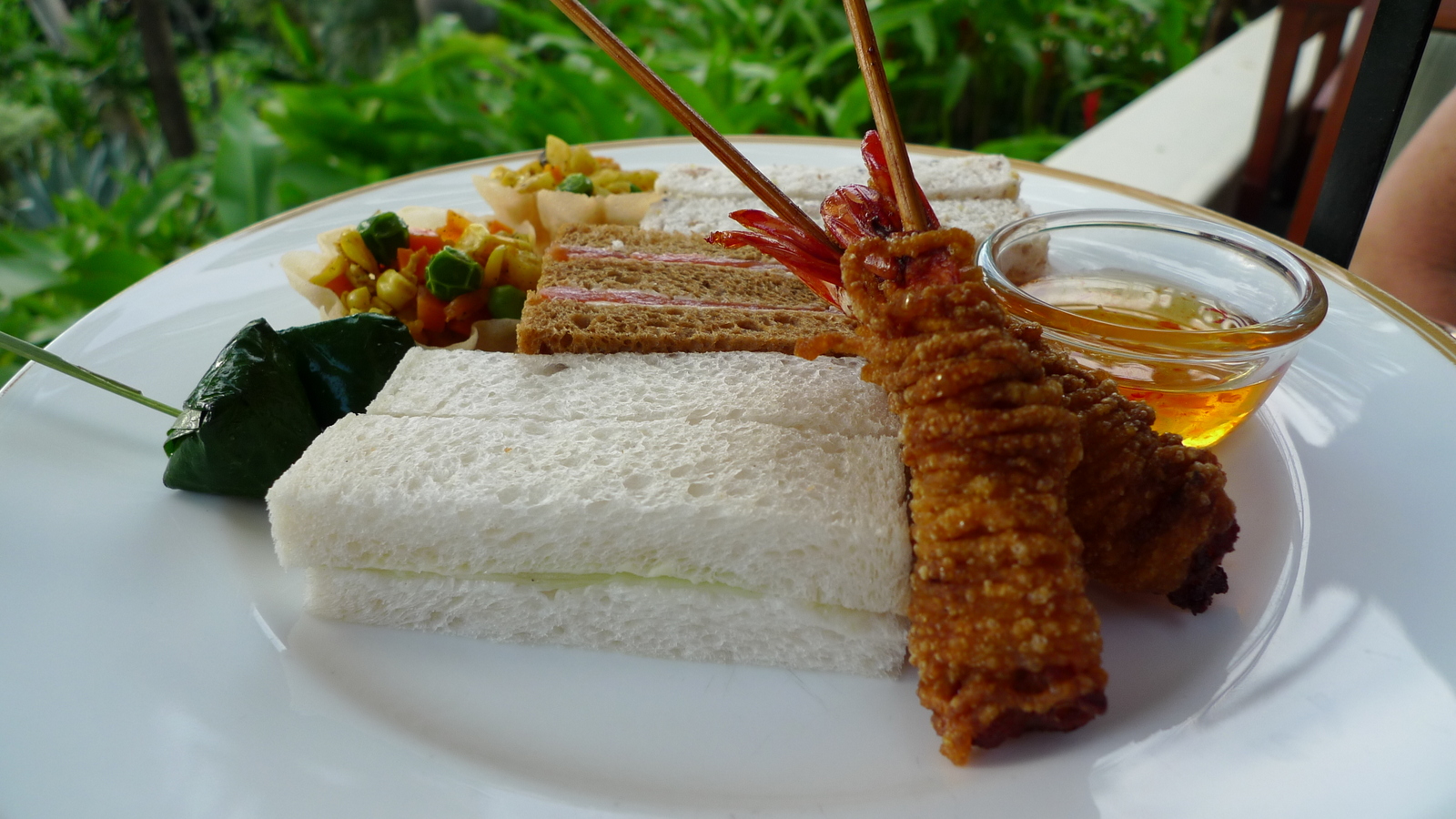
The middle plate in the set featured finger sandwiches (ham and cheese, cucumber, and smoked salmon); fried shrimps wrapped in egg noodles, miang kham (a Thai snack of betel leaves wrapped around savory fillings); and krathong tong (literally “golden baskets” – crispy shells filled with minced chicken and shrimp).
The final plate in the set featured kaffir-lime and raisin scones, served with clotted cream and strawberry jam. All the food was fantastic and the portions were more than adequate for the three of us.
After almost two hours of indulgence, we finally left paradise to return to the city. Without a doubt, the Four Seasons is on my list for future visits. While it may be too far away from the city to actually stay at (unless you specifically want to escape from the world), it is worth a visit for tea.
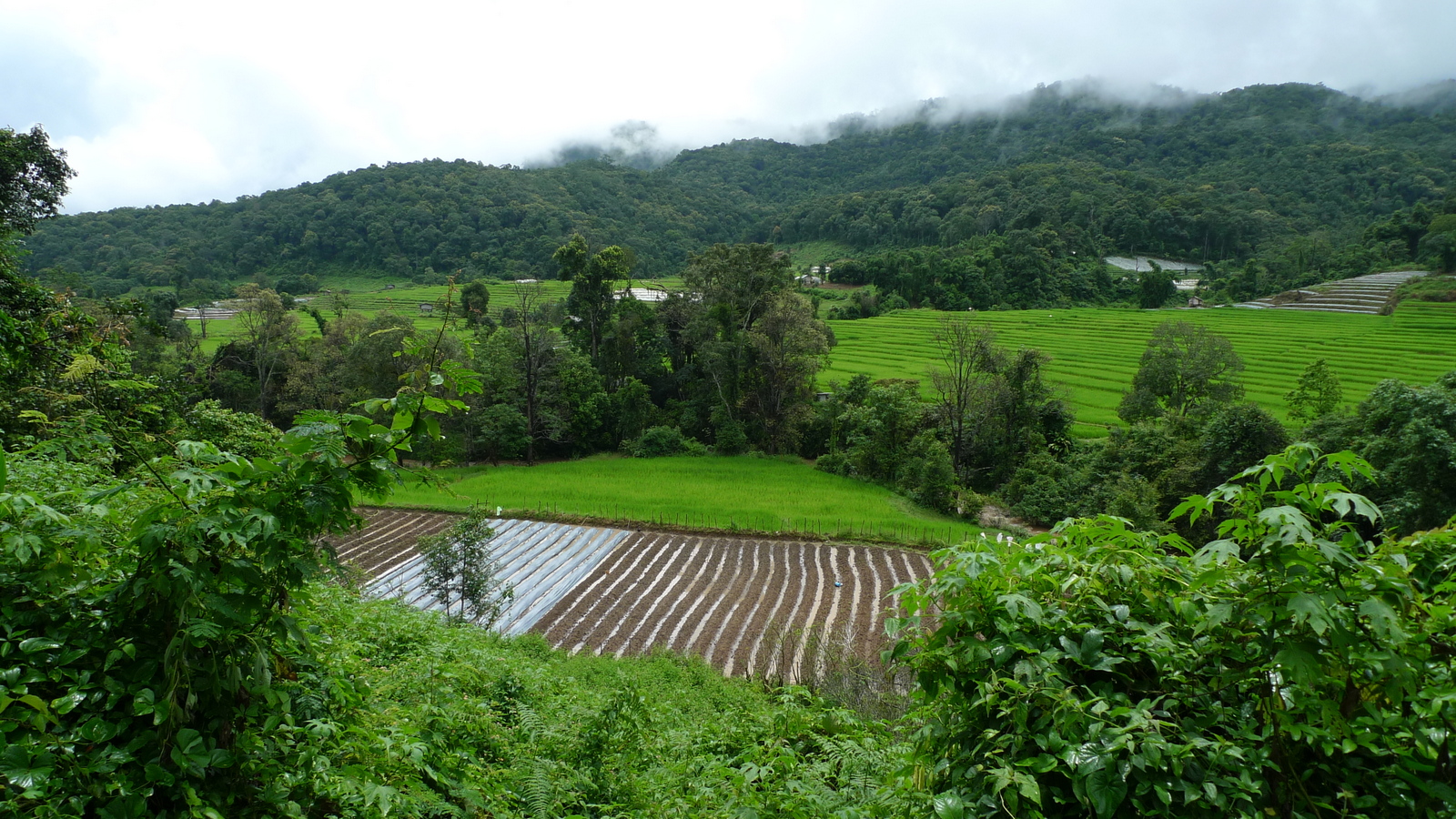
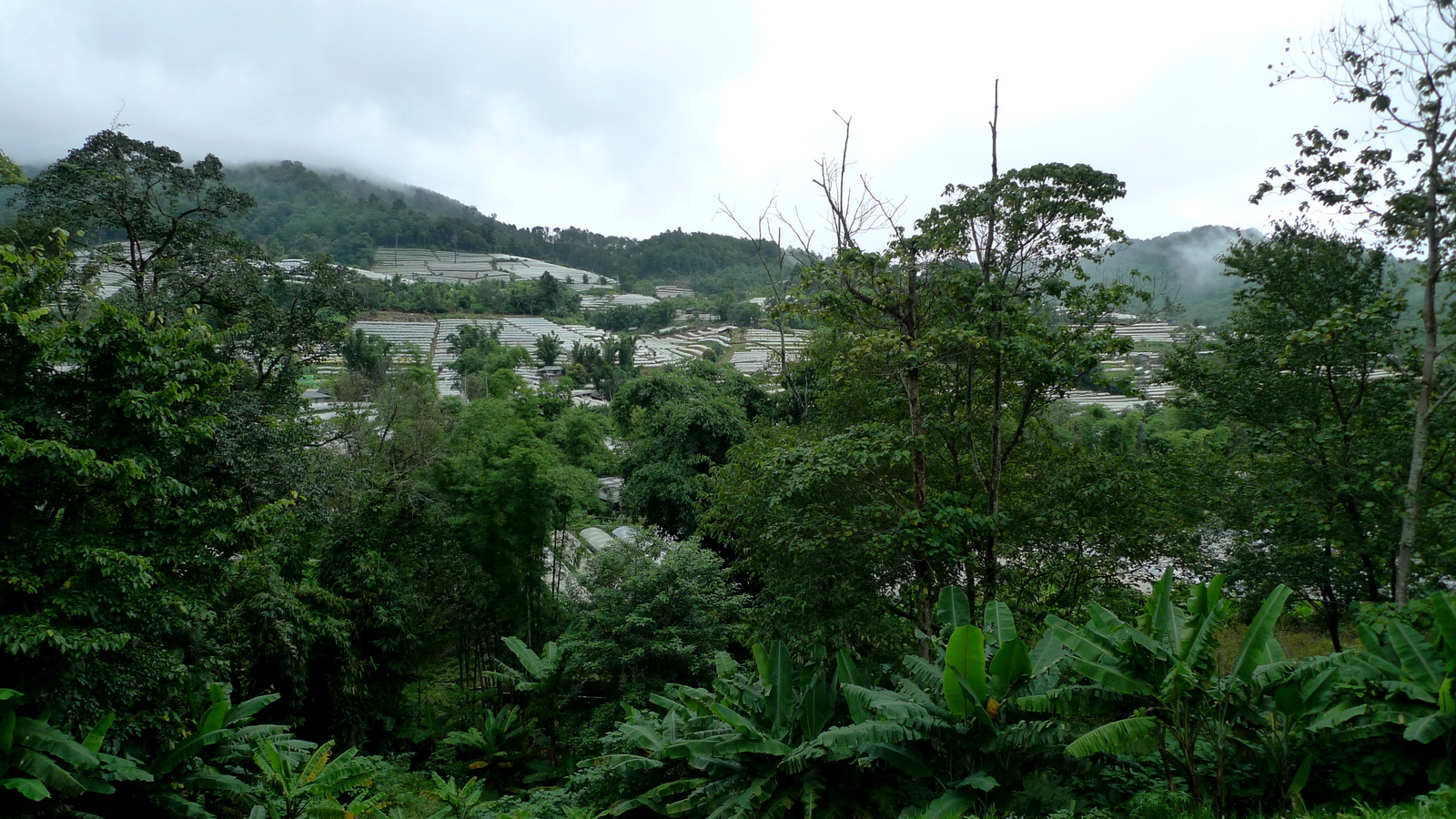
While up in Chiang Mai with visitors last week, I took several pictures that I want to share. It is the height of rainy season and the surrounding countryside was particularly verdant.
On the way up Doi Inthanon, Thailand’s highest mountain, we pulled over to snap this picture of rice paddies terraced in a small valley.
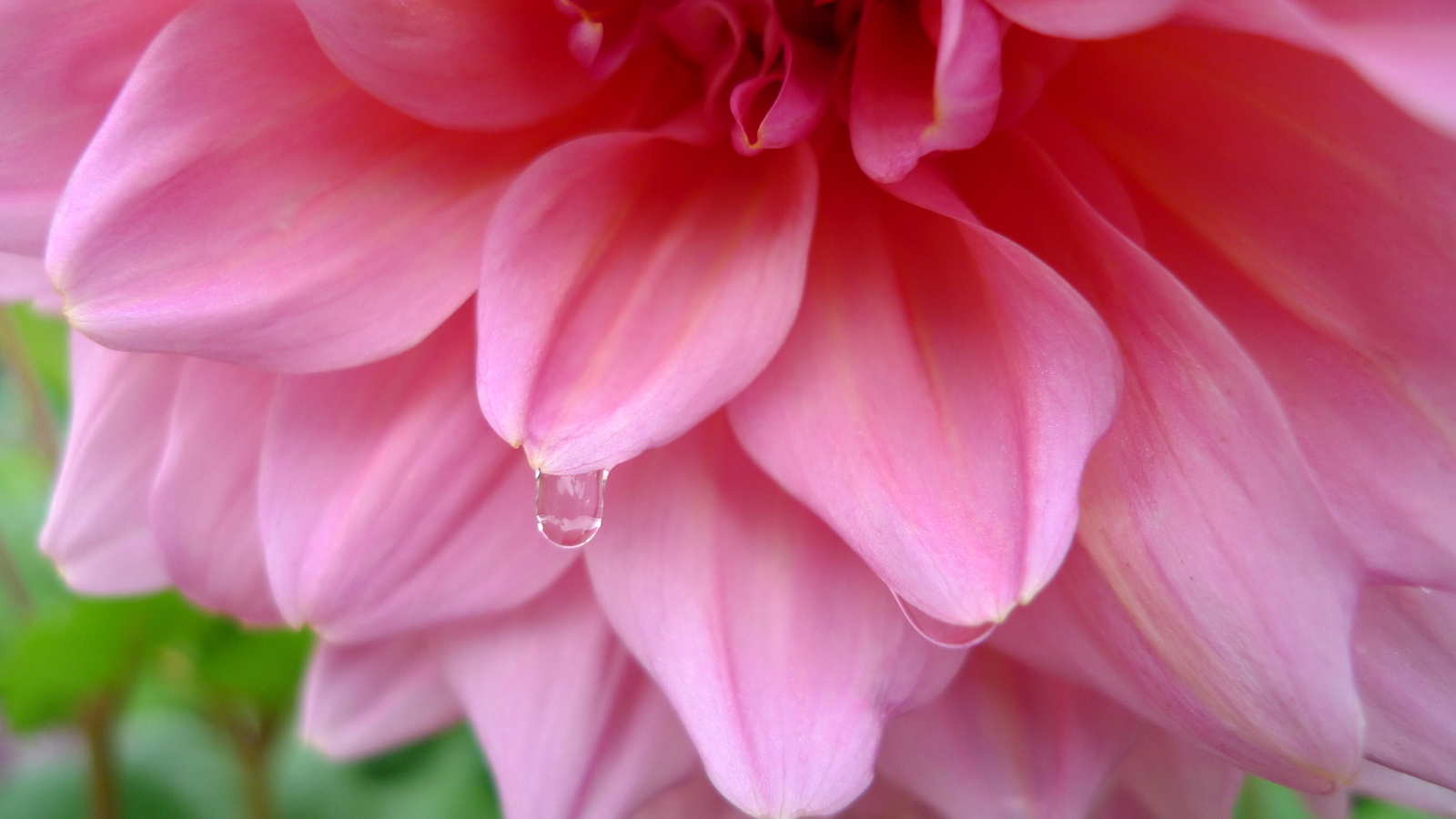
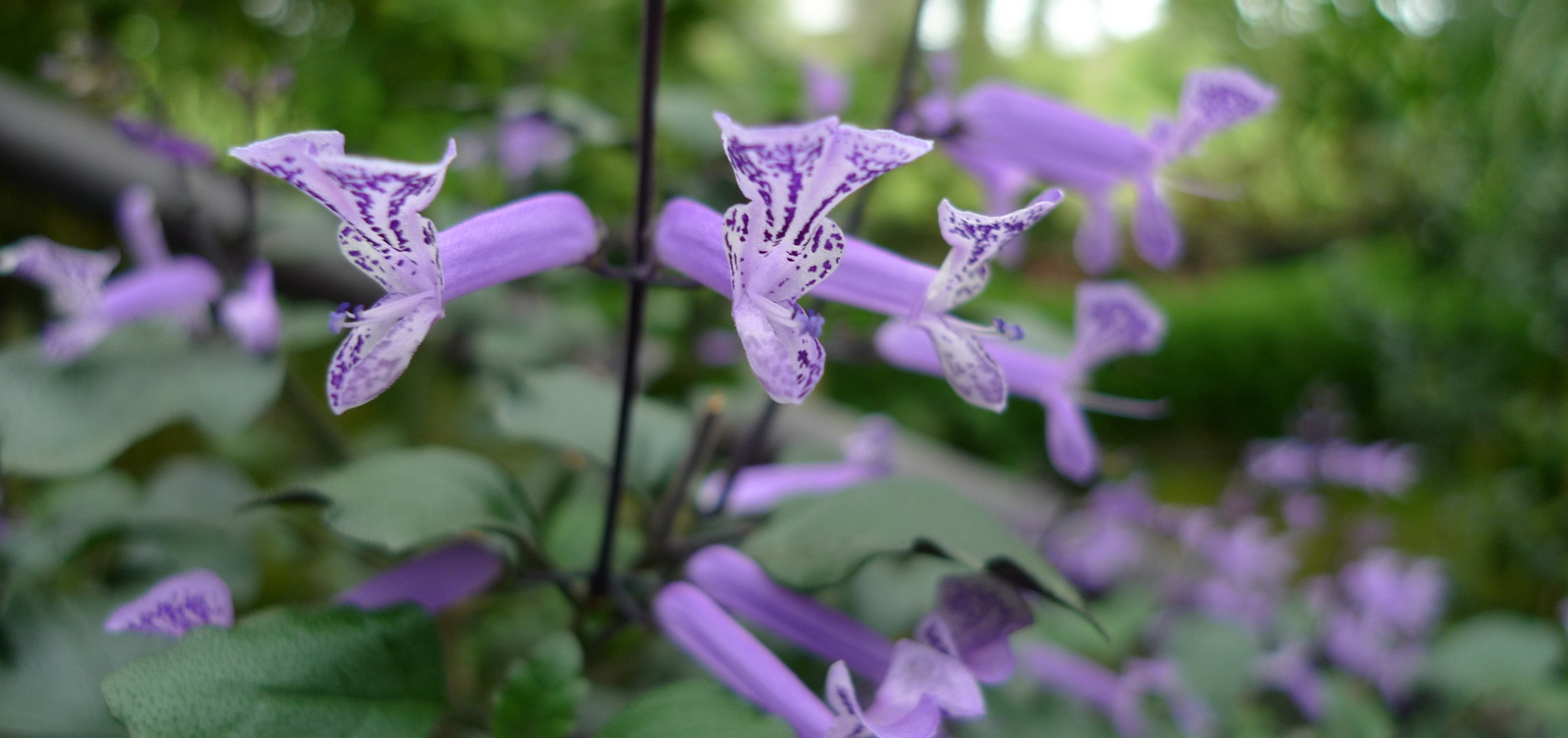
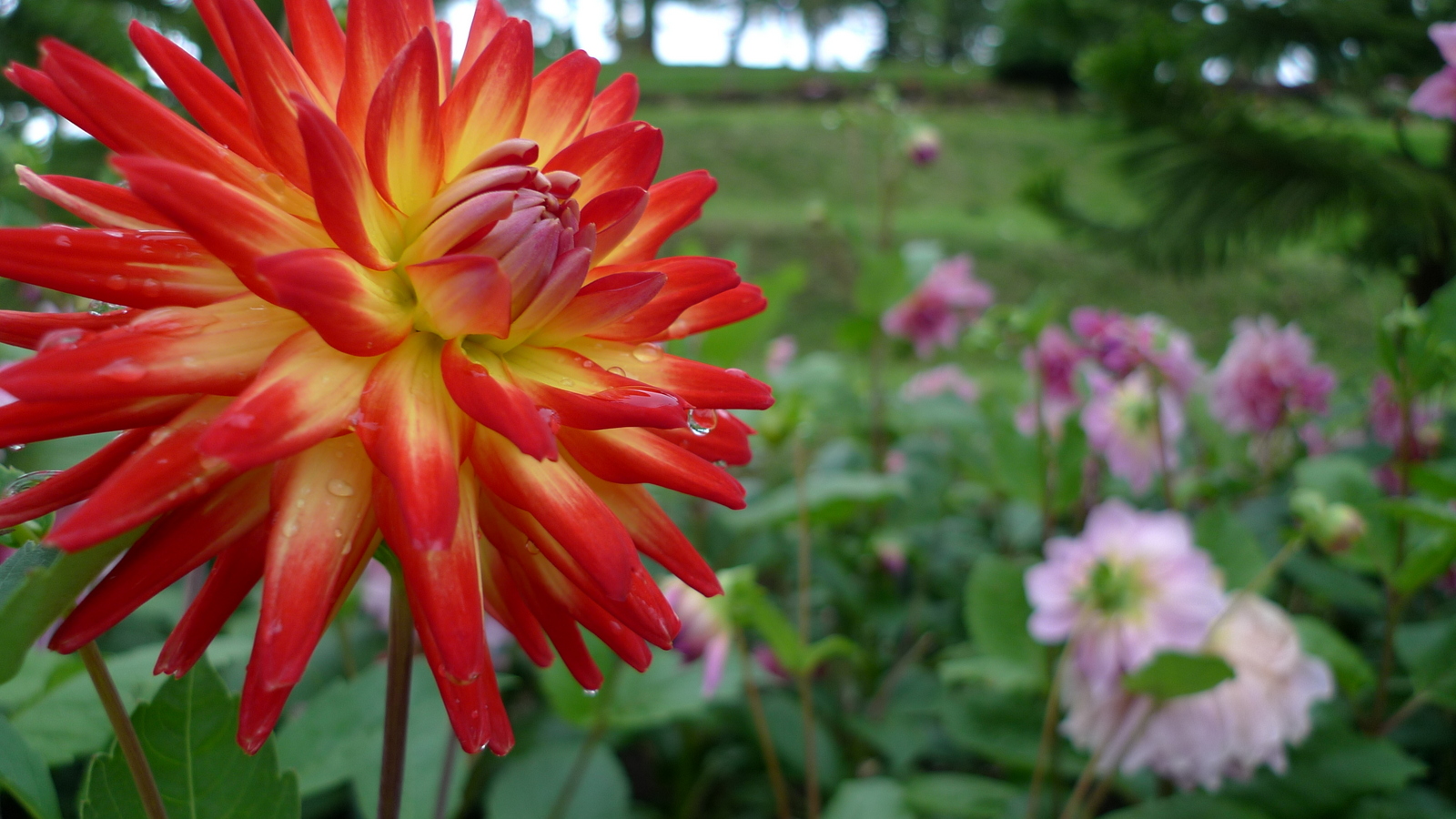
Further up the mountain, we visited the Royal Agricultural Project, which over the last few decades has helped local hill tribes transition from growing poppies (which were used to make heroin) to growing a wide variety of fruits, vegetables, and flowers. The higher elevation provides a climate suitable for select vegetables that could otherwise not be grown in Thailand. The pictures of flowers below are from the display gardens at the project.
By visiting during the weekdays of the rainiest month of the year, we enjoyed not only the beautiful flora but also the smallest crowds of tourists I have ever seen. In fact, “crowds” is not the correct term. “Handfuls” would be more apt.
We also visited Doi Suthep, the mountain immediately to the west of Chiang Mai, which houses a spectacular temple with a golden chedi, or stuppa. This is the second time I’ve visited the temple on an overcast and damp day. The effect is interesting because the gilding is not as bright as on a sunny day, but it contrasts beautifully with the grey skies. In the above picture, I focused on a row of bells the line the temple buildings. Bells are purchased with donations and the donors can write wishes or prayers on the metal leaf hanging from the clapper.
On our final afternoon, we drove north of Chiang Mai to the Four Seasons Resort to enjoy afternoon tea overlooking their property, which is designed to look like a rice farming village. I’ll share the pictures of the gorgeous tea service in another post but wanted to share this view of their pretty property.
This is the story of my first flight aboard the Boeing 787 Dreamliner, traveling on All-Nippon Airways (ANA) flight 1075 from San Jose, California to Narita airport in Tokyo, Japan. An 11-minute video version of this trip report is embedded here if you would prefer to watch instead of read.
The Dreamliner is a revolutionary wide-body aircraft. Made largely with composite materials, it is about 20% more fuel efficient than the older 767 aircraft it is designed to replace. Despite a four-month grounding earlier this year because of electrical problems, the aircraft has performed very well for its initial customers and is opening new “long and thin” routes like San Jose to Tokyo that could not previously have been served profitably.
I arrived at the airport plenty early to watch the inbound aircraft land, which arrived about twenty minutes late. Having grown up in the San Jose area and able to remember the days when the airport was a much smaller operation, it is exciting to see this cutting-edge plane regularly scheduled to fly here.
ANA operates from terminal A. Now nearly a quarter-century old, I still recall terminal A as the “new” terminal compared to the 1960s era terminal C that was only recently demolished. As a child, I relished the opportunity to walk across the tarmac and climb a set of stairs to board the airplane. To me, that made air travel much more exciting. These days, the two terminals at San Jose are modern and entirely enclosed. Certainly the facilities are nicer but the travel experience is also more sterile.
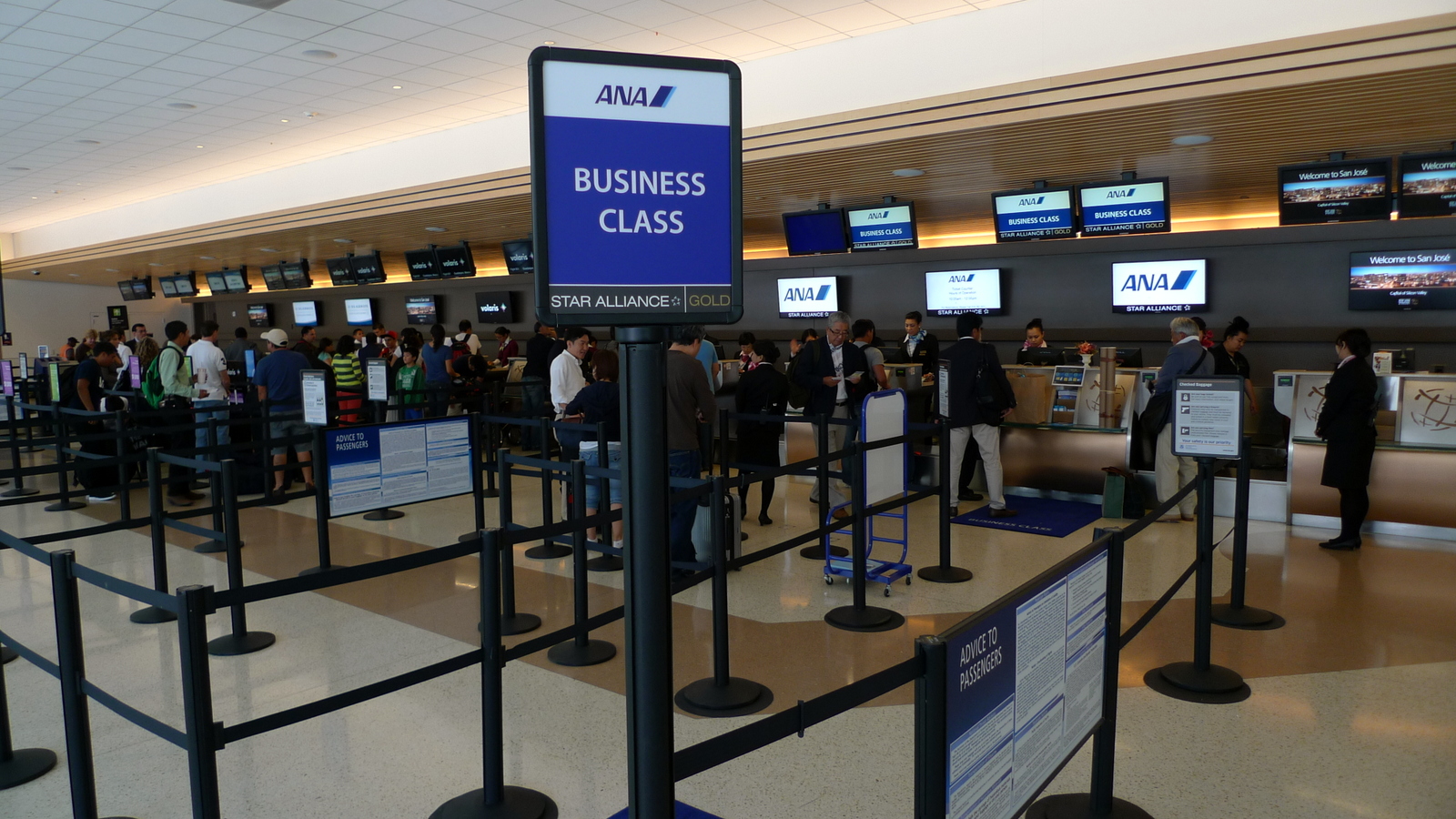
ANA has a small counter space but lots of employees working check-in. As a Star Alliance gold level member, there was no wait and I was efficiently checked in by a friendly agent. While the agent did not appear to be of Japanese heritage – several of the staff members were – she displayed all the appropriate cultural training such as receiving and handing documents with both hands. This was a nice touch and leads me to believe that instead of relying on contract employees, ANA is using its own staff.
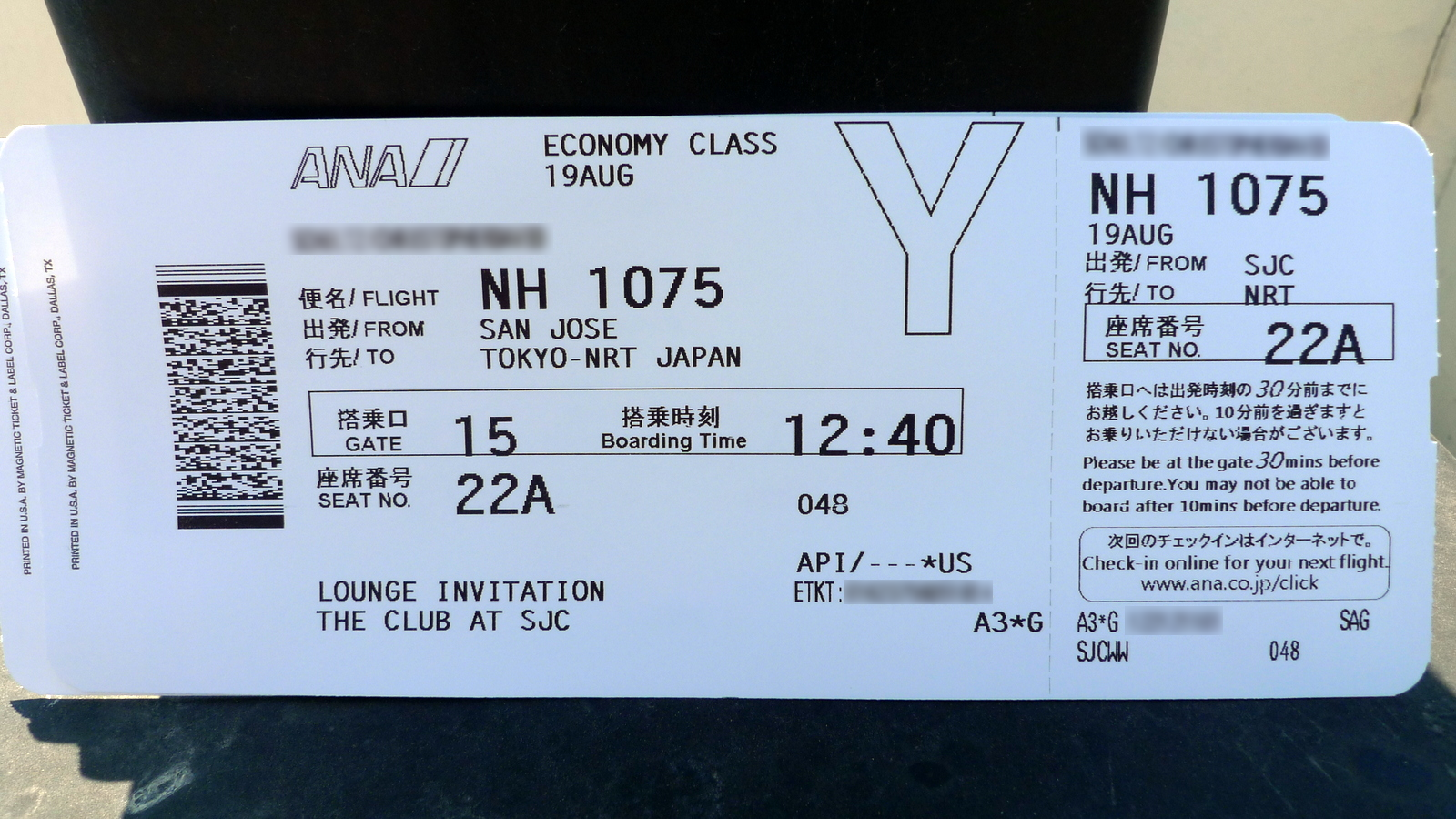
Boarding pass in hand – a window seat in the second row of economy class – I headed up the escalator to the security screening area. The terminal has a single consolidated screening point and while there weren’t that many people in line, the process took a bit of time. In particular, the crew of Mexican budget airline Volaris seemed to be holding up the line, unfamiliar with the TSA’s screening procedures. It took several of the flight attendants multiple trips through the metal detector before they finally removed all of their metal items.
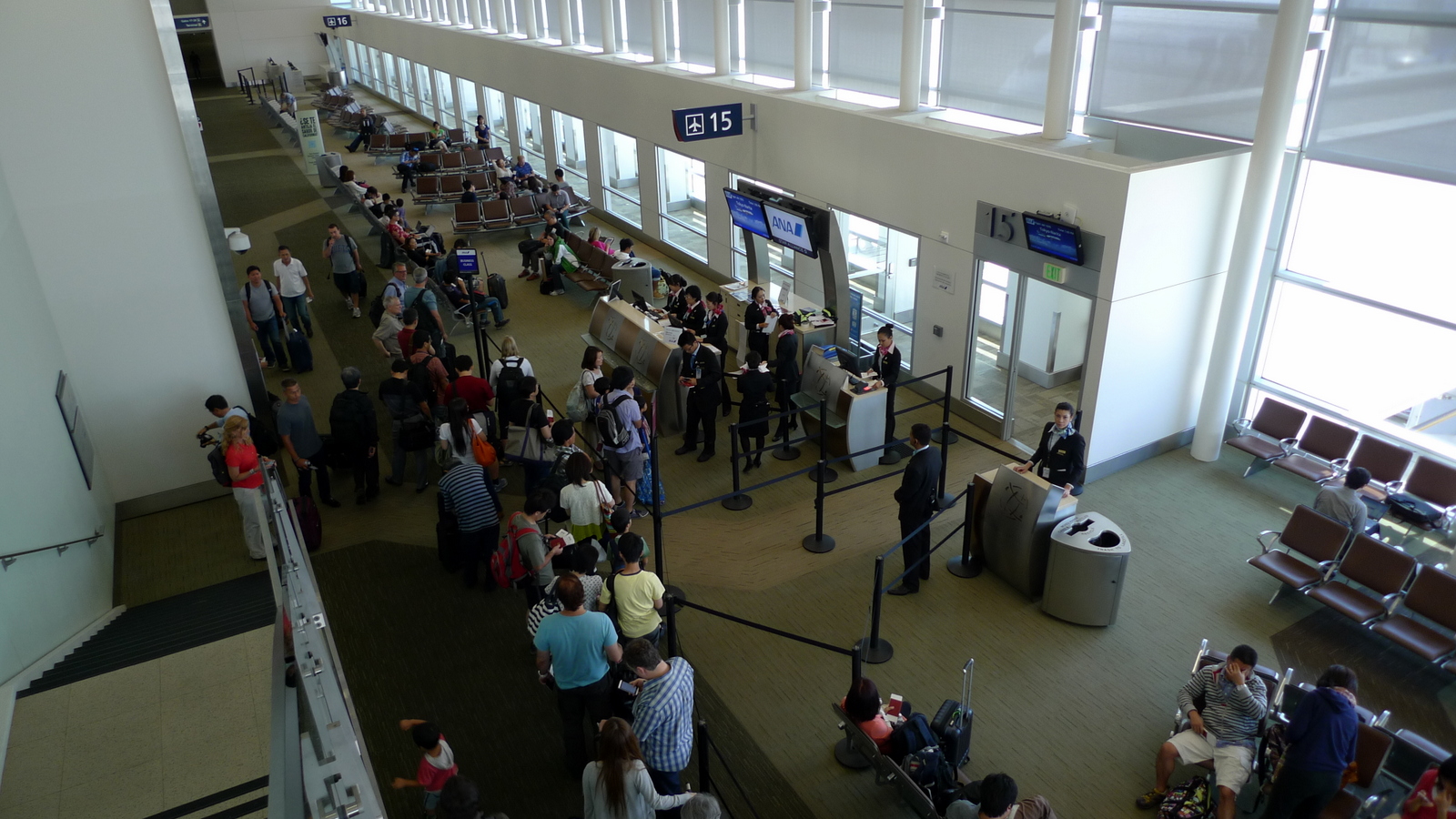
Today’s flight operated from gate 15, one of two gates connected to the International Arrivals Area. This section of the terminal is essentially the connector between terminals A and B. There are few amenities but the windows offer a good view of the tarmac. Unfortunately, the sterile corridor leading to the customs and immigration area means you look out through two sets of windows.
I spent plenty of time taking pictures of the Dreamliner. It is a unique-looking airplane, with an asymmetrical nose. The plane’s proportions make it looks smaller than it actually is, perhaps because it looks unusually low to the ground for so large an aircraft.
After taking plenty of pictures – something lots of other waiting passengers were also doing – I headed to The Club at SJC, a private lounge that ANA uses for its premium customers. The Club is the only lounge at SJC, where the only dominant airline is Southwest.
Located upstairs from the departure gate, the lounge offers limited views of the tarmac but has two large seating areas, workspaces, and a decent selection of food and beverage. They also have a single shower room, so I freshened up before the flight.
It was nearing time to board. ANA operates the San Jose service with a 787 in a very low density configuration, only 158 passengers in a plane that can easily seat more than 220. Because of this, the gate area was not crowded.
After the highest level members of ANA’s frequent flyer program were boarded, Star Alliance Gold members were invited. A single jetway is used at this gate but with so few passengers boarding, it isn’t a problem. I was welcomed aboard warmly and directed towards my seat.
Business class, divided into two cabins, seats 46 people in alternating rows of 1-1-1 and 1-2-1 seating. All seats have direct aisle access and a lot of privacy. The problem with this arrangement is that it isn’t very friendly for couples traveling together. I know that privacy is something that a lot of premium customers value highly, but I prefer arrangements that are a little less cubicle-like.
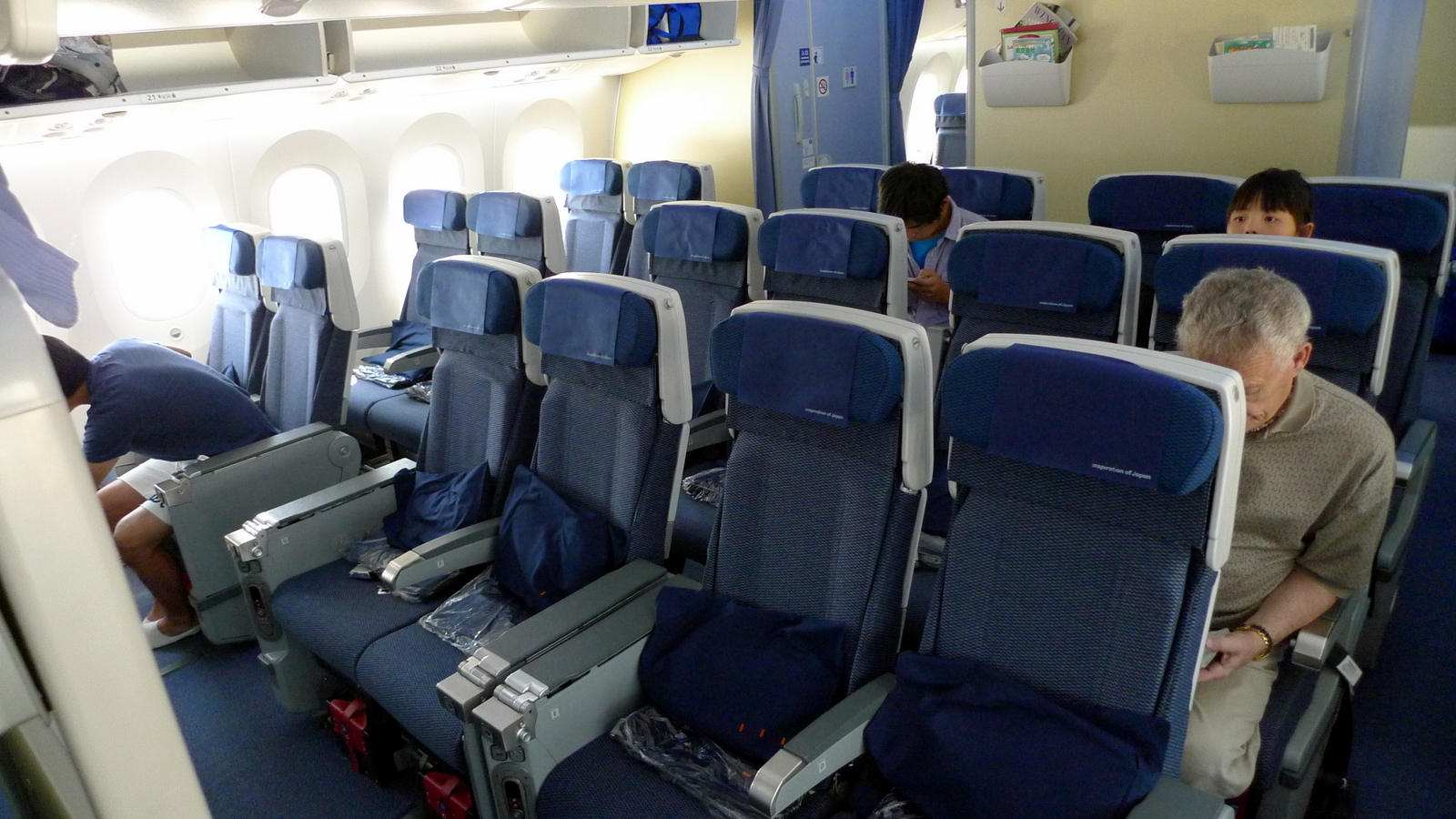
A small economy class cabin of just three rows sits behind business class and the mid-cabin lavatories. In another configuration, this area has premium economy seating with 38” legroom and only seven seats across. I can understand why they made that choice: there is nearly a foot of empty floor behind the last row in this cabin. Even without installing premium economy, they could have added a few more inches to each of these three rows.
The design of the overhead bins offers plenty of room to store roll-aboard bags placed on their side. The bins also pivot into the ceiling, making for a very open cabin when they are closed. This being a low-density seating configuration, lots of storage space remained even after everyone had boarded.
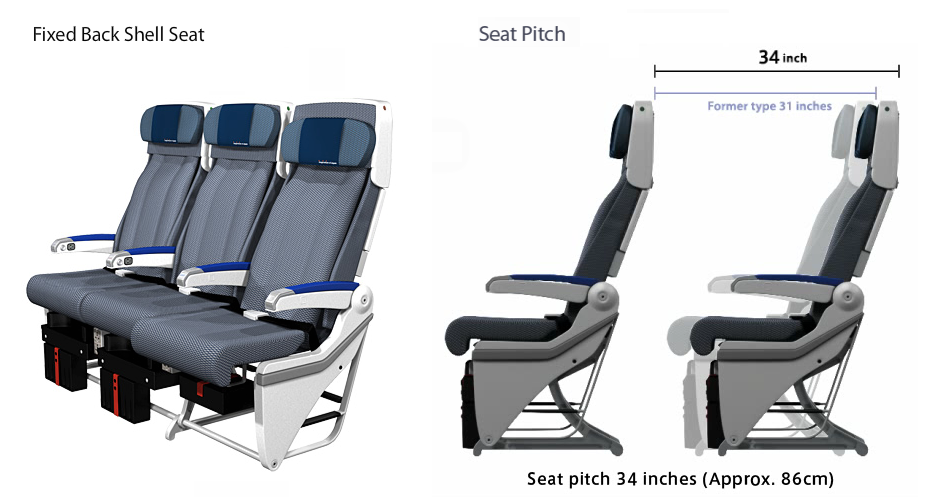
ANA uses fixed-shell seats in economy, where instead of reclining back into the row behind you, your seat slides forward. I like this arrangement because my personal space remains fixed. With 33 to 34 inches of seat pitch, ANA’s Dreamliner offers several more inches of legroom than most competitors including joint-venture partner United Airlines. My one complaint with these seats is that the headrest doesn’t move up and down and, perhaps because it is designed for Japanese customers, it manages to fall at my neck rather than the back of my head.
The inflight entertainment system is an “on-demand” system with touch screen controls. The selection of movies, TV shows, games, and music is extensive – plenty to keep you occupied on your flight. The system was also one of the more responsive that I have used. When you touch the screen, it reacts promptly. The overhead passenger service unit features a new design and it was nice to be on a wide-body airplane with personal air vents.
Boarding was complete in about fifteen minutes and soon enough we had pushed back and the safety demo was finished. As the engines spooled up – a higher pitch whine than I’ve heard before – the ANA ground staff lined up to send us off with a wave. Being a small airport, we reached the departure end of runway 30 R in just a few minutes. Number one for takeoff, we pulled onto the runway and launched into our roll without a stop.
Our departure followed an interesting path, indicated in green on the map. We leveled off at 5,000 feet and maintained that altitude across the south end of the bay, towards Woodside.
Meanwhile, aircraft were circling wide on our left (yellow on the map), cutting behind us to line up for arrival on runways 28 L and R at San Francisco. While I am confident the air traffic controllers were keeping a close watch on us, the other aircraft came a lot closer than you usually see from your window. It was nice to have such a good view! As we approached Half Moon Bay, we resumed our climb, joining the westbound route across the Pacific.
About forty minutes after departure, inflight service began with hot towels – real cloth towels – followed by a beverage service with snacks.
The snacks were simple – rice crackers – and the selection of beverages included complimentary wine, beer, and spirits. The crew was friendly and helpful and there were no difficulties in communicating with them in English.
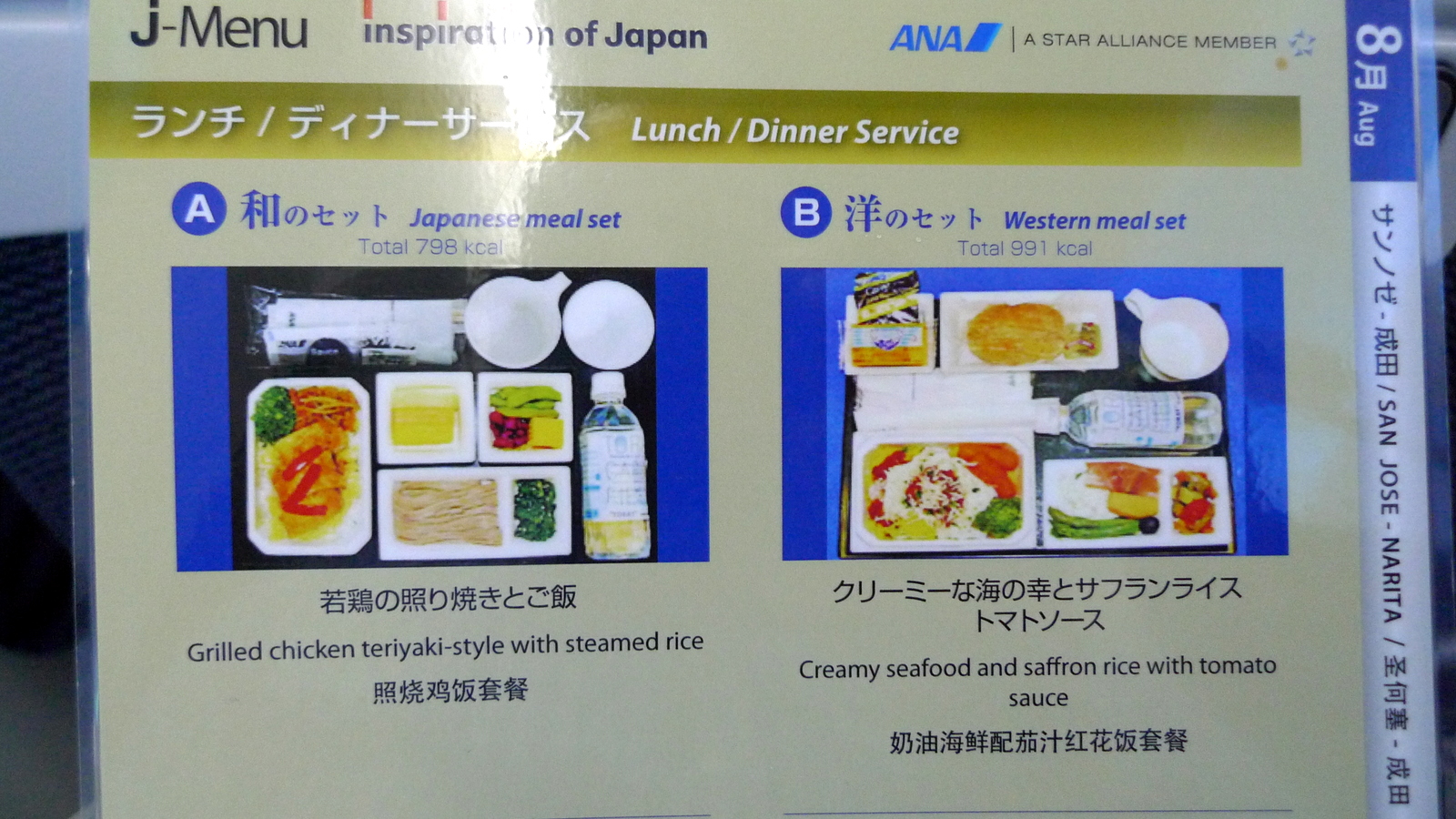
An in-seat menu card described the general service while the specific meal choices for today’s flight could be read on the inflight entertainment system and also on laminated cards the flight attendants had on their carts.
For dinner, I chose the Japanese option – a chicken teriyaki dish served with cold soba – buckwheat noodles. The portion was generous and the food was tasty. The dinner also included miso soup served from a pitcher.
Afterwards, flight attendants distributed Häagen-Dazs ice cream – a simple and satisfying dessert. Since the meal was served with metal cutlery, I could use an actual spoon to scoop the rock-hard ice cream instead of the flimsy plastic one contained inside the ice cream container’s lid.
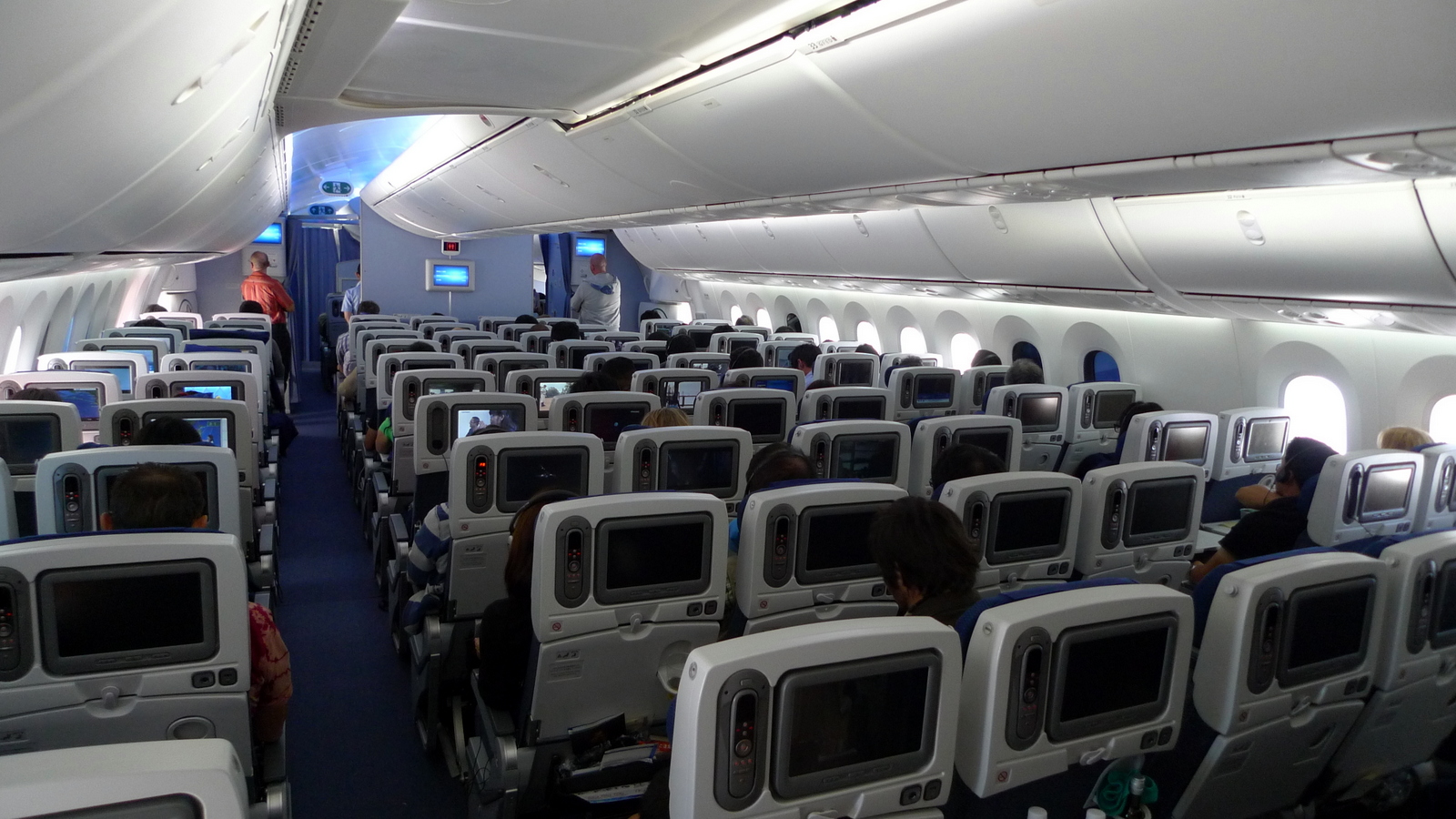
After lunch, I walked around the mostly-full cabin. You can see the windows, which are about thirty percent larger than conventional airplane windows. Truthfully, this didn’t make as big an impression on me as I thought they would. Sure, the windows were large, but the biggest effect was that it made the cabin look narrower. I’m not sure if that makes sense, but because I am used to a standard-size window, as I looked across the width of the cabin and mentally estimated the width, the wall looked closer to me than it really was. Instead of shades, the windows use LCD controls for different levels of shading. Above, you can see two of the windows at the maximum-dark setting.
The rear cabin has eleven additional rows of economy class seats. As you can see, the cabin has a spacious feel and the 2-4-2 arrangement is quite pleasant. Unfortunately, ANA is moving towards a 3-3-3 arrangement like most operators so the comfortably wide seats will be a thing of the past. I can understand the economics but will say that as a customer, I will go out of my way to fly an 8-abreast 787 instead of a 9-abreast configuration.
The other thing I noticed is that the screens on the entertainment system are coated in such a way that they are not visible unless viewed almost straight-on. For example, I couldn’t tell if the person seated next to me had his screen on until I leaned over to look. This would seem to be a good thing, minimizing extraneous light and also giving greater (although not complete) privacy in what you are viewing.
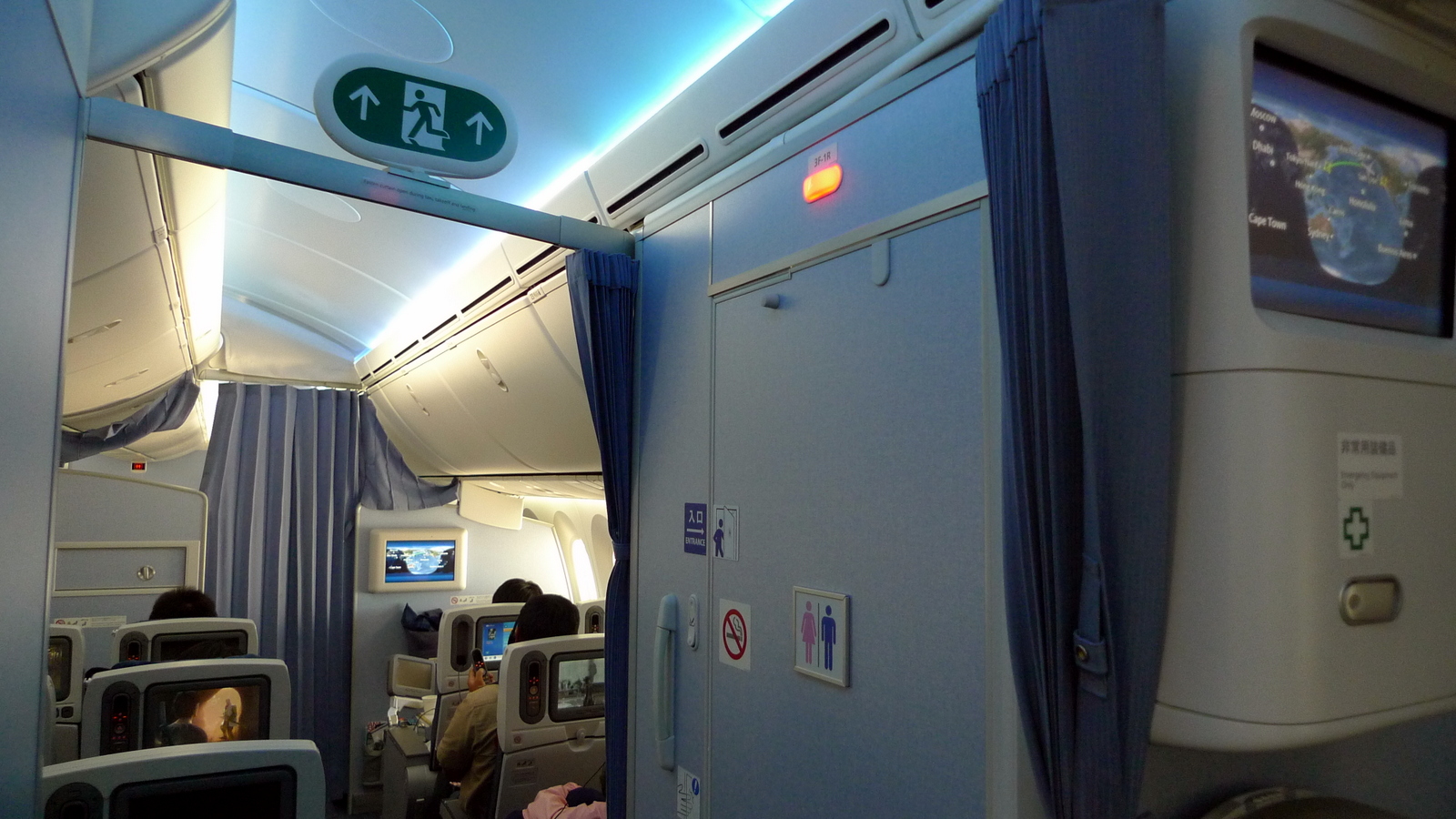
The galley and entrance to the crew rest area are at the rear of the cabin. This arrangement is nice because it gives the crew plenty of space to work and minimizes the number of passengers congregating in this area. Instead, the congregate mid-cabin by the lavatories.
Three lavatories are in the middle of the economy class cabin, located by doors 3 left and 3 right. I didn’t get a picture or video of them, but the doors are hinged in an interesting way. Instead of pivoting on a hinge at one side of the door or folding in half, the door slides and pivots into the toilet, lying flat against the side wall. This improves the accessibility of the lavatory although isn’t intuitive. I noticed several people pushing and pulling the door before they figured out how it moved.
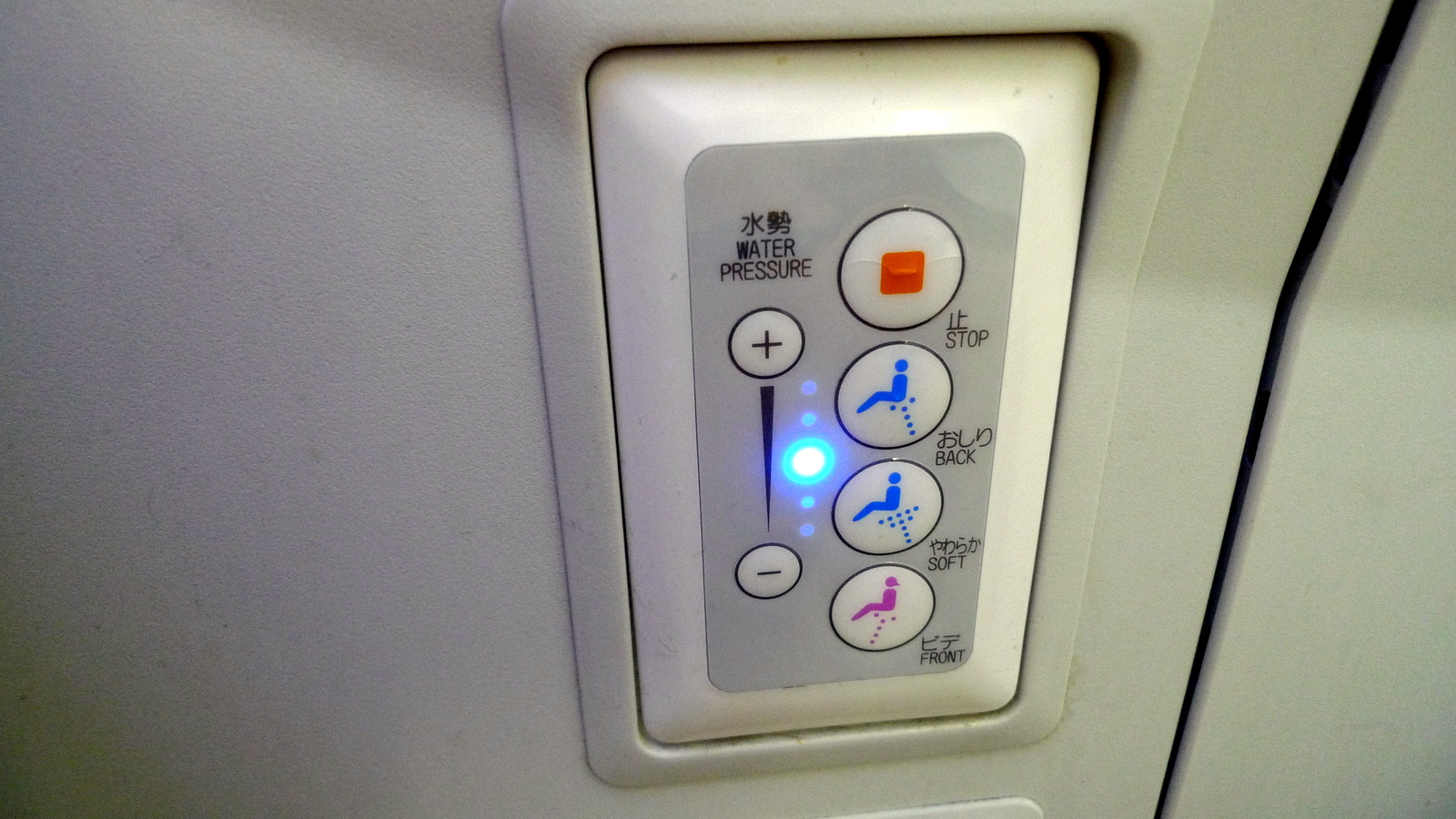
The lavatories are high-tech on ANA featuring lots of buttons, including for the automated bidet, in case you need to wash your bum afterwards. When you press the flush button, the toilet seat cover is automatically lowered. Oddly, though, the flush happens while the cover is still lowering. Lavatories were kept clean with flight attendants tidying them throughout the flight.
The LCD shading for the windows is interesting. Instead of having physical shades that you pull shut, there are two buttons that allow you to increase the tinting along five settings from nearly transparent to nearly opaque. It seems that the most transparent setting still seems to have a light tint to it, or at least that was my impression.
At its darkest, you can still see through the window although little light passes through. That may not make sense when I write it, but when you look at the windows from the side, they appear to be completely opaque. When you look at the windows straight-on, you can see through them as if they were very dark sunglasses. Mid-flight, which was still full daylight outside, the cabin was dark although not as dark as with physical window shades. If I’m not mistaken, I think the flight attendants were able to master set the windows to the darkest setting although individual passengers could modify the settings for their own windows, making them more transparent as they wished.
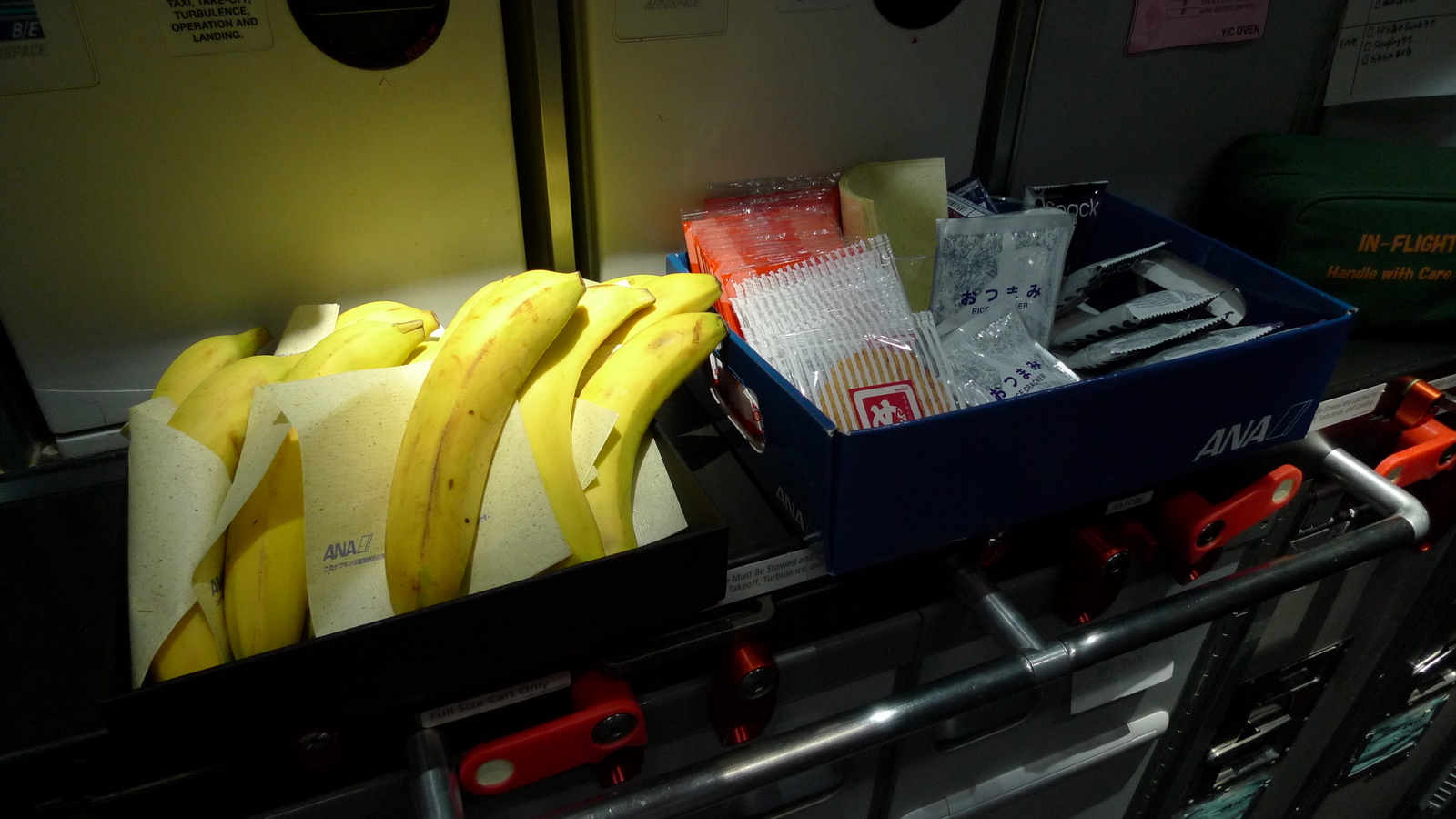
Snacks and beverages were available in the galley throughout the flight. The selection was basic – some crisps and crackers along with bananas.
About two and a half hours before landing – just a little early, in my estimation – a second meal service was offered. Unlike lunch/dinner, which had clear “Japanese” and “Western” options, the choices for the breakfast were less distinct.
I had the chicken cacciatore, which was pretty tasty. The portion size was smaller than the previous meal, but considering that we had eaten just five hours ago, that was okay.
One feature of the Dreamliner is that its cabin is pressurized to the equivalent of a 6000 foot elevation instead of at 8000 feet, as found in most airliners. Also, humidity levels are slightly higher, about 15% versus less than 5% normally. My impression was that the cabin was a bit more comfortable than normal. I travel frequently across the Pacific and find I get very dried out. The effect could just be psychological but on this flight, I felt less dehydrated.
The rest of the flight was smooth as we descended into an overcast northern Japan and landed on-time in Narita. As we approached the airport, there was a lot of other traffic and on our turns there was always a good view of other planes. The rice paddies were also vibrant green and just starting to turn golden yellow.
Again, thanks to the low-density configuration, it took just a few minutes to deplane. My nine hour, forty-five minute flight aboard the ANA Dreamliner left me with a positive impression of both the airplane and the airline.
All things considered, I would go out of my way to fly ANA in general and the Dreamliner in particular on future trips. Additionally, flying out of San Jose was a very convenient option so I will keep that in mind for future trips to and from the Bay Area.
Tuesday evening, I returned to Bangkok after a twelve-day trip to the United States to renew my Thai visa. This trip, like ever other trip I make by myself, always finds me a bit awash in melancholy. This time, the waves came while eating noodles in the lounge at Narita Airport in Tokyo.
I have been traveling by air since I was a month old. Over the years, I have come to associate air travel with so many things: adventure, family, friends, romance, and escape. On each trip, the moment comes when I feel like I am in transit, literally suspended between points in my life. The idea that I am part of a larger network, knowing friends and family around the globe, excites me. At the same time, I feel disconnected and not at home anywhere in particular.
It is an interesting sensation and one that, the more I experience it, the more inviting it becomes. Maybe there is a point where I cease to be grounded at all and am forever flitting about the globe.
A fourteen hour layover in Seattle was my first stop in the United States. Arriving about 9:30 in the morning, I took the convenient light rail into downtown and conducted my most important business: drawing a money order and then mailing it, and my inch-thick Thailand visa application, to the Thai consulate. After a long wait, a surprisingly helpful postal employee walked me through the steps of buying the money order, properly addressing the express mail envelopes, and then packing everything correctly.
After a browse around the Pike Place Public Market and lunch at a cute French restaurant nearby, I visited the Seattle Art Museum to see “Future Beauty: 30 Years of Japanese Fashion“. This exhibit, which runs through Labor Day weekend, has more than 100 dresses from Japanese designers such as Issey Miyake, Kenzo Takada, and Rei Kawakubo. These designers revolutionized the way we think of fashion. I only wish Tawn could have attended the exhibit, which he would have found fascinating.
In the afternoon, I went to my aunt and uncle’s house and spent time with them and my cousins. Their daughter is about a year old and I last saw her in March at my grandparents’ 75th wedding anniversary, so it was nice to see how much she has grown since then. My uncle prepared some excellent wild salmon on the grill, so I was well-fed.
My red eye flight departed Seattle about midnight, heading east to a rainy Cleveland. A two-hour connection allowed me time for breakfast and a shoe shine before I caught my flight into Kansas City.
The next several days in Kansas City were spent visiting family members, attending football (soccer) games and gymnastics lessons, and the like. Four and a half days was enough time to see everyone, catch up, and then move one before wearing out my welcome. Unfortunately, no time for a side trip to Omaha or Quincy, though.
Last Thursday I made a last-minute trip back to the United States to renew my Thai visa. Searching online, I was able to find a combination of dates and routes that were reasonably affordable.
The trip was booked on United Airlines through Tokyo. While I consider most Asian airlines to be a better experience than US-based airlines, I have to say that United’s revamped economy class product was acceptable, better than it used to be. Sadly, their Boeing 747s have not had the revamp. The Boeing 777 fleet, though, has audio-video on-demand and power outlets at every set of seats. The flight attendants are still kind of surly, though.
In Tokyo, I was joined by a group of thirty or so Korean primary school children on their way to a Tae Kwan Do competition in San Francisco. One of the group, 11-year old Jun, was seated between me on the aisle and another guy in the window seat. It made for an interesting flight. He was more outgoing than I would expect, talking with both of us throughout the flight and asking lots of questions. Even when I put on my eye shades and tried to sleep.
My fellow traveler and I looked out for Jun, getting snacks for him from the galley and sharing some snacks we had brought on board. An interesting thing that I assume is a cultural trait, when I offered him some granola bars that I had just opened, he declined to break off a section for himself. Instead, I figured out that he was waiting for me to break off a piece and offer it to him. He then broke a piece from that one and offered it to the guy sitting in the window seat.
After about seven hours of flying, awake the whole time, Jun’s energy ran out and he crashed hard asleep. Contorted in his seat in a strange position, I managed to wake him up for the second meal service since he had complained of being hungry. He was so bleary he could scarcely decide what entree to eat. He fell back asleep and didn’t wake up until we pulled into the gate and I shook his shoulder. Poor kid – hope he didn’t have to complete the following day!
I will be in the United States for ten days. Have already gathered some good food pictures and will share them in the next few days.
Since our guests are adventurous, outdoorsy sorts, I arranged for a half-day bicycle tour of the “Bangkok Jungle” through Spiceroads. Located just across the river from the Khlong Toei district (which includes the part of Sukhumvit Road that I live in), this jungle is just that – an isolated and undeveloped section of the larger metropolitan area. Joining us were a pair of expats, one American and the other British, who I know.
The reason that Phra Pradaeng, the green patch nearly encircled by the Chao Phraya River, has avoided development is that it is actually part of Samut Prakan province instead of Bangkok. Zoning laws were enacted to limit development in this section of the province. The area is often referred to as the “lungs of Bangkok” and includes a large public park.
Our starting point for the tour was a restaurant near the Thong Lo BTS Skytrain station. We rode through a little bit of city traffic, although mostly on back sois (alleys), and then through the slum area of Khlong Toei down near the port. Finally, we boarded a long-tail boat and left the city behind.
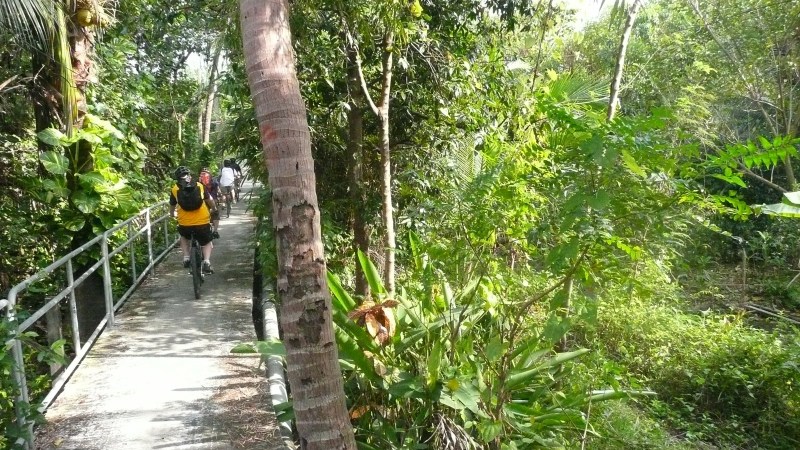
On the other side of the river, any sign of the hustle and bustle of the nation’s capital quickly melted away as we rode along small roads and elevated concrete paths through banana, coconut, and lychee plantations. Except for the occasional view of a skyscraper peeking over the horizon, you could easily forget where you were.
We had time for several breaks, seeing some of the local sites (which are limited), feeding the fish in the park, and trying a Thai snack of sticky rice and starchy bananas steamed in banana leaf.
Back at the pier as we waited for our boat, some local children swam in the edge of the river, showing off for us by performing ever more daring stunts. Here, a double flip into murky waters.
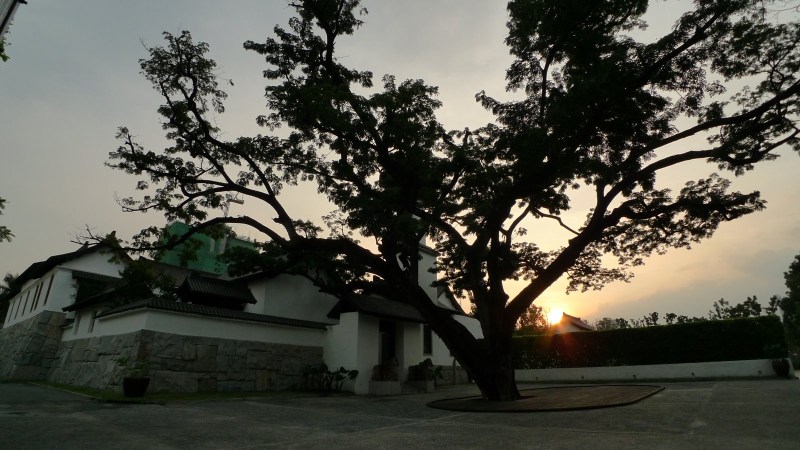
Back near our starting point, I peeked in the front gate of a complex that is usually closed. I don’t know what it is, but it looks almost like a shinto temple. Very beautiful.
Continuing the Curry Puffy Cuisine Crawl, Tawn and I headed out to Central one morning to retrace Gary’s secondary school breakfast steps, on the hunt for Hong Kong milk tea. Our destination this morning was Lan Fong Yuen, ostensibly (but unverifiably) the place where milk tea was first created.
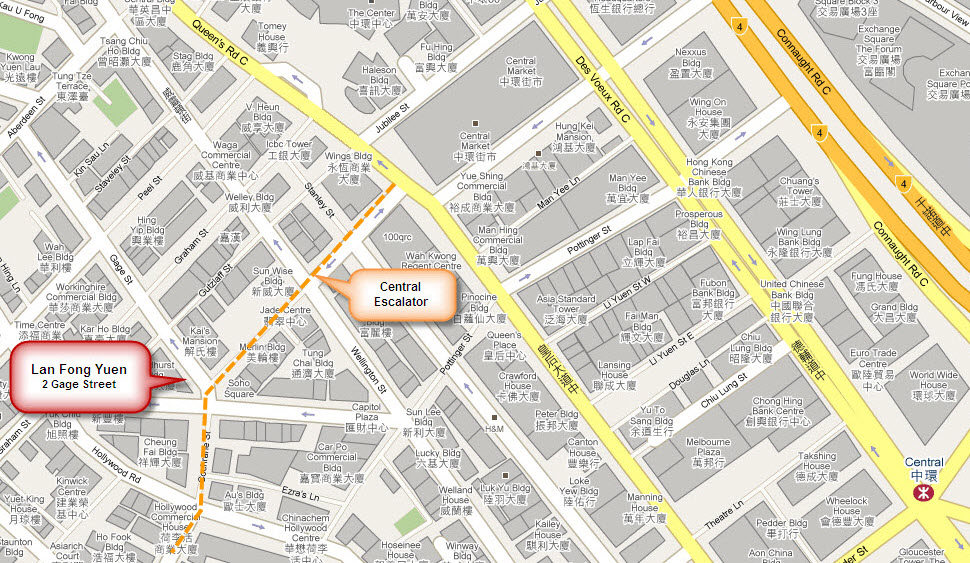
Located on the north side of Hong Kong Island, Central is the business district. Immediately to the south of it is the 1800-foot Victoria Peak. The rapid elevation gain combined with the population density creates an interesting warren of narrow streets that are great for exploring. The Central Escalator, a public conveyance system that combines moving sidewalks and escalators, makes it easier for pedestrians to go from Central to the Mid-Levels, a popular residential and, increasingly, commercial area part way up the mountain.
The Central Escalator bisects Gage Street right where it meets Wellington and right below it sits Lan Fong Yuen. The original shop (there’s a second one a few doors down) still has a pair of wooden stools out front on which you can sit and enjoy your milk tea and a light meal. The picture above shows the Central Escalator in the top left of the picture. The red taxi is on Wellington Street.
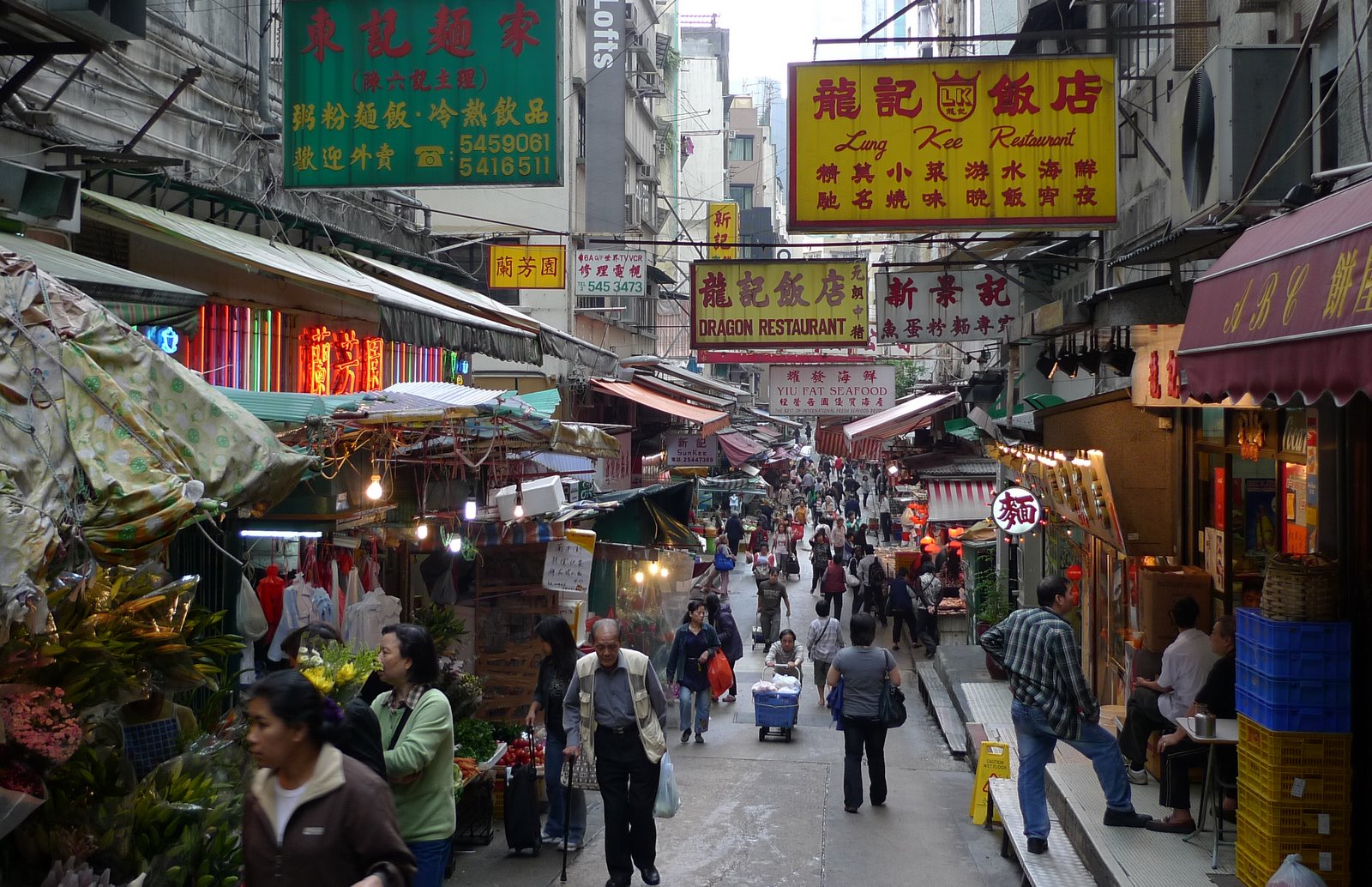
Looking down Gage Street from Wellington, you can hardly resist the urge to go explore. It is a lively street with vibrant sights, well worth a post-tea stroll. But before strolling, it is time for tea.
The interior is clean but dingy, looking just like a hundred other similar restaurants that have been around for ages. The staff is friendly and a picture menu makes it easy for those who don’t speak Chinese to order. Tawn, being part Chinese, gets spoken to in Cantonese everywhere we go in Hong Kong. He’s much too polite, of course, to tell them that he doesn’t understand, so just smiles and nods, occasionally responding in Thai or English.
This is the milk tea. Not much to look at, right? This is the essence of simplicity. It is a very strong black tea cut with evaporated milk. The flavor of it is almost coffee-like, in terms of the richness of the tea. It isn’t your grandmother’s Lipton.
The tea is made using pantyhose – the leaves steep inside a pantyhose strainer set in a metal pot. The pantyhose is attached to a wire handle and it is lifted up and the tea is allowed to drain into the cup. Worth noting, this is the exact same technique used by street vendors in Thailand for making Thai coffee and Thai tea. (Note to self – that’s a future entry needing to be written.)
Lan Fong Yuen is an all-day operations offering the tea along with a dozen snacky type dishes to satisfy your hunger.
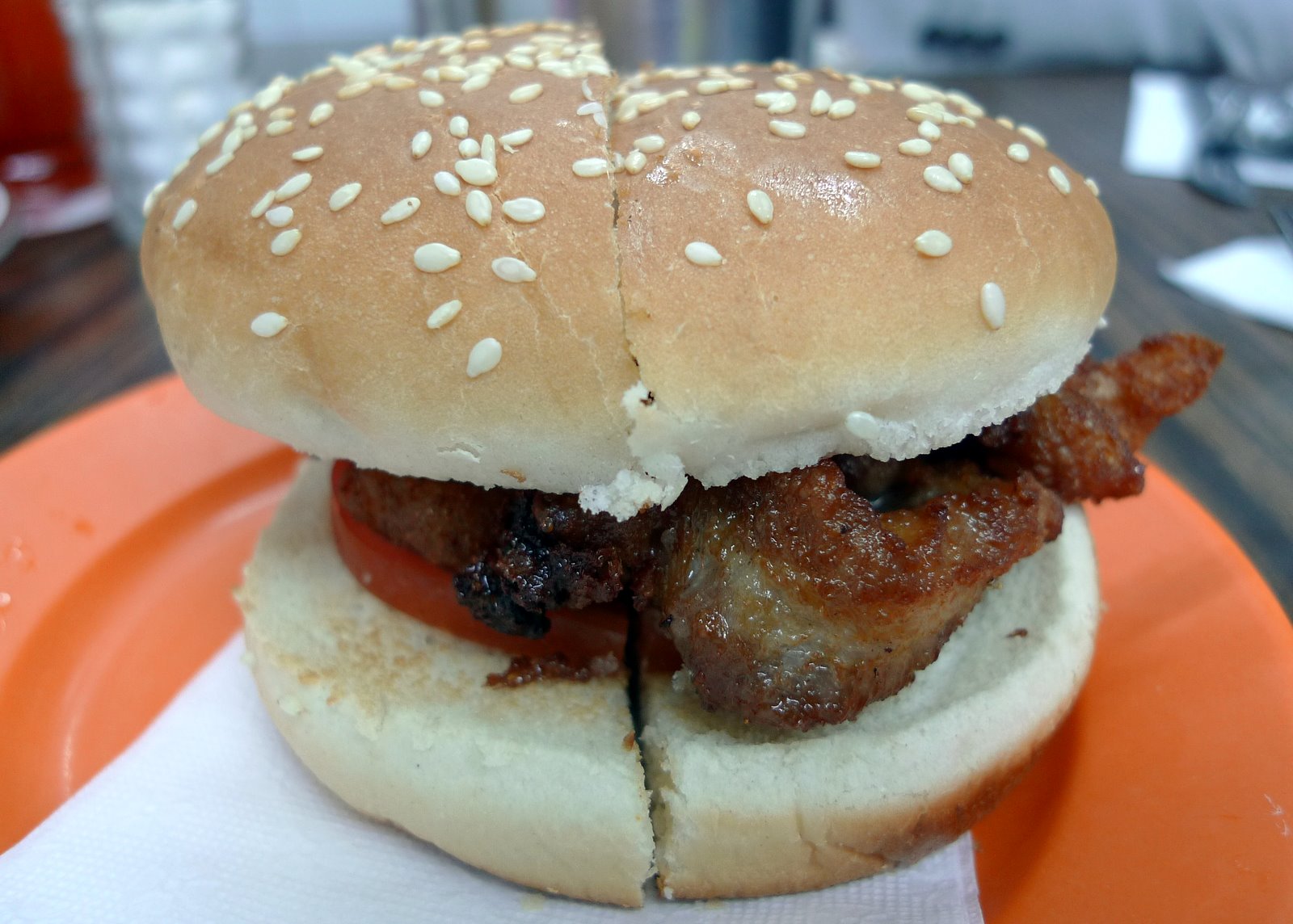
The fried pork sandwich, a single piece of fried pork loin put on a hamburger bun with a slice of tomato and a slather of sauce. Incredibly simple, but very tasty. While at first glance you might think it is tremendously unhealthy, consider that the alternatives offered at fast food restaurants have been heavily processed with added fillers, salts, etc. This is just a slab of pork with some salt and pepper, fried up and placed on the bun. Relatively speaking, better for you than a filet-o-fish.
Probably a little less healthy for you is the French toast.
Two pieces of white bread stuffed with jam inside, battered with egg and then fried in lots of oil. I couldn’t identify whether it was butter or margarine on top and was tempted to think it was the latter. This was tasty but after two bites was a bit overwhelming. Probably best when trying to mop up a hangover.
Tawn ordered one of his childhood favorites – this is what qualifies as Chinese comfort food, it seems. A plate of noodles with some veggies and fried chicken on top. I looked at the noodles and remarked how much they looked like instant ramen. Which was the point at which I learned that they are instant ramen.
So what’s the verdict? Pretty tasty tea and the chicken and pork were both good. There were several other menu items we wanted to try but we had lunch plans just two hours later and needed some room for that. The French toast was fine but was pretty oily, all things considered. For a quick breakfast or a spot of afternoon tea, though, Lan Fong Yuen is definitely on the list!
The first night in Phuket we drove 30 km to Phuket Town, located on the south end of the island, to enjoy a fantastic dinner with Stuart and Piyawat. The venue was this hole-in-the-wall Italian restaurant called La Gaetana. And let me tell you, it was without question the best dining experience I have had in Thailand.
That may sound like hyperbole, but Polermo native Gianni and his Thai wife Chonchita run the most charming of restaurants with the most attentive service I’ve ever received in the Land of Smiles. The restaurant, located in a charmingly decorated 80-year old building, seats just 32 so reservations are a must.
The food is great, atmosphere is cute, etc. but what really makes the experience worthwhile is the passion with which Gianni and his staff, many of whom have worked there for years, attend to your needs. His tableside bottle-opening and decanting is a show in and of itself, and illustrates just how much care is given to each detail of the dining experience.
Here’s a video that shows it all.
Lest you don’t want to watch the video, here it is in pictures:
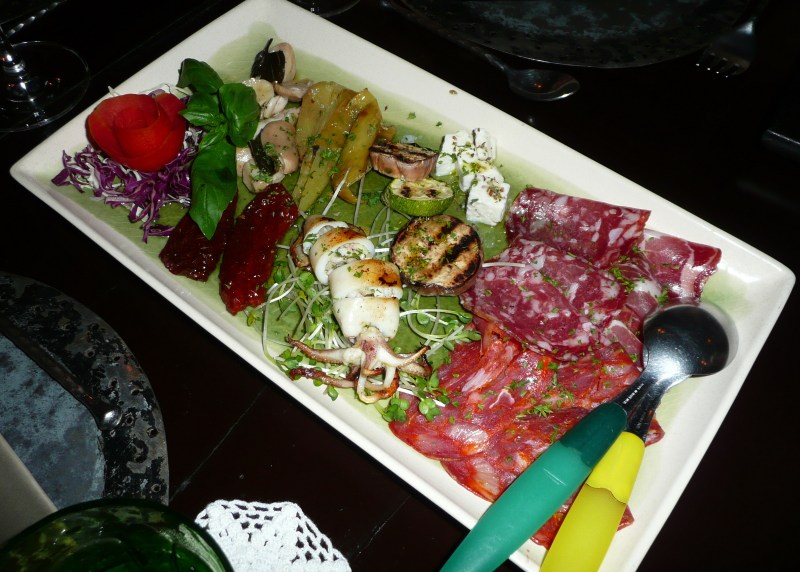
Italian antipasto platter. Yummy!
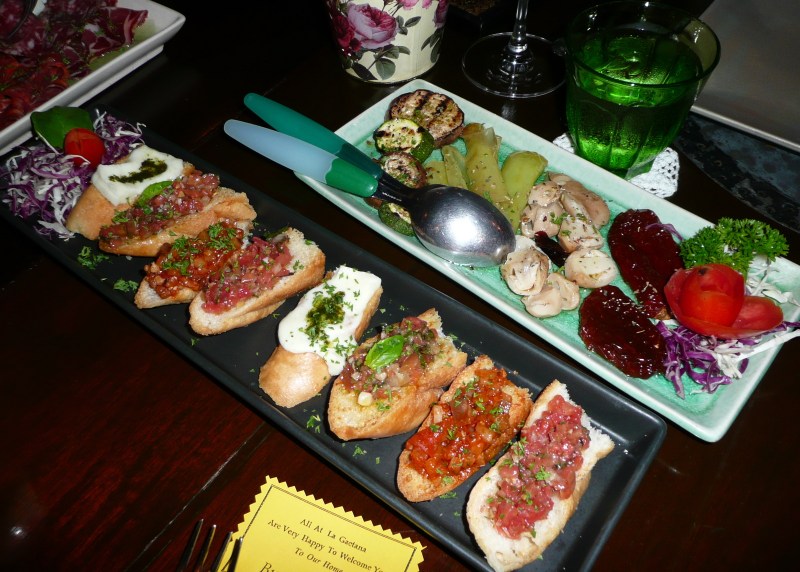
Grilled veggies in the back and a variety of bruschetta in the front.
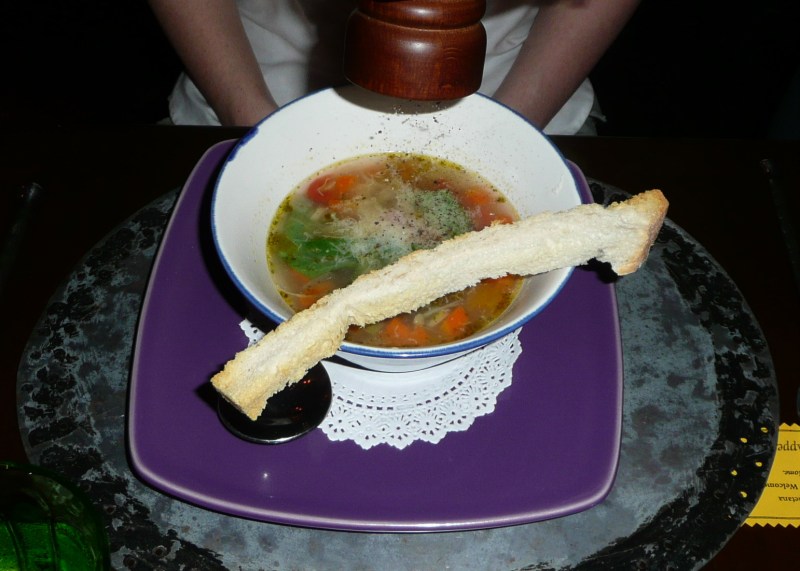
Minestrone soup with fresh ground pepper.
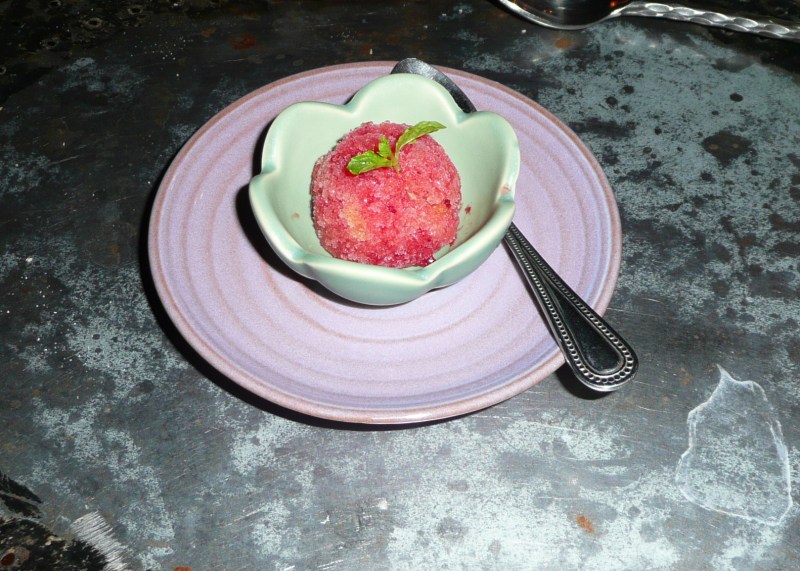
Palate cleanser of passionfruit sorbetto.
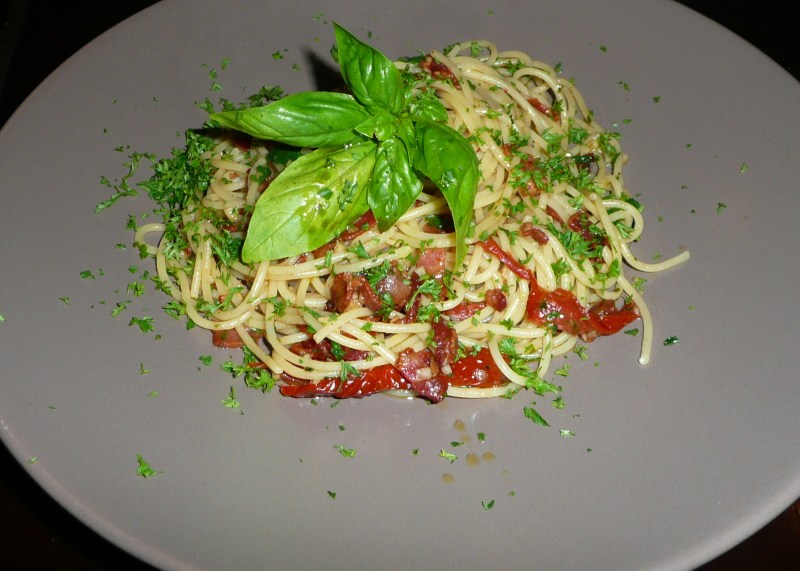
Homemade spaghetti with pancetta and sundried tomatoes.
Grilled salmon with lemongrass sauce and spinach.
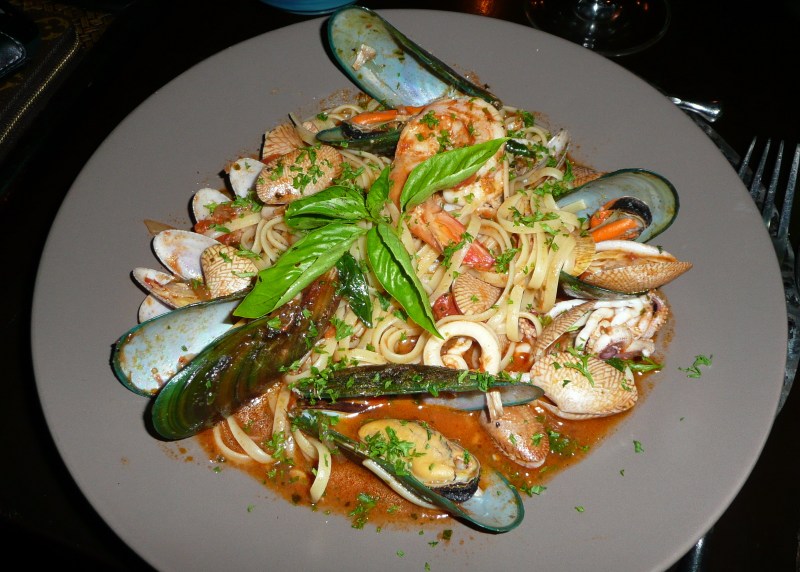
Homemade fettuccine with mixed seafood and tomato sauce.
Grilled bistecca (angus) served with veggies. Very lovely cut with lots of flavor.
For dessert, Gianni displayed the same attention to detail as he did when opening the wine bottles, garnishing each dish before it was served.
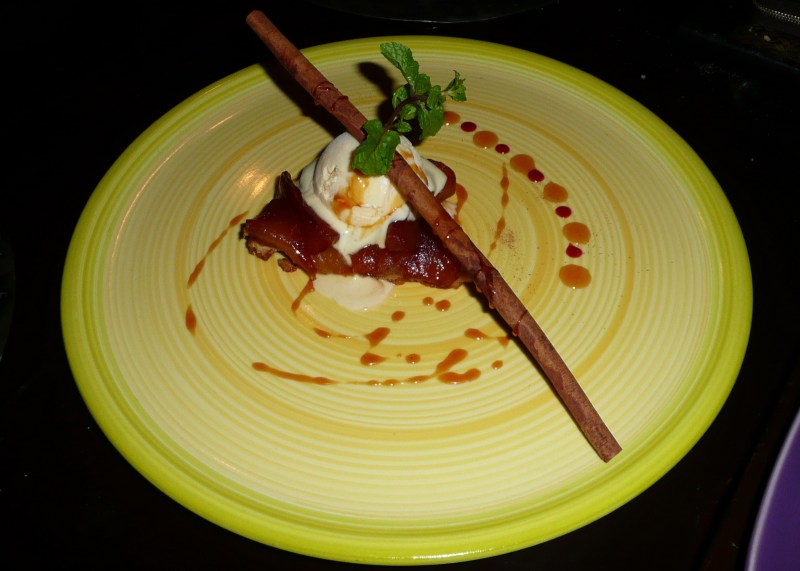
The desserts had a very French feel to them. Here, a tarte tartin.
Classic crème brûlée
Baba au ruhm with more sorbetto.
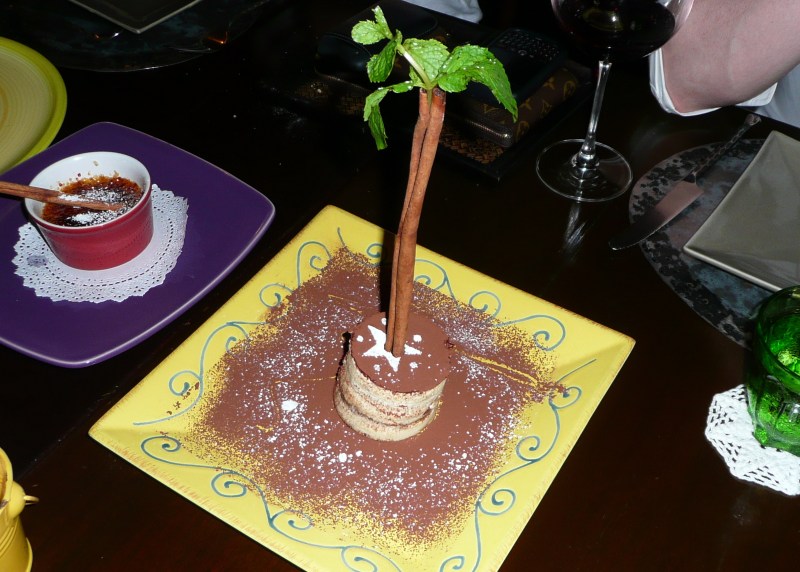
Finally, an Italian dessert! A tiramisu “island” with cinnamon and basil “palm tree”.
This is exactly what I could imagine myself doing in the future. Running my own small restaurant in some idyllic town, spending my days making my guests happy and ensuring they enjoy excellent food, wine and service.
Let me go back into the details about our trip to Burriram province, with our friend Trish.
We went up to this province about five hours to the northeast of Khrungthep, to locate sources of silk for Trish’s new custom-made dress business. Many of Thailand’s provinces are known for their silk, but the Nakhon Ratchasima (aka Korat) and Buriram provinces are known for their high quality and simpler styles. Provinces in the north of the country have more decorative styles of weaving.
While there, we visited several silk shops and a factory, we had a brief visit with some of Tawn’s relatives, and we went to see some ancient Khmer ruins. Here are the details:
Silk, Silk Everywhere
After visiting a few different retail silk shops, Tawn was able to get hold of one of his cousins, who recommended a particular silk factory located in Pak Thong Chai (see map above) with whom she’s worked before. Tawn called the factory, which was not far away, and one of the employees met us at the silk shops to guide us there.
Located a kilometer back from the main road in a nondescript and unmarked set of warehouses, the factory was much different from what I had expected. I shot a lot of video footage and will find the time to edit it in the next week or so, but in the meantime let me share some photos with you.
The owner walked us through the entire production process and was happy to have me take photos.
Raw silk hanging in hoops before being dyed.
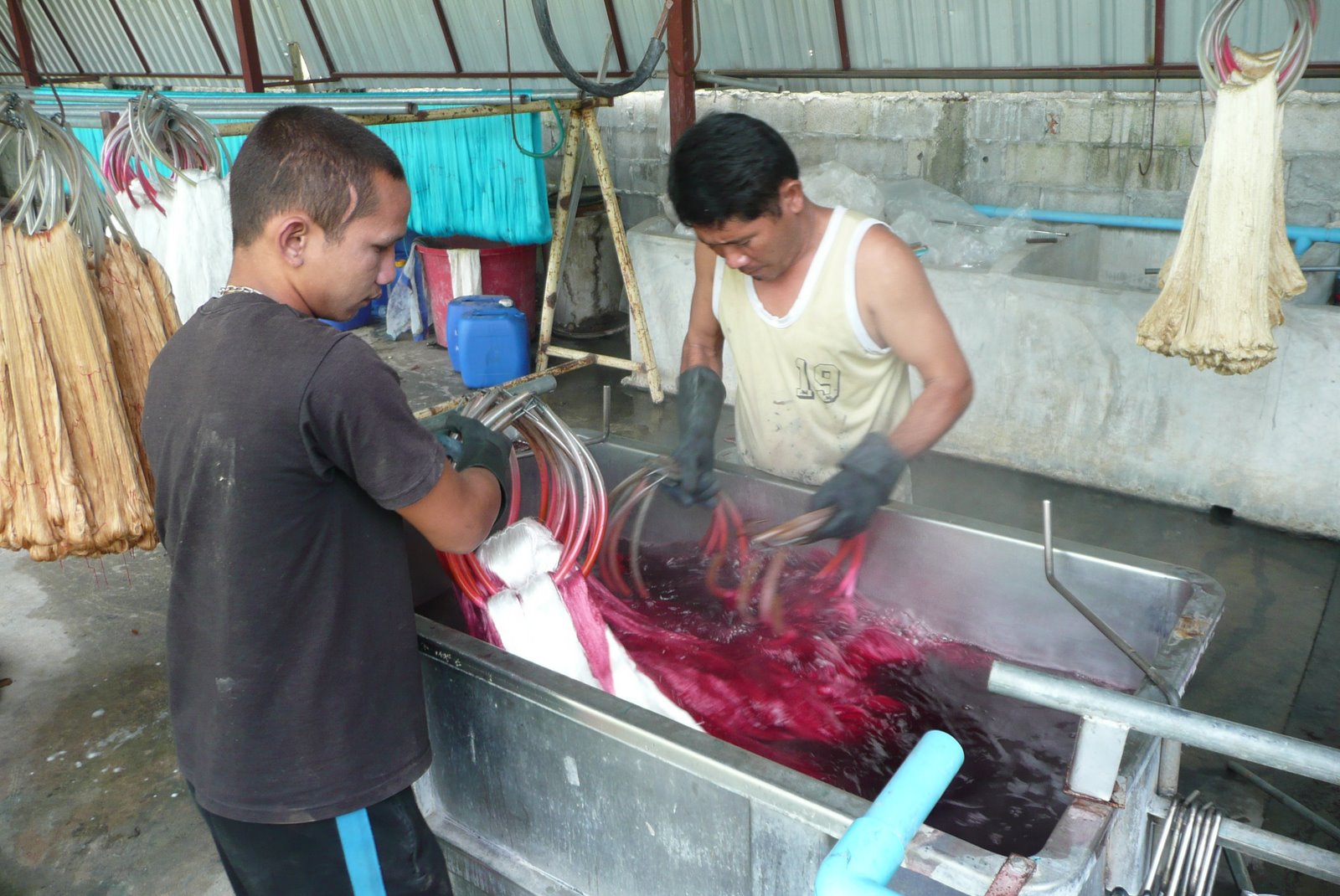
The silk is manually dyed, relying on the skill of the workers to match a particular shade.
A row of drying silk that has been dyed a brilliant turquoise blue.
Trish and Tawn watch the dying process.
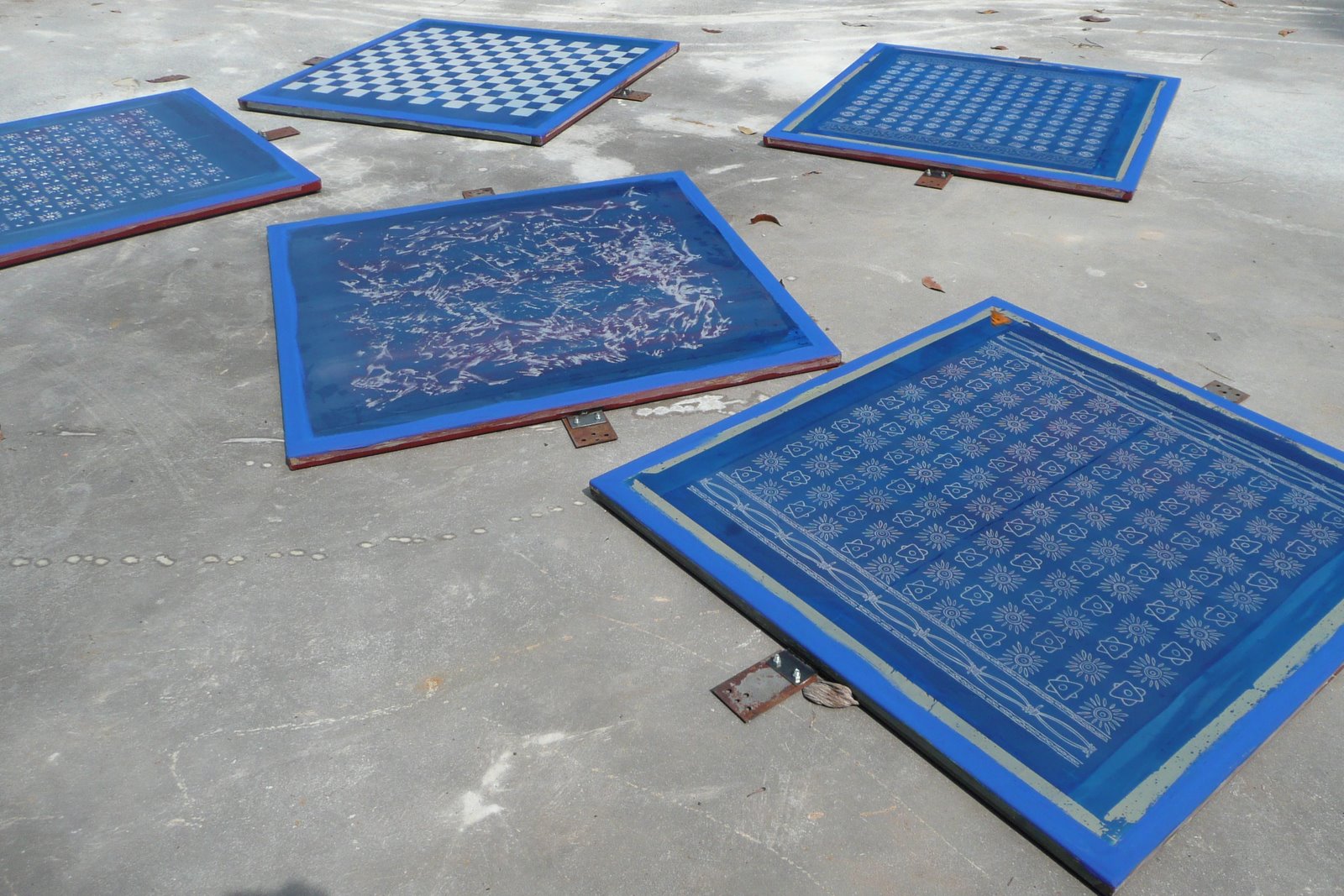
Custom made screens used to print patterns on the silk, hence the term silk-screening.
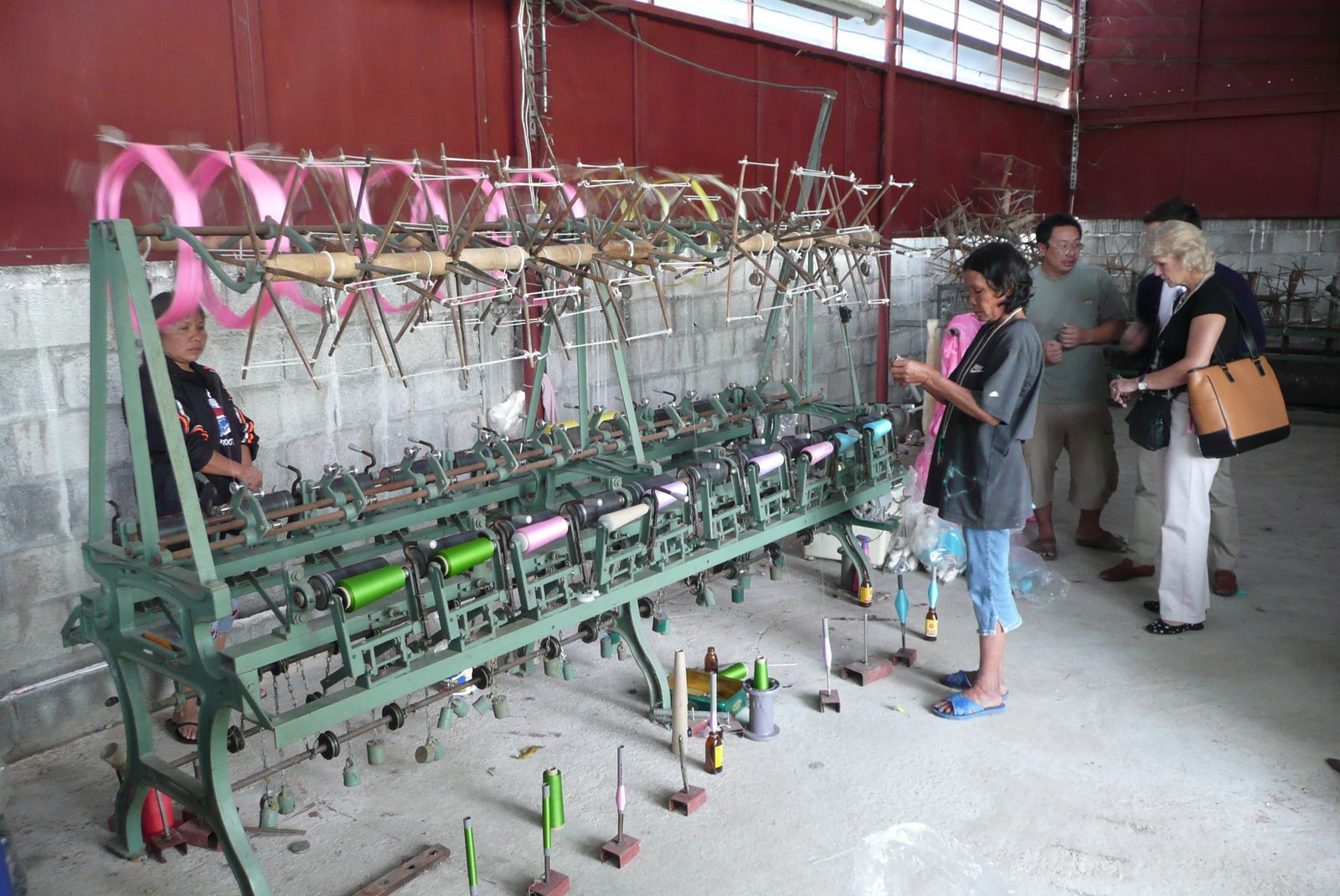
Dyed threads are wound onto spools.
The looms, which are automated but require the constant attention of workers.
The factory manager explains the process to Trish and Tawn.
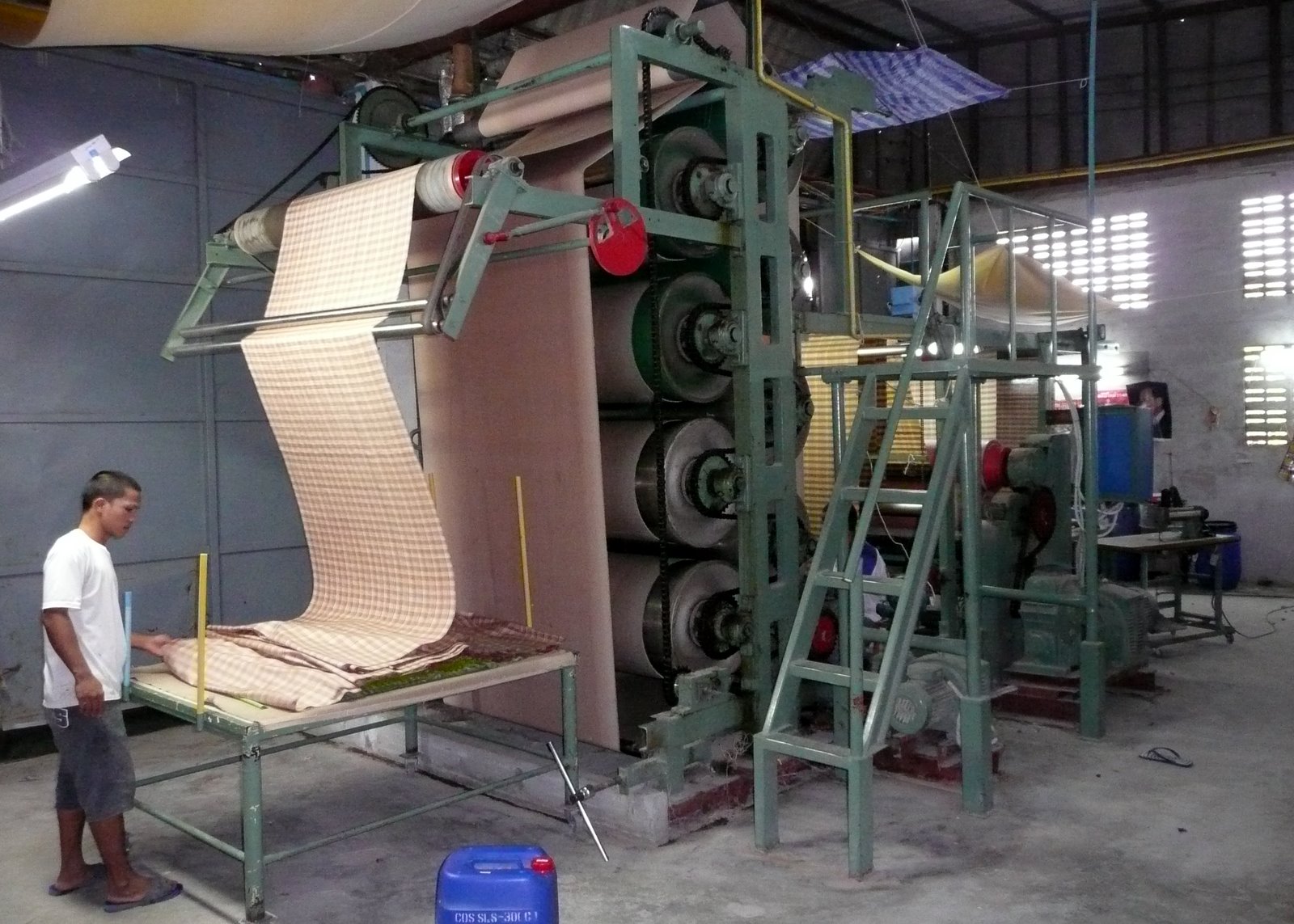
These heated rollers finish the silk, making it smoother to the touch.
Finally, sample batches of silk for Trish to sort through.
Here’s a video that runs down the process.
We spent three hours at the factory that first day, learning about silk, looking at different colors and patterns, and finally making clear what it was we were looking for.
By the time we left for Buriram, the sun was already setting.
Buriram
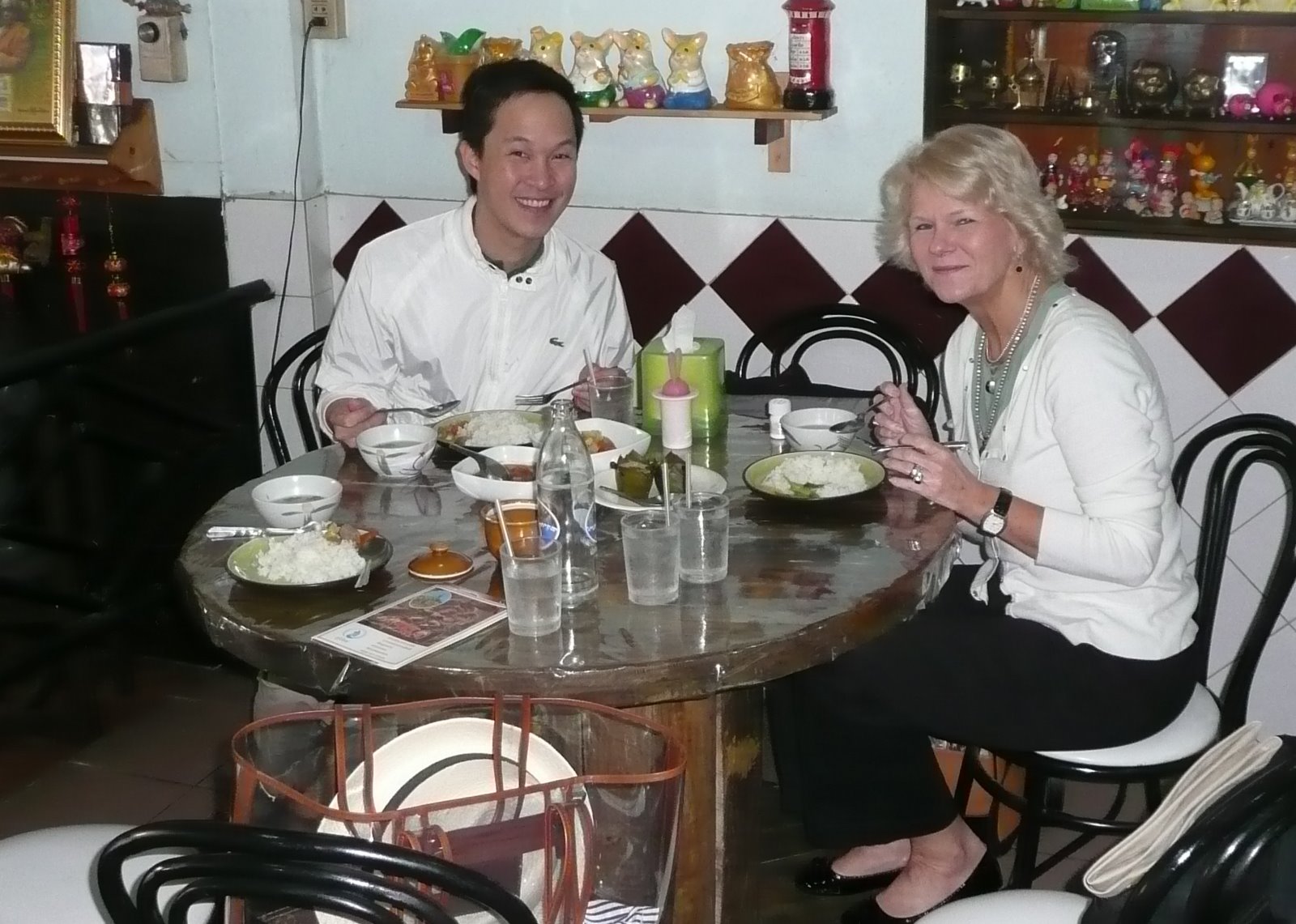
Saturday morning we started with an early breakfast at a restaurant owned by one of Tawn’s cousins. A typical Thai restaurant, there were shelves and shelves filled with kitchy collectables, below. Trish had her first authentic Thai breakfast, various gap khao (“with rice”) dishes including some fried fish, a curried fish mousse and mixed vegetables.
Our tour guide, a friend of Tawn’s cousin, met us at the restaurant. She is a retired primary school English teacher, so spoke English well enough to comfortably make corny jokes.
Our destination was Phnom Rung Historical Park, located just 30 km shy of the Cambodian border south of the main city of Buriram. This Khmer style Hindu temple dates back to the 10th century and is one of the best-preserved examples of Khmer architecture in Thailand.
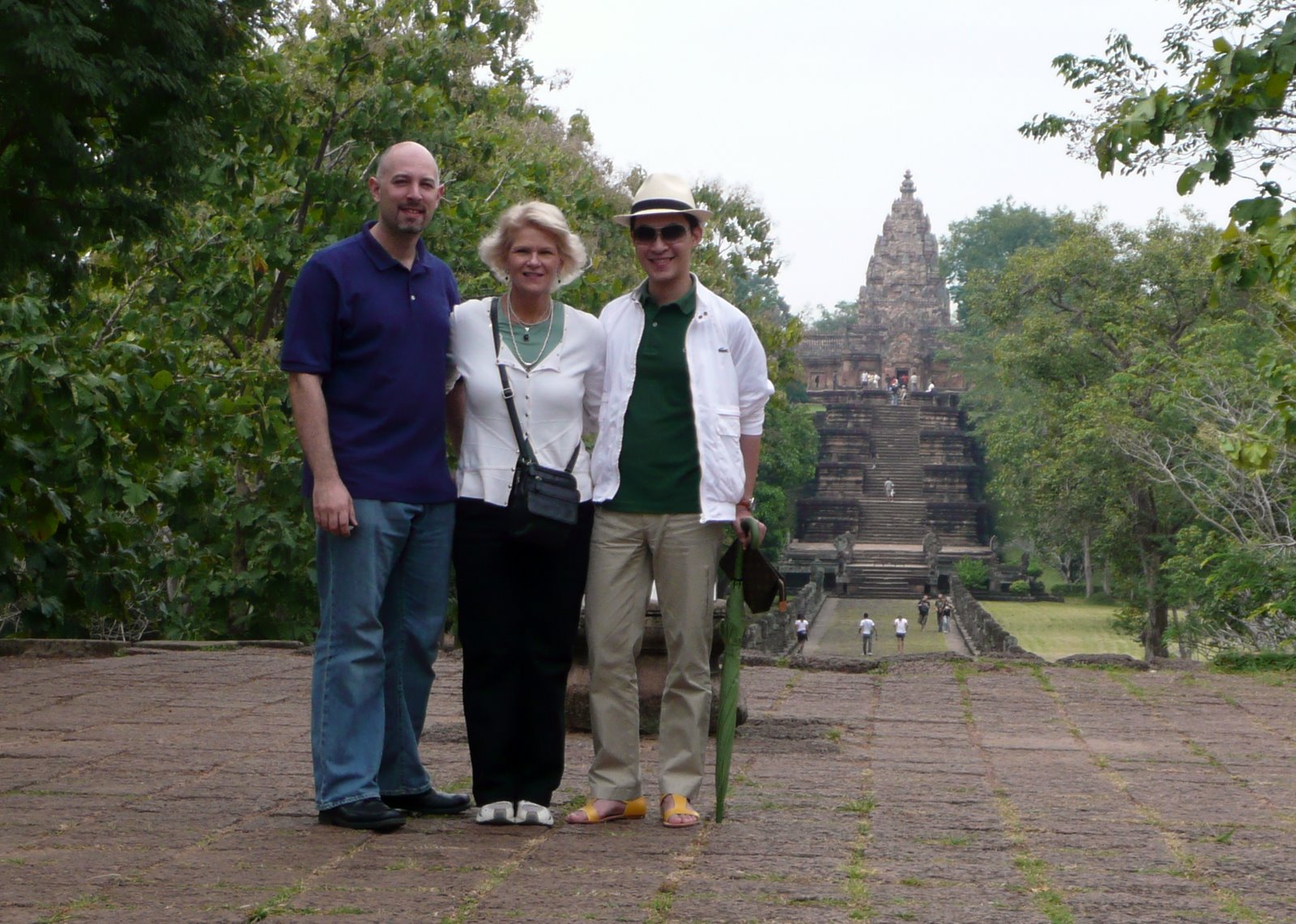
We stand at the far end of the promenade, a quarter-mile long processional walkway that connects the lower stairway with the main temple complex.
Standing in front of the main temple complex and the second naga bridge. You see two of the four pools of water that represent the four oceans and the raised platform represents the bridge between the human realm (between the four oceans) and the heavenly realm, where the temple is.
The amount of symbolism in the construction of the Hindu temples was amazing. This is the main tower, or prang. It is covered with depictions of gods, humans, hermits, snakes, dragons and all of manner of beings. Our tour guide spent about ninety minutes giving us the run-down on this temple and afterwards explained that she had exhausted maybe only ten percent of her knowledge about the temple.
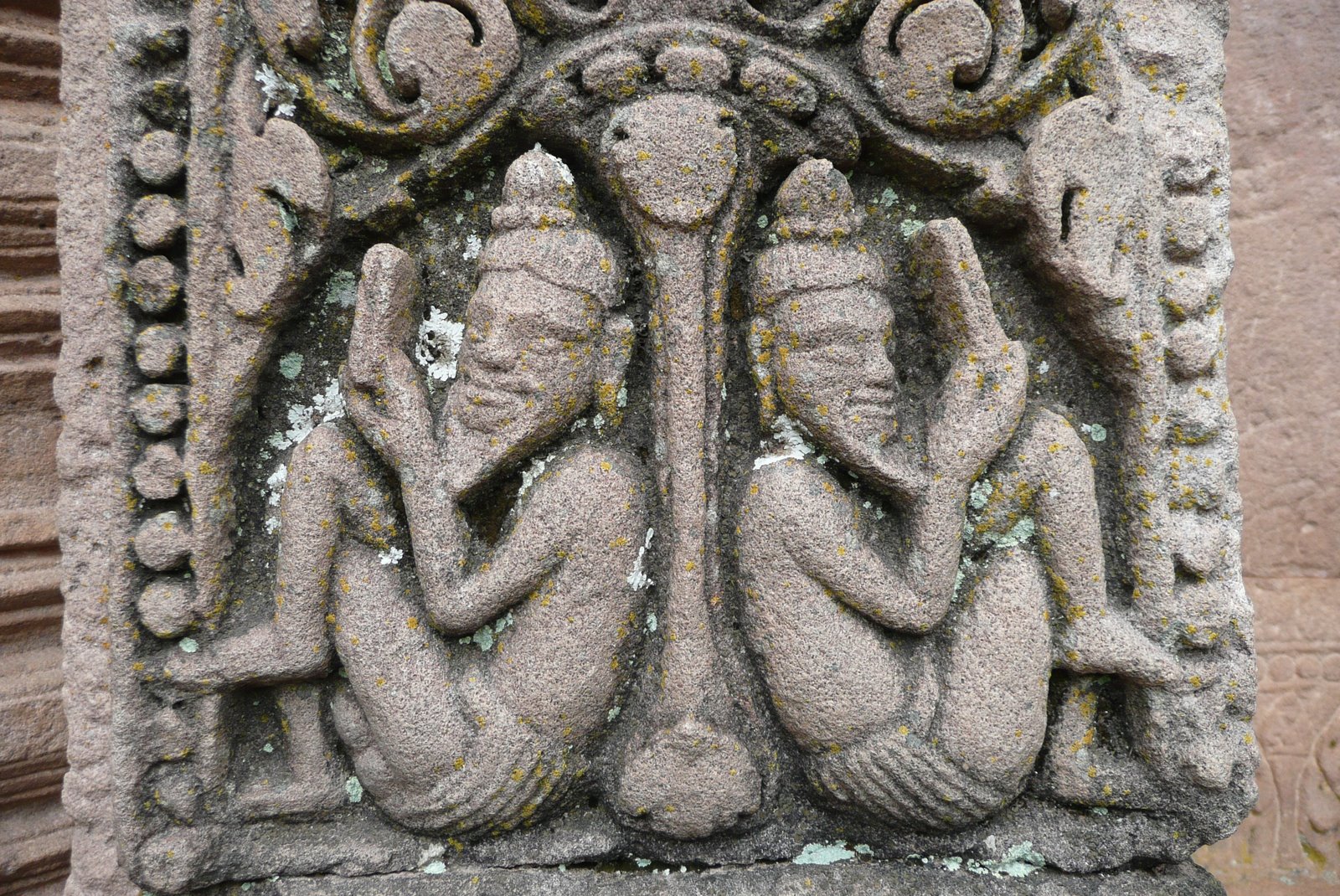
To give you an example of the sort of knowledge she had to share, she explained that this detail (it shows an area about the width of two hands) showed two hermits reading copies of Playboy magazine. One of the hermits, she said, was obviously not wearing any underwear.
Can you see which one doesn’t have any underwear? (Answer at the end of the post.) This was the type of humor we enjoyed all morning.
The construction of the temple was amazing. It is made out of sandstone and instead of carving blocks then putting them into place, they instead stacked all the blocks (which were not always regular sizes) and then carved away to reveal the detail they wanted.
In this picture, you can where the blocks were carved to make the steps. The block in the center top of the picture has many different faces as it was carved to be part of two separate steps as well as the adjacent wall. This made the construction all the more difficult.
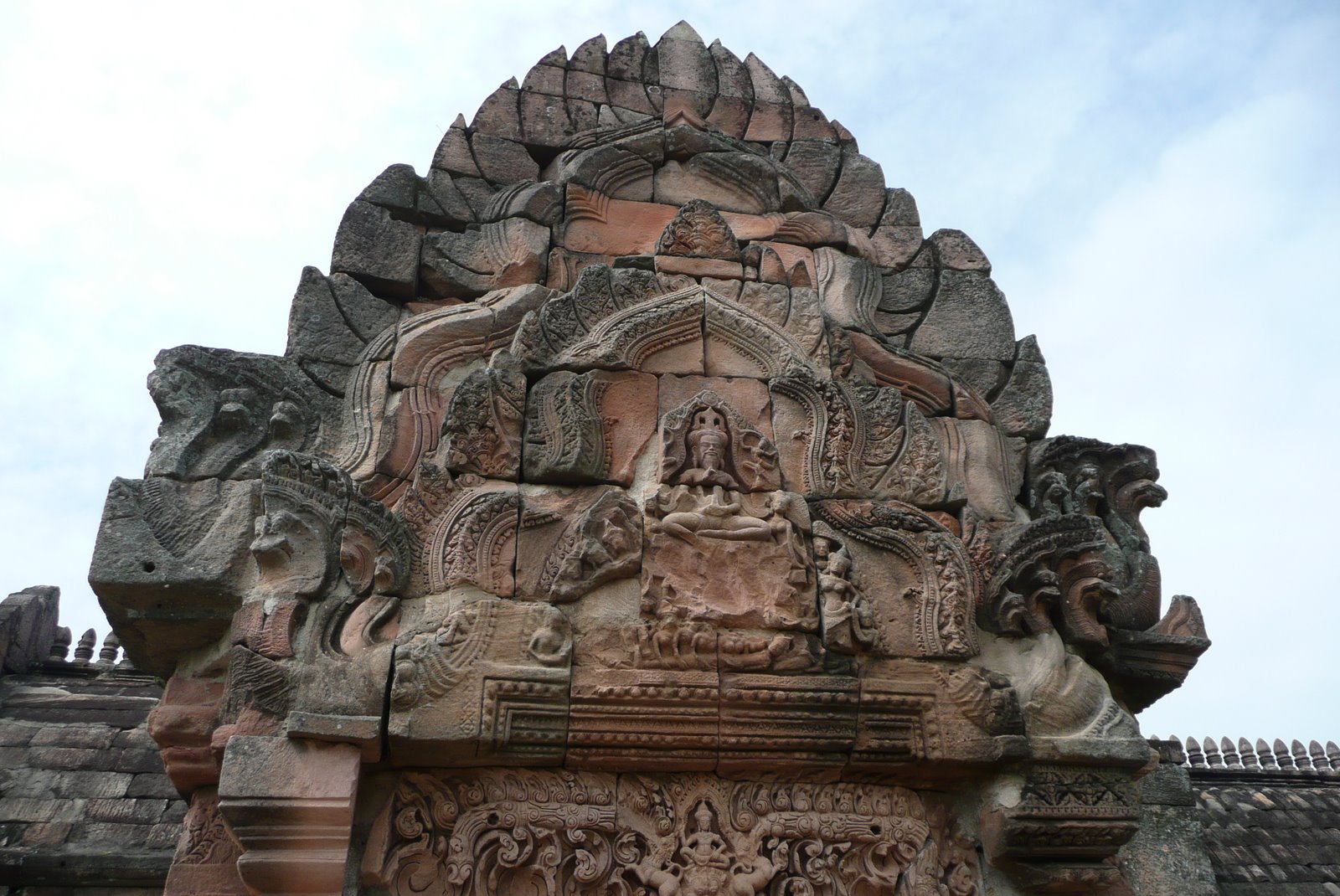
Detail of the principle prang. This temple was primarily devoted to Shiva, one of the supreme dieties of the Hindu religion. Shiva is depicted in the center of this panel. Remember that with the way the temple was constructed, this was just a solid stack of limestone blocks. The artisans had to chisel away to make all the ornamentation. Because of that, mistakes could not be undone as there was no practical way to remove a block and replace it. I think that makes the detail all the more amazing.
Like most historical sights, there is a lot to digest and after a few hours, a break is needed. Since we had only a limited time in the province that weekend, we wrapped things up and dropped our guide off in the main town of Buriram just after noon.
Back in Town
After a quick bite of bami moo daeng – egg noodles with barbeque pork – we stopped by a local coffee shop for a latte. So far we had consumed only Nescafe, which isn’t real coffee even though it seems to be the national coffee drink of Thailand.
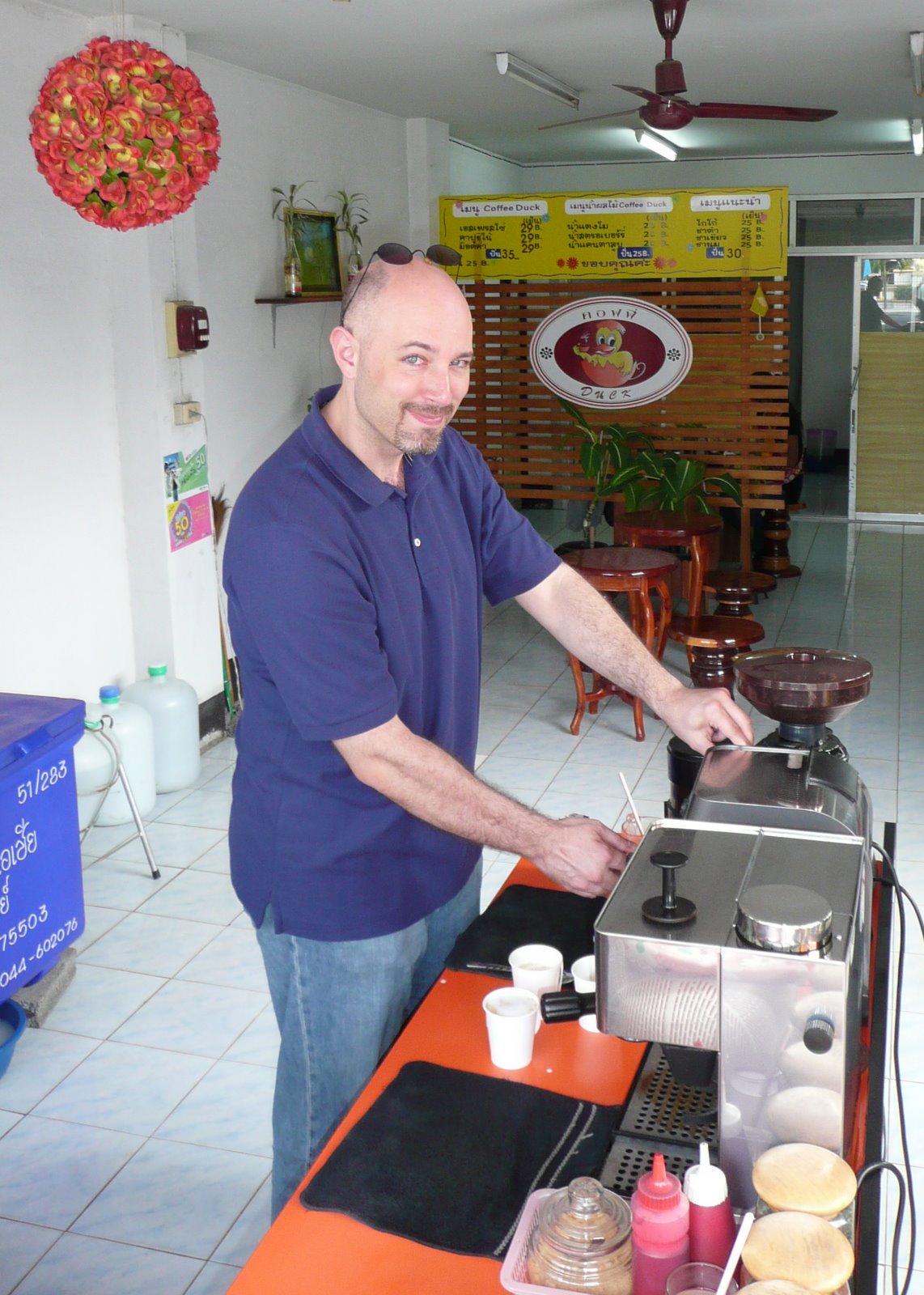
We found a “real” coffee shop that had espresso machines, but when we asked for lattes the young lady said they couldn’t do lattes as they didn’t carry fresh milk. Strangely, though, they offered cappuccinos. Tawn inquired how they made cappuccino with no milk and she pulled out a pitcher of sweetened condensed milk.
Really wanting my afternoon latte (which my Italian cousin will no doubt shake her head at, as espresso drinks with milk are strictly for the mornings, right?), I asked whether we could comandeer her espresso machine. Like most Thai employees, she was a bit overwhelmed by the confrontation but didn’t say no.
Next door was a pharmacy that had a refrigerator of bottled drinks, including individual cartons of milk. I bought two, poured them into a glass measuring cup, and started frothing the milk while she pulled espresso from another machine.
Thankfully, I do have some training on this. Back in the days when I managed movie theatres, we had cafes that featured Starbucks equipment and coffee. As such, we had access to expert training and so I learned how to froth milk like nobody’s business. I’m all about the velvety foam.
Ten minutes later, we had a trio of nearly perfect lattes. Along the way, Tawn had kept imploring the young lady to pay attention so she could learn how to do this, but she didn’t seem to want anything to do with our milk steaming.
As we left, she was no doubt glad that we were out of her shop. We tipped her well though and I walked away with the cocky satisfaction of someone who has brought civilization to the natives. Ah, the espresso drinker’s burden.
We stopped at one final silk shop after lunch. While Tawn and Trish ooh’d and aah’d over the beautiful textiles, I was busy watching a pair of city maintenance workers install a new street light.
It was pretty amazing. They pulled up in a pickup truck, a pair of lights in the back. A bamboo ladder was leaned against the concrete electrical pole and a young man climbed up. He slid a mounting onto the pole, fastened it into place, and then his coworker climbed up the ladder and handed the light fixture to him.
It took a few minutes for him to slip it into place, strip the wires and push them into one of the passing power lines. Try as he might, though, the light wouldn’t illuminate.
Thankfully, they had a second lamp in the truck, so he unfastened the lamp and changed it out. We left before the second lamp was installed, so I wonder if he had any success. One thing that caught my attention, though, was just how little in the way of safety equipment they had. No helmet, no protective gear, and he wore only flip-flops on his feet.
Occupational safety and health administration? Nope.
Uncle’s House
We stopped by Tawn’s grandfather’s house. Tawn’s father is the ninth of twelve children and the old family compound is now owned by his oldest uncle, the fourth child.
After years of hearing Tawn tell stories about his childhood visits to stay with his grandparents, it was fascinating to finally see the place. Tawn’s uncle and several cousins graciously welcomed us and we sat around a table, eating mooncakes and drinking water and visiting.
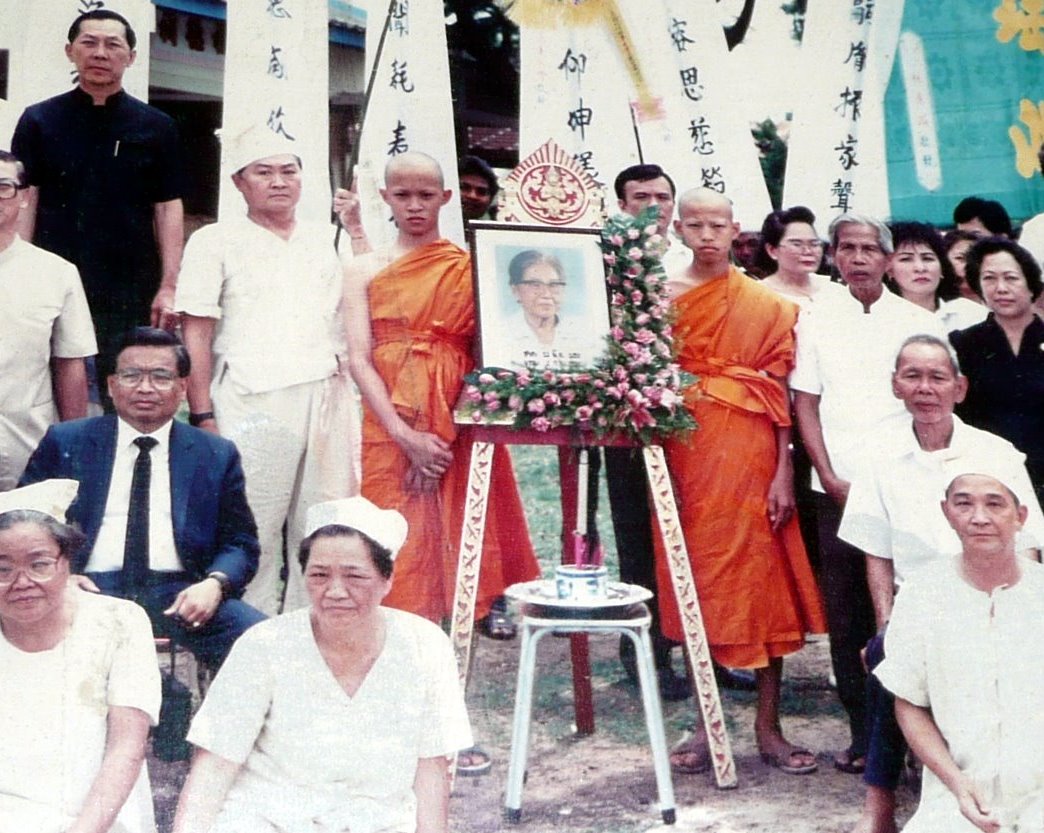
The most fascinating thing on the wall: a picture taken at the funeral of Tawn’s grandmother. It was a panoramic portrait of the more than three hundred family members who gathered at her cremation. Tawn and one of his cousins went into the monkhood for a day to earn merit for their grandmother. Tawn’s the one on the left.
Tawn, who was maybe 13 at the time, doesn’t look too happy about his new haircut. This was the only time Tawn has been a novice in the Buddhist monkhood.
Speaking of teenagers, Tawn has a second cousin, Toy, a fifteen-year old who will be going to the US as an exchange student next August. We visited with him, giving him a chance to practice his English. Tawn suggested that we could coordinate a trip to the US while he is there so that he has the opportunity to visit other parts of the country besides the one where his host family is located. He has not been assigned a specific location yet.
In the evening, after a few hours of relaxing at the hotel, we met another of Tawn’s cousins, Mee, for dinner at his restaurant. Mee has visited us in Bangkok before and it was very nice to see him again. His restaurant serves Thai food with slightly modern twists and everything was delicious.
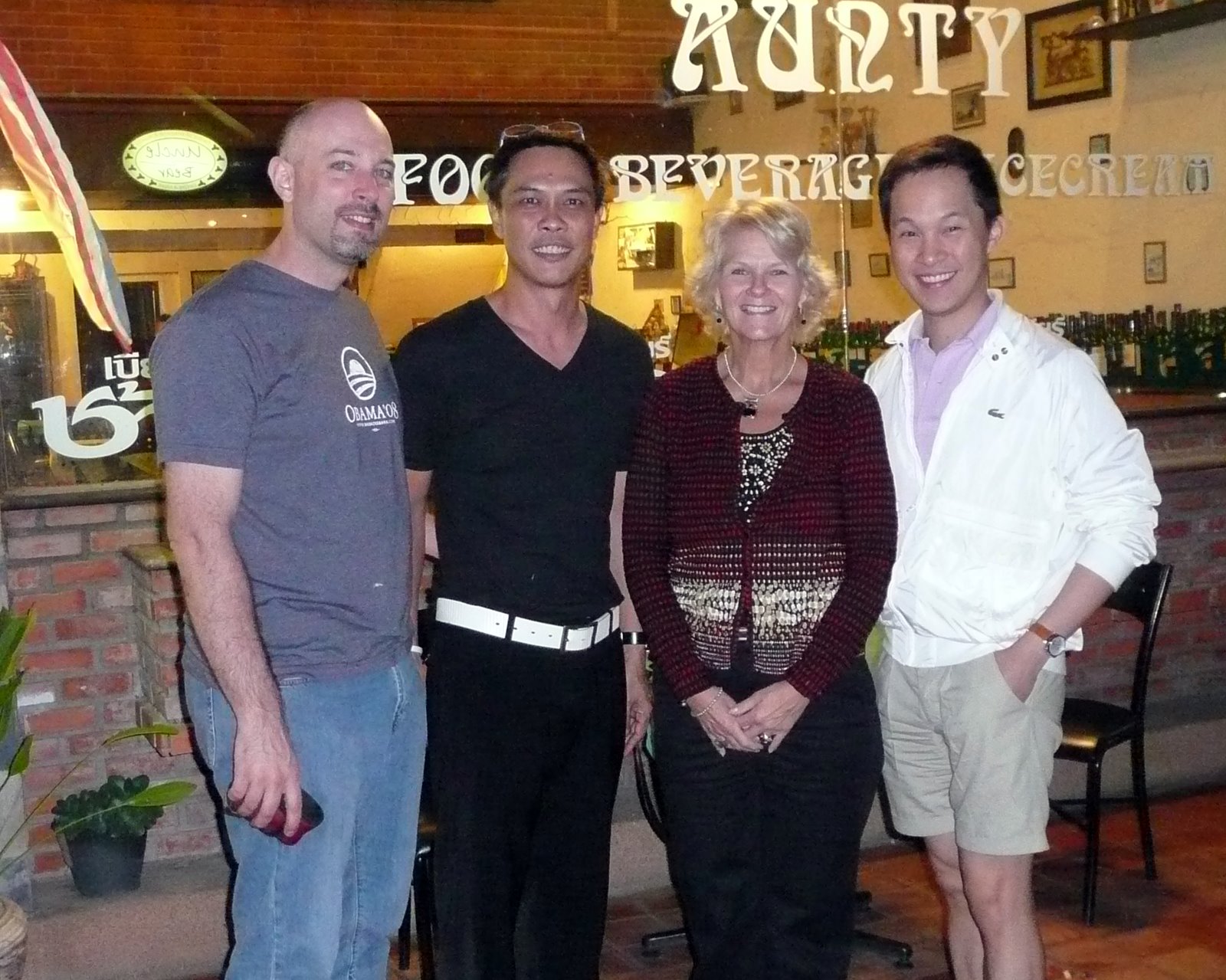
The “Aunty” in the restaurant’s sign refers to Mee’s mother, not to Mee!
Birthday Burger
Sunday was my birthday. We started the morning with a quick hotel breakfast and then stopped at another coffee shop (this one had milk) for lattes before hitting the road.
Next door to the coffee shop/bakery is a bookstore. Just inside the door of the coffee shop is a sign. If reads, “Full stomach already, but is your brain full? Books and journals, please go this direction.” Quite clever.
We stopped back by the silk factory for another two and a half hours. The owner had arranged for us to peruse a broad range of colors and we finally made some purchases. Unfortunately, after returning to Khrunthep, Trish discovered that some of the silks were not two-ply as we had been told, but only one-play. Tawn is working with the factory owner to fix that.
Our final stop on the way in was Chokchai Farms, Thailand’s largest cattle operation. There was a huge crowd as people went on farm tours, ate at the steak house, and bought ice cream. We decided to stop for a steak burger to celebrate my birthday.
The burgers were pretty tasty, although they had way too much mayonaise on them, which seems to be a Thai thing. Trish claims this was the first burger she has had in fifteen years. Glad we were able to knock her off the wagon.
Video of the experience.
Afterwards, we had some ice cream, bought some snacks, and I tried to milk a huge cow. Look at its expression!
We returned to Khrungthep a bit after sunset, pretty exhausted after our weekend up in the northeast.
Answer: The hermit on the left is blowing in the breeze.













































 christao408