Me and the Thai Bureaucrats

In the past two days I’ve spent about eight hours engaging the Thai Ministry of Labour and other bureaucrats in order to learn how to get a 90-day extension to my work permit. Previously, I’ve just gone to a law firm and paid them about 2000 baht (US$58) to do this work for me. Over time, I wondered whether I could learn to do the renewal myself and save money. After the past two days, I’m not sure the “savings” are worth it.

Some background first:

In order to live and work in Thailand, you need both a non-resident visa as well as a work permit. The visa is issued overseas from a Thai embassy or consulate and is good for one year. However, you are required to physically leave the country every 90 days. Ostensibly this is so Immigration can run a criminal check on you when you come back in, to make sure your record is clean. In reality, there’s no reason you need to leave the country to do this. It is just a ploy to inject more money into the tourism and travel sectors.

On top of the visa, you have to get a work permit. It is also applied for at the Ministry of Labour once a year but it can only be valid for as long as your visa is valid. Since I can only get a 90-day entry with my visa, my work permit is only valid for 90 days at a time. So after returning from a “visa run” I have to get my work permit extended to match my new 90-day stamp in my passport.

Confused yet?

My friend Stuart is in a similar situation as me and he’s been going to the Ministry of Labour and extending his work permit himself for some time. He agreed to go with me and walk me through the steps, so we set off yesterday afternoon. The MOL’s website doesn’t contain a list of requirements but a little searching online gave me a simple list: copies of my company’s articles of incorporation, copies of my passport and all the pages in my work permit book, and the completed application form.

We arrived at the MOL, picked up the application form, which is in Thai and English, and I filled it out. Some parts are confusing (in both languages). For example, I am asked to fill out the name and address of my employer on one line, then am asked to fill out the company name and address two lines below that. These would be the same information in most cases. Additionally, there was a second form that Stuart hadn’t seen before.

Arriving at the counter, the lady went through the paperwork, discarded a third of the sheets in the articles of incorporation (“no need”), then pointed to the form which Stuart had never seen. “This has to be in Thai.” Even though the instructions are in both Thai and English and there’s no indication of what language was required. This new form requested some financial data from my company, which I didn’t have memorized.

I returned home from the MOL and spent the evening reviewing the forms with Tawn, making sure they were both completed correctly in Thai.

This morning I switched partners and brought Kobfa along, figuring that a native Thai might be helpful. When I went up to the counter at the MOL (different lady this time), she asked whether I wanted a one-year or 90-day work permit extension. After reviewing the work permit book she determined that I was only eligible for the 90-day as it had to match my current visa expiration date. For a 90-day extension that extra application form with which Stuart was unfamiliar, wasn’t necessary. Would have been nice to know yesterday…

She then looked through the articles of incorporation and discarded several more sheets. “Not necessary, not necessary…” Then she came to two documents in the articles of incorporation. “Wait a minute,” she said, “these documents from the Department of Business Development were prepared 16 months ago. You can’t use documents that are more than six months old.” She explained we had to go to the DBD and get new copies.

Leaving the MOL, I decided we had best go to the law firm I used in the past and seek some clarification: they have been renewing my work permit every 90 days for the past 16 months, since I started my company. It that’s the case, then these 16-month old documents had been more than 6 months old for the last 10 months! How were they getting the work permit renewed? Or were they getting updated documents and not giving them to me afterwards?

The law firm was surprisingly helpful, considering that I wanted information that would enable me not to use their services in the future. The young man who is the work permit contact explained what the DBD was and gave us a number for them. He didn’t, however, really answer my questions about how they had managed to get me a work permit in the past.

Kobfa and I headed to the DBD, which thankfully had an office not too far away. This was something I would never have been able to navigate on my own and I’m in debt for his help. Everything was in Thai only. While I read and write Thai, government language is not my strength. The process for getting updated copies of the documents was surprisingly easy, though, complicated only by the fact that we arrived at 11:50 and the office closes for lunch at 12:00.

After retrieving the completed documents at the DBD after lunch we took a taxi back to the MOL. The lady with whom we had dealt in the morning asked if we had all the other documents we had given her (and she had taken) that morning. No, we replied, she still had them. She pointed to a row of baskets in the working area behind her, each basket given a different date of the month, and indicated that we should go back there and retrieve them. We were both a little confused: we were supposed to go back into the clerks’ working area and rummage through a bunch of applications? Yep. So I sorted through a stack of work permit extension applications (and personal data) until I found mine.

After another thirty minutes of bureaucratic back and forth – go to this window, no not complete yet, take it to that window, go to the cashier then come back, etc. – we finally walked out with my 90-day work permit extension. Which means that sometime in the next 90 days I’ll have to do this all again, except for the trip to the DBD, which shouldn’t need to be done until the end of September.

Whew! And who said living in paradise was easy?

Critical Mass Resumes

About six (or was it nine?) months ago I was participating in the monthly Critical Mass bicycle rides here in Krungthep, held the final Friday night of each month.  Based on their counterparts in San Francisco and dozens of other cities worldwide, CM is about creating a space where bicyclists can safely ride the roads, demonstrating the significance of our numbers to the drivers of motorized vehicles, and calling attention to the importance of including bicycles in the overall scheme of transportation.

As rainy season arrived, attendance at CM diminished, particularly after one Friday night where the two or three dozen of us ended up riding down Sathorn Road in a heavy rain.  We were soaked by that point and seeking shelter was pointless, so we kept riding until we reached the river.

Perusing the Thai-language web board at Thailand Cycling Club’s website, I discovered that CM was once again happening.  In addition to the Friday night downtown ride there is now a weekend daytime ride on the second Saturday of the month, held up at Railroad Park near Chatuchak Weekend Market.  A Thai friend, Poom, confirmed that CM was drawing a good number of people, so Stuart and I decided to join.

P1140784

After setting out from home at 5:30 and stopping by the ProBike store next to Lumpini Park to buy some new headlights (so much brighter than the old ones!), we arrived at the new Bangkok Art and Culture Centre, located right across from MBK and Siam Discovery Centre malls on what has to be one of the most valuable properties in the city.

About sixty cyclists joined and we set off in a reasonably cool and breezy evening, riding up Phahonyotin Road then turning eastbound onto Lad Prao Road.  After about 15 km the group stopped at a night market to eat.  By this point we were pretty far north of home so Stuart and I decided to continue without the group and return to our neighborhood before eating.

Sure enough, after a 40 km circuit which retraced a good part of the previous Sunday’s homeward-bound path, we had worked up a hearty appetite, which was satiated at Great American Rib Company on Sukhumvit 36.  Nothing like some mango margaritas and pulled pork shoulder to add back on those calories that were burned off on the ride!

Pancakes, Tonkatsu and a Sunset

It’s Saturday, so let’s have a food entry, shall we?  Not that we need any excuse for a food entry.

Pancakes

A notable aspect of Thai culture is the snacking.  There are always vendors handy selling food and Thais, not unlike Hobbits, eat many more meals in a day than the typical three.  Why do they do it?  Without a doubt, the answer has something to do with how fun it is to snack.

For the most part, Thais maintain their skinny figure because they aren’t over-eating, just nibbling a little here, a little there.  Most of these snacks are pretty healthy, too.  And since snacking is even more fun when it is done with others, they share their snacks with friends and don’t eat nearly as much that way.

From time to time, non-Thai foods manage to find their way into the snacking scene, probably with not so good results on the waistline.  Waffles are one example.  Many of the Skytrain stations have vendors who sell these small, yeast dough waffles.  They’re very sweet.

Then there are the crepe vendors.  We’ve started to see these over the past few years.  It is a take on the Japanese version of French crepes: cooked very dry and then rolled into a cone shape and filled with either sweet or savory fillings.  No Nutella here, though.

This week, though, I saw the strangest thing: one of the crepe vendors was actually making pancakes.  Yes, yes – I know that crepes are a type of pancake.  But these were big, thick, American-style pancakes.

P1140777

Surprised, I stopped and asked if I could take a picture.  She just looked at me like I was an alien but didn’t say no, so I snapped away.  I was on my way to lunch so I didn’t buy one and try it.  But I’ve now seen her twice in front of the Thong Lo post office, so I’ll have to go back and see what flavor they are.  You can see that she has some crepes prepared, too, on the front of the cart.


Tonkatsu

The largest population of legal foreigners in Thailand are the Japanese.  I’d imagine that the number of Burmese, Lao, or Cambodians may be higher, but many of them are probably not here legally.

One of the benefits of having so many Japanese here is that we can get pretty good Japanese food.  One of the items that I really like is tonkatsu, the pork cutlet that is breaded in panko and then deep-fried.  When done perfectly, tonkatsu is moist with a crunchy exterior, very flavorful, and not at all greasy.

Of course, average tonkatsu is a dime a dozen.  Recently, though, I read a review for Saboten restaurant, located on the sixth floor of the Isetan department store (a Japanese chain) at Central World Plaza.  Oh, this place makes good tonkatsu!

First of all, the place itself is very bright, beautifully designed, and obsessively clean.  The service is very good.  In general, Thai service standards are quite high, but here they bring it to an even higher level.  Every time someone approaches the table, they give a little bow, even if they are just refilling my tea.

The menu is simple: they offer only tonkatsu and only about six different varieties.  Meals come with a bottomless bowl of shredded cabbage, which you can dress with either a sesame dressing or a vinaigrette.  Rice and miso soup are also bottomless, although one of each is always enough for me.

P1140780

The tonkatsu is amazing: the panko are perfectly textured with not a drop of oil.  Nothing about the crust is soggy at all!  The meat is tasty and moist.  The sauce, which is mixed with toasted black and white sesame seeds that you grind yourself, is just a tad too sweet.  Another restaurant we know has a slightly spicy version that really is nice.  But all in all, this is good tonkatsu.

The best part is, it really is quite reasonably priced at about 300 baht.  Yes, a lot more than a 30-baht bowl of noodles from a street vendor.  But for what you get, it is a great value.


Sunset

Finally, let me leave you with this photo from Ipanema Beach in Rio de Janeiro.  This comes courtesy of Prachya, who took it last year while on holiday there.

Ipanema Sunset

Normally I don’t post others’ photos, but when I saw it on his Facebook album, I thought it was so pretty that it should be shared with you!  I hope you enjoy it. 

Have a great weekend!


The Sound of Music in a Very “The King and I” Sort of Way

Less than an hour after returning home from the 90+ km bike ride on Sunday, I had to turn around and head out with Tawn for an evening social event.  One of Tawn’s childhood friends is the director of Satit Bilingual School of Rangsit University, located north of the old Don Meaung Airport in Pathumthani Province.

As part of the school’s emphasis on an international, Thai-English education, this is the second year they’ve mounted a production of an English language musical.  This production, into which a great effort was put, was of “The Sound of Music”.  Running multiple days and featuring the university’s orchestra and a cast of primary and secondary school students, this special event was attended by Her Royal Highness Princess Soamsavoli Kitiyakara, the former wife of His Royal Highness the Crown Prince and mother of the first grandchild of Their Majesties the Kign and Queen.

First we stopped to pick up another of Tawn’s childhood friends, Mon, who looked stunning in her outfit. 

We got a little lost in finding the school but had left home plenty early, so arrived with an hour to spare before curtain.  There were police everywhere – I’d imagine 200 or more officers are used whenever a member of the Royal Family goes to some event – but fortunately as friends of the school’s director, the guard pointed us to what he called the “IP” parking.  I guess we didn’t make “Very” status, only “Important” status!

Pim and her daughter Tara greeted us.  Tara had a special responsibility along with another young girl: to give a present to the Princess.  Kind of like the role of a flower girl in a wedding, she was all dressed up (as a princess, no less!) and when the time came to curtsey then walk up to the Princess, Tara and her friend needed a lot of guidance from one of the Naval Protocol Officers.

There was a large reception in the administration building.  We were upstairs in a secondary reception area – the IP area, I guess.  Notice the red carpet in the picture below.  This was set up for the Princess and students were sitting the full length of it, neatly dressed, awaiting her arrival.

We entered the auditorium about twenty minutes before show time.  Oddly, the chairs were set some distance back from the stage and orchestra.  You’ll notice the raised platform and special chair set up for the Princess.  We’ve been many arts events where a member of the Royal Family has attended and I always think they must get a bit lonely because even if they attend with friends or family members, the highest ranking person is always set on a pedestal, away from all the other seats.

The show itself was interesting: they removed almost all of the dialogue between the musical numbers, so the entire show was done in less than ninety minutes, compared to the usual three hours.  If you weren’t familiar with the story, though, you could easily have become lost.  Who is this person delivering mail?  Why is Maria going back to the abbey?  Who is the Baronness?

How was the singing?  Well, Maria and Captain Von Trapp were not the strongest singers.  Some problems with the microphones and amplification made the situation even worse, rendering their high notes nearly inaudible.  The girl who played Liesl, though, had a lovely voice and her duet with the boy playing Rolf (“Sixteen Going on Seventeen”) was one of the high points of the show.

The biggest thing that tickled me was the accents.  I know, I shouldn’t laugh at this, but it was so cute as many of the students are Thai and some of them speak English with a strong Thai accent.  Especially the boy playing Captain Von Trapp.  When he spoke, I couldn’t help but think of Yul Brenner saying “etcetera, etcetera, etcetera” in The King and I.  Awful thing to say, huh?

After the show we stood as Her Royal Highness departed to the playing of her own anthem, and then took some more pictures before heading home.  Needless to say, I slept very well Sunday night after a bike ride, a drive all the way to Rangsit, and then an exciting musical performance.

Biking to Ko Kred (Longest Ride Yet)

In what was my longest ride yet here in Thailand, I joined the Thailand MTB group for what was billed as a 70-km round trip to Ko Kred (Kred Island), a car-free ethnic Mon enclave in the middle of the Chao Phraya River north of Krungthep.

Poom, an American-educated Thai who I met on some Thailand Cycling Club and Critical Mass rides, extended the invitation and I forwarded it on to Stuart.  I’ve never ridden with Thailand MTB (“mountain bike”) before but am always up for a new adventure.

The adventure required me to be up Sunday morning at 5:00 so that I had time to shower, stretch, eat a bite and check my tire pressure before meeting Stuart on Thong Lo about 6:30.  From there we met up with Poom at Wireless Road and then the three of us continued to the Sathorn District office, which is tucked away down a small soi in the Sathorn/Silom business district.  This first leg added about 10 km to our journey and we hadn’t even official started the ride yet.

Thailand MTB is mostly the younger, rougher, more testosterone-driven types (they are mountain bikers, after all) compared with the more varied group that you find with the Thailand Cycling Club.  That’s okay, though: I wanted to ride harder and faster than the usual liesurely pace of the TCC events.

Push hard we did.  It was a hot and humid morning and we didn’t make our first stop along the route until we were up at the point where the north-bound route makes a hard left turn to the west.  This was some 20 km from our starting part on Sathorn.

Kob Kred to Sathorn Ride

By about 10:00 we arrived at the ferry to Ko Kred.  After taking the wrong ferry we finally ended up at the island.  As mentioned before, Ko Kred is in the middle of the Chao Praya River.  It was just a peninsula at a bend in the river but in the early 1700s it was decided by the Siamese government to build a canal through the peninsula to create a more direct shipping route to the old capital of Ayuthaya.  Over time, the canal was widened and now it is the main river channel.

The island is still populated with ethnic Mon.  A popular day-trip for Thais, Ko Kred is automobile free, mostly marshland with elevated concrete paths connecting different parts of the island.  Along the way there is no shortage of vendors seling nick-knacks, food, and the earthenware pottery for which the island is famous.

We ate lunch at one of the two temples, both of which have large markets, then did a 5-km circuit of the island, dodging the mostly Thai tourists.  On the far side of the island we stopped at the second temple.  Stuart and Poom bought some fried food, the exact ingredients of which are unclear.  I think they were vegetables with one maybe being a flower blossom?

P1140746

P1140747

Above, the mysterious fried foods.

P1140751 I decided that oil didn’t meet my needs so instead opted for homemade coconut ice cream with sticky rice and peanuts.  At the ice cream stand, an older lady was passing with her two young grandsons.  They stared at my in my bicycle helmet and sunglasses and commented about the farang.   I responded by saying hello and asking them if they knew how to speak English.

Shy, they declined to answer.  Their grandmother smiled and prodded them: “Sure you can.  You learned how to say ‘Hello’ right?”  They nodded at her but were still too shy to practice their vocabulary word with me.

While at the market, I noticed several stray dogs wandering near a riverside pavillion, earing scraps of food.  One looked quite large and, upon closer observation, I realized it was a wild boar, left.

Nobody seemed too concerned that a boar was wandering around the market so I didn’t worry about it either.

We regrouped at the ferry pier and started our ride back.  By this time it was 1:00 and we were under the open sky, hot sun evaporating our sweat nearly as quickly as it appeared on the skin.  Poom was riding a collapsable bike, one of those types with small wheels that can easily be brought onto a train or bus.  The problem is, smaller wheels means you have to pedal more.

On the way back, this extra effort was beginning to show.  He fell a bit behind and so Stuart and I slowed up so as not to abandon him.  At the next stop, we told the rest of the group, who was eager to ride like the wind, to go ahead without us.  We knew our way back.

An hour later we were at the Mo Chit Skytrain station, near the Chatuchak Weekend Market.  Poom decided to call it quits and ride the train back to his car.  That sounded fine to me, as we had already put in 68 of our planned 70 km. 

Stuart’s ambition stepped up, though, and he said he was going to push forward and do the last 20 or so kilometers home, taking another route down Lad Prao Road, connecting to Ram Intra / Ekkamai.  The return route isn’t on the map above, but Stuart mapped out the whole course at this link.

Never one to look like a quitter in front of others, I joined him.  Ninety minutes and a lot of traffic later, I pulled into my condo’s car park with 92 km on the odometer, exhausted but satisfied with my accomplishment.


The Thai Pickup

When you ask people to name the motor vehicle they most associate with Thailand, most will name the tuk-tuk, the (t)rusty three-wheeler that death-defyingly (and not always defyingly) careens through the congested streets of Krungthep.  But the tuk-tuk isn’t the most Thai of motor vehicles: the pickup truck is.

P1140529

Why are pickup trucks so popular here?  First of all, imported vehicles carry a tariff of about 100% or more, depending on weight and price tag.  Many brands of pickup trucks, particularly Toyotas, are built here in Thailand, making them much more affordable.  In fact, Thailand produces more Toyota pickups than any other country.

The other reason pickups are so popular is the sheer utility of them.  Why buy a sedan that only seats six or seven or eight when you can get fifteen or more into a pickup?  Yes, even the advertisements for Toyota pickups shown in the cinema have images of a truck transporting an entire team of child footballers, cheering their victory.  No mention, of course, that driving with people in the back of the truck is tremendously dangerous especially when those people are children.

Driving down the roads and highways of Thailand, we see no shortage of pickups filled to the brim with all sorts of cargo, all manner of people, and even some buffaloes.  Even on the hottest days people are huddled in the back, jackets draped over them to keep the sun off their bodies.

So as Tawn and I start thinking about replacing his nearly 12 year old Nissan sedan, maybe we should start thinking in practical terms and consider a pickup!


Sunday Morning Solo Ride

Sunday morning I set out about 6:30 for another bicycle ride, this time solo since none of my other fellow cyclists was available.  I traveled the usual route – about 50 km roundtrip (a bit more, actually) from Thong Lo out to Minburi and return. 

This time I explored a few new side streets out in the countryside, discovering a way to get “back to nature” more quickly.  Sure enough, I was able to arrive at rice paddies and quiet canals a good 5 km earlier than usual.

On the way out to the ride site, I follow alongside the airport expressway.  It isn’t the most scenic part of the route but the frontage road has wide shoulders and is smoothly paved.  That counts for a lot.  Along the way I pass a couple of large mosques.  Since Islam forbids the depiction of animals or humans in artwork, mosques are instead decorated with gorgeous geometric patterns and architectural flourishes.  This one is fairly basic in design but I still think the lines are so graceful.

P1140566

Where the expressway intersects with the outer ring road there are many new housing developments, gated suburban communities that wouldn’t seem so out of place in Los Angeles, except for the lotus flowers in a pond outside the gate.

P1140568

Not long after taking the above picture, I found myself riding through rice fields, down small rural sois with unfriendly dogs, and on a narrow elevated concrete path two meters above a peaceful canal.  I dismounted to take this picture, managing to catch my riding shorts on the bicycle seat and pulling a muscle in the process.

P1140574

Continuing a few kilometers down the road I came across an area where people dump a lot of garbage, particularly the insulation from old refrigerators and other appliances.  Judging from the scorching on the ground, it looks like they dispose of this garbage by burning it.  What a terrible shame!

P1140575

This area out in Minburi is a beautiful place to ride.  However, since my bicycle rack for the car broke a few weeks back, I’m forced to ride all the way out here.  By the time I’ve fit that 50 km in, I haven’t much energy left for exploring!  Maybe I need to eat a proper breakfast before I start out.  Normally I just have a bowl of soup noodles along the way.


Trip to Taling Chan Floating Market

On the to-do list for many visitors to Thailand is a trip to the floating market.  But the challenge is finding one that is reasonably authentic and is reasonably nearby.  All the pictures you see of floating markets in your Lonely Planet guide are of Damnoen Saduak in Ratchaburi province.  This is a strictly-for-tourists operation and isn’t particularly worth it.

There is also a nighttime floating market that operates Friday-Sunday at Amphawa in Samut Songkram province.  This is geared towards Thais and is great fun, but requires you to drive ninety minutes each way, which is a drag.

Closer to home there is the Bang Nam Phung market in Phra Pradaeng.  That’s weekends only and has a nice selection of food, but there’s nothing floating about it.  Still, you have to take a ferry across the river to reach it, so there’s at least some nautical action along the way.

A fourth market, Taling Chan, is one I’ve heard about before but assumed it was very touristy and had never sought it out.  Finally, this weekend I had the opportunity as Otto and Han were in town from Singapore with their friend Dixon in tow, all at the same time as Pong from Kuala Lumpur.

After meeting them all for dinner on Friday evening at a local place near the Lumpini police station, Pong and Dixon decided that they were game for some sightseeing.  I met them at Saladaeng BTS station on Saturday morning and we headed to the end of the line at Saphan Taksin.  Instead of fighting with the touts, I stopped at the travel desk inside the station and negotiated a 2-hour canal tour for the three of us with a stop at the floating market for 2000 baht – about $20 per person.

P1140538

Above: Long-tail boats floating on the Chao Phraya River.

We headed up the river for about about twenty minutes, passing all the fancy hotels (Oriental, Peninsula, Shangri-La, Sheraton, Hilton), until we reached the area of the Grand Palace.  Across from Tammasart University, the “UC Berkeley” of Thailand, we turned into Khlong Bangkok Noi – “Bangkok little canal” and headed west.

Taling Chan

About ten minutes along the river we came to the Taling Chan floating market.  This is a combination of a land market and then a series of covered, floating platforms with seating areas in the middle of each.  Boat-borne vendors are moored alongside and you can order your food from them.

The crowd was mostly Thai, although I did see several other tour groups stop.  Our guide took the easy way out and left us to our own devices for a half-hour.  Perhaps if I had not made the effort to speak Thai with him, he’d have done his work.

P1140544

Above, Dixon and Pong seated at the floating market.  The vendors are just over the side on the water.

We ate all sorts of nice things.  I didn’t take pictures of them all, but here is a selection:

P1140541 P1140542 P1140546

From left to right: gwuitiaw moo – mixed pork over rice noodles; satay gai – chicken grilled with coconut milk and served with peanut dipping sauce; gung ob wun sen – Baked shrimp with vermicelli noodles, normally served in a clay pot but here on a banana leaf.

P1140547

Dessert – khanom buang.  A Thai taco with a crispy shell, a meringue-like paste (not from egg whites, though) and either shredded sweet pork or shredded egg yolks cooked in palm sugar syrup. 

Across from the market some children played in the water.  The canal is surprisingly clean, more so than the Saen Saeb canal.

P1140548

Back on the boat, Pong poses for a picture.

P1140552

We had a nice ride back, enjoying the breeze and continuing through the canals until we came back to the river about halfway downriver from where we turned into the first canal.  Even on a hot day, the temperatures are cooler when you’re on the water.

P1140553  

Above: a picture of the Thai Navy headquarters and, on the right, Wat Arun – the Temple of Dawn.

Since we started so early, we were back at the Taksin pier before 11:00, plenty of time left in the day for other things.  I’m glad I took a chance on the Taling Chan market, though.  Well worth another visit.


Wittayu and Ploenchit

Speaking of movies, this picture I took at the corner of Wittayu (aka “Wireless”) and Ploenchit roads looks like a movie set, doesn’t it?

P1140524

The corner pictured above is the upper left-hand corner of the property shown in this photo below – just to the right of the shophouses that are being demolished – originally posted in early December.

P1120495

Please return your attention to the first photograph.  There are several things that are very interesting and instructive about this photo.  Bear with me and I’ll explain them.

P1140524 - X

A – Two things here.  First, the building on the corner is a police box.  Almost every intersection in the city has one.  The signals, although sometimes set to “automatic”, are generally operated by a police officer sitting in the box.  During rush hour, other policemen will come out of the box and assist with directing traffic.  They use radios to coordinate the traffic signals.  Whether they are coordinating with any other intersection is anyone’s guess.

The second interesting thing is to notice how narrow the sidewalk is on the corner.  The area behind the box (covered by the new metal cage – more about that in a moment) is private land.  The previous shops that stood there had outdoor restaurants along this stretch and it became a de facto public sidwalk, making moot the dangerous narrow pedestrian footpath in front of the police box.

It looks like the new owner/developer of the property has agreed to maintain that public right-of-way.

B – Obstacle course… er, footpath.  Not only does this stretch of sidewalk (and pretty much every other stretch in the city) have vendors crowding, but you can see where construction work has been done and left in a perilous state.  Large plastic conduits lie half-burried in the concrete, creating tripping hazards galore. 

The conrete itself is actually a hopeful sign, though: previously, sidewalks were covered with individual pavers floating on a bed of compacted dirt and sand.  This looked nice for about a week, but eventualy the weight of vendor’s carts and other traffic would cause the pavers to shift, resulting in a very unstable surface.  The Bangkok Metropolitan Authority is now pouring a sub-layer of concrete and then paving on top of that.  We’ll see how it works.  In the meantime, watch your step!

C – Nice, new footpath.  The owners/developers of the new project – which I understand will be a mixed-use highrise – have rebuilt the quasi-public sidewalk so it is level, smooth, and – alors! – has metal posts spaced to prevent vendors and motorcycles from entering.  It is so nice, you almost want to cry.

D – Safety cage.  I’m not sure if the construction will be immediately adjacent to the footpath or not.  Normally, they use plywood to create a solid barrier.  This barrier lets in light and air but also any smaller particles that might fall to the earth.  I’m curious to see how this works.  Nicely, though, they built openings in the cage for the existing trees.

There’s your slice of Krungthep for the day.


What’s it Like to Live in Thailand?

In the past year using Facebook, reconnecting with old friends, colleagues and classmates, several people have asked me upon learning that I live in Thailand, “What’s it like living there?” I’ve given short, snappy answers (“Well, the Thai food is amazing!”) in lieu of anything more thoughtful. This morning I took a stab at coming up with a better, more substantive answer to that question. What is it like living here?

Part of the reason for not coming up with a better answer in the first place, is that it is difficult to succinctly explain what life is like anywhere – especially when it is very different from life in the questioners’ hometowns. I get up, eat breakfast, work, watch movies, etc. It is the same and, yet, very much not the same.

On Language

The most overriding feature of living in Thailand is the different language. I’ve been here three-and-a-half years and have studied Thai all except two months of that time. It is hard to explain just how big an effect operating in a different language environment can have.

In my home (I work from home) I am immersed in a language in which I’m hyper-fluent. I look at a page of English text and meaning jumps out at me. Comprehension requires no effort.

2009-03-03 01

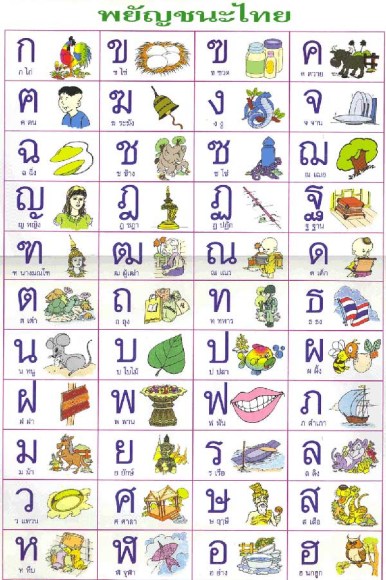
Above: the Thai consonant chart. Each consonant is related to a specific word, similar to “A-Apple, B-Boy” except the word is used consistently with that consonant.

When I step out of my home, I am immersed in a world that is as inaccessible as my English world is accessible. I see the printed Thai script but unless I specifically make the effort to find the words and their meaning, it is just a collection of now-familiar characters: 44 consonants representing 21 sounds, 18 vowels, four tone marks.

The best analogy: playing one of those hidden-word games where words are buried in a grid of letters. That’s how it is when I see Thai: When I look, I see a bunch of Thai characters. I have to look much closer to find the words. Finding the meaning requires yet another step, as I’m at the stage in building my vocabulary where I recognize that I’ve seen a word before, but am uncertain of its meaning.

It is much the same with conversation. If someone is speaking to me and I know what subject we’re talking about, then I am generally okay. I won’t know all the vocabulary, but I can follow along and even contribute a bit. If it is a random conversation into which I stumble, I’ll likely be lost, recognizing some words as they pass by but as unable to grasp onto them as I am unable to board a rapidly-moving train.

That’s the first and most significant aspect of my life in Thailand. I realize, upon rereading what I’ve written so far, that it may sound like a complaint. It isn’t. In truth, Tawn or any other Thai is likely very impressed with my progress. I’m well ahead of 95% of the expats who live here. But I’m also well behind the top 1-2% who are truly fluent in Thai.

Mai Pben Rai

The second notable answer to the question has to do with understanding the Thai mentality – heavily rooted in Buddhism – and the Thai way of looking at the world. Some illustrations:

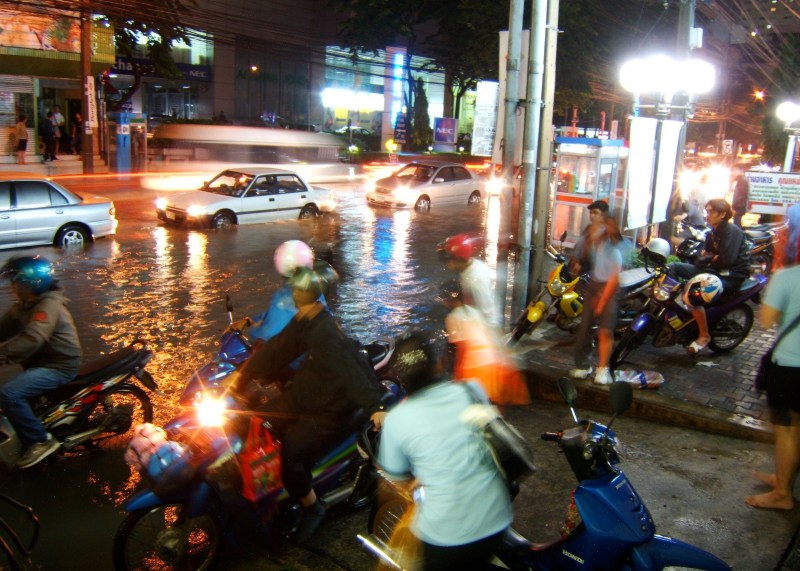
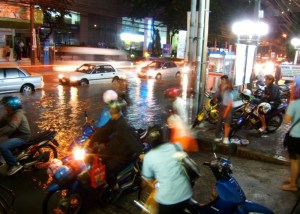
Mai pben rai – literally, “it’s nothing”. This phrase is constantly invoked by Thais to indicate a “no worries” approach to life. You’re running late for class? Mai pben rai. Stuck on a flooded street? Mai pben rai. You forgot to run an errand? Mai pben rai. Not interested in completing the job as promised? Yes, you guessed it: Mai pben rai.
2009-03-03 02

Above: Flooded street leaves you stranded for hours? Mai pben rai!

At first, this can be infuriating. In many (especially Western) cultures, we make a big deal out of things such as being on time, doing what you promise, following up on details, etc.

2009-03-03 03

But Thais subscribe to the belief that you shouldn’t sweat the small stuff. And, it seems, nearly everything is small stuff.

The upside to this is that you learn to be much more sanguine about the world, much more accepting about the truth that our sense of control over most aspects of life is largely an illusion. Stuck in a traffic jam? Mai pben rai – don’t worry, you can’t control the traffic. Unable to watch a film you badly wanted to see? Mai pben rai – maybe it will be available on DVD soon. Caught in a rainstorm without an umbrella? Mai pben rai – just duck into a restaurant for a snack.

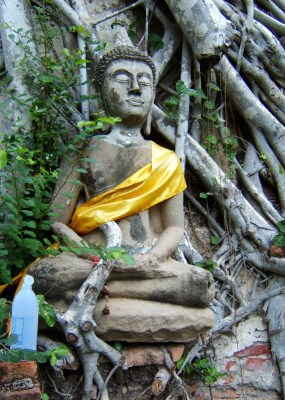
Thai culture’s Buddhist roots, with its emphasis on the impermanence of all things, is seen everywhere. From the lack of city planning to the way that most plants are potted rather than being planted into the ground to the quality of sidewalk construction, Thais are wired for short-term thinking.

2009-03-03 05

The Land of Smiles

The Tourism Authority bills Thailand as “The Land of Smiles”. Try telling that to a load of commuters on the un-air conditioned number 38 bus line in Bangkok.

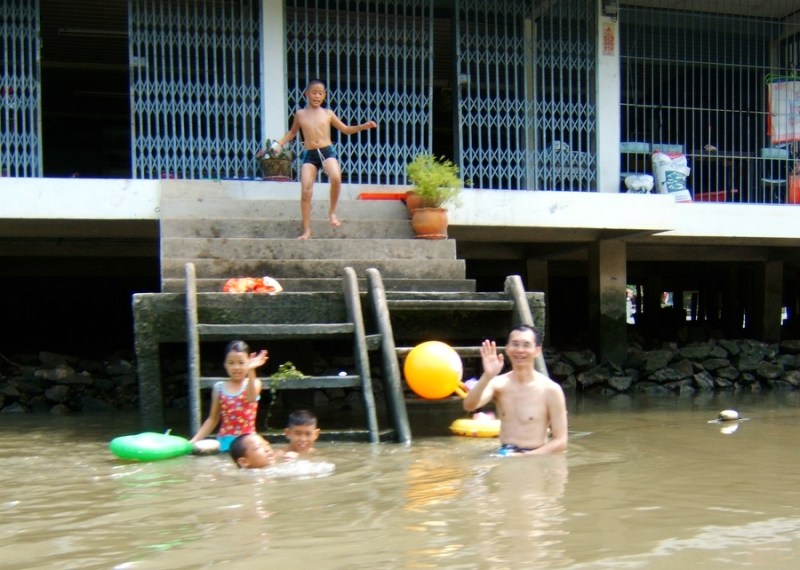
Seriously, though, two features of life here are illustrated by the concepts of suphap (“polite”) and sanuk (“fun”). Thais believe that, regardless of how they think or feel on the inside, the exterior should be polite and pleasant. Why should everyone else suffer just because you are feeling down? Keep a smile on your face and be pleasant to others.

2009-03-03 04

Above: Friendly and polite locals wave as we pass by in a boat.

At first a foreigner might mistake those smiles for happiness, agreement, being pleased, etc. Eventually, most learn that Thai smiles have a hundred meanings, only some of which are positive. .

Upon learning this, some foreigners disdain this outward veneer of pleasantness as being artificial. It is hard to explain adequately but perhaps it helps to see the Thai perspective on things:

A Thai walks into a store in Los Angeles and the cashier smiles broadly, asks how her day is going, asks where she’s from and how she likes the weather. The Thai is used to walking into a store in the other City of Angels and being greeted with a pleasantly soft “Sawatdii kha” and the prayer-like wai in which the palms of the hands are placed together in the center of the chest. To an Angelino, the Los Angeles cashier seems very friendly. To the Thai, that same cashier is being over-familiar.

But here’s the contradiction: in the west, if you walk up to someone on the street to ask for directions, their initial reaction will likely be apprehensive and guarded. Especially in an urban environment, they may well wonder if they’re being taken advantage of.

Here in Thailand, when we stop a person on the street and ask a question – “Hey, uncle, do you know where I can find that famous noodle shop with the tom yum broth?” – we get a friendly smile and helpful directions.

I’ve observed this among Thais, so it isn’t just a Thai-foreigner thing.
2009-03-03 06

The Food

Even though my original snappy answer to the question was that Thai food is really good here, it actually is one of the true answers: Thai food really is better here.

When I lived in the US, I thought Thai food was good no matter which restaurant you went to. “Bad Thai food?” I thought, “Surely there is no such thing.” Of course, once I moved here, I realized that there are few Thai restaurants in the US worth eating at unless it is a case of severe gaeng kiaw waan withdrawal.

But beyond that, Thailand has much more healthy, fresh, inexpensive food readily at hand than in the US (and maybe many other places in the west). You’re in the US, it is 3:00 pm and you want a snack. What are your options? Donuts, burgers, fries, tacos, ice cream? None of which are good for you nor really that satisfying.

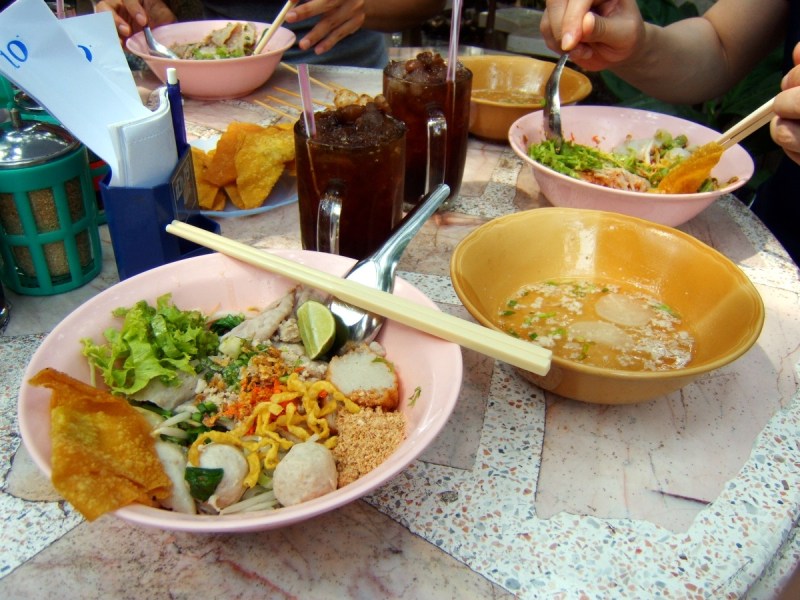
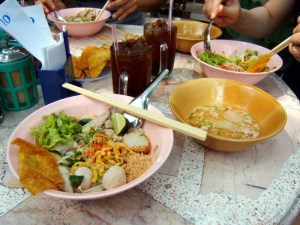
In Thailand, a bowl of noodle soup, a plate of spicy green papaya salad, a stick of grilled fish balls in sweet chili sauce, or a bag of fresh fruit are readily available on most any street corner, are relatively healthy and are very inexpensive.

Sure, Starbucks’ venti mocha frappaccino with extra whipped cream and McDonald’s hamburgers are available here (and the growing incidence of childhood obesity testifies to that fact) but there are so many readily available, healthier options, options that I miss when I’m back in the west.

2009-03-03 07

Beauty and the Good Life

The French have their joie de vivre, the Italians their la dolce vita. Thais, too, are all about ease, comfort and enjoyment of life. Even with some of the world’s worst traffic, Bangkok residents make enjoying life a priority. There is always something fun happening, things are festively decorated, and thinking too much about your cares and worries is discouraged.

People interact more with each other and their surroundings here than in the west. People are more playful, too, but not in the sarcastic or mean-spirited way you see in the west.

There is great beauty. Thai temples and Brahmanist spirit houses are elaborately and colorfully decorated. Fairy lights – what North Americans call Christmas lights – are used to dress up the landscape for no reason other than the sheer fun of having little twinkling lights strung up in the trees.

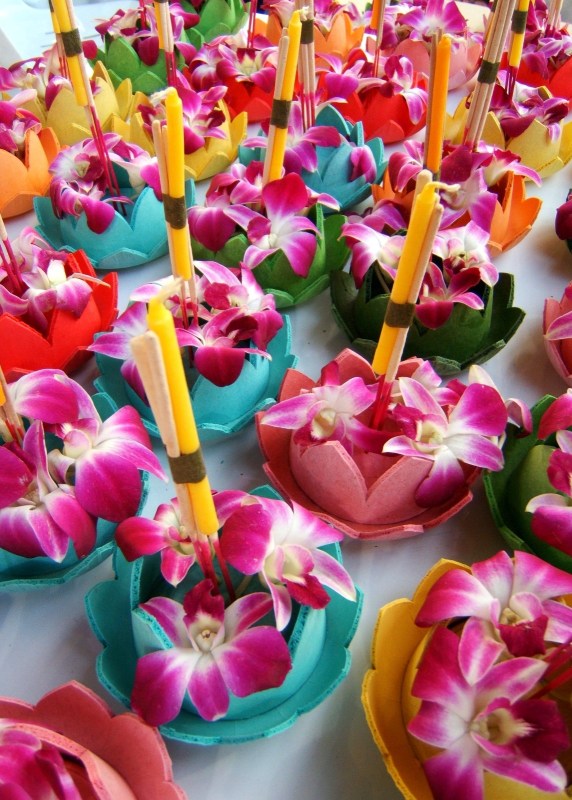
Flowers are very inexpensive, very beautiful and very bountiful here. Every market and many street vendors sell beautiful blossoms and fragrant jasmine garlands. Again, in line with the Buddhist belief in impermanence, potted plants decorate sidewalks and balconies, rearranged endlessly and replaced when they die.

2009-03-03 08

Thais take great care to keep things (including themselves) looking neat and clean even in the midst of the city’s chaos and pollution. Even from the working class houses lining the murky Saen Saeb canal, carefully-groomed residents emerge on their way to work, shirts neatly pressed and great thought given to what handbag (probably a knock-off sold at a discount mall) to carry.

The Social Ladder

Thailand has a very hierarchical society: When two Thais meet, they try to determine who is higher than whom on the social order. This ranking has great effect on all aspects of their subsequent relationship: how to address each other, who serves whom at the table, who pays the bills, who walks out the door first, etc.

This chafes western egalitarianism and takes a long time for foreigners to get used to and understand. It is hard to overestimate how important it is for Thais to understand where they are on this hierarchy.

2009-03-03 09

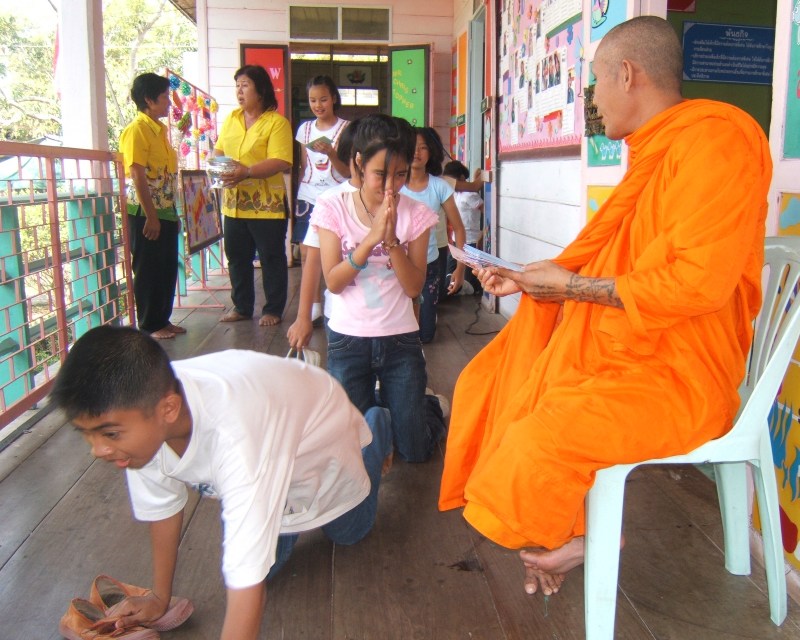
Above: Students behave appropriately, approaching the monk on their knees then crawling past him. Females are especially careful to avoid coming into direct contact with him.

The ways in which this impacts foreigners are numerous and subtle. One expat incorrectly explained to me that foreigners, being guests, always rank highly, just below politicians, royalty and monks. He couldn’t have been much more wrong.

Foreigners are in their own category, separate and measured by another standard, namely, the extent to which you understand and play by the Thai rules.

What’s the practical effect of this? On the Skytrain, for example, I move out of the way for those above me on the social ladder – elders, for example – but not for teenagers.

When I walk past puu yai – literally “big person” or “adults” – who are having a conversation, I duck my head ever so slightly, showing my respect by not towering over them.

2009-03-03 10

Above: Even the leaders of the September 2006 coup were careful to visually emphasize that they knew their place – still below the monarchy.

Remember the scene in the musical “The King and I” (banned in the Kingdom of Thailand) in which Anna Leowens and the King of Siam debate over how high she should hold her head in comparison to the king? It is the same thing – your head you should be lower (or, at least, bowed a little in respect) as you pass by or sit with someone who is of a higher rank than you.

When speaking with monks, I should hold my hands in a wai at my chest. When hanging out with peers in my age group, I can relax and not be so concerned as we’re equals. When teaching at the school and helping a student with his work, he offers me his seat and then kneels next to me as I explain the assignment. Everyone has his or her place in the hierarchy and that place is relative to the people with whom you are interacting.

Small things? Maybe, but ones that show that you know your place in the order of things.

At the very top of the order are the religion and the monarchy. Pictures of His Majesty King Rama IX adorn nearly every house and place of business.

2009-03-03 11

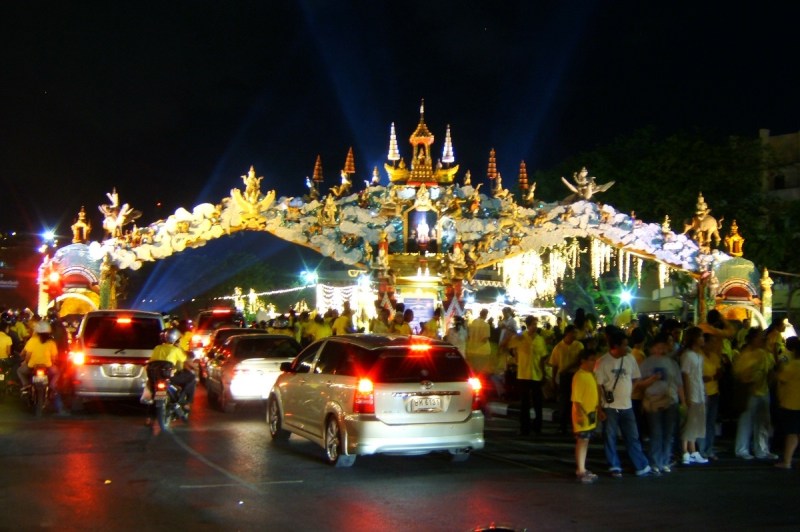
Above: Street decorations celebrating the 60th anniversary of the King’s reign.

At the start of movies and concerts, the audience stands for the royal anthem. If a royal motorcade passes, people stand quietly and respectfully at the side of the road and, if it is the king or queen passing, bow at the waist as their car goes by.

One important facet of this respect for the monarchy is that you don’t – don’t – discuss the affairs of royalty. You don’t ask Thais what they think of the Crown Prince or Crown Princess. You don’t speculate as to who will succeed the King. You don’t debate the merits of a constitutional monarchy or the appropriateness of still having (and enforcing) lese majesty laws.

Even with a Thai with whom you think you’re close, you are best advised to leave this topic alone.

My Final Answer

The final answer to the question of what it is like to live here lies in an additional Thai concept: samruam. Roughly translated, “restrained”. It is related to the previously-mentioned concept of suphap – “polite”.

The thing that keeps this culture going is the emphasis on external appearances, most significantly, keeping up a polite and appropriate appearance and being restrained in your behavior.

For example, Thais believe that the feet – the lowest part of your body – are the dirtiest and least polite part, too. Resting your feet (especially with shoes on) on furniture or the wall, pointing your feet towards someone or an image of the King or the Buddha, or touching someone, moving something or gesturing with your foot, are all hugely mai suphap – impolite.

In fact, the slang term for “foot” is muu farang – foreigner’s hand. That’s because westerners are more inclined to push, gesture and touch with their feet – actions the Thais associate with being coarse and unrefined. In other words, being a foreigner.

You see this in the way people sit in public: feet flat on the floor or, if a woman crosses her legs (not very suphap), it is done with legs tightly together and the foot pointed down. On the Skytrain last week, I observed a foreigner sitting with his legs stretched out across the aisle, pointed towards a lady on the other side of the car. Had he not been absorbed in the pictures on his phone, he might have noticed the dirty looks other passengers were giving him.

Samruam – restraint – is related to suphap. Thai culture is about moderation in behavior, voice, feelings, etc. Thais are fun-loving people but rarely boorish, loud or obnoxious. Thais get upset but rarely do you see public bursts of anger.

The recent prime minister, Samak Sundaravej, caused quite the stir because of his famous outbursts. When questioned by a female reporter once, he avoided answering by accusing her of not having enough sex. In general, prime ministers aside, losing your temper diminishes your public standing. To berate someone publicly is an invitation to revenge.

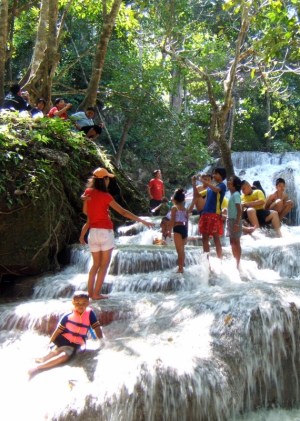
Thais dress modestly. When a foreigner is sitting at a restaurant on a sunny day and takes off his shirt to enjoy the sun, Thais are taken aback. (I’ve witnessed this. I wanted to say something but restrained myself – confrontation is seen as even worse than being not samruam.) Women in spaghetti strap tops are assumed to be bar girls or sex workers. If they are foreigners, the fact that their foreigners (again, course and unrefined) is their excuse.
2009-03-03 12

Above: Even at the Erawan Waterfall, Thais are dressed with relative modesty. Only foreigners and young children show bare shoulders.

On the surface, this may sound prudish. But to really understand it, you have to remember that in Thai culture, it is important to keep up appearances. Loud, obnoxious, revealing and unrestrained clothing/behavior/manners don’t keep proper, considerate appearances up. They make life less pleasant for everyone else.

And that’s an important part of life here. That’s why, despite the heat and humidity, I rarely wear shorts (even cargo shorts) out of the house. And when I do, it is only for Saturday morning errands in the neighborhood, never out for dinner.

Conclusion

So what is life like here? Living in the environment of a different language makes it very challenging but opens worlds of understanding. The mai pben rai attitude is more relaxed, less worried, and occasionally frustrating when you want to get something done.

Politeness, appropriateness and fun are values that influence all aspects of life and behavior, generally making social interaction smoother and more pleasant. Knowing your place in the hierarchy of society makes you more considerate of others and, in return, you receive more respect from others, too.

Finally, from food to flowers to music, life here has a lot of good things to offer, even when they aren’t expensive or are surrounded by a chaotic environment.

I hope that I’ve given you a bit of an answer to what life is like here. As you can probably see, it is hard to describe it succinctly. The only short answer I can think of is:

“Requires different operating instructions.”